


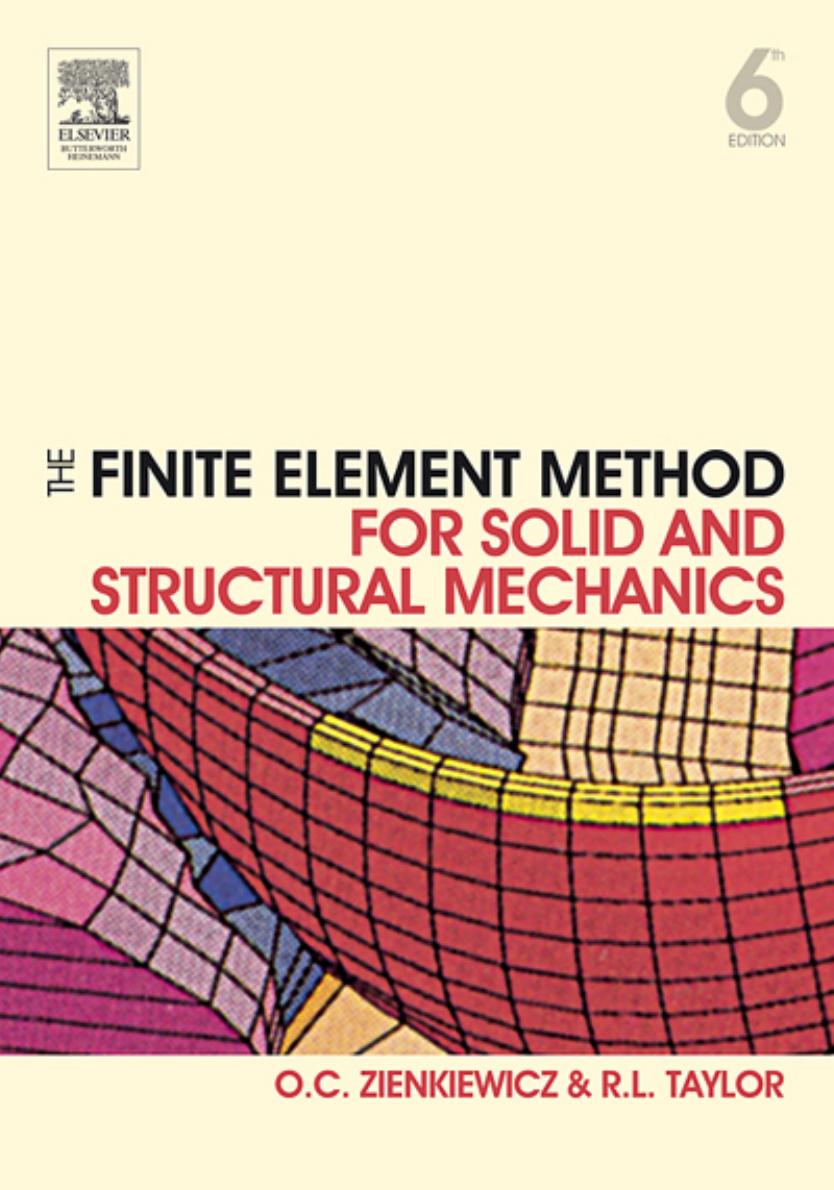
The Finite Element Method for Solid and Structural Mechanics 6th Edition by Zienkiewicz, Taylor ISBN 0080455587 9780080455587
Original price was: $70.00.$35.00Current price is: $35.00.
Instant download Finite Element Method for Solid and Structural Mechanics Sixth Edition The O. C. Zienkiewicz R. L. Taylor after payment
The Finite Element Method for Solid and Structural Mechanics 6th Edition by Zienkiewicz, Taylor – Ebook PDF Instant Download/Delivery: 0080455587, 9780080455587
Full download The Finite Element Method for Solid and Structural Mechanics 6th edition after payment
Product details:
ISBN 10: 0080455587
ISBN 13: 9780080455587
Author: Zienkiewicz, Taylor
This is the key text and reference for engineers, researchers and senior students dealing with the analysis and modelling of structures – from large civil engineering projects such as dams, to aircraft structures, through to small engineered components. Covering small and large deformation behaviour of solids and structures, it is an essential book for engineers and mathematicians. The new edition is a complete solids and structures text and reference in its own right and forms part of the world-renowned Finite Element Method series by Zienkiewicz and Taylor.
New material in this edition includes separate coverage of solid continua and structural theories of rods, plates and shells; extended coverage of plasticity (isotropic and anisotropic); node-to-surface and ‘mortar’ method treatments; problems involving solids and rigid and pseudo-rigid bodies; and multi-scale modelling.
The Finite Element Method for Solid and Structural Mechanics 6th Table of contents:
Chapter 1. General problems in solid mechanics and non-linearity
1.1 Introduction
1.2 Small deformation solid mechanics problems
1.3 Variational forms for non-linear elasticity
1.4 Weak forms of governing equations
1.5 Concluding remarks
References
Chapter 2. Galerkin method of approximation –irreducible and mixed forms
2.1 Introduction
2.2 Finite element approximation – Galerkin method
2.3 Numerical integration – quadrature
2.4 Non-linear transient and steady-state problems
2.5 Boundary conditions: non-linear problems
2.6 Mixed or irreducible forms
2.7 Non-linear quasi-harmonic field problems
2.8 Typical examples of transient non-linear calculations
2.9 Concluding remarks
References
Chapter 3. Solution of non-linear algebraic equations
3.1 Introduction
3.2 Iterative techniques
3.3 General remarks – incremental and rate methods
References
Chapter 4. Inelastic and non-linear materials
4.1 Introduction
4.2 Viscoelasticity – history dependence of deformation
4.3 Classical time-independent plasticity theory
4.4 Computation of stress increments
4.5 Isotropic plasticity models
4.6 Generalized plasticity
4.7 Some examples of plastic computation
4.8 Basic formulation of creep problems
4.9 Viscoplasticity – a generalization
4.10 Some special problems of brittle materials
4.11 Non-uniqueness and localization in elasto-plastic deformations
4.12 Non-linear quasi-harmonic field problems
4.13 Concluding remarks
References
Chapter 5. Geometrically non-linear problems – finite deformation
5.1 Introduction
5.2 Governing equations
5.3 Variational description for finite deformation
5.4 Two-dimensional forms
5.5 A three-field, mixed finite deformation formulation
5.6 A mixed–enhanced finite deformation formulation
5.7 Forces dependent on deformation– pressure loads
5.8 Concluding remarks
References
Chapter 6. Material constitution for finite deformation
6.1 Introduction
6.2 Isotropic elasticity
6.3 Isotropic viscoelasticity
6.4 Plasticity models
6.5 Incremental formulations
6.6 Rate constitutive models
6.7 Numerical examples
6.8 Concluding remarks
References
Chapter 7. Treatment of constraints – contact and tied interfaces
7.1 Introduction
7.2 Node–node contact: Hertzian contact
7.3 Tied interfaces
7.4 Node–surface contact
7.5 Surface–surface contact
7.6 Numerical examples
7.7 Concluding remarks
References
Chapter 8. Pseudo-rigid and rigid–flexible bodies
8.1 Introduction
8.2 Pseudo-rigid motions
8.3 Rigid motions
8.4 Connecting a rigid body to a flexible body
8.5 Multibody coupling by joints
8.6 Numerical examples
References
Chapter 9. Discrete element methods
9.1 Introduction
9.2 Early DEM formulations
9.3 Contact detection
9.4 Contact constraints and boundary conditions
9.5 Block deformability
9.6 Time integration for discrete element methods
9.7 Associated discontinuous modelling methodologies
9.8 Unifying aspects of discrete element methods
9.9 Concluding remarks
References
Chapter 10. Structural mechanics problems in one dimension– rods
10.1 Introduction
10.2 Governing equations
10.3 Weak (Galerkin) forms for rods
10.4 Finite element solution: Euler–Bernoulli rods
10.5 Finite element solution: Timoshenko rods
10.6 Forms without rotation parameters
10.7 Moment resisting frames
10.8 Concluding remarks
References
Chapter 11. Plate bending approximation: thin (Kirchhoff) plates and C1 continuity requirements
11.1 Introduction
11.2 The plate problem: thick and thin formulations
11.3 Rectangular element with corner nodes (12 degrees of freedom)
11.4 Quadrilateral and parallelogram elements
11.5 Triangular element with corner nodes (9 degrees of freedom)
11.6 Triangular element of the simplest form (6 degrees of freedom)
11.7 The patch test– an analytical requirement
11.8 Numerical examples
11.9 General remarks
11.10 Singular shape functions for the simple triangular element
11.11 An 18 degree-of-freedom triangular element with conforming shape functions
11.12 Compatible quadrilateral elements
11.13 Quasi-conforming elements
11.14 Hermitian rectangle shape function
11.15 The 21 and 18 degree-of-freedom triangle
11.16 Mixed formulations – general remarks
11.17 Hybrid plate elements
11.18 Discrete Kirchhoff constraints
11.19 Rotation-free elements
11.20 Inelastic material behaviour
11.21 Concluding remarks – which elements?
References
Chapter 12. ‘Thick’ Reissner-Mindlin plates – irreducible and mixed formulations
12.1 Introduction
12.2 The irreducible formulation– reduced integration
12.3 Mixed formulation for thick plates
12.4 The patch test for plate bending elements
12.5 Elements with discrete collocation constraints
12.6 Elements with rotational bubble or enhanced modes
12.7 Linked interpolation– an improvement of accuracy
12.8 Discrete ‘exact’ thin plate limit
12.9 Performance of various ‘thick’ plate elements – limitations of thin plate theory
12.10 Inelastic material behaviour
12.11 Concluding remarks – adaptive refinement
References
Chapter 13. Shells as an assembly of flat elements
13.1 Introduction
13.2 Stiffness of a plane element in local coordinates
13.3 Transformation to global coordinates and assembly of elements
13.4 Local direction cosines
13.5 ‘Drilling’ rotational stiffness – 6 degree-of-freedom assembly
13.6 Elements with mid-side slope connections only
13.7 Choice of element
13.8 Practical examples
References
Chapter 14. Curved rods and axisymmetric shells
14.1 Introduction
14.2 Straight element
14.3 Curved elements
14.4 Independent slope–displacement interpolation with penalty functions (thick or thin shell form
References
Chapter 15. Shells as a special case of three-dimensional analysis – Reissner–Mindlin assumption
15.1 Introduction
15.2 Shell element with displacement and rotation parameters
15.3 Special case of axisymmetric, curved, thick shells
15.4 Special case of thick plates
15.5 Convergence
15.6 Inelastic behaviour
15.7 Some shell examples
15.8 Concluding remarks
References
Chapter 16. Semi-analytical finite element processes – use of orthogonal functions and ‘finite str
16.1 Introduction
16.2 Prismatic bar
16.3 Thin membrane box structures
16.4 Plates and boxes with flexure
16.5 Axisymmetric solids with non-symmetrical load
16.6 Axisymmetric shells with non-symmetrical load
16.7 Concluding remarks
References
Chapter 17. Non-linear structural problems – large displacement and instability
17.1 Introduction
17.2 Large displacement theory of beams
17.3 Elastic stability – energy interpretation
17.4 Large displacement theory of thick plates
17.5 Large displacement theory of thin plates
17.6 Solution of large deflection problems
17.7 Shells
17.8 Concluding remarks
References
Chapter 18. Multiscale modelling
18.1 Introduction
18.2 Asymptotic analysis
18.3 Statement of the problem and assumptions
18.4 Formalism of the homogenization procedure
18.5 Global solution
18.6 Local approximation of the stress vector
18.7 Finite element analysis applied to the local problem
18.8 The non-linear case and bridging over several scales
18.9 Asymptotic homogenization at three levels: micro, meso and macro
18.10 Recovery of the micro description of the variables of the problem
18.11 Material characteristics and homogenization results
18.12 Multilevel procedures which use homogenization as an ingredient
18.13 General first-order and second-order procedures
18.14 Discrete-to-continuum linkage
18.15 Local analysis of a unit cell
18.16 Homogenization procedure – definition of successive yield surfaces
18.17 Numerically developed global self-consistent elastic–plastic constitutive law
18.18 Global solution and stress-recovery procedure
18.19 Concluding remarks
References
Chapter 19. Computer procedures for finite element analysis
19.1 Introduction
19.2 Solution of non-linear problems
19.3 Eigensolutions
19.4 Restart option
19.5 Concluding remarks
References
Appendix A. Isoparametric finite element approximations
Appendix B. Invariants of second-order tensors
Author index
Subject index
Colour Plates
People also search for The Finite Element Method for Solid and Structural Mechanics 6th:
the finite element method for solid and structural mechanics pdf
finite element method for solids and structures pdf
finite element method
finite element techniques
finite element method solidworks
Tags: Zienkiewicz, Taylor, The Finite, Structural Mechanics