


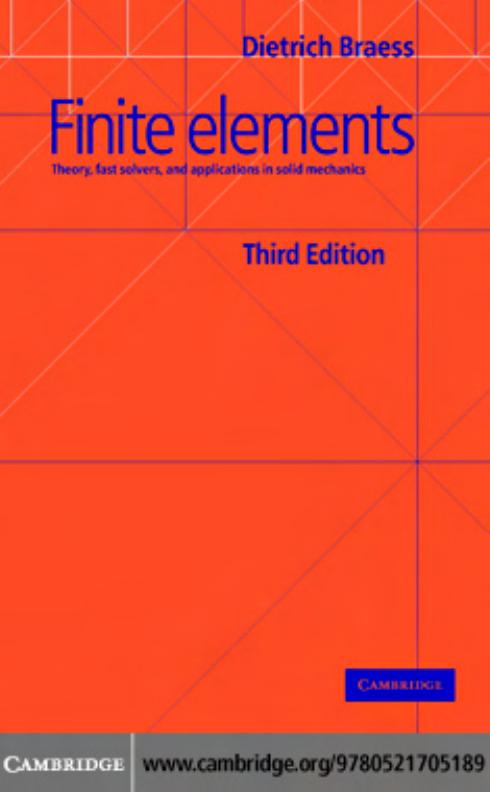
Finite elements theory fast solvers and applications in elasticity theory 3rd edition by Dietrich Braess – Ebook PDF Instant Download/Delivery: 0721662439, 978-0415061391
Full download Finite elements theory fast solvers and applications in elasticity theory 3rd edition after payment
Product details:
ISBN 10: 0721662439
ISBN 13: 978-0415061391
Author: Dietrich Braess
This definitive introduction to finite element methods was thoroughly updated for this 2007 third edition, which features important material for both research and application of the finite element method. The discussion of saddle-point problems is a highlight of the book and has been elaborated to include many more nonstandard applications. The chapter on applications in elasticity now contains a complete discussion of locking phenomena. The numerical solution of elliptic partial differential equations is an important application of finite elements and the author discusses this subject comprehensively. These equations are treated as variational problems for which the Sobolev spaces are the right framework. Graduate students who do not necessarily have any particular background in differential equations, but require an introduction to finite element methods will find this text invaluable. Specifically, the chapter on finite elements in solid mechanics provides a bridge between mathematics and engineering.
Finite elements theory fast solvers and applications in elasticity theory 3rd Table of contents:
Chapter I Introduction
§ 1. Examples and Classification of PDE’s
Examples
Classification of PDE’s
Well-posed Problems
Problems
§ 2. The Maximum Principle
Examples
Corollaries
Problem
§ 3. Finite Difference Methods
Discretization
Discrete Maximum Principle
Problem
§ 4. A Convergence Theory for Difference Methods
Consistency
Local and Global Error
Limits of the Convergence Theory
Problems
Chapter II Conforming Finite Elements
§ 1. Sobolev Spaces
Introduction to Sobolev Spaces
Friedrichs’ Inequality
Possible Singularities of H1 functions
Compact Imbeddings
Problems
§ 2. Variational Formulation of Elliptic Boundary-Value Problems of Second Order
Variational Formulation
Reduction to Homogeneous Boundary Conditions
Existence of Solutions
Inhomogeneous Boundary Conditions
Problems
§ 3. The Neumann Boundary-Value Problem. A Trace Theorem
Ellipticity in H1
Boundary-Value Problems with Natural Boundary Conditions
Neumann Boundary Conditions
Mixed Boundary Conditions
Proof of the Trace Theorem
Practical Consequences of the Trace Theorem
Problems
§ 4. The Ritz–Galerkin Method and Some Finite Elements
Model Problem
Problems
§ 5. Some Standard Finite Elements
Requirements on the Meshes
Significance of the Differentiability Properties
Triangular Elements with Complete Polynomials
Remarks on C1 Elements
Bilinear Elements
Quadratic Rectangular Elements
Affine Families
Choice of an Element
Problems
§ 6. Approximation Properties
The Bramble–Hilbert Lemma
Triangular Elements with Complete Polynomials
Bilinear Quadrilateral Elements
Inverse Estimates
Clément’s Interpolation
Appendix: On the Optimality of the Estimates
Problems
§ 7. Error Bounds for Elliptic Problems of Second Order
Remarks on Regularity
Error Bounds in the Energy Norm
A Simple L∞-Estimate
The L2-Projector
Problems
§ 8. Computational Considerations
Assembling the Stiffness Matrix
Static Condensation
Complexity of Setting up the Matrix
Effect on the Choice of a Grid
Local Mesh Refinement
Refinements of Partitions of 3-Dimensional Domain
Implementation of the Neumann Boundary-Value Problem
Problems
Chapter III Nonconforming and Other Methods
§ 1. Abstract Lemmas and a Simple Boundary Approximation
Generalizations of Céa’s Lemma
Duality Methods
The Crouzeix–Raviart Element
A Simple Approximation to Curved Boundaries
Modifications of the Duality Argument
Problems
§ 2. Isoparametric Elements
Isoparametric Triangular Elements
Isoparametric Quadrilateral Elements
Problems
§ 3. Further Tools from Functional Analysis
Negative Norms
Adjoint Operators
An Abstract Existence Theorem
An Abstract Convergence Theorem
Proof of Theorem 3.4
Problems
§ 4. Saddle Point Problems
Saddle Points and Minima
The inf-sup Condition
Mixed Finite Element Methods
Fortin Interpolation
Saddle Point Problems with Penalty Term
Typical Applications
Problems
§ 5. Mixed Methods for the Poisson Equation
The Poisson Equation as a Mixed Problem
The Raviart–Thomas Element
Interpolation by Raviart–Thomas elements
Implementation and Postprocessing
Mesh-Dependent Norms for the Raviart–Thomas Element
The Softening Behavior of Mixed Methods
Problems
§ 6. The Stokes Equation
Variational Formulation
The inf-sup Condition
Nearly Incompressible Flows
Problems
§ 7. Finite Elements for the Stokes Problem
An Instable Element
The Taylor–Hood Element
The MINI Element
The Divergence-Free Nonconforming Element
Problems
§ 8. A Posteriori Error Estimates
Residual Estimators
Lower Estimates
Remark on Other Estimators
Local Mesh Refinement and Convergence
Problems
§ 9. A Posteriori Error Estimates via the Hypercircle Method
Problem
Chapter IV The Conjugate Gradient Method
§ 1. Classical Iterative Methods for Solving Linear Systems
Stationary Linear Processes
The Jacobi and Gauss–Seidel Methods
The Model Problem
Overrelaxation
Problems
§ 2. Gradient Methods
The General Gradient Method
Gradient Methods and Quadratic Functions
Convergence Behavior in the Case of Large Condition Numbers
Problems
§ 3. Conjugate Gradients and the Minimal Residual Method
The CG Algorithm
Analysis of the CG method as an Optimal Method
The Minimal Residual Method
Indefinite and Unsymmetric Matrices
Problems
§ 4. Preconditioning
Preconditioning by SSOR
Preconditioning by ILU
Remarks on Parallelization
Nonlinear Problems
Problems
§ 5. Saddle Point Problems
The Uzawa Algorithm and its Variants
An Alternative
Problems
Chapter V Multigrid Methods
§ 1. Multigrid Methods for Variational Problems
Smoothing Properties of Classical Iterative Methods
The Multigrid Idea
The Algorithm
Transfer Between Grids
Problems
§ 2. Convergence of Multigrid Methods
Discrete Norms
Connection with the Sobolev Norm
Approximation Property
Convergence Proof for the Two-Grid Method
An Alternative Short Proof
Some Variants
Problems
§ 3. Convergence for Several Levels
A Recurrence Formula for the W-Cycle
An Improvement for the Energy Norm
The Convergence Proof for the V-cycle
Problems
§ 4. Nested Iteration
Computation of Starting Values
Complexity
Multigrid Methods with a Small Number of Levels
The CASCADE Algorithm
Problems
§ 5. Multigrid Analysis via Space Decomposition
Schwarz’ Alternating Method
Algebraic Description of Space Decomposition Algorithms
Assumptions
Direct Consequences
Convergence of Multiplicative Methods
Verification of A1
Local Mesh Refinements
Problems
§ 6. Nonlinear Problems
The Multigrid Newton Method
The Nonlinear Multigrid Method
Starting Values
Problems
Chapter VI Finite Elements in Solid Mechanics
§ 1. Introduction to Elasticity Theory
Kinematics
The Equilibrium Equations
The Piola Transform
Constitutive Equations
Linear Material Laws
Problem
§ 2. Hyperelastic Materials
Problems
§ 3. Linear Elasticity Theory
The Variational Problem
The Displacement Formulation
The Mixed Method of Hellinger and Reissner
The Mixed Method of Hu and Washizu
Nearly Incompressible Material
Locking
Locking of the Timoshenko Beam and Typical Remedies
Problems
§ 4. Membranes
Plane Stress States
Plane Strain States
Membrane Elements
The PEERS Element
Problems
§ 5. Beams and Plates: The Kirchhoff Plate
The Hypotheses
Note on Beam Models
Mixed Methods for the Kirchhoff Plate
DKT Elements
Problems
§ 6. The Mindlin–Reissner Plate
The Helmholtz Decomposition
The Mixed Formulation with the Helmholtz Decomposition
MITC Elements
The Model without a Helmholtz Decomposition
Problems
References
Index
People also search for Finite elements theory fast solvers and applications in elasticity theory 3rd:
finite model theory
finite element theory
finite elements and fast iterative solvers
finite element solver python
finite element solvers
Tags: Dietrich Braess, Finite elements, theory fast, elasticity theory