


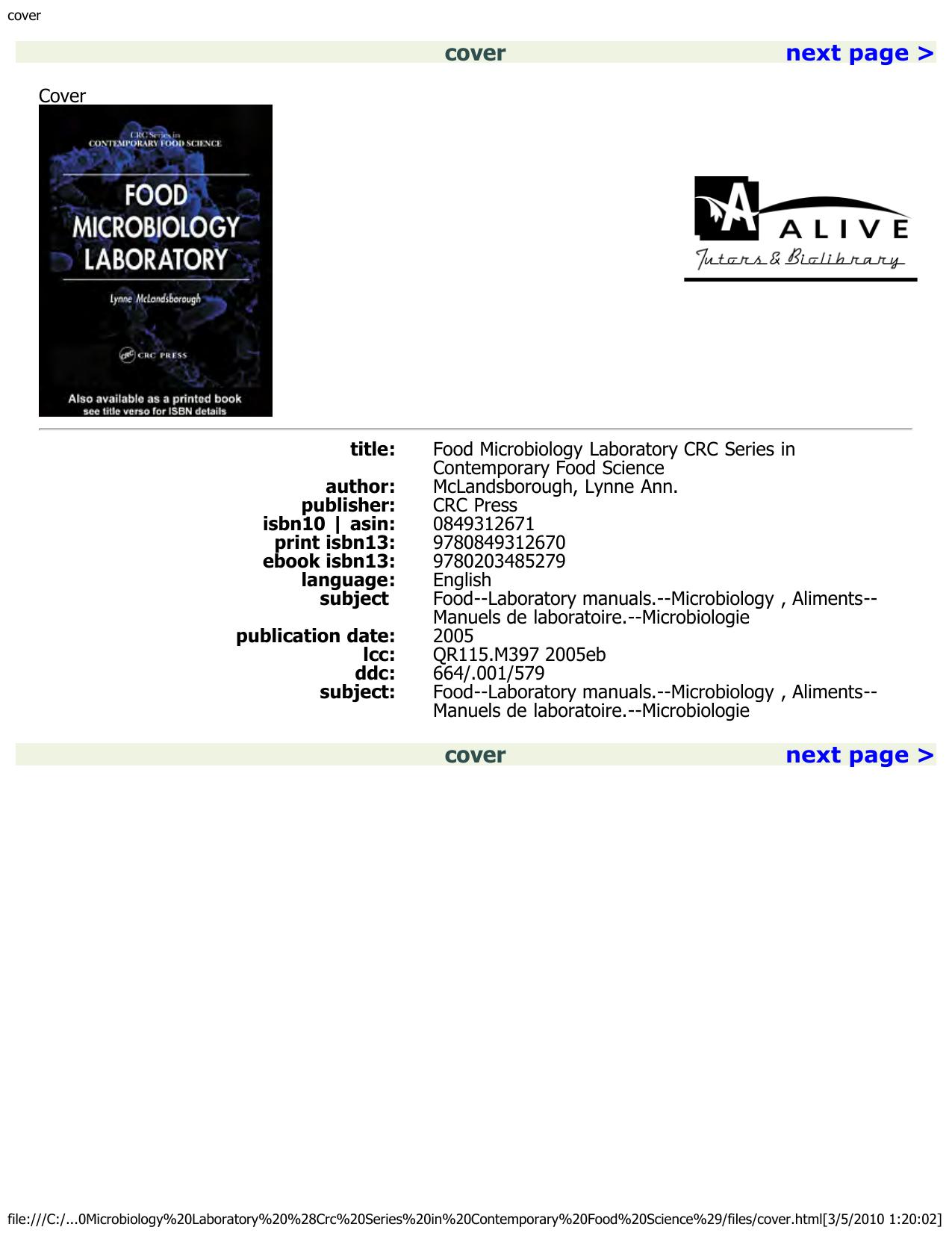
Food Microbiology Laboratory 1st edition by Lynne McLandsborough – Ebook PDF Instant Download/Delivery: 1138426571, 978-1138426573
Full download Food Microbiology Laboratory 1st edition after payment

Product details:
ISBN 10: 1138426571
ISBN 13: 978-1138426573
Author: Lynne McLandsborough
In order to truly understand food microbiology, it is necessary to have some experience in a laboratory. Food Microbiology Laboratory presents 18 well-tested, student-proven, and thoroughly outlined experiments for use in a one-semester introductory food microbiology course. Based on lab experiments developed for food science and microbiology courses at the University of Massachusetts, this manual provides students with hands-on experience with both traditional methods of enumerating microorganisms from food samples and “rapid methods” often used by industry. It covers topics such as E. coli, Staph, and Salmonella detection, as well as the thermal destruction of microorganisms, and using PCR to confirm Listeria monocytogenes. All parameters and dilutions presented in the text have been optimized to ensure the success of each exercise. An instructor’s manual is also available with qualifying course adoptions to assist in the planning, ordering, and preparation of materials. This valuable text features well-established laboratory exercises based upon methods published in the FDA Bacteriological Analytical Manual. It provides the backbone for any laboratory session and may be customized with test kits to reflect the emphasis and level of the class.
Food Microbiology Laboratory 1st Table of contents:
Laboratory 1: Fish Microflora: Basic Microbiological Techniques and Standard Plate Counts
I. Objectives
II. Background
III. Methods
IV. Results
V. Discussion Questions
Laboratory 2: Microscopic Examination of Yeast, Mold, and Bacteria
I. Objectives
II. Background
III. Methods
IV. Results
V. Discussion Questions
Laboratory 3: Enumeration of Yeasts and Molds from Foods
I. Objective
II. Background
III. Methods
IV. Results
V. Discussion Questions
Laboratory 4: Coliforms and Escherichia coli from Water: Most Probable Number Methods and 3M® Petrifilm™
I. Objectives
II. Background
III. Methods
IV. Results
V. Discussion Questions
Laboratory 5: Ground Beef Microflora: SPC and Escherichia coli Count
I. Objective
II. Background
III. Methods
IV. Results
V. Discussion Questions
Laboratory 6: Escherichia coli 0157:H7 Enrichment and Immunomagnetic Separation
I. Objectives
II. Background
III. Methods
IV. Results
V. Discussion Questions
Laboratory 7: Detection and Identification of Salmonella spp
I. Objectives
II. Background
III. Methods
IV. Results
V. Discussion Questions
Laboratory 8: Enrichment MPN of Vibrio parahaemolyticus from Shrimp
I. Objectives
II. Background
III. Methods
IV. Results
V. Discussion Questions
Laboratory 9: Isolation of Campylobacter jejuni/coli
I. Objective
II. Background
III. Methods
IV. Results
V. Discussion Questions
Laboratory 10: Enumeration of Staphylococcus aureus from Food
I. Objective
II. Background
III. Methods
IV. Results
V. Discussion Questions
Laboratory 11: Isolation of Listeria spp. from Refrigerated Foods
I. Objective
II. Background
III. Methods
IV. Results
V. Discussion Questions
Laboratory 12: Screening of Listeria Enrichments Using PCR-Based Testing
I. Objectives
II. Background
III. Methods
IV. Results
V. Discussion Questions
Laboratory 13: Enumeration of Spores from Pepper
I. Objective
II. Background
III. Methods
IV. Results
V. Discussion Questions
Laboratory 14: Thermal Destruction of Microorganisms
I. Objectives
II. Background
III. Methods
IV. Results
V. Discussion Questions
Laboratory 15: Canning and Spoilage of Low-Acid Products
I. Objective
II. Background
III. Methods
IV. Results
V. Discussion Questions
Laboratory 16: Combined Effects of Intrinsic Formulation and Extrinsic Factors Using Gradient Plates
I. Objective
II. Background
III. Methods
IV. Results
V. Discussion Questions
Laboratory 17: Cleaning and Sanitation
I. Objectives
II. Background
III. Methods
IV. Results
V. Discussion Questions
Laboratory 18: Luciferin/Luciferase Detection of ATP Associated with Bacteria and Food Residues
I. Objectives
II. Background
III. Methods
IV. Results
V. Discussion Questions
People also search for Food Microbiology Laboratory 1st:
food microbiology labs in kerala
what tests are performed in a microbiology lab
laboratory methods in food microbiology
food microbiology laboratory for the food science student
food microbiology laboratory for the food science student pdf