


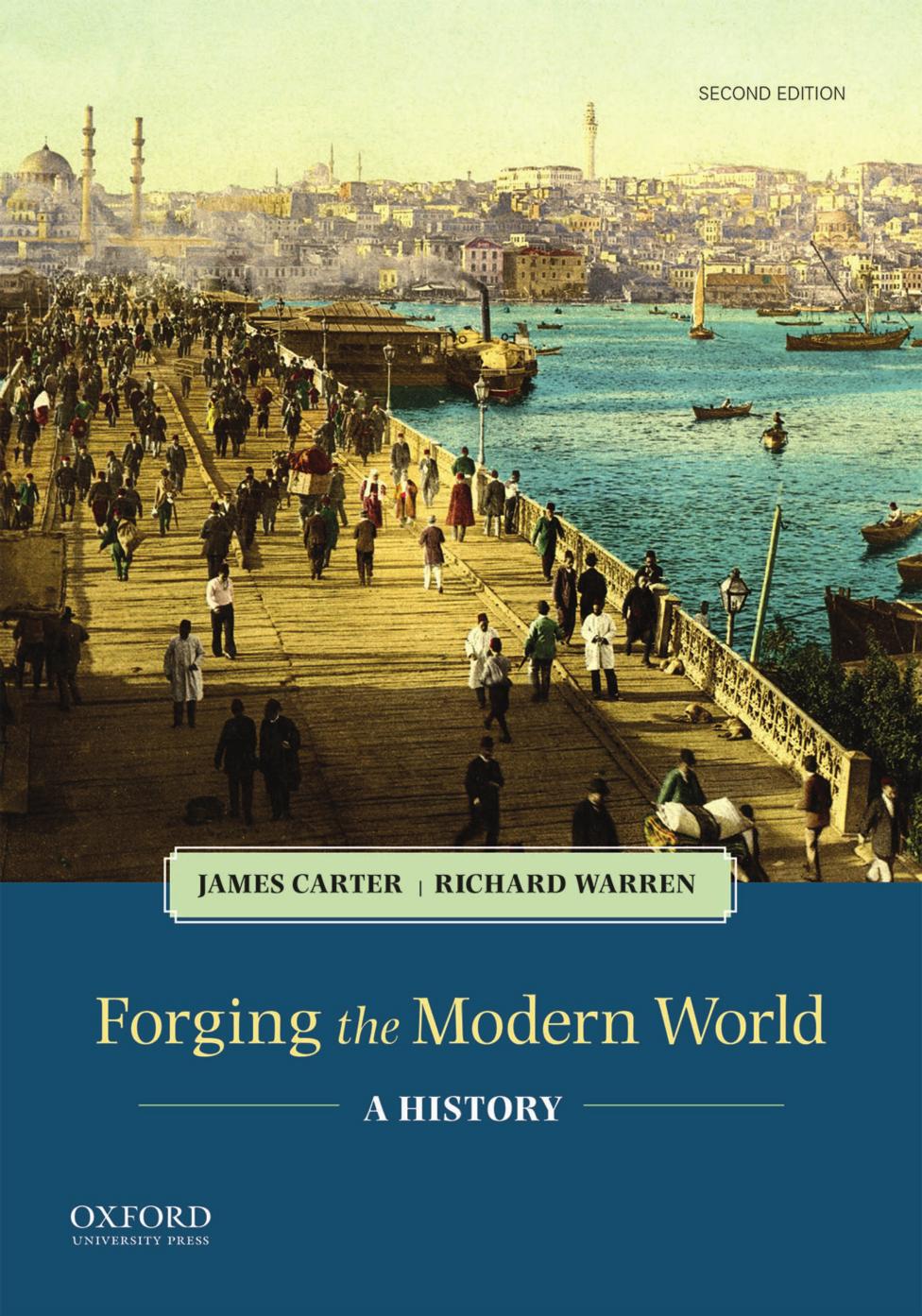
Forging the Modern World 2nd edition by James Carter, Richard Warren – Ebook PDF Instant Download/Delivery: 0190901896, 978-0190901899
Full download Forging the Modern World 2nd edition after payment
Product details:
ISBN 10: 0190901896
ISBN 13: 978-0190901899
Author: James Carter, Richard Warren
In Forging the Modern World: A History, Second Edition, authors James Carter and Richard Warren offer an accessible explanation of key transformations in global economic, political, and ideological relationships since the sixteenth century. The book is distinct from most world history texts in three important ways. First, it explores the ways in which historians use and produce information. Each chapter delves deeply into one or two specific issues of historical inquiry related to the chapter theme, showing how new primary sources, methodologies, or intellectual trends have changed how we engage with the past. Second, it clearly explains the political, economic, and ideological concepts that students need to understand in order to compare events and trends across time and space. Finally, the chapters are organized around global historical themes, which are explored through an array of conceptual and comparative lenses. While the book chapters proceed chronologically, each chapter is written with some chronological overlap linking it to preceding and subsequent chapters. This strategy emphasizes the interconnectedness between the events and themes of one chapter and those of surrounding chapters.
Forging the Modern World 2nd Table of contents:
Chapter 1 The Many Worlds of The Fifteenth Century, 1405–1510
1.1 “The Staging Post for Companies of Pilgrims From the Sudan and Caravans of Merchants Going to Cairo.” Ibn Khaldun, Muqqadimah, CA. 1378
The Sultan’s Gift to the King of Mali of the Sudan Bordering on the Maghrib
The Deputation of the Sudan, Their Gift, and the Amazement Which They Provoked With a Giraffe
Questions to Consider
1.2 “Zheng He, Who Had Been Sent to the Various Countries of the Western Ocean, Returned.” Ming Veritable Records, 1405–1431
11 Jul 1405
18 Jul 1405
8 Oct 1407
6 Jul 1411
18 Dec 1412
10 Oct 1415
28 Dec 1416
Questions to Consider
1.3 “There Also Came Envoys From Riga, Iur’ev, Kolyvan, and LÜbeck.” Treaty of Novgorod With the Hanseatic Towns, 1436
Questions to Consider
1.4 “They Exchanged Gold Until They Depressed Its Value in Egypt and Caused Its Price to Fall.” Al-umari, Mansa Musa’s Visit to Cairo, 1324
Questions to Consider
1.5 “If We Were Willing to Barter for So Many Rubies, He Would Amply Satisfy Us.” The Itinerary of Ludovico Di Varthema of Bologna, 1510
Questions to Consider
1.6 “They Bring Their Pale Gold and Give It in Exchange.” Ma huan, Overall Survey of the Ocean’s Shores, 1433
Hormuz
Questions to Consider
Chapter 2 The New Global Interface, 1486 –1639
2.1 “We Shall Powerfully Enter Into Your Country.” The Spanish Requirement, 1510
Questions to Consider
2.2 “Whenever They Chose to Come, They Would See Who We Were.” Letter of Hernán CortÉs to King Charles V, 1520
Questions to Consider
2.3 “They Were Like One Who Speaks a Barbarous Tongue.” Indigenous Accounts of the Conflict With CortÉs, Mid-sixteenth Century
Excerpt 1
Excerpt 2
Questions to Consider
2.4 “The Spanish Commonwealth Will Be Gravely Risked.” Letter of Viceroy of New Spain Luis De Velasco to Emperor Charles V, 1553
Questions to Consider
2.5 “The Dutch Must Maintain Their Right of Trade.” Hugo Grotius, The Freedom of the Seas, 1609
Chapter X Trade With the East Indies Does Not Belong to the Portuguese by Virtue of a Title Based on the Papal Donation.
Chapter XIII The Dutch Must Maintain Their Right of Trade With the East Indies by Peace, by Treat Y, or by War.
Questions to Consider
2.6 “Japanese Ships Are Strictly Forbidden to Leave for Foreign Countries.” Sakoku Edict, 1635
Closed Country Edict of 1635
Questions to Consider
Chapter 3 The Paradoxes of Early Modern Empire, 1501–1661
3.1 “How Things Are in Real Life.” NiccolÒ Machiavelli, The Prince, 1513
Questions to Consider
3.2 “With God’s Help We Sank and Utterly Destroyed One of the Enemy’s Galleons.” Seydi Ali Reis, The Mirror of Countries, 1557
Questions to Consider
3.3 “Have Mercy on These Poor People! Let Whoever Can Stab, Smite, Slay.” The Twelve Articles of the Upper Swabian Peasants and Martin Luther, Against the Murdering and Robbing Bands of Peasants, 1525
Excerpt 1: The Twelve Articles of the Upper Swabian Peasants (1525)
Article One
Article Two
Article Three
Article Four
Article Five
Article Six
Article Seven
Article Nine
In Conclusion
Excerpt 2: Martin Luther, Against the Robbing and Murdering Hordes of Peasants (1525)
Questions to Consider
3.4 “Only Those Who Justly Deserve to Be Punished Should Be Punished.” Robert Bellarmine, the Office of a Christian Prince, 1618
Questions to Consider
3.5 “Conquest Tolerates Not Inaction.” Memoirs of Babur, CA. 1526
Excerpt 1: the March Toward Delhi
Excerpt 2: From a Let Ter to Humayun
Questions to Consider
3.6 “Everything From Your Own Person Up to the Whole Nation Should Be a Matter of Study.” Gu Yanwu, true Learning and on Bureaucratic Local Administration, CA. 1660
Excerpt 1: On the Concentration of Authority at Court
Excerpt 2: On Bureaucratic Local Administration
Questions to Consider
Chapter 4 Production and Consumption in the First Global Economy,
4.1 “Some Making a Profit, Others Left Bankrupt.” Evliya CÇElebÍ, The Book of Travels, CA. 1630–1672
Excerpt on the Royal Covered Bazaar at Diyarbekir
Description of the Fair at Doyran
Questions to Consider
4.2 “A Great Harm Not Only to the Service of God, but to the Security and Peace of Our Kingdoms.” afonso of Congo to the King of Portugal, 1526 and advice to the King of Spain and Portugal on Slavery, CA. 1612
Excerpt 1: Afonso of Congo to the King of Portugal, 1526
Excerpt 2: Advice to the King of Spain and Portugal on Sl Avery, CA. 1612
Questions to Consider
4.3 “He Pours Out the Treasures of the Indies.” JosÉ De Acosta, Natural and Moral History of the Indies, 1590
Questions to Consider
4.4 “Shall You Grow to Be a Great Tree.” A Letter From the Administrator of Nagasaki to the Governor General of the Dutch East India Company, 1642
Questions to Consider
4.5 “Prohibit the Traffic in the Above-mentioned Merchandise From China.” Spanish Empire Correspondence, 1586
Questions to Consider
4.6 “Gold and Silver Come at Length to Be Swallowed Up in Hindoustan.” FrancÇois Bernier, Travels in the Mogul Empire, Ad 1656 –1668, 1670
Questions for Consideration
Chapter 5 Global War and Imperial Reform, 1655–1765
5.1 “The Reason Why Men Enter Into Society is the Preservation of Their Property.” John Locke, Two Treatises of Government, 1689
Of the State of Nature
Of Paternal Power
Political or Civil Society
Paternal, Political, and Despotic Power Considered Together
Of the Ends of Political Society and Government
Of the Dissolution of Government
Questions to Consider
5.2 “Discover as Much as Possible How to Put Ships to Sea During a Naval Battle.” Peter the Great, Decrees,1714 and 1724
Decree on Compulsory Education of the Russian Nobility, 1714
An Instruction to Russian Students Abroad Studying Navigation, 1714
A Decree on the Founding of the Academy, 1724
Questions to Consider
5.3 “Esteem Most Highly Filial Piety and Brotherly Submission.” The Sacred Edict of the Yongzheng Emperor, CA. 1723–1735
Questions to Consider
5.4 “They Were Resolved to Regain Their Liberty if Possible.” William Snelgrave, A New Account of Some Parts of Guinea and the Slave Trade, 1734
Questions to Consider
5.5 “We Fear the Damage From a Public Disclosure.” Jorge Juan and Antonio De Ulloa, Discourse and Political Reflections on the Kingdom of Peru, 1749
Questions to Consider
5.6 “Our Hearty Thanks for the Care You Take of Us in Supplying Us With Ammunition.” Meetings Between a British General and Leaders of the Mohawks, Oneidas, and Tuscaroras, 1755–1756
Speeches From Iroquois Leaders to General Johnson, December 1755
Johnson’s Communications With Iroquois Leaders, February 1756
Questions to Consider
5.7 “The Sovereign is Absolute.” Catherine II of Russia, Instructions for a New Law Code, 1767
Questions to Consider
Chapter 6 A New Order for the Ages, 1755–1839
6.1 “We Hold These Truths to Be Self-evident.” The US Declaration of Independence, 1776
Questions to Consider
6.2 “The State Ought Not to Be Considered as Nothing Better Than a Partnership Agreement.” Edmund Burke, Reflections on the Revolution in France, 1790
Questions to Consider
6.3 “Woman is Born Free and Lives Equal to Man in Her Rights.” Olympe De Gouges, Declaration of the Rights of Woman and the Female Citizen, 1791
Preamble
Article I
Article II
Article III
Article IV
Article V
Article VI
Article VII
Article VIII
Article IX
Article X
Article XI
Article XII
Article XIII
Article XIV
Article XV
Article XVI
Article XVII
Postscript
Form for a Social Contract Bet Ween Man and Woman
Questions to Consider
6.4 “We Will Distance Forever From This Colony the Horrible Events.” Toussaint Louverture, Proclamation, 1801
NOVEMBER 25, 1801
Questions to Consider
6.5 “I Have Simply Been a Mere Plaything of the Revolutionary Storm.” SimÓn BolÍvar, Address to the Congress of Angostura, 1819
Questions to Consider
6.6 “Great Revolutions Are the Work Rather of Principles Than of Bayonets.” Giuseppe Mazzini, Manifesto of Young Italy, 1831
Questions to Consider
6.7 “The Benefit of a Good Administration.” The Rescript of GÜlhane, 1839
Questions to Consider
Chapter 7 The Engines of Industrialization, 1787–1868
7.1 “The Principle of the Factory System Then is, to Substitute Mechanical Science for Hand Skill.” Andrew Ure, The Philosophy of Manufactures, 1835
Questions for Consideration
7.2 “I Have Wrought in the Bowels of the Earth Thirty-three Years.” The Condition and Treatment of the Children Employed in the Mines and Collieries, 1842
Questions to Consider
7.3 “No Exemptions From Attacks of Epidemic Disease.” Edwin Chadwick, Report on the Sanitary Condition of the Labouring Population, 1842
Recapitulation of Conclusions
Questions to Consider
7.4 “The Statutes of the Heavenly Dynasty Cannot but Be Obeyed With Fear and Trembling!” Qianlong Emperor to King George III, 1793 and Letter From the High Imperial Commissioner Lin and His Colleagues to Queen Victoria of England, 1840
Excerpt From the Letter of the Qianlong Emperor to King George III
Excerpt From Commissioner Lin’s Let Ter to Queen Victoria
Questions to Consider
7.5 “To Carry the Laws of the United States Into Turkey and China.” Caleb Cushing, Opinion of the Attorney General, 1855
Questions to Consider
7.6 “All Lie Stretched in the Mud and Dust, Drenched in Their Own Blood.” Henry Dunant, A Memory of Solferino, 1859 and Florence Nightingale, Letter to Sidney Herbert, 1855
Excerpt 1, From Henry Dunant, A Memory of Solferino (1859)
Excerpt 2, From a Letter From Florence Nightingale to Sidney Herbert, January 8, 1855
Questions to Consider
7.7 “The Best Adapted to All the Crops Cultivated in This Country.” Solon Robinson, Guano: a Treatise of Practical Information, 1853
Questions to Consider
Chapter 8 Modernity Organized, 1840–1889
8.1 “Working Men of All Countries, Unite.” Karl Marx and Friedrich Engels, Manifesto of the Community Party, 1848
Questions to Consider
8.2 “Paris in America.” Herbert H. Smith, Brazil, the Amazons, and the Coast, 1879
Questions to Consider
8.3 “The History of Mankind is a History of Repeated Injuries and Usurpations on the Part of Man Toward Woman.” Elizabeth Cady Stanton, Declaration of Sentiments, 1848
Questions to Consider
8.4 “Demand Rights for Women.” Flora Tristán, Workers’ Union, 1843 And Sojourner Truth, Address to the First Annual Meeting of the American Equal Rights Association, 1867
Excerpt 1: From Flor a Tristán, Workers’ Union (1843)
Excerpt 2: From Sojourner Truth, A Merican Equal Rights Association address (1867)
Questions to Consider
8.5 “Evil Customs of the Past Shall Be Broken Off.” The Charter Oath(Japan), 1868 and The Emancipation Manifesto(Russia), 1861
Excerpt 1: Dr Afts of The Charter OathAnd Excerpts From The Document on the Form of Government (Japan, 1868)
General Outline on Legislative Matters
A Compact
Oath
ExcerptS from The Document on the Form of Government (Seitaisho), 1868
Excerpt 2: The Emancipation Manifesto (Russia, 1861)
Questions for Consideration
8.6 “There Are Endless Changes in the World.” Zeng Guofan and Li Hongzhang, Letter to the Zongli Yamen, 1871 and Xue Fucheng, Suggestions on Foreign Affairs, 1879
Excerpt 1: Zeng Guofan and Li Hongzhang, Letter to the Zongli Yamen (Foreign Affairs Office), 1871
Excerpt 2: Xue Fucheng, Suggestions on Foreign Affairs, 1879
Questions to Consider
8.7 “China is Just the Opposite.” Li Gui, Glimpses of a Modern Society, 1876
The Women’s Pavilion
A Police Station and a Court
Questions to Consider
Chapter 9 Globalization and Its Discontents, 1878–1910
9.1 “Take Up the White Man’s Burden.” Rudyard Kipling, “The White Man’s Burden,” 1899 and H. T. Johnson, “THe Black Man’s Burden,” 1899
Excerpt 1: “The White Man’s Burden,” Rudyard Kipling
Excerpt 2: “The Black Man’s Burden,” H. T. Johnson
Questions to Consider
9.2 “A Matter of Vital Importance for Germany’s Development.” Friedrich Fabri, Does Germany Need Colonies?, 1879
Questions to Consider
9.3 “What a Pity She Wasn’t Born a Lad.” Emmeline Pankhurst, My Own Story, 1914
Questions to Consider
9.4 “One Knows the Futility of Trying to Prevent the Onslaught of Western Civilization.” Fukuzawa Yukichi, Goodbye Asia, 1885
Questions to Consider
9.5 “Civilisation is Not an Incurable Disease, but It Should Never Be Forgotten That the English People Are at Present Afflicted by It.” Mohandas K. Gandhi, “Civilisation” from Hind Swaraj, 1909
Chapter VI Civilisation
Questions to Consider
9.6 “They Thought It Better for a Man to Die Rather Than Live in Such Torment.” Oral Histories on the Outbreak of the Maji Maji Uprising of 1905-1907, 1967
Mzee Ambrose Ngombale Mwiru of Kipatimu, Interviewed 26 September 1967.
Mzee Ndundule Mangaya of Kipatimu, Interviewed 2–10 September 1967
Mzee Ngapata Mkupali of Mipoto Chumo, Interviewed 21 September 1967
Mzee Kibil Ange Upunda of Nandete, Interviewed 6 –22 September 1967
Bw. Ali Abdall Ah Kapungu of Kibata , Interviewed 23 August 1967
Mzee Ndundule Mangaya of Kipatimu, Interviewed 7 August 1967
Bw. Ali Abdall Ah Kapungu of Kibata , Interviewed 23 August 1967
Questions to Consider
9.7 “Do Not Tell the White People About This.” Wovoka and the Ghost Dance, 1890
Wovok a’s Message
Questions to Consider
Chapter 10 Total War and Mass Society, 1905–1928
10.1 “Things Will Never Be as They Were.” Correspondence of Vera Brittain, 1915 AND 1918
Vera to Roland, Buxton, April 17, 1915
Roland to Vera, Flanders, April 29, 1915
Roland to Vera, Flanders May 13, 1915
In the Trenches, Flanders, May 9, 1915
Vera to Edith Brittain, 24th General Hospital, ÉTaples, France, August 5, 1917
October 12, 1917
Questions to Consider
10.2 “A Free, Open-minded, and Absolutely Impartial Adjustment of All Colonial Claims.” Woodrow Wilson, Address to Us Congress, 1918 and Nguyen Ai Quoc (Ho Chi Minh), Letter to Us Secretary of State, 1919
Excerpt 1: Woodrow Wilson
Excerpt 2: Petition From Vietnamese Delegation
Questions to Consider
10.3 “The Nation Shall at All Times Have the Right to Impose on Private Property.” The Constitution of Mexico, 1917
Questions to Consider
10.4 “It is Proved in the Pamphlet That the War of 1914–18 was Imperialist.” V. I. Lenin, Imperialism, the Highest Stage of Capitalism: a Popular Outline, 1917 and 1920
From the Preface of a New Edition, Published in 1920
Questions to Consider
10.5 “Throughout History One of the Constant Features of Social Struggle Has Been the Attempt to Change Relationships Between the Sexes.” Alexandra Kollontai, Sexual Relations and the Class Struggle, 1921
Questions to Consider
10.6 “The Peoples of Asia Have Cherished the Hope of Shaking Off the Yoke of European Oppression.” Sun Yat-sen, Speech on Panasianism, 1924
Questions to Consider
10.7 “The Fascist Conception of Life Stresses the Importance of the State.” Benito Mussolini and Giovanni Gentile, The Political and Social Doctrine of Fascism, 1934
Questions to Consider
Chapter 11 The Ongoing Crisis of Global Order, 1919–1948
11.1 “Certainly a Government Needs Power, It Needs Strength.” Adolf Hitler, Munich Speech (April 12), 1921
Questions to Consider
11.2 “It is International Morality Which is at Stake.” Haile Selassie, Speech to the League of Nations, 1936
Questions to Consider
11.3 “They Will Sweep All the Imperialists, Warlords, Corrupt Officials, Local Tyrants and Evil Gentry Into Their Graves.” Mao Zedong, Report of an Investigation Into the Peasant Movement in Hunan, 1927
Importance of the Peasant Problem
The Question of “Going Too Far”
Overthrowing the Clan Authority of the Ancestral Temples and Clan Elders, the Religious Authority of Town and Village Gods, and the Masculine Authority of Husbands
Questions to Consider
11.4 “When Will It No Longer Be Necessary to Attach Special Weight to the Word ‘Woman’?” Ding Ling, Thoughts on March 8 (International Women’s Day), 1942
Dawn, 3 August
Questions to Consider
11.5 “Who is to Blame for the Condition of China?” Hirosi Saito, The Conflict in the Far East, 1939
Questions to Consider
11.6 “The Work of Operating the Gas Chambers Was Carried Out by a Special Commando.” Primo Levi With Leonardo De Benedetti, Auschwitz Report, 1946
Questions to Consider
11.7 “Our Forces Dare Take Their Position Beside Any Force in the World.” General Aung San, Address to the East West Association, 1945
Questions to Consider
Chapter 12 Hot Wars, Cold Wars, and Decolonization 1942–1975
12.1 “An Iron Curtain Has Descended Across the Continent.” Winston Churchill, Address at Westminster College(Fulton, Missouri), 1946
Questions to Consider
12.2 “Mr. Churchill and His Friends Bear a Striking Resemblance to Hitler.” Joseph Stalin Interview, 1946
Questions to Consider
12.3 “Vietnam Has the Right to Be a Free and Independent Country.” Vietnamese Declaration of Independence, 1945
Questions to Consider
12.4 “The Equal and Inalienable Rights of All Members of the Human Family.” United Nations, Universal Declaration of Human Rights, 1948
Preamble
People also search for Forging the Modern World 2nd :
forging the modern world 2nd edition pdf free
forging the modern world 2nd edition
forging the modern world 2nd edition ebook
forging the modern world third edition
forging the modern world 2nd edition pdf
Tags: James Carter, Richard Warren, Modern World