


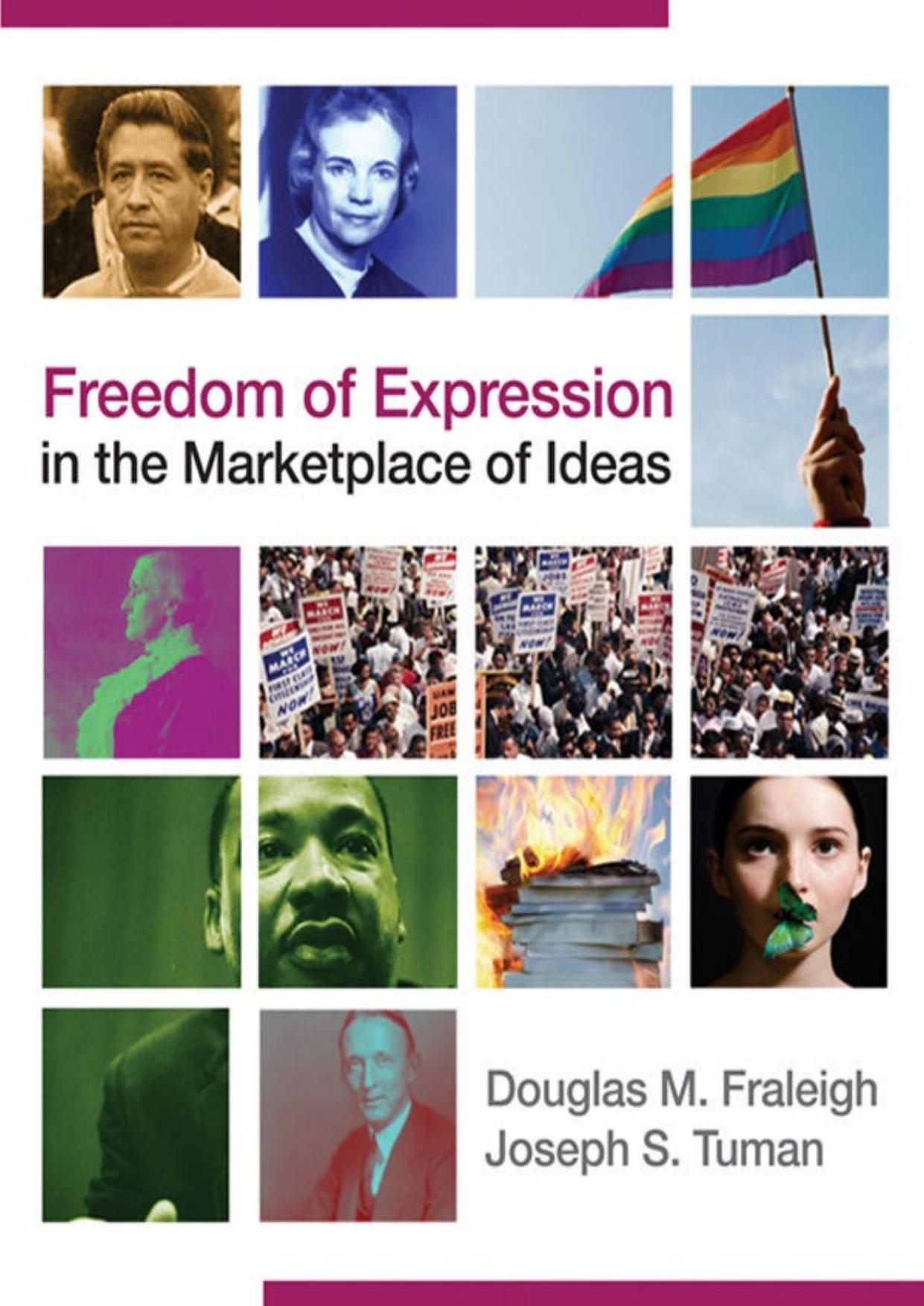
Freedom of Expression in the Marketplace of Ideas 1st edition by Douglas Fraleigh, Joseph Tuman ISBN 1412974674 978-1412974677
Original price was: $70.00.$35.00Current price is: $35.00.
Instant download Freedom of Expression in the Marketplace of Ideas Douglas Fraleigh & Joseph S. Tuman after payment
Freedom of Expression in the Marketplace of Ideas 1st edition by Douglas Fraleigh, Joseph Tuman – Ebook PDF Instant Download/Delivery: 1412974674, 978-1412974677
Full download Freedom of Expression in the Marketplace of Ideas 1st edition after payment
Product details:
ISBN 10: 1412974674
ISBN 13: 978-1412974677
Author: Douglas Fraleigh, Joseph Tuman
A comprehensive guide to effective participation in the public debate about our most indispensable right: freedom of expression
Encouraging readers to think critically about freedom of speech and expression and the diverse critical perspectives that challenge the existing state of the law, this text provides a comprehensive analysis of the historical and legal contexts of the First Amendment, from its early foundations all the way to censorship on the Internet. Throughout the book, authors Douglas M. Fraleigh and Joseph S. Tuman use the “Marketplace of Ideas” metaphor to help readers visualize a world where the exchange of ideas is relatively unrestrained and self-monitored.
The text provides students with the opportunity to read significant excerpts of landmark decisions and to think critically about the issues and controversies raised in these cases. Students will appreciate the treatment of contemporary issues, including free speech in a post-9/11 world, free expression in cyberspace, and First Amendment rights on college campuses.
Freedom of Expression in the Marketplace of Ideas 1st Table of contents:
1 Introduction to Freedom of Expression and the American Legal System
The Nature of Freedom of Speech
The Definition of Expression
The Definition of Freedom
How Free Expression Rights Are Determined
A Communicator Delivers a Message
The Communicator’s Expression Is Sanctioned
The Sanction Is Challenged on First Amendment Grounds
The Case Is Appealed to the Supreme Court
The Supreme Court Establishes a Free Expression Precedent
Justifications and Critiques of Freedom of Expression
Benefits of Freedom of Expression
Arguments for Limiting Freedom of Speech
Conclusion
2 Historical Perspectives on Freedom of Expression
Free Expression in World Cultures
Barriers to Freedom of Speech
The Nature of Restrictions on Speech
Examples of Freedom of Speech
Reversals of Freedom of Speech
Freedom of Expression in America: 1600–1917
Freedom of Expression in Pre-Revolutionary America
The New Nation Adopts the Bill of Rights
Crises Threaten Freedom of Expression
Conclusion
3 Incitement to Illegal Conduct and True Threats
The Clear and Present Danger Test
The Origin of the Clear and Present Danger Test
A Call to Require a More Clear and Present Danger
Critical Thinking: When Should a Speaker Be Held Accountable?
The Gitlow Decision Protects Freedom of Speech From State Abridgment
Freedom of Speech for Communists: Clear and Present Danger?
Speech at a Communist Meeting
Persecution of Communists Intensifies
Repression of Communist Speech Decreases
Brandenburg v. Ohio: Strengthening Protection of Speech
The Court’s Opinion Strengthens Protection for Speakers
Black and Douglas Concurrences: Farewell to Clear and Present Danger?
Federal Courts Apply the Brandenburg Test
The Brandenburg Rule and Contemporary Communication
Distinguishing Incitement From True Threats
Conclusion
4 National Security and Freedom of Expression
A National Security Exception to the Constitution?
The Framers’ Intent: Restrict Government Power, Not Public Debate
The Courts Weigh In: No Extraordinary Power in Wartime
Government Efforts to Limit Free Expression in Wartime
War and Peace: The Debate
Pathological Periods: The Pushback Against Dissent
The Supreme Court and Protection of Antiwar Speech
Government Practices That Keep Information Secret
Issues Raised by Government Secrecy
Secrecy of Operational Details
The Pentagon Papers Case
The War on Terror: Publication of Classified Information
Government Surveillance of Its Citizens
The Years Before 9/11: Domestic Surveillance Abuses Circumscribed
The Post-9/11 World: Expansion of Domestic Surveillance
Legislative and Judicial Responses to the NSA Surveillance Program
Conclusion
5 Fighting Words and the Categorical Exceptions Doctrines
The Categorical Exceptions and Fighting Words Doctrines Are Announced in Chaplinsky
The Fighting Words Definition Is Refined in Terminiello
The Definition of Fighting Words Is Narrowed
Cohen v. California: Diverse Contributions to Freedom of Speech Doctrine
Gooding v. Wilson: Rejection of the Average Person Test for Fighting Words?
Cohen and Gooding Are Used to Vacate Fighting Words Convictions
R.A.V. v. City of St. Paul: Fighting Words and Categorical Exceptions Doctrines Live On
The R.A.V. Decision
R.A.V.’s Impact on the Categorical Exceptions and Fighting Words Doctrines
Conclusion
6 Hate Speech
The Problem of Hate Speech
Why Is Hate Speech Harmful?
The Challenges of Hate Speech on Campus
Do Speech Codes Violate the First Amendment?
The University of Michigan Policy: No First Amendment Exception for Offensive Speech
The University of Wisconsin Policy: Not Saved by the Categorical Exceptions Theory
George Mason University: Offensiveness Not Valid Grounds for Controlling Expression
Summary of the Federal Court Decisions on Speech Codes
Thinking Critically About Hate Speech Regulation
Hate Speech Not Compatible With First Amendment Doctrine
Developing Speech Codes That Are Consistent With First Amendment Doctrine
A Marketplace of Ideas Remedy for Hate Speech
Conclusion
7 Defamation: First Amendment Issues
New York Times v. Sullivan: The Actual Malice Rule
State Defamation Law Before New York Times v. Sullivan
The Context of New York Times v. Sullivan
The New York Times Rule: Application of the Actual Malice Test
The Court Defines Public Officials and Official Conduct
The Actual Malice Rule Applies to Public Figures, Not Private Citizens
The Standards for Determining Who Is a Public Figure
The New York Times Rule: Proof of Actual Malice
The Supreme Court Considers Arguments for Knowing Falsity
The Supreme Court Explains Reckless Disregard for the Truth
Actual Malice and Negligence Compared
Beyond New York Times v. Sullivan: Additional First Amendment Protections
Clear and Convincing Evidence
Independent Appellate Review of Actual Malice Findings
The Burden to Prove a Defamatory Statement Is False
Discovery of the Defendant’s State of Mind
Has the Actual Malice Rule Served Its Purpose?
The Actual Malice Rule Perpetuates the Chilling Effect
The Actual Malice Rule Has Succeeded
The Actual Malice Rule Should be Reformed
Conclusion
8 Obscenity and Child Pornography
Obscenity Not Protected by the First Amendment
1957–1973: The Supreme Court Struggles With Meaning of Obscenity
The Roth Test for Obscenity
Judicial Attempts to Clarify Obscenity After Roth
Court Majority Agrees on Obscenity
The Court Announces Miller Test
Subsequent Cases Apply Miller Test
Does Context Influence Constitutional Protection?
Court Protects Private Possession of Obscene Material
Court Rejects Stanley Rationale for Adults-Only Theaters
Critical Thinking About Obscenity
Conservative Viewpoint: Obscenity Immoral
Violence Against Women?
The Civil Libertarian Perspective
Distinguishing Obscenity From Child Pornography
Crafting a New Categorical Exception Based on Protecting Children
Extending Stanley v. Georgia to Private Possession of Child Pornography?
Regulating Child Pornography on the Internet
Conclusion
9 Time, Place, or Manner Restrictions
Historical Developments
The Modern Time, Place, or Manner Test
What Constitutes a Reasonable Time, Place, or Manner Restriction?
Application of the Three-Pronged Time, Place, or Manner Test
The Forums Held in Trust for Public Expression
Public Forums Defined by Historical Usage
Using Property’s Historical Function to Determine a Public Forum?
Time, Place, or Manner Rules: Noteworthy Controversies
The Nazi March in Skokie, Illinois
Freedom of Speech in the Public Schools
Free Expression Rights of Abortion Protesters
Forced Inclusion of an Organization in a Public Parade?
Conclusion
10 Symbolic Expression
The Benefits of Symbolic Expression
The Definitions of Symbolic Expression
Communication Perspectives and Symbolic Expression
Judicial Definition of Symbolic Expression
The Test for Constitutional Protection of Symbolic Expression
United States v. O’Brien: A Landmark Case
The O’Brien Test in Practice
Restrictions Related to Suppression: The Flag Burning Issue
The Symbolic Importance of the American Flag
The Supreme Court and the American Flag, 1907–1982
Texas v. Johnson: The First Amendment Question Answered
Flag Protection Legislation: Constitutional Antidote to Texas v. Johnson?
Conclusion
11 Technology and the First Amendment
Medium-Specific Restrictions on Expression: Early History
Motion Picture Censorship Boards
The Communications Act of 1934 and Radio/Television
Telephone Companies: Common Carriers
Theories Used to Justify Broadcast Regulation
Issues Raised by Frequency Scarcity
Issues Raised by the Pervasiveness of Broadcasting
Regulation of Internet Communication
Landmark Decision: Reno v. ACLU
Implications of Reno v. ACLU
Congress Continues Focus on Internet Indecency
Technological Convergence and First Amendment Doctrine
Conclusion
12 Privacy and Free Speech
Privacy and the Search for Penumbral Rights
The Right to Privacy in One’s Self
The Right to Privacy Within the Home
Balancing a Right to Persuade With a Right to Privacy in Public Spaces Outside the Home
The Right to Informational Privacy
Disclosure of Personal Information
False Light Invasion of Privacy
Conclusion
13 Access to Information
A Right of Access to Government Information
The Importance of Government Information to the Marketplace of Ideas
The Reluctance of Government to Share Information
A First Amendment Right of Access to Information?
Statutory Access to Information
Journalists’ Privilege
Landmark Decision: Branzburg v. Hayes
Journalists’ Privilege: Competing Fact and Value Claims
Federal Courts Apply Branzburg
Shield Laws to Protect Reporters
Access to Judicial Proceedings
Conclusion
14 Copyright and the First Amendment
Copyright Law in the United States
Early Copyright Law: A Short History
The Copyright Revision Act of 1976
Fair Use of Copyrighted Works
Copyright Law and the First Amendment
The Supreme Court and First Amendment Challenges
Outside the Traditional Contours: An Opening for First Amendment Claims?
U.S. Copyright Law: Striking the Correct Balance?
Copyright and New Technology
The Court and New Technology: Deference to Congress
RIAA Enforcement Against Consumers
The Digital Millennium Copyright Act
Conclusion
15 International and Comparative Perspectives on Freedom of Expression
The Global Freedom of Expression Landscape
Freedom of Expression in World Constitutions
Factors Affecting the Extent of Free Expression
Cultural Values and Free Expression Rights
Promoting Human Dignity
Considering Morality and Sexually Explicit Messages
Adapting to Religious Doctrines and Beliefs
Preserving Order and Protecting National Security
Judicial Decisions on Freedom of Expression
South Africa: Defamation
India: Public Order and Religious Sensitivities
Japan: Time, Place, or Manner Restrictions
International Criminal Tribunal for Rwanda: Incitement to Illegal Conduct
Judicial Decisions Outside the United States: A Summary
Twenty-First Century Technology and International Freedom of Expression
Choice of Law Issues
Internet Service Provider Obligations
Using Technology to Circumvent Restrictions
Conclusion
People also search for Freedom of Expression in the Marketplace of Ideas 1st :
freedom of expression in the marketplace of ideas pdf
freedom of expression policy
freedom of expression examples
freedom in the marketplace definition
freedom in the marketplace examples
Tags: Douglas Fraleigh, Joseph Tuman, the Marketplace, Freedom of Expression