


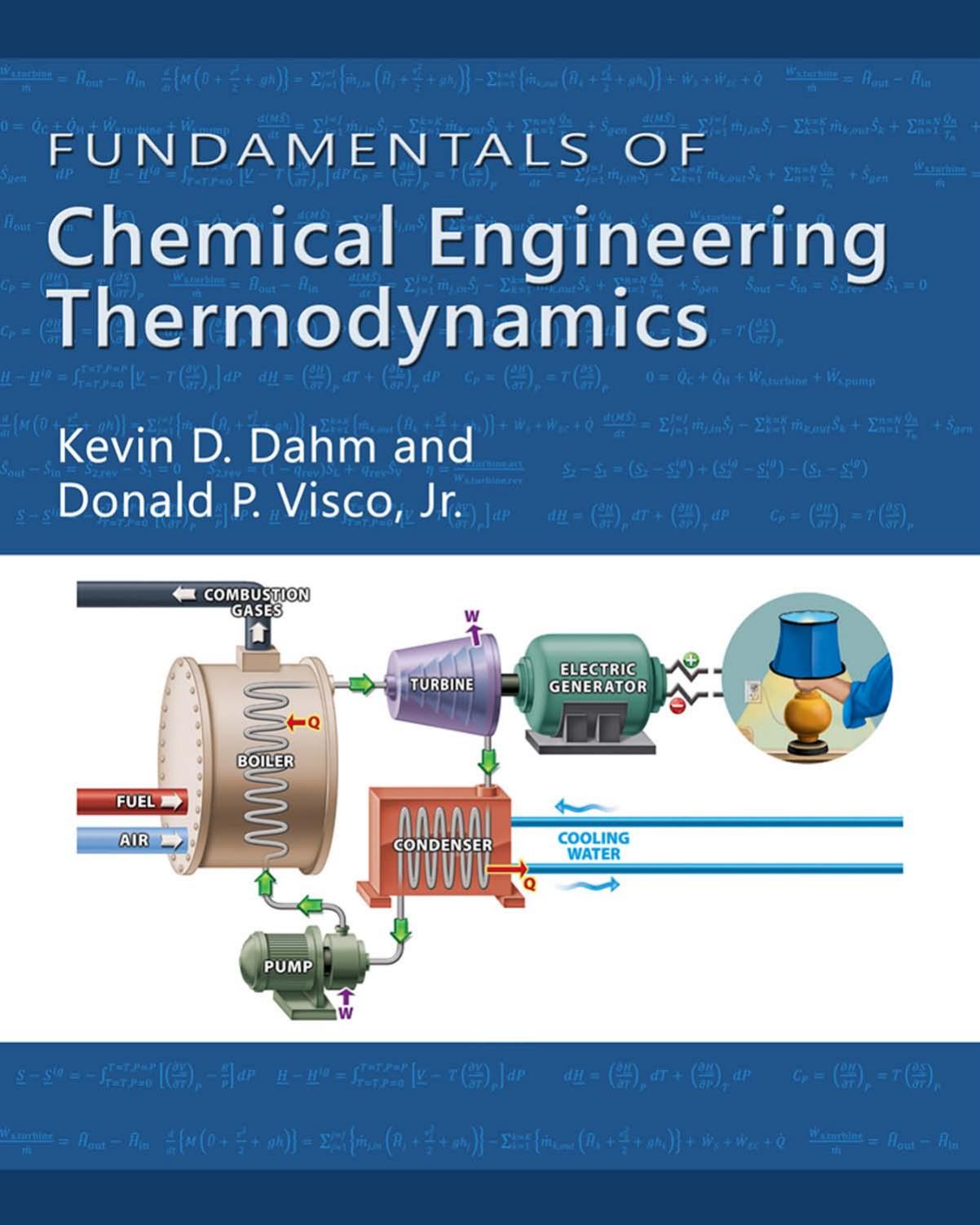
Fundamentals of Chemical Engineering Thermodynamics 1st edition by Kevin Dahm, Donald Visco- Ebook PDF Instant Download/Delivery: B00H7HTY2E, 978-1285968360
Full download Fundamentals of Chemical Engineering Thermodynamics 1st edition after payment
Product details:
ISBN 10: B00H7HTY2E
ISBN 13: 978-1285968360
Author: Kevin Dahm, Donald Visco
A brand new book, FUNDAMENTALS OF CHEMICAL ENGINEERING THERMODYNAMICS makes the abstract subject of chemical engineering thermodynamics more accessible to undergraduate students. The subject is presented through a problem-solving inductive (from specific to general) learning approach, written in a conversational and approachable manner. Suitable for either a one-semester course or two-semester sequence in the subject, this book covers thermodynamics in a complete and mathematically rigorous manner, with an emphasis on solving practical engineering problems. The approach taken stresses problem-solving, and draws from “”best practice”” engineering teaching strategies. FUNDAMENTALS OF CHEMICAL ENGINEERING THERMODYNAMICS uses examples to frame the importance of the material. Each topic begins with a motivational example that is investigated in context to that topic. This framing of the material is helpful to all readers, particularly to global learners who require “”big picture”” insights, and hands-on learners who struggle with abstractions. Each worked example is fully annotated with sketches and comments on the thought process behind the solved problems. Common errors are presented and explained. Extensive margin notes add to the book accessibility as well as presenting opportunities for investigation.
Fundamentals of Chemical Engineering Thermodynamics 1st Table of contents:
Ch 1: Introduction
1.1: The Role of Thermodynamics in Chemical Engineering
1.2: Motivational Example: The Conversion of Fuel into Electricity
1.3: Systems and Processes
1.4: The Forms of Energy
1.5: Summary of Chapter One
1.6: Exercises
1.7: Problems
1.8: Glossary of Symbols
1.9: References
Ch 2: The Physical Properties of Pure Compounds
2.1: Motivational Example: Vapor Pressure of Water and Its Effect on the Rankine Cycle
2.2: Physical Properties of Pure Chemical Compounds
2.3 Thermodynamic Models of Physical Properties
2.4: Summary of Chapter Two
2.5: Exercises
2.6: Problems
2.7: Glossary of Symbols
2.8: References
Ch 3: Material and Energy Balances
3.1: Motivational Example: Rockets
3.2: Material Balances
3.3: Mathematical Expression of the First Law of Thermodynamics
3.4: Applications of the Generalized Energy Balance Equation
3.5: Combining the Energy Balance with Simple Thermodynamic Models
3.6: Energy Balances for Common Chemical Process Equipment
3.7: Summary of Chapter Three
3.8: Exercises
3.9: Problems
3.10: Glossary of Symbols
3.11: References
Ch 4: Entropy
4.1: Motivational Example: Turbines
4.2: Reversible Processes
4.3: Defining and Describing Entropy
4.4: The Entropy Balance
4.5: The Carnot Heat Engine
4.6: Summary of Chapter Four
4.7: Exercises
4.8: Problems
4.9: Glossary of Symbols
4.10: References
Ch 5: Thermodynamic Processes and Cycles
5.1: Motivational Example: Chemical Process Design
5.2: Real Heat Engines
5.3: Refrigeration-The Vapor-Compression Cycle
5.4: Liquefaction
5.5: Summary of Chapter Five
5.6: Exercises
5.7: Problems
5.8: Glossary of Symbols
5.9: References
Ch 6: Thermodynamic Models of Real, Pure Compounds
6.1: Motivational Example: Joule-Thomson Expansion
6.2: Mathematical Models of Thermodynamic Properties
6.3: Heat Capacity and Residual Properties
6.4: Summary of Chapter Six
6.5: Exercises
6.6: Problems
6.7: Glossary of Symbols
6.8: Reference
Ch 7: Equations of State (EOS)
7.1: Motivational Examples: Transportation of Natural Gas
7.2: Cubic Equations of State
7.3: The Principle of Corresponding States
7.4: Beyond the Cubic Equations of State
7.5: Summary of Chapter Seven
7.6: Exercises
7.7: Problems
7.8: Glossary of Symbols
7.9: References
Ch 8: Modeling Phase Equilibrium for Pure Components
8.1: Motivational Example: VLE Curves for Refrigerants
8.2: Mathematical Models of Phase Equilibrium
8.3: Fugacity and Its Use in Modeling Phase Equilibrium
8.4: Summary of Chapter Eight
8.5: Exercises
8.6: Problems
8.7: Glossary of Symbols
8.8: References
Ch 9: An Introduction to Mixtures
9.1: Motivational Example: Mixing Chemicals-Intuition
9.2 Ideal Solutions
9.3: Properties of Mixing
9.4: Mathematical Framework for Solutions
9.5: Ideal Gas Mixtures
9.6: Summary of Chapter Nine
9.7: Exercises
9.8: Problems
9.9: Glossary of Symbols
9.10: References
Ch 10: Vapor-Liquid Equilibrium
10.1: Motivational Example
10.2: Raoult’s Law and the Presentation of Data
10.3: Mixture Critical Points
10.4: Lever Rule and the Flash Problem
10.5: Summary of Chapter Ten
10.6: Exercises
10.7: Problems
10.8: Glossary of Symbols
10.9: References
Ch 11: Theories and Models for Vapor-Liquid Equilibrium of Mixtures: Modified Raoult’s Law Approache
11.1: Motivational Example
11.2: Phase Equilibrium for Mixtures
11.3: Fugacity in Mixtures
11.4: Gamma-Phi Modeling
11.5: Modified Raoult’s Law
11.6: Excess Molar Gibbs Free Energy Models: An Introduction
11.7: Excess Molar Gibbs Free Energy Models: Usage
11.8: Predictive Excess Molar Gibbs Free Energy Models
11.9: Thermodynamic Consistency
11.10: Summary of Chapter Eleven
11.11: Exercises
11.12: Problems
11.13: Glossary of Symbols
11.14: References
Ch 12: Theories and Models for Vapor-Liquid Equilibrium of Mixtures: Using Equations of State
12.1: Motivational Example
12.2: Deviations from the Ideal Gas Model for the Vapor Phase
12.3: Phi-Phi Modeling
12.4: Ideal Solution for the Vapor Phase
12.5: Summary of Chapter Twelve
12.6: Exercises
12.7: Problems
12.8: Glossary of Symbols
12.9: References
Ch 13: Liquid-Liquid, Vapor-Liquid-Liquid, and Solid-Liquid Equilibrium
13.1: Motivational Example
13.2: Liquid-Liquid Equilibrium
13.3: Various Types of LLE
13.4: Miscibility Gaps from a Delta G of Mixing Perspective
13.5: Stability Criterion for Liquid Mixtures
13.6: Modeling Liquid-Liquid Equilibrium
13.7: Vapor-Liquid-Liquid Equilibrium (VLLE)
13.8: Modeling of Vapor-Liquid-Liquid Equilibrium (VLLE)
13.9: Solid-Liquid Equilibrium (SLE)
13.10: Modeling Solid-Liquid Equilibrium (SLE)
13.11: Summary of Chapter Thirteen
13.12: Exercises
13.13 Problems
13.14: Glossary of Symbols
13.15: References
Ch 14: Fundamentals of Chemical Reaction Equilibrium
14.1: Motivational Example: Ethylene from Ethane
14.2: Chemical Reaction Stoichiometry
14.3: The Equilibrium Criterion Applied to a Chemical Reaction
14.4: Multiple Reaction Equilibrium
14.5: Summary of Chapter Fourteen
14.6: Exercises
14.7: Problems
14.8: Glossary of Symbols
14.9: References
Ch 15: Synthesis of Thermodynamic Principles
15.1: Motivational Example: Reactive Distillation
15.2 Energy Balances on Chemical Reactors
15.3: Simultaneous Reaction and Phase Equilibrium
15.4: A Complete Chemical Process
15.5: Summary of Chapter Fifteen
15.6: Problems
15.7: Glossary of Symbols
15.8: References
Appendix
Appendix A: Steam Tables
Appendix B: Mathematical Techniques
Appendix C: Physical Properties
Appendix D: Heat Capacity
Appendix E: Antoine Coefficients
Appendix F: Thermodynamic Diagrams
Appendix G: The Joback Group Additivity Method
Index
People also search for Fundamentals of Chemical Engineering Thermodynamics 1st :
practical fundamentals of chemical engineering pdf
basic fundamentals of chemical engineering
practical fundamentals of chemical engineering
fundamentals of chemical engineering unimelb
fundamentals of chemical engineering pdf