


Fundamentals of Vibrations 1st edition by Leonard Meirovitch – Ebook PDF Instant Download/Delivery: B00HSTA5RO , 978-1478614104
Full download Fundamentals of Vibrations 1st edition after payment
Product details:
ISBN 10: B00HSTA5RO
ISBN 13: 978-1478614104
Author: Leonard Meirovitch
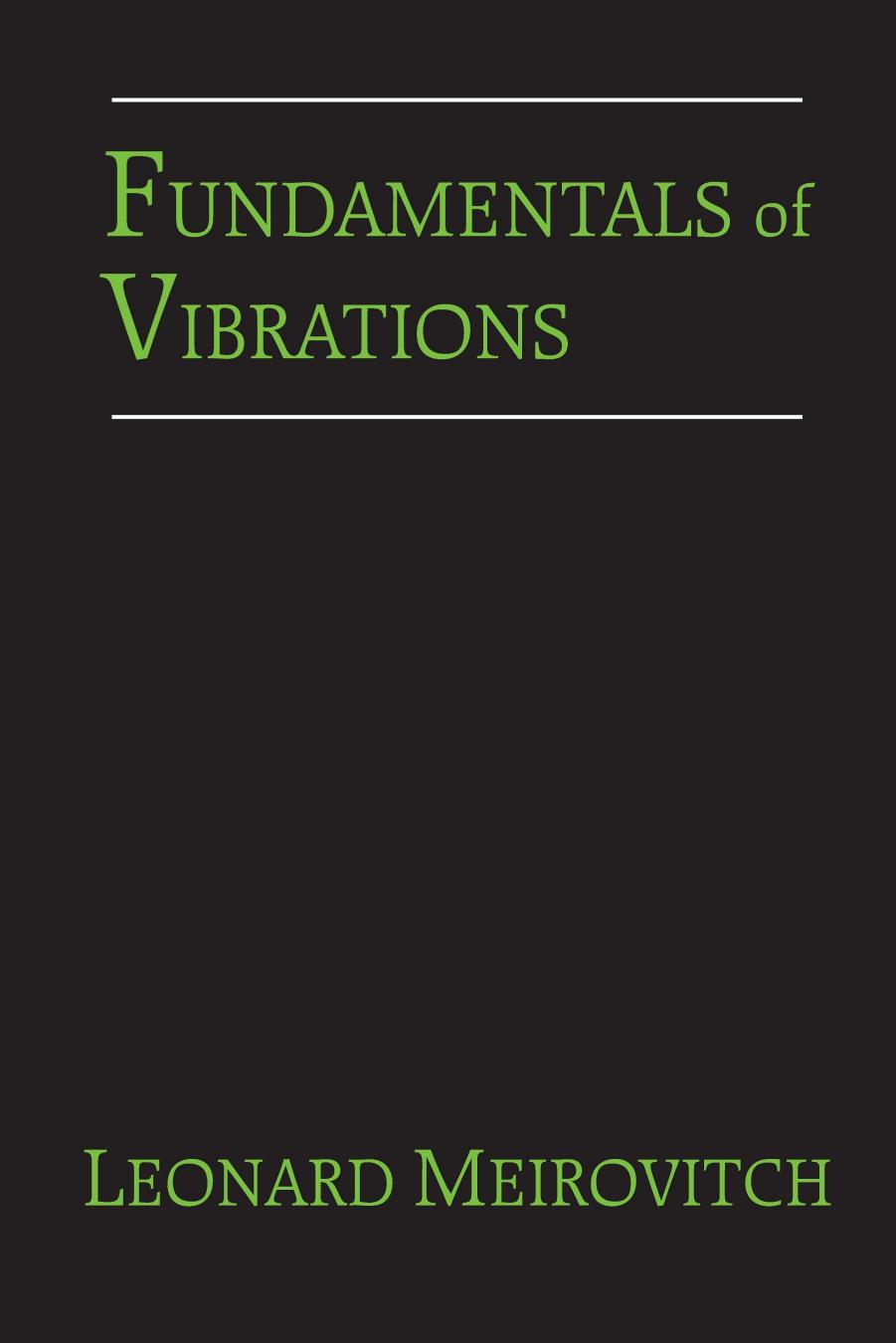
Fundamentals of Vibrations provides a comprehensive coverage of mechanical vibrations theory and applications. Suitable as a textbook for courses ranging from introductory to graduate level, it can also serve as a reference for practicing engineers. Written by a leading authority in the field, this volume features a clear and precise presentation of the material and is supported by an abundance of physical explanations, many worked-out examples, and numerous homework problems. The modern approach to vibrations emphasizes analytical and computational solutions that are enhanced by the use of MATLAB. The text covers single-degree-of-freedom systems, two-degree-of-freedom systems, elements of analytical dynamics, multi-degree-of-freedom systems, exact methods for distributed-parameter systems, approximate methods for distributed-parameter systems, including the finite element method, nonlinear oscillations, and random vibrations. Three appendices provide pertinent material from Fourier series, Laplace transformation, and linear algebra.
Fundamentals of Vibrations 1st Table of contents:
Introduction
Chapter 1- Concepts from Vibrations
1.1 Newton’s Laws
1.2 Moment of a Force and Angular Momentum
1.3 Work and Energy
1.4 Dynamics of Systems of Particles
1.5 Dynamics of Rigid Bodies
1.5.1 Pure Translation Relative to the Inertial Space
1.5.2 Pure Rotation About a Fixed Point
1.5.3 General Planar Motion Referred to the Mass Center
1.6 Kinetic Energy of Rigid Bodies in Planar Motion
1.6.1 Pure Translation Relative to the Inertial Space
1.6.2 Pure Rotation About a Fixed Point
1.6.3 General Planar Motion Referred to the Mass Center
1.7 Characteristics of Discrete System Components
1.8 Equivalent Springs, Dampers and Masses
1.9 Modeling of Mechanical Systems
1.10 System Differential Equations of Motion
1.11 Nature of Excitations
1.12 System and Response Characteristics. The Superposition Principle
1.13 Vibration about Equilibrium Points
1.14 Summary
Problems
Chapter 2- Response of Single-Degree-of-Freedom Systems to Initial Excitations
2.1 Undamped Single-Degree-of-Freedom Systems. Harmonic Oscillator
2.2 Viscously Damped Single-Degree-of-Freedom Systems
2.3 Measurement of Damping
2.4 Coulomb Damping. Dry Friction
2.5 Plotting the Response to Initial Excitations by MATLAB
2.6 Summary
Problems
Chapter 3- Response of Single-Degree-of-Freedom Systems to Harmonic and Periodic Excitations
3.1 Response of Single-Degree-of-Freedom Systems to Harmonic Excitations
3.2 Frequency Response Plots
3.3 Systems with Rotating Unbalanced Masses
3.4 Whirling of Rotating Shafts
3.5 Harmonic Motion of the Base
3.6 Vibration Isolation
3.7 Vibration Measuring Instruments
3.7.1 Accelerometers—High Frequency Instruments
3.7.2 Seismometers—Low Frequency Instruments
3.8 Energy Dissipation. Structural Damping
3.9 Response to Periodic Excitations. Fourier Series
3.10 Frequency Response Plots by MATLAB
3.11 Summary
Problems
Chapter 4- Response of Single-Degree-of-Freedom Systems to Nonperiodic Excitations
4.1 The Unit Impulse. Impulse Response
4.2 The Unit Step Function. Step Response
4.3 The Unit Ramp Function. Ramp Response
4.4 Response to Arbitrary Excitations. The Convolution Integral
4.5 Shock Spectrum
4.6 System Response by the Laplace Transformation Method. Transfer Function
4.7 General System Response
4.8 Response by the State Transition Matrix
4.9 Discrete-Time Systems. The Convolution Sum
4.10 Discrete-Time Response Using the Transition Matrix
4.11 Response by the Convolution Sum Using MATLAB
4.12 Response by the Discrete-Time Transition Matrix Using MATLAB
4.13 Summary
Problems
Chapter 5- Two-Degree-of-Freedom Systems
5.1 System Configuration
5.2 The Equations of Motion of Two-Degree-of-Freedom Systems
5.3 Free Vibration of Undamped Systems. Natural Modes
5.4 Response to Initial Excitations
5.5 Coordinate Transformations. Coupling
5.6 Orthogonality of Modes. Natural Coordinates
5.7 Beat Phenomenon
5.8 Response of Two-Degree-of-Freedom Systems to Harmonic Excitations
5.9 Undamped Vibration Absorbers
5.10 Response of Two-Degree-of-Freedom Systems to Nonperiodic Excitations
5.11 Response to Nonperiodic Excitations by the Convolution Sum
5.12 Response to Initial Excitations by MATLAB
5.13 Frequency Response Plots for Two-Degree-of-Freedom Systems by MATLAB
5.14 Response to a Rectangular Pulse by the Convolution Sum Using MATLAB
5.15 Summary
Problems
Chapter 6- Elements of Analytical Dynamics
6.1 Degrees of Freedom and Generalized Coordinates
6.2 The Principle of Virtual Work
6.3 The Principle of D’Alembert
6.4 The Extended Hamilton’s Principle
6.5 Lagrange’s Equations
6.6 Summary
Problems
Chapter 7- Multi-Degree-of-Freedom Systems
7.1 Equations of Motion for Linear Systems
7.2 Flexibility and Stiffness Influence Coefficients
7.3 Properties of the Stiffness and Mass Coefficients
7.4 Lagrange’s Equations Linearized about Equilibrium
7.5 Linear Transformations. Coupling
7.6 Undamped Free Vibration. The Eigenvalue Problem
7.7 Orthogonality of Modal Vectors
7.8 Systems Admitting Rigid-Body Motions
7.9 Decomposition of the Response in Terms of Modal Vectors
7.10 Response to Initial Excitations by Modal Analysis
7.11 Eigenvalue Problem in Terms of a Single Symmetric Matrix
7.12 Geometric Interpretation of the Eigenvalue Problem
7.13 Rayleigh’s Quotient and Its Properties
7.14 Response to Harmonic External Excitations
7.15 Response to External Excitations by Modal Analysis
7.15.1 Undamped Systems
7.15.2 Systems with Proportional Damping
7.16 Systems with Arbitrary Viscous Damping
7.17 Discrete-Time Systems
7.18 Solution of the Eigenvalue Problem. MATLAB Programs
7.19 Response to Initial Excitations by Modal Analysis Using MATLAB
7.20 Response by the Discrete-Time Transition Matrix Using MATLAB
7.21 Summary
Problems
Chapter 8- Distributed-Parameter Systems: Exact Solutions
8.1 Relation between Discrete and Distributed Systems. Transverse Vibration of Strings
8.2 Derivation of the String Vibration Problem by the Extended Hamilton Principle
8.3 Bending Vibration of Beams
8.4 Free Vibration. The Differential Eigenvalue Problem
8.5 Orthogonality of Modes. Expansion Theorem
8.6 Systems with Lumped Masses at the Boundaries
8.7 Eigenvalue Problem and Expansion Theorem for Problems with Lumped Masses at the Boundaries
8.8 Rayleigh’s Quotient. The Variational Approach to the Differential Eigenvalue Problem
8.9 Response to Initial Excitations
8.10 Response to External Excitations
8.11 Systems with External Forces at Boundaries
8.1 2 The Wave Equation
8.13 Traveling Waves in Rods of Finite Length
8.14 Summary
Problems
Chapter 9- Distributed-Parameter Systems: Approximate Methods
9.1 Discretization of Distributed-Parameter Systems by Lumping
9.2 Lumped-Parameter Method Using Influence Coefficients
9.3 Holzer’s Method for Torsional Vibration
9.4 Myklestad’s Method for Bending Vibration
9.5 Rayleigh’s Principle
9.6 The Rayleigh-Ritz Method
9.7 An Enhanced Rayleigh-Ritz Method
9.8 The Assumed-Modes Method. System Response
9.9 The Galerkin Method
9.10 The Collocation Method
9.11 MATLAB Program for the Solution of the Eigenvalue Problem by the Rayleigh-Ritz Method
9.1 2 Summary
Problems
Chapter 10- The Finite Element Method
10.1 The Finite Element Method as a Rayleigh-Ritz Method
10.2 Strings, Rods and Shafts
10.3 Higher-Degree Interpolation Functions
10.4 Beams in Bending Vibration
10.5 Errors in the Eigenvalues
10.6 Finite Element Modeling of Trusses
10.7 Finite Element Modeling of Frames
10.8 System Response by the Finite Element Method
10.9 MATLAB Program for the Solution of the Eigenvalue Problem by the Finite Element Method
10.10 Summary
Problems
Chapter 11- Nonlinear Oscillations
11.1 Fundamental Concepts in Stability. Equilibrium Points
11.2 Small Motions of Single-Degree-of-Freedom Systems from Equilibrium
11.3 Conservative Systems. Motions in the Large
11.4 Limit Cycles. The van der Pol Oscillator
11.5 The Fundamental Perturbation Technique
11.6 Secular Terms
11.7 Lindstedt’s Method
11.8 Forced Oscillation of Quasi-Harmonic Systems. Jump Phenomenon
11.9 Subharmonics and Combination Harmonics
11.10 Systems with Time-Dependent Coefficients. Mathieu’s Equation
11.11 Numerical Integration of the Equations of Motion. The Runge-Kutta Methods
11.12 Trajectories for the van der Pol Oscillator by MATLAB
11.13 Summary
Problems
Chapter 12- Random Vibrations
12.1 Ensemble Averages. Stationary Random Processes
12.2 Time Averages. Ergodic Random Processes
12.3 Mean Square Values and Standard Deviation
12.4 Probability Density Functions
12.5 Description of Random Data in Terms of Probability Density Functions
12.6 Properties of Autocorrelation Functions
12.7 Response to Arbitrary Excitations by Fourier Transforms
12.8 Power Spectral Density Functions
12.9 Narrowband and Wideband Random Processes
12.10 Response of Linear Systems to Stationary Random Excitations
12.11 Response of Single-Degree-of-Freedom Systems to Random Excitations
12.12 Joint Probability Distribution of Two Random Variables
12.13 Joint Properties of Stationary Random Processes
12.14 Joint Properties of Ergodic Random Processes
12.15 Response Cross-Correlation Functions for Linear Systems
12.16 Response of Multi-Degree-of-Freedom Systems to Random Excitations
12.17 Response of Distributed-Parameter Systems to Random Excitations
12.18 Summary
Problems
Appendix A: Fourier Series
A.1 Orthogonal Sets of Functions
A.2 Trigonometric Series
A.3 Complex Form of Fourier Series
Appendix B: Laplace Transformation
B.1 Definition of the Laplace Transformation
B.2 Transformation of Derivatives
B.3 Transformation of Ordinary Differential Equations
B.4 The Inverse Laplace Transformation
B.5 Shifting Theorems
B.6 Method of Partial Fractions
B.7 The Convolution Integral. Borel’s Theorem
B.8 Table of Laplace Transform Pairs
Appendix C: Linear Algebra
C.1 Matrices
C.2 Vector Spaces
C.3 Linear Transformations
Bibliography
Index
People also search for Fundamentals of Vibrations 1st :
fundamentals of vibrations leonard meirovitch solutions manual pdf
meirovitch leonard fundamentals of vibrations waveland press 2010
fundamentals of vibrations leonard meirovitch solutions
fundamentals of vibrations meirovitch
what is fundamental vibration