

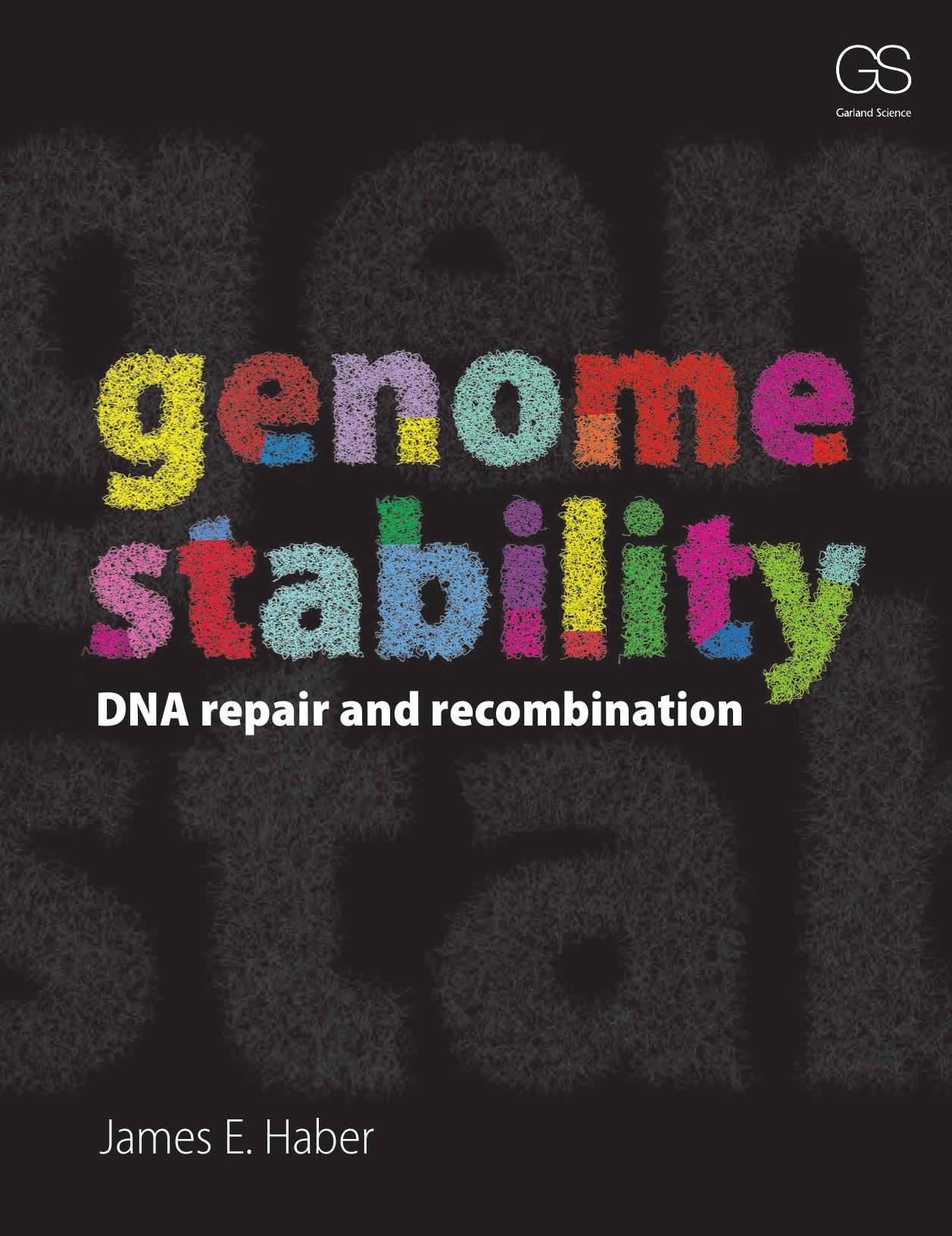
Genome Stability 1st edition by James Haber – Ebook PDF Instant Download/Delivery: 0815344856 , 978-0815344858
Full download Genome Stability 1st edition after payment
Product details:
ISBN 10: 0815344856
ISBN 13: 978-0815344858
Author: James Haber
Genome Stability: DNA Repair and Recombination describes the various mechanisms of repairing DNA damage by recombination, most notably the repair of chromosomal breaks. The text presents a definitive history of the evolution of molecular models of DNA repair, emphasizing current research. The book introduces the central players in recombination. An overview of the four major pathways of homologous recombinational repair is followed by a description of the several mechanisms of nonhomologous end-joining. Designed as a textbook for advanced undergraduate and graduate students with a molecular biology and genetics background, researchers and practitioners, especially in cancer biology, will also appreciate the book as a reference.
Genome Stability 1st Table of contents:
Chapter 1 Restarting DNA Replication by Recombination
1.1 DNA Breaks Occur Frequently During Replication
1.2 Leading- and Lagging-Strand DNA Syntheses are Coordinated at the Replication Fork
1.3 Replication Fork Stalling may Occur in Several Different Ways
1.4 An Introduction to the Holliday Junction
1.5 A Holliday Junction can be Resolved by Enzymatic Cleavage
1.6 HJ Resolvases can Promote Replication Restart by Break-Induced Replication
Summary
Suggested Reading
Chapter 2 Double-Strand Break Repair Pathways
2.1 Some DNA Repair Occurs at Single-Stranded Gaps
2.2 Repair Of DSBs can Occur in Several Ways
Summary
Suggested Reading
Chapter 3 RecA/Rad51 and the Search for Homology
3.1 RecA and Rad51 are the Key Strand Exchange Proteins
3.2 Filament Assembly of RecA and Rad51 can be Assayed In Vitro
3.3 X-Ray Crystallography has Revealed a Great Deal about RecA Structure and Function
3.4 Strand Exchange can be Studied In Vitro
3.5 Strand Exchange Takes Place Inside the RecA Filament
A topological approach to studying strand invasion
Single molecule analysis of recombination
3.6 In Vitro Analysis Suggests Homology Searching Proceeds by a Tethered Three-Dimensional Search
3.7 The Requirements of Homology Searching and Strand Invasion can be Assayed in Vivo
3.8 Broken DNA Ends become more Mobile
3.9 Rad51’s Properties can be Altered by Associated Proteins
3.10 Strand Invasion can Apparently Occur Without Rad51
Summary
Suggested Reading
Chapter 4 Preparation of the Reca/Rad51 Filament
4.1 DSB Ends are Resected in a 5’to 3’Direction
4.2 Resection has been Well Studied in E. Coli
4.3 Resection in Budding Yeast can be Monitored in VIVO
4.4 Several Different Protein Complexes are Involved in Resection in Budding Yeast
4.5 BLM Protein is Important in Two Exonuclease Complexes for Resection in Mammalian Cells
4.6 Resection must Pass through Chromatin
4.7 Preparing ssDNA for the Loading of RecA/Rad51 Requires ssDNA Binding Proteins
4.8 RPA and Rad51 Assembly can be Assayed in Vivo
4.9 Creating a Recombinase Filament in Bacteria needs the Participation of Several Mediators
4.10 Mediators in Eukaryotes are Surprisingly Unrelated to those in Bacteria
4.11 Rad52 and Rad55–Rad57 are the Principal Mediators in Saccharomyces Cerevisiae
Rad51 Paralogs: Rad55 and Rad57
Additional mediators: the PCSS complex
Rad59, sharing homology with Rad52, is not a mediator but plays an important role
4.12 Rad51 Filament Assembly in Fission Yeast Involves Even more Proteins
Rad55/Rad57 versus Swi5/Sfr1
4.13 Mediators of Recombinase Filament Assembly have been Identified in Vertebrate Cells
Vertebrate Rad51 paralogs
Rad52 and BRCA2
4.14 Homologs of BRCA2 are found in Many Eukaryotes, Including a Yeast
4.15 Many Questions Remain Unanswered
Summary
Suggested Reading
Chapter 5 Single-Strand Annealing
5.1 5‘to 3’ Resection Promotes Single-Strand Annealing
5.2 SSA in Budding Yeast can be Studied after Inducing a Site-Specific DSB
5.3 SSA is Rad51 Independent
5.4 SSA Depends on Rad52’s Strand Annealing Activity
5.5 The Removal of Nonhomologous Tails is Required for the Completion of SSA
5.6 SSA can Occur between Mismatched Sequences
5.7 The Behavior of DSB Ends can be Explored Using SSA
5.8 SSA can be seen in other Organisms
Summary
Suggested Reading
Chapter 6 Gene conversion
6.1 Gene Conversions Were Initially Defined From Aberrant Segregation of Alleles in Meiosis
6.2 Analogous Gene Conversions Arise in Mitotic Cells
6.3 Most Gene Conversion Arises From Mismatch Correction of Heteroduplex Dna
6.4 Gene Conversions Can be Accompanied by Crossing Over
6.5 Gene Conversion can be Assayed in Haploid Yeast
6.6 The Molecular Basis of Gene Conversion was Deduced by Recombining Linearized Plasmid Dna With a Chromosome
6.7 A Question of Semantics: Can There be Gene Conversions if the Donor and Recipient Chromosomes are Identical?
6.8 Heteroduplex Correction Often Defines Gene Conversion Tract Lengths
6.9 Where Does Heteroduplex Dna Form During Dsb Repair?
6.10 Gene Conversion Tract Lengths Have Been Measured in Budding Yeast
6.11 Gene Conversions Associated with Crossing Over May Occur by Alternative Mechanisms
6.12 There are Alternative Ways to Generate Crossovers
6.13 Recombination Between Sequences of Limited Homology Length Constrains Measuring Hdna
6.14 Gene Conversion Tract Lengths are Very Different in Mitotic and Meiotic Yeast Cells
6.15 A Complication: Heterologies Introduce Uncertainty
6.16 There is Competition Among Possible Gene Conversion Donors
6.17 Gene Conversion is Mutagenic: Evidence for Reduced Dna Polymerase Processivity
6.18 Gene Conversion Frequencies are Influenced by Chromosomal Position
6.19 Gene Conversion and Gene Conversion Tracts Have Been Defined in Other Model Organisms
S. pombe
Drosophila
6.20 Homologous Recombination Can be Analyzed in Plants
6.21 Gene Conversions Have Been Studied in Mammals
6.22 Crossing Over Accompanying Gene Conversion is Rare in Mammalian Cells
6.23 Some DSB Repair Events Begin by Homologous Recombination But Terminate With a Nonhomologous End
Summary
Suggested Reading
Chapter 7 éIn Vivo Biochemistry‐: Recombination in Yeast
7.1 Budding Yeast MatSwitching Allows us to Describe the Molecular Events During a Gene Conversion Event
7.2 Mat Switching can be Physically Monitored on Southern Blots
7.3 The Loading of Rad51 on SsDNA can be Visualized by Chromatin Immunoprecipitation
7.4 The Encounter of the Rad51 Filament with the Donor Locus can also be Monitored by Chromatin Immunoprecipitation
7.5 A PCR Assay can be Used to Detect the Beginning of new DNA Synthesis
7.6 Heavy Isotope Labeling can be Used to Show that new DNA Synthesis is “Conservative”
7.7 A Nucleosome Protection Assay Reveals that Strand Invasion also Involves Chromatin Remodeling
7.8 The Capture of the Second Homologous end During Gene Conversion can also be Studied
7.9 A Small Fraction of Ectopic Gene Conversion Events are Crossover Associated
7.10 Two other Helicases Regulate Gene Conversion Outcomes
7.11 Dsb Break Repair is Surprisingly Different from Gap Repair
7.12 Study of Mismatch Correction During Strand Invasion Raises Questions about How Mat Switching Occurs
7.13 Another Special Feature of Mat Switching is Donor Preference
7.14 Mating-Type Switching in s. Pombe is Surprisingly Different From That in s. Cerevisiae
7.15 Fission Yeast Mat1 Switching Donor Preference Involves Chromatin Remodeling
7.16 A Mat1 Dsb is not Lethal in The Absence of the Donors
7.17 Are there Recombination Enhancers in Other Programmed Recombination Events?
Summary
Suggested Reading
Chapter 8 Break-Induced Replication
8.1 Bir is Important in the Maturation and Replication of Bacteriophage
8.2 Bir Is Also Important In E. Coli
8.3 Bir Has Been Well Documented In Budding Yeast
8.4 Bir Is Usually Rad51 Dependent
8.5 Rad51-Dependent Bir Requires All Three Major Dna Polymerases
8.6 Many Other Genes Affect The Efficiency Of Bir
8.7 Replication During Bir Is Far More Mutagenic Than Normal Replication
8.8 How Bir Is Finally Resolved Is Not Yet Known
8.9 There Is Also A Rad51-Independent Bir Pathway
8.10 Half-Crossovers Are An Alternative Pathway Producing Nonreciprocal Translocations
8.11 Bir Is Observed In Other Organisms
Telomere elongation in Kluyveromyces lactis
BIR in Schizosaccharomyces pombe
Drosophila melanogaster telomere elongation
BIR in Xenopus laevis extracts
8.12 Bir-Like Events Are Important For Humans
8.13 There Is A Rad52-Independent Homologous Recombination Pathway
8.14 Bir Can Produce Copy Number Variation
Segmental duplications arise in budding yeast
Nonrecurrent SDs in human disease may involve BIR
8.15 Cnv May Arise From Microhomology-Mediated Bir
8.16 Chromothripsis is an Unexpected Type of Genome Instability that May Require BIR
Summary
Suggested Reading
Chapter 9 Sister Chromatid Repair
9.1 Homologous Recombination is Required After Ionizing Radiation
9.2 Sister Chromatid Repair is Preferred Over Recombination With a Homolog
9.3 Scr Can be Visualized on Chromosome-Separating Gels
9.4 Some Sister Chromatid Repair is Seen as Sister Chromatid Exchange
9.5 Brdu Labeling in Mammalian Cells Reveals “Harlequin” Chromosomes
9.6 Sce Can Also Been Seen By Using The Co-Fish Technique
9.7 Sce Can Be Assayed Genetically By Studying Unequal Sce and Long-Tract Gene Conversion
9.8 The Genetic Requirements for Spontaneous Scr Differ From Those Seen in Interhomolog Repair
9.9 Sce Can be Analyzed Genetically in Mammalian Cells
9.10 Radio-Resistance in Deinococcus Radiodurans Involves Both Efficient DNA Repair and Resistance to Other Oxidative Damage
9.11 Sister Chromatid Repair Leaves Several Important Questions Unanswered
Summary
Suggested Reading
Chapter 10 Gene Targeting
10.1 Bacterial Transformation Provided the First Evidence of Gene Targeting
10.2 Gene Correction and Modification in a Eukaryote was First Accomplished in Budding Yeast
10.3 Double-Strand breaks greatly improve Gene targeting
10.4 Gene Targeting is More Difficult in Mammals Than in Yeast
10.5 Gene Targeting is Improved by Creating a Chromosomal Dsb at the target locus
Modifications of an existing site-specifc endonuclease
Zinc-finger nucleases
TALE nucleases (TALENs)
CRISPR nucleases
10.6 Designer Meganucleases Make it Possible to Think About Genetic Surgery
10.7 Conditional Gene Knockouts Make it Possible to Analyze Essential Genes
10.8 Ends-Out transformation likely happens through several different pathways
Hit-and-run transformation
Assimilation of a single strand of transforming DNA
Independent strand invasions
10.9 Ends-in targeting is much more efficient than ends-Out targeting
10.10 Gene Knockouts And Gene Modification are Efficient in Modified Bacteria
10.11 Gene targeting strategies can be adapted to other organisms
Gene modification in Drosophila
Plants have lagged behind in gene modification
Summary
Suggested Reading
Chapter 11 Site-Specific Recombination
11.1 Phase Variation in Salmonella Depends on a Site-Specific Recombinase
11.2 Cre Recombinase Recombines at a Pair of Lox Sites
11.3 Cre-Mediated recombination can be used to create genome modifications
11.4 Flp Recombinase Exchanges Between First Sites
11.5 ɸC31 Integration Can Transfer Large Chromosomal Segments
Summary
Suggested Reading
Chapter 12 Cytology and Genetics Of Meiosis
12.1 Recombination is Required to Generate Diversity but also to Ensure Chromosome Segregation
12.2 Early Meiosis in Drosophila Studies Showed That Recombination Occurs After Chromosome Replication
12.3 In Fungi, all four products of a single meiosis can be recovered
12.4 Gene Conversions arise frequently in Meiosis
12.5 Post-Meiotic Segregation is Seen in the Absence Of Mismatch Repair
12.6 Meiotic segregation patterns reveal how recombination is initiated
12.7 Branch Migration can lead to Ab4:4 Segregation
12.8 Gene conversion and crossing over have a strong correlation
12.9 Major events in meiosis can be observed cytologically
12.10 Sc assembly can proceed in two distinct ways
12.11 Chromosomes exhibit dynamic movements prior to zygotene
12.12 A Strong Bias Favors Interhomolog over Intersister Recombination
12.13 Some Meiotic Mutants can be Analyzed by Bypassing Meiosis I
spo13Δ rescue of recombination-defective diploid yeast cells
spo13Δ rescue of haploid meiosis
12.14 Return-To-Growth Experiments Reveal a Period Of Commitment to Meiotic Levels of Recombination
12.15 Interference Regulates the Distribution of Crossovers
12.16 Homeostasis Assures that Small Chromosomes Usually Get at Least One Crossover During Meiosis
12.17 There are Several Models of Interference
Summary
Suggested Reading
Chapter 13 Molecular Events During Meiotic Recombination
13.1 Spo11 Creates Dsbs to Initiate Meiotic Recombination
13.2 Dsb Formation is Associated with Replication and Chromatin Modifications
13.3 Meiotic Hot Spots can be Identified in Many Different Organisms
Fission yeast
Mammals
13.4 Meiotic Hot Spots in Mammals Correlate Strongly with Prdm9 Histone Methyltransferase
13.5 Homologous Chromosome Pairing Often Requires Spo11-Induced Recombination
13.6 Recombination Cannot Begin Until Spo11 is Released from the Dsb Ends
13.7 in Meiosis, in Many Organisms, Rad51 is Not the only Reca-Like Strand Exchange Protein
13.8 Dmc1 Works with Several Meiosis-Specific Auxiliary Factors
13.9 Rad51 Plays only a Supporting Role in Yeast Meiosis
13.10 Molecular Intermediates of Meiotic Recombination are Well-Studied in Budding Yeast
Crossover products
DNA end resection in meiosis is less extensive than in mitotic cells
Binding of Dmc1 and Rad51 to DSB ends
13.11 Transient Strand Invasion Intermediates can be Identified by 2-D Gel Electrophoresis
Single-end invasion
dHJ formation
Initiation of new DNA synthesis
HJ formation in S. pombe
13.12 to Complete Gene Conversion the Second Dsb End Must be Captured
13.13 Axial Element Components are Important in the Control of the Interhomolog Bias
13.14 Zmm Proteins Play Key Roles in Regulating Crossovers and Implementing Interference
Msh4–Msh5
Mlh1/Mlh3
Mer3
Zip1/Zip2/Zip3/Zip4/Spo16
13.15 Zmm Proteins are Equally Important in Meiosis of Metazoans and Plants
13.16 the Crossover/Noncrossover Decision Appears to be Made Early in Dsb Repair
13.17 At Least one More Crossover System Exists, in Addition to that Controlled by Zmm Proteins
13.18 Distribution of Crossovers and Noncrossovers can be Analyzed Genomewide in Budding Yeast
13.19 Global Analysis of Meiotic Events has been Extended to Metazoans and Plants
Drosophila
Arabidopsis
Mouse
Humans
13.20 Meiotic Recombination can be Induced by Meganuclease-Induced Dsbs
HO endonuclease
VDE
I-SceI cleavage in S. pombe meiosis
Mos1 transposon
Gamma irradiation
Summary
Suggested Reading
Chapter 14 Holliday Junction Resolvases and Crossing Over
14.1 Holliday Junctions can Adopt Alternative Configurations
14.2 Canonical HJ Resolvases Make Symmetrical Cuts that Can be Re-Ligated
14.3 Noncanonical Resolvases May Act on Nicked HJs
14.4 There Are at Least Four HJ Resolvases in Eukaryotes
Mus81 complex
Yen1/Gen1
Slx1–Slx4
Exo1–Mlh1–Mlh3
14.5 Different HJ Resolvases Play Different Roles in Different Organisms
Budding yeast mitotic cells
Budding yeast meiosis
Fission yeast
Drosophila
Caenorhabditis
Mammals
14.6 Branch Migration Enzymes Can Influence HJ Cleavage
14.7 Mismatch Repair also Influences Crossover Regulation
Summary
Suggested Reading
Chapter 15 Nonhomologous end-Joining
15.1 “Classical” Nhej is Essential for the Mammalian Immune System
15.2 VDJ Joinings Often Exhibit Additional Modifications at the Junction
15.3 NHEJ Contributes to DSB Repair in Yeast
15.4 NHEJ Facilitates Capture of DNA Fragments at DSBs
15.5 End-Joining May Also Occur by Alternative NHEJ
15.6 The 53Bp1 Protein Plays Multiple Roles in End-Joining
15.7 Gene Amplifiication can Occur Via NHEJ and BFB Cycles
Summary
Suggested Reading
Chapter 16 DNA Damage Checkpoints And Genome Instability
16.1 The DNA Damage Checkpoint Provides a Cell Cycle Delay to Allow DNA Repair
16.2 PI3 kinase-like kinases are at the apex of DNA Damage Signaling
16.3 Different mechanisms activate ATM And ATR in response to a DSB
16.4 ATM And ATR Initiate a Protein Kinase Cascade
16.5 DSB-Induced cell cycle Arrest In mammals Occurs Before S Phase and Mitosis
16.6 DSB-Induced cell cycle arrest In Budding Yeast Occurs Primarily Before Anaphase
16.7 γ-H2AX Is important For sister chromatid Repair In Mammals
16.8 The Dna Damage Checkpoint Modulates Dsb Repair In Many Ways
16.9 Failures Of The DNA Damage Response Contribute To Genome Instability
16.10 Cancer Chemotherapies Exploit Targets In Multiple DNA Repair Pathways
16.11 Homologous Recombination Turns Up In Stem Cell Reprogramming
People also search for Genome Stability 1st :
genome stability definition
genome stability genes
genome stability
what is genome stability
genetic stability
Tags: James Haber, Genome Stability