


Graphical Data Analysis with R 1st edition by Antony Unwin – Ebook PDF Instant Download/Delivery: 1032477312, 9781032477312
Full download Graphical Data Analysis with R 1st edition after payment
Product details:
ISBN 10: 1032477312
ISBN 13: 9781032477312
Author: Antony Unwin
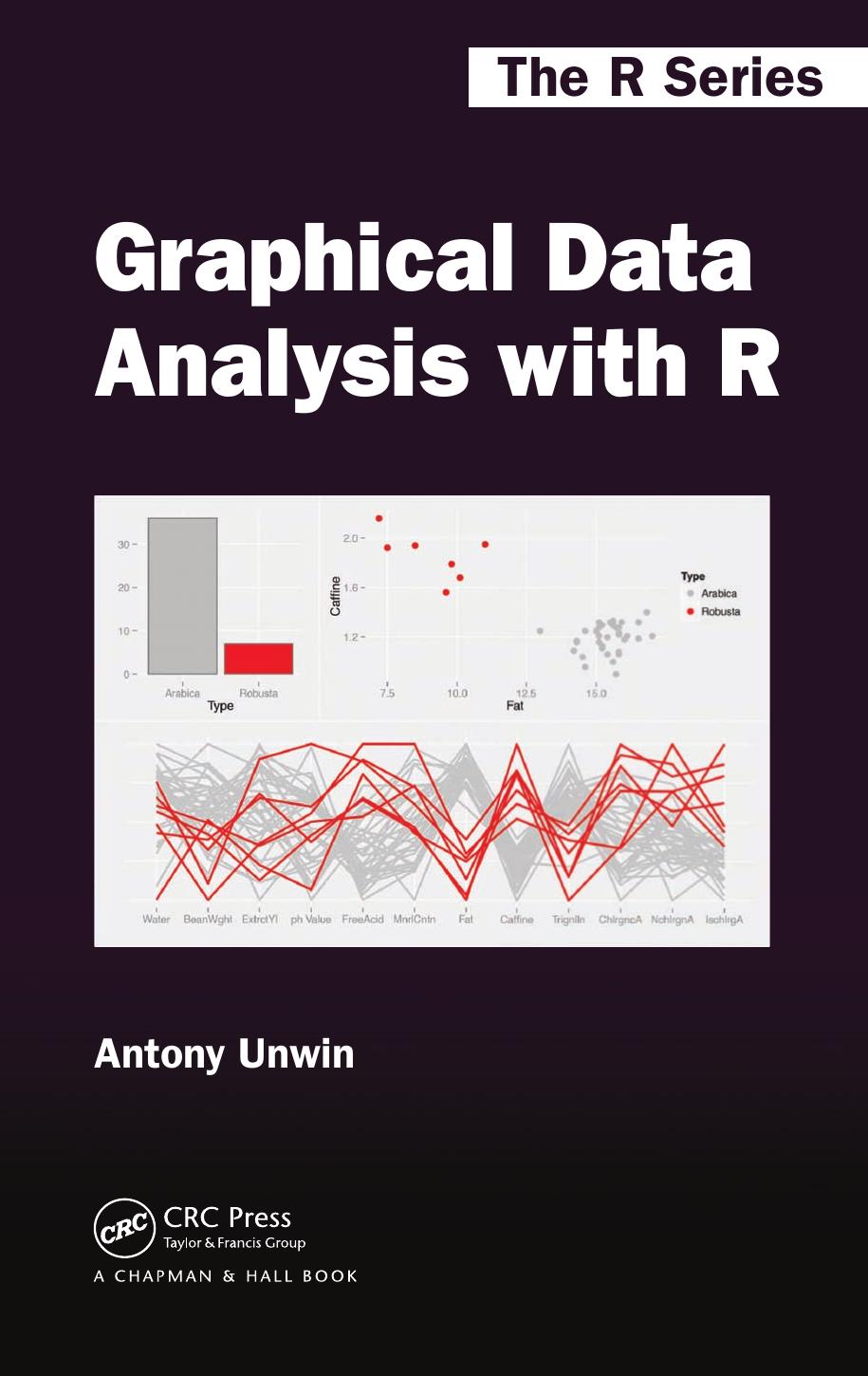
Graphical Data Analysis with R shows you what information you can gain from graphical displays. The book focuses on why you draw graphics to display data and which graphics to draw (and uses R to do so). All the datasets are available in R or one of its packages and the R code is available at rosuda.org/GDA.
Graphical data analysis is useful for data cleaning, exploring data structure, detecting outliers and unusual groups, identifying trends and clusters, spotting local patterns, evaluating modelling output, and presenting results. This book guides you in choosing graphics and understanding what information you can glean from them. It can be used as a primary text in a graphical data analysis course or as a supplement in a statistics course. Colour graphics are used throughout.
Graphical Data Analysis with R 1st Table of contents:
1 Setting the Scene
1.1 Graphics in action
1.2 Introduction
1.3 What is Graphical Data Analysis (GDA)?
1.4 Using this book, the R code in it, and the book’s webpage
2 Brief Review of the Literature and Background Materials
2.1 Literature review
2.2 Interactive graphics
2.3 Other graphics software
2.4 Websites
2.5 Datasets
2.6 Statistical texts
3 Examining Continuous Variables
3.1 Introduction
3.2 What features might continuous variables have?
3.3 Looking for features
3.4 Comparing distributions by subgroups
3.5 What plots are there for individual continuous variables?
3.6 Plot options
3.7 Modelling and testing for continuous variables
4 Displaying Categorical Data
4.1 Introduction
4.2 What features might categorical variables have?
4.3 Nominal data—no fixed category order
4.4 Ordinal data—fixed category order
4.5 Discrete data—counts and integers
4.6 Formats, factors, estimates, and barcharts
4.7 Modelling and testing for categorical variables
5 Looking for Structure: Dependency Relationships and Associations
5.1 Introduction
5.2 What features might be visible in scatterplots?
5.3 Looking at pairs of continuous variables
5.4 Adding models: lines and smooths
5.5 Comparing groups within scatterplots
5.6 Scatterplot matrices for looking at many pairs of variables
5.7 Scatterplot options
5.8 Modelling and testing for relationships between variables
6 Investigating Multivariate Continuous Data
6.1 Introduction
6.2 What is a parallel coordinate plot (pcp)?
6.3 Features you can see with parallel coordinate plots
6.4 Interpreting clustering results
6.5 Parallel coordinate plots and time series
6.6 Parallel coordinate plots for indices
6.7 Options for parallel coordinate plots
6.8 Modelling and testing for multivariate continuous data
6.9 Parallel coordinate plots and comparing model results
7 Studying Multivariate Categorical Data
7.1 Introduction
7.2 Data on the sinking of the Titanic
7.3 What is amosaicplot?
7.4 Different mosaicplots for different questions of interest
7.5 Which mosaicplot is the right one?
7.6 Additional options
7.7 Modelling and testing for multivariate categorical data
8 Getting an Overview
8.1 Introduction
8.2 Many individual displays
8.3 Multivariate overviews
8.4 Multivariate overviews for categorical variables
8.5 Graphics by group
8.6 Modelling and testing for overviews
9 Graphics and Data Quality: How Good Are the Data?
9.1 Introduction
9.2 Missing values
9.3 Outliers
9.4 Modelling and testing for data quality
10 Comparisons, Comparisons, Comparisons
10.1 Introduction
10.2 Making comparisons
10.3 Making visual comparisons
10.4 Comparing group effects graphically
10.5 Comparing rates visually
10.6 Graphics for comparing many subsets
10.7 Graphics principles for comparisons
10.8 Modelling and testing for comparisons
11 Graphics for Time Series
11.1 Introduction
11.2 Graphics for a single time series
11.3 Multiple series
11.4 Special features of time series
11.5 Alternative graphics for time series
11.6 R classes and packages for time series
11.7 Modelling and testing time series
12 Ensemble Graphics and Case Studies
12.1 Introduction
12.2 What is an ensemble of graphics?
12.3 Combining different views—a case study example
12.4 Case studies
13 Some Notes on Graphics with R
13.1 Graphics systems in R
13.2 Loading datasets and packages for graphical analysis
13.3 Graphics conventions in statistics
13.4 What is a graphic anyway?
13.5 Options for all graphics
13.6 Some R graphics advice and coding tips
13.7 Other graphics
13.8 Large datasets
13.9 Perfecting graphics
14 Summary
14.1 Data analysis and graphics
14.2 Key features of GDA
14.3 Strengths and weaknesses of GDA
14.4 Recommendations for GDA
People also search for Graphical Data Analysis with R 1st :
types of graphs for data analysis
graphical data analysis with r pdf
graphs for data analysis
graphical data analysis
graphical data analysis tools