


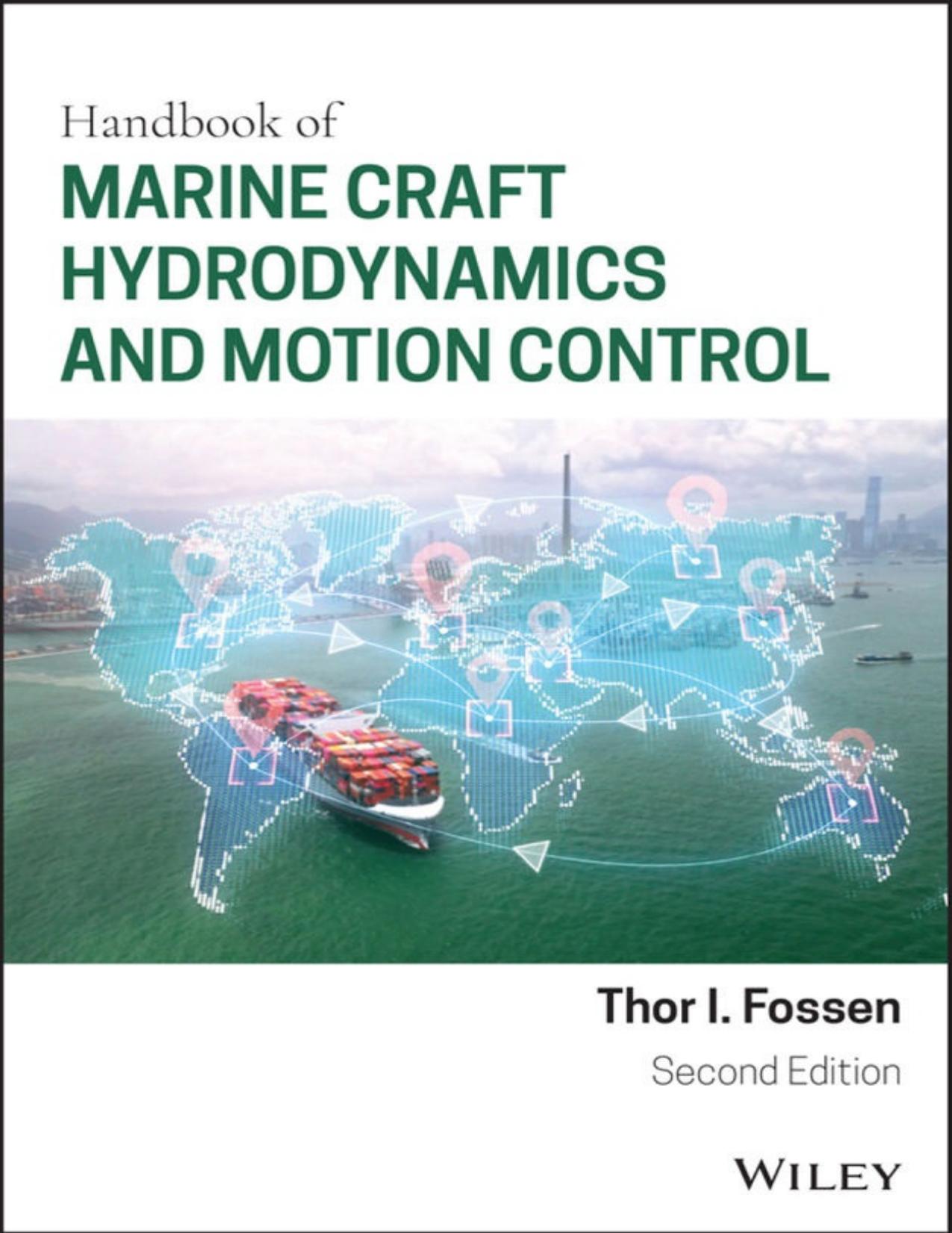
Handbook of Marine Craft Hydrodynamics and Motion Control 2nd edition by Thor Fossen- Ebook PDF Instant Download/Delivery: 1119575052, 978-1119575054
Full download Handbook of Marine Craft Hydrodynamics and Motion Control 2nd edition after payment
Product details:
ISBN 10: 1119575052
ISBN 13: 978-1119575054
Author: Thor Fossen
Handbook of MARINE CRAFT HYDRODYNAMICS AND MOTION CONTROL
The latest tools for analysis and design of advanced GNC systems
Handbook of Marine Craft Hydrodynamics and Motion Control is an extensive study of the latest research in hydrodynamics, guidance, navigation, and control systems for marine craft. The text establishes how the implementation of mathematical models and modern control theory can be used for simulation and verification of control systems, decision-support systems, and situational awareness systems. Coverage includes hydrodynamic models for marine craft, models for wind, waves and ocean currents, dynamics and stability of marine craft, advanced guidance principles, sensor fusion, and inertial navigation.
This important book includes the latest tools for analysis and design of advanced GNC systems and presents new material on unmanned underwater vehicles, surface craft, and autonomous vehicles. References and examples are included to enable engineers to analyze existing projects before making their own designs, as well as MATLAB scripts for hands-on software development and testing. Highlights of this Second Edition include:
- Topical case studies and worked examples demonstrating how you can apply modeling and control design techniques to your own designs
- A Github repository with MATLAB scripts (MSS toolbox) compatible with the latest software releases from Mathworks
- New content on mathematical modeling, including models for ships and underwater vehicles, hydrostatics, and control forces and moments
- New methods for guidance and navigation, including line-of-sight (LOS) guidance laws for path following, sensory systems, model-based navigation systems, and inertial navigation systems
This fully revised Second Edition includes innovative research in hydrodynamics and GNC systems for marine craft, from ships to autonomous vehicles operating on the surface and under water. Handbook of Marine Craft Hydrodynamics and Motion Control is a must-have for students and engineers working with unmanned systems, field robots, autonomous vehicles, and ships.
Handbook of Marine Craft Hydrodynamics and Motion Control 2nd Table of contents:
Part One Marine Craft Hydrodynamics
Chapter 1 Introduction to Part I
1.1 Classification of Models
1.2 The Classical Models in Naval Architecture
1.2.1 Maneuvering Theory
1.2.2 Seakeeping Theory
1.2.3 Unified Theory
1.3 Fossen’s Robot‐inspired Model for Marine Craft
Chapter 2 Kinematics
2.1 Kinematic Preliminaries
2.1.1 Reference Frames
2.1.2 Body‐fixed Reference Points
2.1.3 Generalized Coordinates
2.2 Transformations Between BODY and NED
2.2.1 Euler Angle Transformation
2.2.2 Unit Quaternions
2.2.3 Unit Quaternion from Euler Angles
2.2.4 Euler Angles from a Unit Quaternion
2.3 Transformations Between ECEF and NED
2.3.1 Longitude and Latitude Rotation Matrix
2.3.2 Longitude, Latitude and Height from ECEF Coordinates
2.3.3 ECEF Coordinates from Longitude, Latitude and Height
2.4 Transformations between ECEF and Flat‐Earth Coordinates
2.4.1 Longitude, Latitude and Height from Flat‐Earth Coordinates
2.4.2 Flat‐Earth Coordinates from Longitude, Latitude and Height
2.5 Transformations Between BODY and FLOW
2.5.1 Definitions of Heading, Course and Crab Angles
2.5.2 Definitions of Angle of Attack and Sideslip Angle
2.5.3 Flow‐axes Rotation Matrix
Chapter 3 Rigid‐body Kinetics
3.1 Newton–Euler Equations of Motion about the CG
3.1.1 Translational Motion About the CG
3.1.2 Rotational Motion About the CG
3.1.3 Equations of Motion About the CG
3.2 Newton–Euler Equations of Motion About the CO
3.2.1 Translational Motion About the CO
3.2.2 Rotational Motion About the CO
3.3 Rigid‐body Equations of Motion
3.3.1 Nonlinear 6‐DOF Rigid‐body Equations of Motion
3.3.2 Linearized 6‐DOF Rigid‐body Equations of Motion
Chapter 4 Hydrostatics
4.1 Restoring Forces for Underwater Vehicles
4.1.1 Hydrostatics of Submerged Vehicles
4.2 Restoring Forces for Surface Vessels
4.2.1 Hydrostatics of Floating Vessels
4.2.2 Linear (Small Angle) Theory for Boxed‐shaped Vessels
4.2.3 Computation of Metacenter Heights for Surface Vessels
4.3 Load Conditions and Natural Periods
4.3.1 Decoupled Computation of Natural Periods
4.3.2 Computation of Natural Periods in a 6‐DOF Coupled System
4.3.3 Natural Periods as a Function of Load Condition
4.3.4 Free‐surface Effects
4.3.5 Payload Effects
4.4 Seakeeping Analysis
4.4.1 Harmonic Oscillator with Sinusoidal Forcing
4.4.2 Steady‐state Heave, Roll and Pitch Responses in Regular Waves
4.4.3 Explicit Formulae for Boxed‐shaped Vessels in Regular Waves
4.4.4 Case Study: Resonances in the Heave, Roll and Pitch Modes
4.5 Ballast Systems
4.5.1 Static Conditions for Trim and Heel
4.5.2 Automatic Ballast Control Systems
Chapter 5 Seakeeping Models
5.1 Hydrodynamic Concepts and Potential Theory
5.1.1 Numerical Approaches and Hydrodynamic Codes
5.2 Seakeeping and Maneuvering Kinematics
5.2.1 Seakeeping Reference Frame
5.2.2 Transformation Between BODY and SEAKEEPING
5.3 The Classical Frequency‐domain Model
5.3.1 Frequency‐dependent Hydrodynamic Coefficients
5.3.2 Viscous Damping
5.3.3 Response Amplitude Operators
5.4 Time‐domain Models including Fluid Memory Effects
5.4.1 Cummins Equation in SEAKEEPING Coordinates
5.4.2 Linear Time‐domain Seakeeping Equations in BODY Coordinates
5.4.3 Nonlinear Unified Seakeeping and Maneuvering Model with Fluid Memory Effects
5.5 Identification of Fluid Memory Effects
5.5.1 Frequency‐domain Identification Using the MSS FDI Toolbox
Chapter 6 Maneuvering Models
6.1 Rigid‐body Kinetics
6.2 Potential Coefficients
6.2.1 Frequency‐independent Added Mass and Potential Damping
6.2.2 Extension to 6‐DOF Models
6.3 Added Mass Forces in a Rotating Coordinate System
6.3.1 Lagrangian Mechanics
6.3.2 Kirchhoff’s Equation
6.3.3 Added Mass and Coriolis–Centripetal Matrices
6.4 Dissipative Forces
6.4.1 Linear Damping
6.4.2 Nonlinear Surge Damping
6.4.3 Cross‐flow Drag Principle
6.5 Ship Maneuvering Models (3 DOFs)
6.5.1 Nonlinear Equations of Motion
6.5.2 Nonlinear Maneuvering Model Based on Surge Resistance and Cross‐flow Drag
6.5.3 Nonlinear Maneuvering Model Based on Second‐order Modulus Functions
6.5.4 Nonlinear Maneuvering Model Based on Odd Functions
6.5.5 Linear Maneuvering Model
6.6 Ship Maneuvering Models Including Roll (4 DOFs)
6.6.1 The Nonlinear Model of Son and Nomoto
6.6.2 The Nonlinear Model of Blanke and Christensen
6.7 Low‐Speed Maneuvering Models for Dynamic Positioning (3 DOFs)
6.7.1 Current Coefficients
6.7.2 Nonlinear DP Model Based on Current Coefficients
6.7.3 Linear Time‐varying DP Model
Chapter 7 Autopilot Models for Course and Heading Control
7.1 Autopilot Models for Course Control
7.1.1 State‐space Model for Course Control
7.1.2 Course Angle Transfer Function
7.2 Autopilot Models for Heading Control
7.2.1 Second‐order Nomoto Model
7.2.2 First‐order Nomoto Model
7.2.3 Nonlinear Extensions of Nomoto’s Model
7.2.4 Pivot Point
Chapter 8 Models for Underwater Vehicles
8.1 6‐DOF Models for AUVs and ROVs
8.1.1 Equations of Motion Expressed in BODY
8.1.2 Equations of Motion Expressed in NED
8.1.3 Properties of the 6‐DOF Model
8.1.4 Symmetry Considerations of the System Inertia Matrix
8.2 Longitudinal and Lateral Models for Submarines
8.2.1 Longitudinal Subsystem
8.2.2 Lateral Subsystem
8.3 Decoupled Models for “Flying Underwater Vehicles”
8.3.1 Forward Speed Subsystem
8.3.2 Course Angle Subsystem
8.3.3 Pitch–Depth Subsystem
8.4 Cylinder‐Shaped Vehicles and Myring‐type Hulls
8.4.1 Myring‐type Hull
8.4.2 Spheroid Approximation
8.5 Spherical‐Shaped Vehicles
Chapter 9 Control Forces and Moments
9.1 Propellers as Thrust Devices
9.1.1 Fixed‐pitch Propeller
9.1.2 Controllable‐pitch Propeller
9.2 Ship Propulsion Systems
9.2.1 Podded Propulsion Units
9.2.2 Prime Mover System
9.3 USV and Underwater Vehicle Propulsion Systems
9.3.1 Propeller Shaft Speed Models
9.3.2 Motor Armature Current Control
9.3.3 Motor Speed Control
9.4 Thrusters
9.4.1 Tunnel Thrusters
9.4.2 Azimuth Thrusters
9.5 Rudder in the Propeller Slipstream
9.5.1 Rudder Forces and Moment
9.5.2 Steering Machine Dynamics
9.6 Fin Stabilizators
9.6.1 Lift and Drag Forces on Fins
9.6.2 Roll Moment Produced by Symmetrical Fin Stabilizers
9.7 Underwater Vehicle Control Surfaces
9.7.1 Rudder
9.7.2 Dive Planes
9.8 Control Moment Gyroscope
9.8.1 Ship Roll Gyrostabilizer
9.8.2 Control Moment Gyros for Underwater Vehicles
9.9 Moving Mass Actuators
Chapter 10 Environmental Forces and Moments
10.1 Wind Forces and Moments
10.1.1 Wind Forces and Moments on Marine Craft at Rest
10.1.2 Wind Forces and Moments on Moving Marine Craft
10.1.3 Wind Coefficients Based on Helmholtz–Kirchhoff Plate Theory
10.1.4 Wind Coefficients for Merchant Ships
10.1.5 Wind Coefficients for Very Large Crude Carriers
10.1.6 Wind Coefficients for Large Tankers and Medium‐sized Ships
10.1.7 Wind Coefficients for Moored Ships and Floating Structures
10.2 Wave Forces and Moments
10.2.1 Sea‐state Descriptions
10.2.2 Wave Spectra
10.2.3 Wave Amplitude Response Model
10.2.4 Force RAOs
10.2.5 Motion RAOs
10.2.6 State‐space Models for Wave Response Simulation
10.3 Ocean Current Forces and Moments
10.3.1 3D Irrotational Ocean Current Model
10.3.2 2D Irrotational Ocean Current Model
Part Two Motion Control
Chapter 11 Introduction to Part II
11.1 Guidance, Navigation and Control Systems
11.1.1 Historical Remarks
11.1.2 Autopilots
11.1.3 Dynamic Positioning and Position Mooring Systems
11.1.4 Waypoint Tracking and Path‐following Control Systems
11.2 Control Allocation
11.2.1 Propulsion and Actuator Models
11.2.2 Unconstrained Control Allocation
11.2.3 Constrained Control Allocation
Chapter 12 Guidance Systems
12.1 Trajectory Tracking
12.1.1 Reference Models for Trajectory Generation
12.1.2 Trajectory Generation using a Marine Craft Simulator
12.1.3 Optimal Trajectory Generation
12.2 Guidance Laws for Target Tracking
12.2.1 Line‐of‐sight Guidance Law
12.2.2 Pure‐pursuit Guidance Law
12.2.3 Constant Bearing Guidance Law
12.3 Linear Design Methods for Path Following
12.3.1 Waypoints
12.3.2 Path Generation using Straight Lines and Inscribed Circles
12.3.3 Straight‐line Paths Based on Circles of Acceptance
12.3.4 Path Generation using Dubins Path
12.3.5 Transfer Function Models for Straight‐line Path Following
12.4 LOS Guidance Laws for Path Following using Course Autopilots
12.4.1 Vector‐field Guidance Law
12.4.2 Proportional LOS Guidance Law
12.4.3 Lookahead‐ and Enclosure‐based LOS Steering
12.4.4 Integral LOS
12.5 LOS Guidance Laws for Path Following using Heading Autopilots
12.5.1 Crab Angle Compensation by Direct Measurements
12.5.2 Integral LOS
12.6 Curved‐Path Path Following
12.6.1 Path Generation using Interpolation Methods
12.6.2 Proportional LOS Guidance Law for Curved Paths
12.6.3 Path‐following using Serret–Frenet Coordinates
12.6.4 Case Study: Path‐following Control using Serret–Frenet Coordinates
Chapter 13 Model‐based Navigation Systems
13.1 Sensors for Marine Craft
13.1.1 GNSS Position
13.1.2 GNSS Heading
13.1.3 Magnetic Compass
13.1.4 Gyrocompass
13.2 Wave Filtering
13.2.1 Low‐pass Filtering
13.2.2 Cascaded Low‐pass and Notch Filtering
13.2.3 Wave‐frequency Estimation
13.3 Fixed‐gain Observer Design
13.3.1 Observability
13.3.2 Luenberger Observer
13.3.3 Case Study: Luenberger Observer for Heading Autopilot
13.4 Kalman Filter Design
13.4.1 Discrete‐time Kalman Filter
13.4.2 Discrete‐time Extended Kalman Filter
13.4.3 Modification for Euler Angles to Avoid Discontinuous Jumps
13.4.4 Modification for Asynchronous Measurement Data
13.4.5 Case Study: Kalman Filter Design for Heading Autopilots
13.4.6 Case Study: Kalman Filter for Dynamic Positioning Systems
13.5 Passive Observer Design
13.5.1 Case Study: Passive Observer for Dynamic Positioning using GNSS and Compass Measurements
13.5.2 Case Study: Passive Observer for Heading Autopilots using only Compass Measurements
13.5.3 Case Study: Passive Observer for Heading Autopilots using both Compass and Angular Rate Senso
Chapter 14 Inertial Navigation Systems
14.1 Inertial Measurement Unit
14.1.1 Attitude Rate Sensors
14.1.2 Accelerometers
14.1.3 Magnetometer
14.2 Attitude Estimation
14.2.1 Static Mapping from Specific Force to Roll and Pitch Angles
14.2.2 Vertical Reference Unit (VRU) Transformations
14.2.3 Nonlinear Attitude Observer using Reference Vectors
14.3 Direct Filters for Aided INS
14.3.1 Fixed‐gain Observer using Attitude Measurements
14.3.2 Direct Kalman Filter using Attitude Measurements
14.3.3 Direct Kalman Filter with Attitude Estimation
14.4 Indirect Filters for Aided INS
14.4.1 Introductory Example
14.4.2 Error‐state Kalman Filter using Attitude Measurements
14.4.3 Error‐state Extended Kalman Filter with Attitude Estimation
Chapter 15 Motion Control Systems
15.1 Open‐Loop Stability and Maneuverability
15.1.1 Straight‐line, Directional and Positional Motion Stability
15.1.2 Maneuverability
15.2 Autopilot Design Using Successive Loop Closure
15.2.1 Successive Loop Closure
15.2.2 Case Study: Heading Autopilot for Marine Craft
15.2.3 Case Study: Path‐following Control System for Marine Craft
15.2.4 Case Study: Diving Autopilot for Underwater Vehicles
15.3 PID Pole‐Placement Algorithms
15.3.1 Linear Mass–Damper–Spring Systems
15.3.2 SISO Linear PID Control
15.3.3 MIMO Nonlinear PID Control
15.3.4 Case Study: Heading Autopilot for Marine Craft
15.3.5 Case Study: LOS Path‐following Control for Marine Craft
15.3.6 Case Study: Dynamic Positioning System for Surface Vessels
15.3.7 Case Study: Position Mooring System for Surface Vessels
Chapter 16 Advanced Motion Control Systems
16.1 Linear‐quadratic Optimal Control
16.1.1 Linear‐quadratic Regulator
16.1.2 LQR Design for Trajectory Tracking and Integral Action
16.1.3 General Solution of the LQ Trajectory‐tracking Problem
16.1.4 Operability and Motion Sickness Incidence Criteria
16.1.5 Case Study: Optimal Heading Autopilot for Marine Craft
16.1.6 Case Study: Optimal DP System for Surface Vessels
16.1.7 Case Study: Optimal Rudder‐roll Damping Systems for Ships
16.1.8 Case Study: Optimal Fin and RRD Systems for Ships
16.2 State Feedback Linearization
16.2.1 Decoupling in the BODY Frame (Velocity Control)
16.2.2 Decoupling in the NED Frame (Position and Attitude Control)
16.2.3 Case Study: Speed Control Based on Feedback Linearization
16.2.4 Case Study: Autopilot Based on Feedback Linearization
16.3 Integrator Backstepping
16.3.1 A Brief History of Backstepping
16.3.2 The Main Idea of Integrator Backstepping
16.3.3 Backstepping of SISO Mass–Damper–Spring Systems
16.3.4 Integral Action by Constant Parameter Adaptation
16.3.5 Integrator Augmentation Technique
16.3.6 Case Study: Backstepping Design for Mass–Damper–Spring
16.3.7 Case Study: Backstepping Design for Robot Manipulators
16.3.8 Case Study: Backstepping Design for Surface Craft
16.3.9 Case Study: Autopilot Based on Backstepping
16.3.10 Case Study: Path‐following Controller for Underactuated Marine Craft
16.3.11 Case Study: Weather Optimal Position Control
16.4 Sliding Mode Control
16.4.1 Conventional Integral SMC for Second‐order Systems
16.4.2 Conventional Integral SMC for Third‐order Systems
16.4.3 Super‐twisting Adaptive Sliding Mode Control
16.4.4 Case Study: Heading Autopilot Based on Conventional Integral SMC
16.4.5 Case Study: Depth Autopilot for Diving Based on Conventional Integral SMC
16.4.6 Case Study: Heading Autopilot Based on the Adaptive‐gain Super Twisting Algorithm
Part Three Appendices
A Nonlinear Stability Theory
A.1 Lyapunov Stability for Autonomous Systems
A.1.1 Stability and Convergence
A.1.2 Lyapunov’s Direct Method
A.1.3 Krasovskii–LaSalle’s Theorem
A.1.4 Global Exponential Stability
A.2 Lyapunov Stability of Non‐autonomous Systems
A.2.1 Barbălat’s Lemma
A.2.2 LaSalle–Yoshizawa’s Theorem
A.2.3 On USGES of Proportional Line‐of‐sight Guidance Laws
A.2.4 UGAS when Backstepping with Integral Action
B Numerical Methods
B.1 Discretization of Continuous‐time Systems
B.1.1 State‐space Models
B.1.2 Computation of the Transition Matrix
B.2 Numerical Integration Methods
B.2.1 Euler’s Method
B.2.2 Adams–Bashford’s Second‐order Method
B.2.3 Runge–Kutta Second‐order Method
B.2.4 Runge–Kutta Fourth‐order Method
B.3 Numerical Differentiation
C Model Transformations
C.1 Transforming the Equations of Motion to an Arbitrarily Point
C.1.1 System Transformation Matrix
C.1.2 Equations of Motion About an Arbitrarily Point
C.2 Matrix and Vector Transformations
D Non‐dimensional Equations of Motion
D.1 Non‐dimensionalization
D.1.1 Non‐dimensional Hydrodynamic Coefficients
D.1.2 Non‐dimensional Nomoto Models
D.1.3 Non‐dimensional Maneuvering Models
D.2 6‐DOF Procedure for Non‐dimensionalization
Index
People also search for Handbook of Marine Craft Hydrodynamics and Motion Control 2nd:
fossen handbook of marine craft hydrodynamics and motion control
ti fossen handbook of marine craft hydrodynamics and motion control
fossen handbook of marine craft hydrodynamics and motion control pdf
handbook of marine craft hydrodynamics and motion control pdf
handbook of marine craft hydrodynamics and motion control 2nd edition