


Instruction Manual for Macroeconomics 2nd Edition by Daron Acemoglu, David Laibson, John List – Ebook PDF Instant Download/Delivery: 0134492056, 9780134492056
Full download Macroeconomics 2nd edition after payment
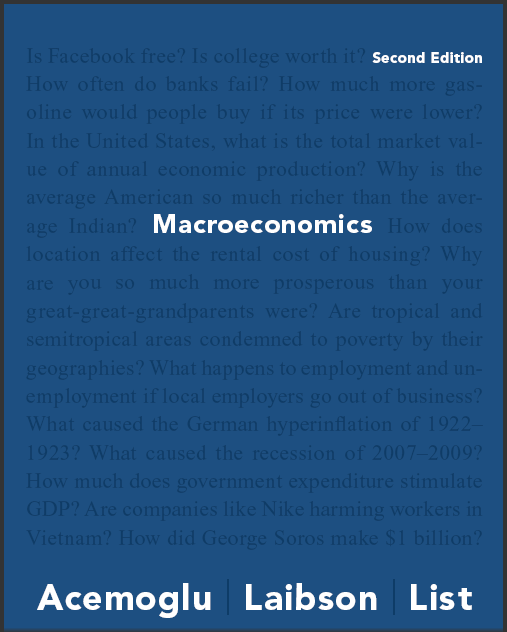
Product details:
ISBN 10: 0134492056
ISBN 13: 9780134492056
Author: Daron Acemoglu, David Laibson, John List
This is the eBook of the printed book and may not include any media, website access codes, or print supplements that may come packaged with the bound book. For courses in Principles of Macroeconomics. An evidence-based approach to economics Throughout Macroeconomics, 2nd Edition, authors Daron Acemoglu, David Laibson, and John List use real economic questions and data to help readers learn about the world around them. Taking a fresh approach, they use the themes of optimization, equilibrium, and empiricism to not only illustrate the power of simple economic ideas, but also to explain and predict what’s happening in today’s society. Each chapter begins with an empirical question that is relevant to the life of the reader, and is later answered using data in the Evidence-Based Economics feature. As a result of the text’s practical emphasis, readers will learn to apply economic principles to guide the decisions they make in their own lives. Also available with MyLab Economics MyLab™ Economics is an online homework, tutorial, and assessment program designed to work with this text to engage students and improve results. Within its structured environment, students practice what they learn, test their understanding, and pursue a personalized study plan that helps them better absorb course material and understand difficult concepts. Learn more. Note: You are purchasing a standalone product; MyLab Economics does not come packaged with this content. Students, if interested in purchasing this title with MyLab Economics, ask your instructor to confirm the correct package ISBN and Course ID. Instructors, contact your Pearson representative for more information. If you would like to purchase both the physical text and MyLab Economics, search for: 0134641477 / 9780134641478 Macroeconomics Plus MyLab Economics with Pearson eText — Access Card Package, 2/e Package consists of: 0134492056 / 9780134492056 Macroeconomics 013451906X / 9780134519067 MyLab Economics with Pearson eText — Access Card — for Macroeconomics
Macroeconomics 2nd Table of contents:
Part I: Introduction to Economics
1. The Principles and Practice of Economics
-
Chapter Outline
-
Key Ideas
1.1 The Scope of Economics
• Economic Agents and Economic Resources
• Definition of Economics
• Positive vs. Normative Economics
• Normative Analysis and Public Policy
• Microeconomics and Macroeconomics
1.2 Three Principles of Economics
1.3 The First Principle: Optimization
• Trade-offs and Budget Constraints
• Opportunity Cost
• Monetary Value of Opportunity Cost
• Cost-Benefit Analysis
1.4 The Second Principle: Equilibrium
• The Free-Rider Problem
1.5 The Third Principle: Empiricism
1.6 Is Economics Good for You? -
Summary
-
Key Terms
-
Questions
-
Problems
2. Economic Methods and Economic Questions
-
Chapter Outline
-
Key Ideas
2.1 The Scientific Method
• Models and Data
• Means and Medians
• Argument by Anecdote
2.2 Causation and Correlation
• The Red Ad Blues
• Experimental and Natural Experiments
2.3 Economic Questions and Answers -
Summary
-
Key Terms
-
Questions
-
Problems
Appendix: Constructing and Interpreting Charts and Graphs
-
A Study about Incentives
-
Experimental Design
-
Describing Variables
-
Pie Charts
-
Bar Charts
-
Time Series Graphs
-
Cause and Effect
-
Correlation ≠ Causality
-
Key Terms
-
Problems
3. Optimization: Doing the Best You Can
-
Chapter Outline
-
Key Ideas
3.1 Optimization: Choosing the Best Option
3.2 Application: Renting the Optimal Apartment
3.3 Optimization Using Marginal Analysis
• Marginal Cost -
Summary
-
Key Terms
-
Questions
-
Problems
4. Demand, Supply, and Equilibrium
-
Chapter Outline
-
Key Ideas
4.1 Markets
• Competitive Markets
4.2 Buyer Behavior
• Demand Curves, Willingness to Pay
• Aggregate Demand Curve
• Shifts in Demand
4.3 Seller Behavior
• Supply Curves, Willingness to Accept
• Aggregate Supply Curve
• Shifts in Supply
4.4 Market Equilibrium
4.5 Government Price Controls (Gasoline Example) -
Summary
-
Key Terms
-
Questions
-
Problems
Part II: Introduction to Macroeconomics
5. The Wealth of Nations: Measuring Macroeconomic Aggregates
-
Chapter Outline
-
Key Ideas
5.1 Macroeconomic Questions
5.2 National Income Accounts
• Production = Expenditure = Income
• Circular Flow
5.3 GDP Limitations
5.4 Real vs. Nominal
• GDP Deflator
• CPI
• Inflation Adjustment -
Summary
-
Key Terms
-
Questions
-
Problems
6. Aggregate Incomes
-
Chapter Outline
-
Key Ideas
6.1 Global Inequality
• GDP per Capita, Productivity, Living Standards
6.2 Aggregate Production Function
6.3 Role of Technology
• Dimensions, Entrepreneurship -
Summary
-
Key Terms
-
Questions
-
Problems
Appendix: Mathematics of Aggregate Production Functions
Part III: Long-Run Growth and Development
7. Economic Growth
-
Chapter Outline
-
Key Ideas
7.1 U.S. Growth and Patterns
7.2 How Economies Grow
• Saving vs. Consumption
• Knowledge & Technological Change
7.3 History of Growth
• Malthusian Limits, Industrial Revolution
7.4 Growth, Inequality, Poverty -
Summary
-
Key Terms
-
Questions
-
Problems
Appendix: The Solow Growth Model
-
Steady-State Equilibrium
-
GDP Determinants
-
Dynamic Equilibrium
-
Growth Sources
-
Compound Growth Rate Calculations
-
Key Terms
-
Problems
8. Why Isn’t the Whole World Developed?
-
Chapter Outline
-
Key Ideas
8.1 Proximate vs. Fundamental Causes
• Geography, Culture, Institutions
8.2 Institutions & Development
• Inclusive vs. Extractive
8.3 Foreign Aid & Poverty -
Summary
-
Key Terms
-
Questions
-
Problems
Part IV: Equilibrium in the Macroeconomy
9. Employment and Unemployment
-
Chapter Outline
-
Key Ideas
9.1 Labor Market Metrics
9.2 Labor Market Equilibrium
9.3 Types of Unemployment
• Frictional, Voluntary
9.4 Wage Rigidity
• Minimum Wage, Unions, Efficiency Wages
9.5 Cyclical and Natural Unemployment -
Summary
-
Key Terms
-
Questions
-
Problems
10. Credit Markets
-
Chapter Outline
-
Key Ideas
10.1 What Is the Credit Market?
• Credit Demand and Supply Curves
10.2 Banks and Intermediation
• Balance Sheets, Risks, Regulation -
Summary
-
Key Terms
-
Questions
-
Problems
11. The Monetary System
-
Chapter Outline
-
Key Ideas
11.1 Money: Functions and Types
11.2 Money, Prices, and GDP
• Quantity Theory
11.3 Inflation
11.4 The Federal Reserve
• Policy Tools, Regulation
11.5 Bank Reserves & Liquidity
• Federal Funds Market
• Inflation Control
• Long-Term Rates -
Summary
-
Key Terms
-
Questions
-
Problems
Part V: Short-Run Fluctuations and Policy
12. Short-Run Fluctuations
-
Chapter Outline
-
Key Ideas
12.1 Economic Cycles
12.2 Fluctuation Sources
• Technology, Sentiment, Monetary Factors
• Recovery Models
12.3 Modeling Expansions -
Summary
-
Key Terms
-
Questions
-
Problems
13. Countercyclical Macroeconomic Policy
-
Chapter Outline
-
Key Ideas
13.1 Policy Objectives
13.2 Monetary Policy
• Fed Tools, ZLB, Trade-offs
13.3 Fiscal Policy
• Automatic vs. Discretionary
• Expenditure, Tax, Labor Policies
• Lags & Waste -
Summary
-
Key Terms
-
Questions
-
Problems
Part VI: Macroeconomics in a Global Economy
14. Macroeconomics and International Trade
-
Chapter Outline
-
Key Ideas
14.1 Why & How We Trade
14.2 Current and Financial Accounts
14.3 Trade, Technology Transfer & Growth -
Summary
-
Key Terms
-
Questions
-
Problems
15. Open Economy Macroeconomics
-
Chapter Outline
-
Key Ideas
15.1 Exchange Rates
• Nominal, Real, Flexible, Fixed
15.2 Foreign Exchange Market
• Government Interventions
15.3 Real Exchange Rate and Exports
15.4 GDP in an Open Economy -
Summary
-
Key Terms
-
Questions
-
Problems
Endnotes
Glossary
Credits
Index
People also search for Macroeconomics 2nd :
principles of macroeconomics 2nd edition pdf
understanding macroeconomics 2nd edition
understanding macroeconomics 2nd edition pdf
mankiw macroeconomics 2nd edition
macroeconomics 2nd edition pdf
Tags: Daron Acemoglu, David Laibson, John List, Macroeconomics