


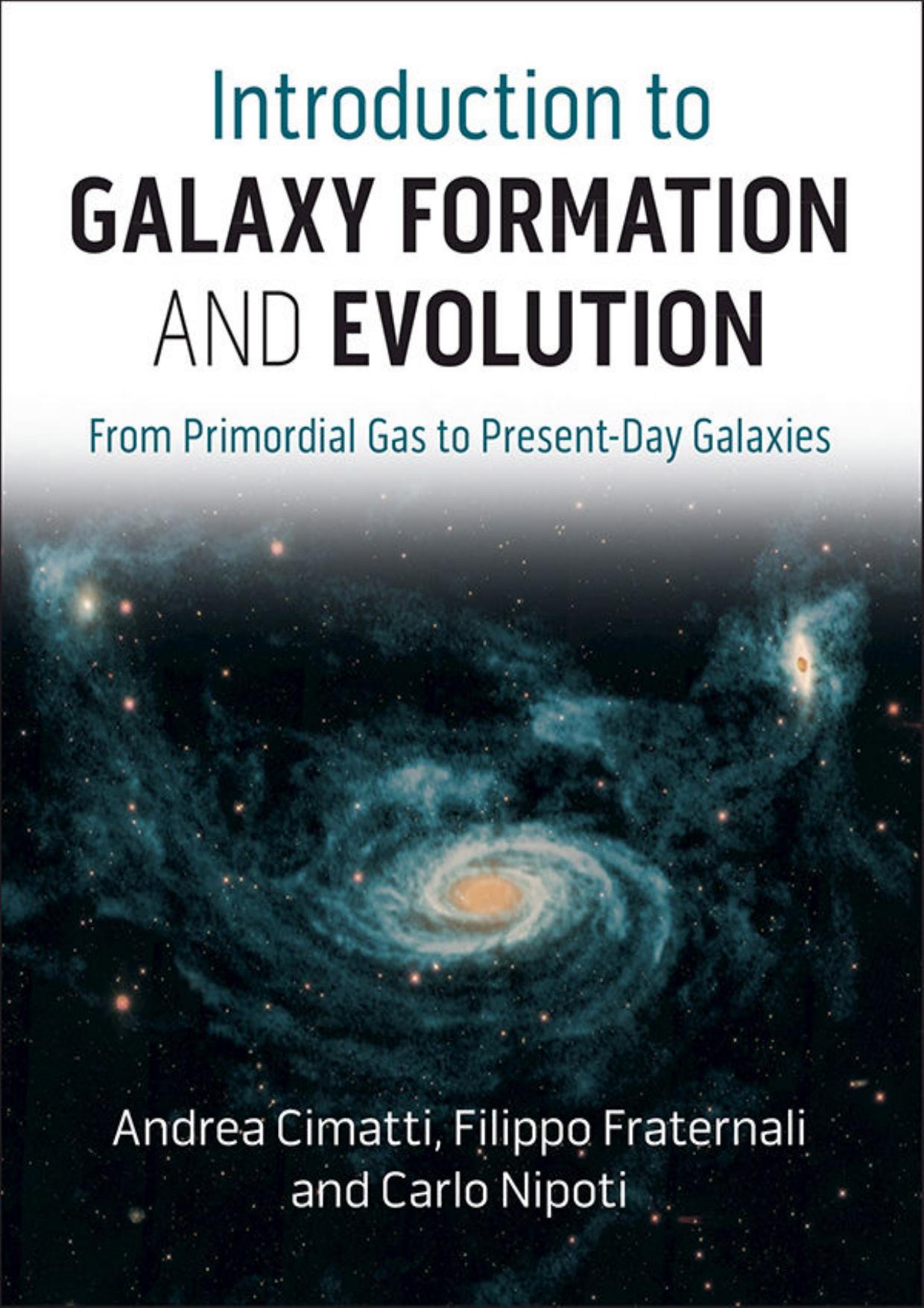
Introduction to Galaxy Formation and Evolution 1st edition by Andrea Cimatti, Filippo Fraternali, Carlo Nipoti ISBN 1107134765 978-1107134768
Original price was: $70.00.$35.00Current price is: $35.00.
Instant download Introduction to Galaxy Formation and Evolution Andrea Cimatti & Filippo Fraternali & Carlo Nipoti after payment
Introduction to Galaxy Formation and Evolution 1st edition by Andrea Cimatti, Filippo Fraternali, Carlo Nipoti – Ebook PDF Instant Download/Delivery: 1107134765 , 978-1107134768
Full download Introduction to Galaxy Formation and Evolution 1st edition after payment
Product details:
ISBN 10: 1107134765
ISBN 13: 978-1107134768
Author: Andrea Cimatti, Filippo Fraternali, Carlo Nipoti
Present-day elliptical, spiral and irregular galaxies are large systems made of stars, gas and dark matter. Their properties result from a variety of physical processes that have occurred during the nearly fourteen billion years since the Big Bang. This comprehensive textbook, which bridges the gap between introductory and specialized texts, explains the key physical processes of galaxy formation, from the cosmological recombination of primordial gas to the evolution of the different galaxies that we observe in the Universe today. In a logical sequence, the book introduces cosmology, illustrates the properties of galaxies in the present-day Universe, then explains the physical processes behind galaxy formation in the cosmological context, taking into account the most recent developments in this field. The text ends on how to find distant galaxies with multi-wavelength observations, and how to extract the physical and evolutionary properties based on imaging and spectroscopic data.
Introduction to Galaxy Formation and Evolution 1st Table of contents:
1 Introduction
1.1 Galaxies: a Very Brief History
1.2 Galaxies as Astrophysical Laboratories
1.3 Galaxies in the Cosmological Context
1.4 Galaxies: from First Light to Present-Day Galaxies
1.5 Galaxies: Near and Far, Now and Then
1.6 Galaxies: the Emerging Picture and the Road Ahead
2 The Cosmological Framework
2.1 The Expanding Universe
2.1.1 Comoving Observers and Scale Factor
2.1.2 Hubble Flow
2.1.3 Cosmological Redshift
2.1.4 Cosmological Distances
2.2 Dynamics of the Universe
2.2.1 Friedmann Equations
2.2.2 Components of the Universe
2.3 Standard Cosmological Model
2.3.1 Radiation, Matter and Dark Energy Eras
2.3.2 Big Bang, Cosmic Time and Look-Back Time
2.4 Cosmic Microwave Background, Recombination and Reionisation
2.5 Big Bang Nucleosynthesis
2.6 Thermal History of the Universe
3 Present-Day Galaxies as a Benchmark for Evolutionary Studies
3.1 Morphology
3.1.1 The Morphology of Galaxies Depends on Wavelength
3.1.2 Surface Brightness Profiles
3.1.3 The Sérsic Profile
3.1.4 Galaxy Sizes
3.2 Spectral Energy Distributions
3.3 Integrated Radiation from Galaxies
3.4 Galaxy Spectra
3.4.1 Colours and Bimodality
3.5 Statistical Distributions of Galaxy Properties
3.5.1 The Luminosity Function
3.5.2 The Stellar Mass Function
3.5.3 The Baryonic Mass Function
3.6 Active Galactic Nuclei
3.6.1 The Supermassive Black Hole Paradigm
3.6.2 The Structure of Active Galactic Nuclei
3.6.3 The Spectral Energy Distribution of Active Galactic Nuclei
4 Present-Day Star-Forming Galaxies
4.1 Stars
4.1.1 Stellar Discs
4.1.2 Bulges and Bars
4.1.3 Stellar Halos
4.1.4 Colours and Metallicity
4.1.5 Star Formation Rates and Histories
4.2 The Interstellar Medium of Star-Forming Galaxies
4.2.1 Neutral Atomic Gas
4.2.2 Turbulence of the ISM
4.2.3 Photoionised Gas
4.2.4 Collisionally Ionised Gas
4.2.5 Molecular Gas
4.2.6 Global Properties of the Neutral Gas in Star-Forming Galaxies
4.2.7 Interstellar Dust
4.2.8 Magnetic Field
4.2.9 Star Formation Laws
4.2.10 Gas Inflow and Outflow
4.3 Mass Distribution
4.3.1 Gravitational Potential
4.3.2 Spectroscopic Data
4.3.3 Rotation Curves
4.3.4 Mass Decomposition
4.3.5 Dark Matter
4.4 Scaling Relations
4.4.1 Tully–Fisher Relation
4.4.2 Specific Angular Momentum–Stellar Mass Relation
4.4.3 Mass–Metallicity Relation
4.4.4 Star Formation Main Sequence
4.4.5 Size–Mass Relations
4.5 Starburst Galaxies
4.6 The Milky Way
4.6.1 Stellar Components
4.6.2 The Galactic Interstellar Medium
4.6.3 The Galactic Centre
5 Present-Day Early-Type Galaxies
5.1 Stars
5.1.1 Spatial Distribution
5.1.2 Kinematics
5.1.3 Stellar Populations
5.2 Diffuse Matter
5.2.1 Hot Gas
5.2.2 Warm Gas, Cold Gas and Dust
5.3 Mass Distribution
5.3.1 The Virial Theorem Method
5.3.2 Dynamical Modelling
5.3.3 Measuring Mass with X-Ray-Emitting Gas
5.3.4 Measuring Mass with Gravitational Lensing
5.3.5 Baryonic, Dark and Total Mass Distributions
5.4 Structural and Kinematic Scaling Relations
5.4.1 The Fundamental Plane
5.4.2 The Kormendy and Faber–Jackson Relations
5.4.3 Scaling Relations Involving Stellar Mass
5.4.4 Scaling Relations Involving Black Hole Mass
6 The Environment of Present-Day Galaxies
6.1 Interacting Galaxies
6.2 Groups of Galaxies
6.3 The Local Group
6.3.1 Galaxies in the Local Group
6.3.2 Distribution and Masses of Dwarf Galaxies
6.3.3 Star Formation Histories and Chemical Pattern
6.4 Clusters of Galaxies
6.4.1 Galaxies in Clusters
6.4.2 The Intracluster Medium
6.4.3 Cool-Core and Non-Cool-Core Clusters
6.4.4 Cluster Mass and Scaling Relations
6.5 The Influence of the Environment on Galaxy Properties
6.5.1 The Morphology–Density Relation
6.6 Large-Scale Structure and Galaxy Clustering
6.7 Baryon Budget
7 Formation, Evolution and Properties of Dark Matter Halos
7.1 Observational Evidence for Dark Matter Halos
7.2 Dark Matter and Structure Formation
7.3 Evolution of a Density Perturbation
7.3.1 Linear Evolution of a Perturbation
7.3.2 Non-Linear Evolution of an Overdensity
7.4 Statistical Properties of Cosmological Perturbations and Dark Matter Halos
7.4.1 The Power Spectrum of Cosmological Perturbations
7.4.2 Evolution of the Linear Power Spectrum
7.4.3 Halo Mass Function
7.4.4 Hierarchical Merging of Cold Dark Matter Halos: Merger Trees and Merger Rates
7.5 Structural and Kinematic Properties of Dark Matter Halos
7.5.1 Cosmological Numerical Simulations
7.5.2 Density Profiles of Dark Matter Halos
7.5.3 Shape of Dark Matter Halos
7.5.4 Spin of Dark Matter Halos
7.5.5 Effect of Baryons on Dark Matter Halos
8 Main Ingredients of Galaxy Formation Theory
8.1 Thermal Properties of Astrophysical Gases
8.1.1 Radiative Cooling
8.1.2 Photoionisation and Cosmic-Ray Heating
8.1.3 Compton Heating and Cooling
8.1.4 Thermal Instability
8.2 Gas Accretion and Cooling in Dark Matter Halos
8.2.1 Virial Temperature
8.2.2 Shock Heating
8.2.3 Cooling of Virial-Temperature Gas
8.2.4 Hot and Cold Accretion Modes
8.3 Star Formation
8.3.1 Molecule Formation
8.3.2 Jeans Criterion for Gravitational Instability
8.3.3 Formation of Giant Molecular Clouds
8.3.4 Equilibrium of an Isothermal Sphere
8.3.5 Virial Theorem with Magnetic Field
8.3.6 The Role of Magnetic Fields
8.3.7 The Role of Gas Turbulence
8.3.8 Gravitational Collapse
8.3.9 The Initial Mass Function
8.4 Gas Consumption and Evolution of the Interstellar Medium
8.4.1 Gas Return to the ISM from Stellar Evolution
8.4.2 Structural Evolution of a Galaxy Disc
8.5 Chemical Evolution
8.5.1 Stellar Yields
8.5.2 Chemical Evolution Models
8.5.3 Instantaneous Recycling Approximation
8.5.4 Closed-Box Model
8.6 Theoretical Spectra of Evolving Galaxies
8.6.1 Simulating Galaxy Stellar Spectra
8.6.2 Simulating Galaxy Spectra Including the Interstellar Medium
8.7 Feedback from Stars
8.7.1 Evolution of a Supernova Remnant
8.7.2 Stellar Wind Bubbles
8.7.3 Superbubbles and Galactic Winds
8.7.4 Global Models of Galactic Winds
8.8 Feedback from Active Galactic Nuclei
8.8.1 Quasar Mode Feedback
8.8.2 Radio Mode Feedback
8.9 Merging of Galaxies
8.9.1 The Physics of Galaxy Merging
8.9.2 Collisionless Relaxation
8.9.3 Dynamical Friction
8.9.4 Tidal and Ram-Pressure Stripping
8.9.5 Orbital Parameters and Merging Timescale
8.9.6 Properties of the Merger Remnants
8.9.7 Supermassive Black Holes in Merging Galaxies
9 From Recombination to Reionisation
9.1 The Cosmological Recombination
9.1.1 Hydrogen Recombination with Equilibrium Theory
9.1.2 Advanced Modelling of Hydrogen Recombination
9.1.3 Helium and Lithium Recombination
9.2 The Pregalactic Gas in the Dark Ages
9.3 The Collapse of the Pregalactic Gas
9.4 The Cooling of Primordial Gas
9.4.1 The Formation of Primordial Molecules
9.4.2 The Cooling Function of Primordial Molecules
9.5 Population III Stars
9.5.1 The Collapse and Formation of the First Luminous Objects
9.5.2 The Properties and Fate of Population III Stars
9.5.3 Feedback Processes Caused by Population III Stars
9.5.4 The Initial Mass Function of Population III Stars
9.6 From First Stars to First Galaxies
9.7 The Formation of the First Massive Black Holes
9.8 The Intergalactic Medium
9.8.1 The Lyman-α Forest
9.8.2 Physics of the Lyman-α Forest
9.8.3 Lyman Limit and Damped Lyman-α Systems
9.8.4 Metals in the IGM
9.9 The Cosmological Reionisation
9.9.1 Evidence for Reionisation
9.9.2 The Reionisation of Helium
9.9.3 Model Predictions for Reionisation
9.10 Observing the Primeval Universe
9.10.1 Cosmological Recombination
9.10.2 The 21cm Signal from Atomic Hydrogen
9.10.3 Intensity Mapping
9.10.4 Primordial Molecules in the Pregalactic Era
9.10.5 First Stars and First Galaxies
10 Theory of Galaxy Formation
10.1 Formation of Galaxy Components: Discs
10.1.1 The Size of Galaxy Discs
10.1.2 Dissipative Collapse and Global Angular Momentum Problem
10.1.3 The Angular Momentum Distribution
10.1.4 Evolution of the Angular Momentum Distribution
10.1.5 Formation of Exponential Discs
10.1.6 The Development of Spiral Arms
10.1.7 The Vertical Structure: Thin and Thick Discs
10.2 Formation of Galaxy Components: Bars and Pseudobulges
10.2.1 Bar Instability
10.2.2 Buckling Instability and Pseudobulge Formation
10.3 Formation of Galaxy Components: Spheroids
10.3.1 Collapse
10.3.2 Merging
10.3.3 Build-up of Spheroids in a Cosmological Framework
10.4 Formation of Galaxy Components: Stellar Halos
10.5 Characteristic Scales in Galaxy Formation
10.6 Quenching of Star Formation
10.6.1 Mass Quenching
10.6.2 Environmental Quenching
10.6.3 Quenching by Negative Feedback
10.6.4 Maintaining the Gas Hot
10.7 Assembly History of Present-Day Star-Forming Galaxies
10.7.1 Lack of Late Major Mergers
10.7.2 Gas Accretion
10.7.3 Stellar Feedback
10.7.4 Inside-Out Growth
10.7.5 Chemical Evolution of Galaxy Discs
10.8 Assembly History of Present-Day Early-Type Galaxies
10.8.1 Slow Rotators
10.8.2 Fast Rotators
10.9 Formation of Dwarf Galaxies
10.9.1 Origin of the Different Types of Dwarfs
10.9.2 Dark Matter on the Scale of Dwarfs
10.10 Origin of the Demographics of Present-Day Galaxies
10.10.1 Stellar Mass Function and Stellar-to-Halo Mass Relation
10.10.2 Bimodality
10.10.3 Scaling Relations
10.11 Numerical Models of Galaxy Formation
10.11.1 Hydrodynamic Simulations
10.11.2 Semi-analytic Models
11 Observing Galaxy Evolution
11.1 The Main Observables of Galaxy Evolution
11.1.1 Redshifts
11.1.2 Star Formation Rate
11.1.3 Stellar Populations, Stellar Mass and Star Formation History
11.1.4 Interstellar Gas
11.1.5 Interstellar Dust
11.1.6 Morphology and Structure
11.1.7 Kinematics and Dynamical Masses of Distant Galaxies
11.1.8 Statistical Distributions
11.1.9 Galaxy Environment and Clustering
11.2 The Difficult Observation of Distant Galaxies
11.2.1 Surveys for Distant Galaxies
11.2.2 Main Biases in Galaxy Surveys
11.2.3 The K Correction
11.2.4 Searching for Distant Galaxies
11.2.5 Selection in the Optical (Rest-Frame Ultraviolet)
11.2.6 Selection in the Near-Infrared (Rest-Frame Optical)
11.2.7 Selection with Narrow-Band Imaging
11.2.8 Selection with Integral Field or Slitless Spectroscopy
11.2.9 Selection in the Infrared–Millimetre
11.2.10 Selection in the Radio
11.2.11 Selection of Galaxies and Active Galactic Nuclei in the X-Rays
11.2.12 Selection of Active Galactic Nuclei at Other Wavelengths
11.2.13 Selection of Distant Galaxy Clusters
11.2.14 The Last Frontier: Galaxies at Very High Redshifts
11.2.15 Lessons Learned
11.3 The Observation of Galaxy Evolution
11.3.1 The Evolution of Galaxy Morphologies and Sizes
11.3.2 The Evolution of Galaxy Mergers
11.3.3 The Evolution of the Star Formation Rate
11.3.4 The Cosmic Star Formation Rate Density
11.3.5 The Evolution of the Star Formation Main Sequence
11.3.6 The Evolution of Specific Star Formation Rate
11.3.7 The Evolution of Galaxy Stellar Mass
11.3.8 The Influence of the Environment on Galaxy Evolution
11.3.9 The Cosmic Stellar Mass Density
11.3.10 Linking Archaeological and Look-Back Results
11.3.11 The Evolution of the Interstellar Medium
11.3.12 The Evolution of Metallicity of Gas and Stars
11.3.13 The Evolution of Scaling Relations Involving Kinematics
11.3.14 The Evolution of Massive Black Hole Accretion
11.3.15 The Cosmic Multi-Wavelength Background
11.4 Summary
Appendix A Acronyms
Appendix B Constants and Units
Appendix C Astronomical Compendium
Appendix D Physics Compendium
References
Index
People also search for Introduction to Galaxy Formation and Evolution 1st :
introduction to galaxy formation and evolution cimatti pdf
introduction to galaxy formation and evolution cimatti
how did the galaxy begin
how did the galaxy start
galaxy formation lecture
Tags: Andrea Cimatti, Filippo Fraternali, Carlo Nipoti, Galaxy Formation