


Introduction to General Relativity Black Holes and Cosmology 1st edition by Yvonne Choquet Bruhat – Ebook PDF Instant Download/Delivery: 0199666466, 978-0199666461
Full download Introduction to General Relativity Black Holes and Cosmology 1st edition after payment
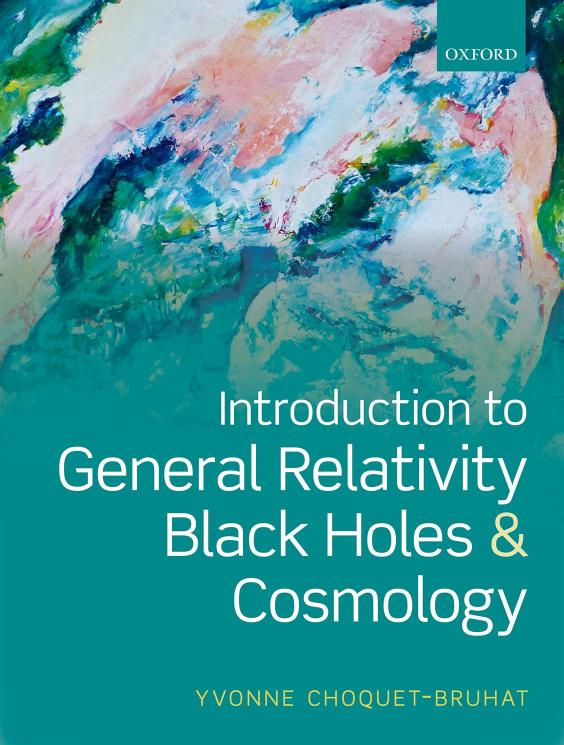
Product details:
ISBN 10: 0199666466
ISBN 13: 978-0199666461
Author: Yvonne Choquet Bruhat
This is an open access title. It is made available under a Creative Commons Attribution-Non Commercial-No Derivatives 4.0 International licence. It is available to read and download as a PDF version on the Oxford Academic platform.
General Relativity is a beautiful geometric theory, simple in its mathematical formulation but leading to numerous consequences with striking physical interpretations: gravitational waves, black holes, cosmological models, and so on.
This introductory textbook is written for mathematics students interested in physics and physics students interested in exact mathematical formulations (or for anyone with a scientific mind who is curious to know more of the world we live in), recent remarkable experimental and observational results which confirm the theory are clearly described and no specialised physics knowledge is required. The mathematical level of Part A is aimed at undergraduate students and could be the basis for a course on General Relativity. Part B is more advanced, but still does not require sophisticated mathematics.
Based on Yvonne Choquet-Bruhat’s more advanced text, General Relativity and the Einstein Equations, the aim of this book is to give with precision, but as simply as possible, the foundations and main consequences of General Relativity. The first five chapters from General Relativity and the Einstein Equations have been updated with new sections and chapters on black holes, gravitational waves, singularities, and the Reissner-Nordstrom and interior Schwarzchild solutions.
The rigour behind this book will provide readers with the perfect preparation to follow the great mathematical progress in the actual development, as well as the ability to model, the latest astrophysical and cosmological observations. The book presents basic General Relativity and provides a basis for understanding and using the fundamental theory.
Introduction to General Relativity Black Holes and Cosmology 1st Table of contents:
Part A: Fundamentals
I. Riemannian and Lorentzian geometry
I.1 Introduction
I.2 Differentiable manifolds and mappings
I.2.1 Differentiable manifolds
I.2.2 Differentiable mappings
I.2.3 Submanifolds
I.2.4 Tangent and cotangent spaces
I.2.5 Vector fields and 1-forms
I.2.6 Moving frames
I.3 Tensors and tensor fields
I.3.1 Tensors, products and contraction
I.3.2 Tensor fields. Pullback and Lie derivative
I.3.3 Exterior forms
I.4 Structure coefficients of moving frames
I.5 Pseudo-Riemannian metrics
I.5.1 General properties
I.5.2 Riemannian metrics
I.5.3 Lorentzian metrics
I.6 Causality
I.6.1 Causal and null cones
I.6.2 Future and past
I.6.3 Spacelike submanifolds
I.6.4 Length and geodesics
I.7 Connections
I.7.1 Linear connection
I.7.2 Riemannian connection
I.8 Geodesics, another definition
I.8.1 Pseudo-Riemannian manifolds
I.8.2 Riemannian manifolds
I.8.3 Lorentzian manifolds
I.9 Curvature
I.9.1 Definitions
I.9.2 Symmetries and antisymmetries
I.9.3 Differential Bianchi identity and contractions
I.10 Geodesic deviation
I.11 Linearized Ricci tensor
I.11.1 Linearized Bianchi identities
I.12 Physical comment
I.13 Solutions of selected exercises
Exercise I.3.2 Image of a vector field
Exercise I.3.4 Components of Lie derivatives
Exercise I.3.5 Lie derivative of exterior forms
Exercise I.5.1 Kronecker symbol and contravariant components of g
Exercise I.7.1 Connection frame-change formula
Exercise I.7.3 Killing equations
I.14 Problems
I.14.1 Liouville theorem
Solution
I.14.2 Codifferential δ and Laplacian of an exterior form
Solution
I.14.3 Geodesic normal coordinates
I.14.4 Cases d = 1, 2, and 3
I.14.5 Wave equation satisfied by the Riemann tensor
Solution
I.14.6 The Bel–Robinson tensor
Solution
I.14.7 The Weyl tensor
I.14.8 The Cotton–York tensor
I.14.9 Linearization of the Riemann tensor
Solution
I.14.10 Second derivative of the Ricci tensor
Solution
II. Special relativity
II.1 Introduction
II.2 Newtonian mechanics
II.2.1 The Galileo–Newton Spacetime
II.2.2 Newtonian dynamics. Galileo group
II.2.3 Physical comment
II.2.4 The Maxwell equations in Galileo–Newton spacetime
II.3 The Lorentz and Poincaré groups
II.4 Lorentz contraction and dilation
II.5 Electromagnetic field and Maxwell equations in Minkowski spacetime M4
II.6 Maxwell equations in arbitrary dimensions
II.7 Special Relativity
II.7.1 Proper time
II.7.2 Proper frame and relative velocities
Addition of velocities
II.8 Some physical comments
II.9 Dynamics of a pointlike mass
II.9.1 Newtonian law
II.9.2 Relativistic law
II.9.3 Newtonian approximation of the relativistic equation
II.9.4 Equivalence of mass and energy
II.9.5 Particles with zero rest mass
II.10 Continuous matter
II.10.1 Case of dust (incoherent matter), massive particles
II.10.2 Perfect fluids
II.10.3 Yang–Mills fields
II.11 Problems
II.11.1 Lorentz transformation of the Maxwell equations
II.11.2 The relativistic Doppler–Fizeau effect
III. General Relativity
III.1 Introduction
III.2 Principle of general covariance
III.3 The Galileo–Newton equivalence principle
III.4 General Relativity
III.4.1 Einstein equivalence principles
III.4.2 Conclusion
III.5 Constants and units of measurement
III.6 Classical fields in General Relativity
III.6.1 Perfect fluid
III.6.2 Electromagnetic field
III.6.3 Charged fluid
III.7 Gravitation and curvature
III.8 Observations and experiments
III.8.1 The Einstein equivalence principle
III.8.2 Deviation of light rays
III.8.3 Proper time, gravitational time delay
III.8.4 Conclusion
III.9 Problems
III.9.1 Newtonian gravitation theory in absolute space and time En×R
III.9.2 Mass in length units (case n=3)
Solution
III.9.3 Planck units
Solution
IV. The Einstein equations
IV.1 Introduction
IV.2 The Einstein equations
IV.2.1 The Einstein equations in vacuum
IV.2.2 Equations with sources
IV.2.3 Matter sources
IV.2.4 Field sources
IV.3 The cosmological constant
IV.4 General Einsteinian spacetimes
IV.4.1 Regularity
IV.4.2 Boundary conditions
IV.4.3 Physical comment
IV.5 Newtonian approximation
IV.5.1 Determination of GE
IV.5.2 Equations of motion
IV.5.3 Post–Newtonian approximation
IV.6 Minkowskian approximation
IV.6.1 Linearized equations at η
IV.6.2 Plane gravitational waves
IV.6.3 Further results on gravitational waves
IV.6.4 Tidal force
IV.6.5 Gravitational radiation
IV.7 Strong high-frequency waves
IV.7.1 Introduction
IV.7.2 Phase and polarization
IV.7.3 Propagation and backreaction
IV.7.4 Observable displacements
IV.8 Stationary spacetimes
IV.8.1 Definition
IV.8.2 Equations
IV.8.3 Non-existence of gravitational solitons
IV.8.4 Gauss’s law
IV.9 Lagrangians
IV.9.1 Einstein–Hilbert Lagrangian in vacuo
IV.9.2 Lagrangians for Einstein equations with sources
General theorem
Matter and field sources
IV.10 Observations and experiments
IV.11 Problems
IV.11.1 The Einstein cylinder
Solution
IV.11.2 de Sitter spacetime
IV.11.3 Anti-de Sitter spacetime
Solution
IV.11.4 Taub–NUT spacetime
IV.11.5 The quadrupole formula
IV.11.6 Gravitational waves
IV.11.7 Landau–Lifshitz pseudotensor
IV.11.8 High-frequency waves from a spherically symmetric star
Solution
IV.11.9 Static solutions with compact spacelike sections
Solution
IV.11.10 Mass of an asymptotically Euclidean spacetime
Solution
IV.11.11 Taub Lagrangian
V. The Schwarzschild spacetime
V.1 Introduction
V.2 Spherically symmetric spacetimes
V.3 Schwarzschild metric
V.4 Other coordinates
V.4.1 Isotropic coordinates
V.4.2 Wave (also called harmonic) coordinates
V.4.3 Painlevé–Gullstrand-like coordinates
V.4.4 Regge–Wheeler coordinates
V.5 Schwarzschild spacetime and event horizon
V.6 The motion of the planets and perihelion precession
V.6.1 Equations
V.6.2 Results of observations
V.6.3 Escape velocity
V.7 Stability of circular orbits
V.8 Deflection of light rays
V.8.1 Theoretical prediction
V.8.2 Fermat’s principle and light travel parameter time
V.8.3 Results of observation
V.9 Redshift and time dilation
V.9.1 Redshift
V.9.2 Time dilation
V.10 Spherically symmetric interior solutions
V.10.1 Static solutions. Upper limit on mass
V.10.2 Matching with an exterior solution
V.10.3 Non-static interior solutions
V.11 Spherically symmetric gravitational collapse
V.11.1 Tolman, Gu, Hu, and Claudel–Newman metrics
V.11.2 Monotonically decreasing density
Collapse of dust shells
Matching with an exterior metric
V.12 Problems
V.12.1 Relativistic and Newtonian gravitational masses
Solution
V.12.2 The Reissner–Nordström solution
V.12.3 Schwarzschild spacetime in dimension n + 1
V.12.4 Schwarzschild metric in isotropic coordinates, n=3
Solution
V.12.5 Wave coordinates for the Schwarzschild metric in dimension n + 1
Solution
VI. Black holes
VI.1 Introduction
VI.2 The Schwarzschild black hole
VI.3 Eddington–Finkelstein extensions
VI.3.1 Eddington–Finkelstein white hole
VI.3.2 Kruskal spacetime
VI.4 Stationary black holes
VI.4.1 Axisymmetric and stationary spacetimes
VI.5 The Kerr spacetime and black hole
VI.5.1 Boyer–Lindquist coordinates
VI.5.2 The Kerr–Schild spacetime
VI.5.3 Essential singularity
VI.5.4 Horizons
The case |a|>m
The case |a|<m
VI.5.5 Limit of stationarity. The ergosphere
VI.5.6 Extended Kerr spacetime
VI.5.7 Absence of realistic interior solutions or models of collapse
VI.6 Uniqueness theorems for stationary black holes
VI.6.1 The Israel uniqueness theorem
VI.6.2 Uniqueness of the Kerr black hole
VI.6.3 Stability of the Kerr black hole
VI.7 General black holes
VI.7.1 Definitions
VI.7.2 Weak cosmic censorship conjecture
VI.7.3 Thermodynamics of black holes
VI.8 Conclusions
VI.8.1 Observations
VI.8.2 The interiors of black holes
VI.9 Solution of Exercise VI.3.1
VI.10 Problems
VI.10.1 Lemaître coordinates
Solution
VI.10.2Reissner–Nordström black hole
Solution
VI.10.3 Kerr–Newman metric
VI.10.4 Irreducible mass (Christodoulou–Ruffini)
Solution
VI.10.5 The Riemannian Penrose inequality
Solution
VII. Introduction to cosmology
VII.1 Introduction
VII.2 The first cosmological models
VII.2.1 Einstein static universe
VII.2.2 de Sitter spacetime
VII.2.3 General models
VII.3 Cosmological principle
VII.3.1 Assumptions
VII.3.2 Observational support
VII.4 Robertson–Walker spacetimes
VII.4.1 Robertson–Walker universes, metric at given t
VII.4.2 Robertson–Walker cosmologies
VII.5 General properties of Robertson–Walker spacetimes
VII.5.1 Cosmological redshift
VII.5.2 The Hubble law
VII.5.3 Deceleration parameter
7.5.4 Age and future of the universe
VII.6 Friedmann–Lemaître universes
VII.6.1 Equations
VII.6.2 Density parameter
VII.6.3 Einstein–de Sitter universe
VII.6.4 General models with p=0
VII.6.5 ΛCDM cosmological model
VII.7 Primordial cosmology
VII.8 Solution of Exercises VII.6.1 and VII.6.2
Solution
VII.9 Problems
VII.9.1 Isotropic and homogeneous Riemannian manifolds
Solution
VII.9.2 Age of the universe
Solution
VII.9.3 Classical Friedmann–Lemaître universes
Solution
VII.9.4 Milne universe
Solution
Part B: Advanced topics
VIII. General Einsteinian spacetimes. The Cauchy problem
VIII.1 Introduction
VIII.2 Wave coordinates
VIII.2.1 Generalized wave coordinates
VIII.2.2 Damped wave coordinates
VIII.3 Evolution in wave gauge
VIII.3.1 Solution of the reduced equations in vacuum
VIII.3.2 Equations with sources
VIII.4 Preservation of the wave gauges
VIII.4.1 Wave gauge constraints
VIII.5 Local existence and uniqueness
VIII.6 Solution of the wave gauge constraints
VIII.6.1 Asymptotically Euclidean manifolds
VIII.6.2 Compact manifolds
VIII.7 Geometric n + 1 splitting
VIII.7.1 Adapted frame and coframe
VIII.7.2 Dynamical system with constraints for gˉ and K
Constraints
Evolution
Preservation of constraints
VIII.7.3 Geometric Cauchy problem. Regularity assumptions
VIII.8 Solution of the constraints by the conformal method
VIII.8.1 Conformally formulated (CF) constraints
VIII.8.2 Elliptic system
VIII.8.3 Physical comment
VIII.9 Motion of a system of compact bodies
VIII.9.1 Effective one-body (EOB) method
VIII.9.2 Numerical Relativity
VIII.10 Global properties
VIII.10.1 Global hyperbolicity and global uniqueness
VIII.10.2 Global existence
VIII.11 Singularities and cosmic censorship conjectures
VIII.11.1 Strong cosmic censorship conjecture
VIII.11.2 Weak cosmic censorship conjecture
VIII.12 Problems
VIII.12.1 Symmetric hyperbolic systems
Solution
VIII.12.2 The wave equation as a symmetric hyperbolic system
Solution
VIII.12.3 The evolution set of Maxwell equations as a first-order symmetric hyperbolic system
VIII.12.4 Conformal transformation of the CF constraints
VIII.12.5 Einstein equations in dimension 2 + 1
Solution
VIII.12.6 Electrovac Einsteinian spacetimes, constraints
Solution
VIII.12.7 Electrovac Einsteinian spacetimes, Lorenz gauge
Solution
VIII.12.8 Wave equation for F
Solution
VIII.12.9 Wave equation for the Riemann tensor
Solution
VIII.12.10 First-order symmetric hyperbolic system for the Riemann tensor, Bel–Robinson energy
Solution
VIII.12.11 Schwarzschild trapped surface
IX. Relativistic fluids
IX.1 Introduction
IX.2 Case of dust
IX.3 Charged dust
IX.4 Perfect fluid
IX.4.1 Stress–energy tensor
IX.4.2 Euler equations
IX.5 Thermodynamics
IX.5.1 Conservation of rest mass
IX.5.2 Definitions. Conservation of entropy
IX.5.3 Equations of state (n=3)
Barotropic fluids
Polytropic fluids
IX.6 Wave fronts and propagation speeds
IX.6.1 Characteristic determinant
IX.6.2 Wave front propagation speed
IX.6.3 Case of perfect fluids
IX.7 Cauchy problem for the Euler and entropy system
IX.7.1 The Euler and entropy equations as a Leray hyperbolic system
IX.7.2 First-order symmetric hyperbolic systems
IX.8 Coupled Einstein–Euler–entropy system
IX.8.1 Initial data
IX.8.2 Evolution
IX.9 Dynamical velocity
IX.9.1 Fluid index and Euler equations
IX.9.2 Vorticity tensor and Helmholtz equations
IX.9.3 {General perfect fluid enthalpy }h
IX.10 Irrotational flows
IX.10.1 Definition and properties
IX.10.2 Coupling with the Einstein equations
IX.11 Equations in a flow–adapted frame
IX.12 Shocks
IX.13 Charged fluids
IX.13.1 Equations
IX.13.2 Fluids with zero conductivity
IX.13.3 Fluids with finite conductivity
IX.14 Magnetohydrodynamics
IX.14.1 Equations
IX.14.2 Wave fronts
IX.15 Yang–Mills fluids (quark–gluon plasmas)
IX.16 Viscous fluids
IX.16.1 Generalized Navier–Stokes equations
IX.16.2 A Leray–Ohya hyperbolic system for viscous fluids
IX.17 The heat equation
IX.18 Conclusion
IX.19 Solution of Exercise IX.6.2
IX.20 Problems
IX.20.1 Specific volume
IX.20.2 Motion of isolated bodies
Solution
IX.20.3 Euler equations for the dynamic velocity
Solution
IX.20.4 Hyperbolic Leray system for the dynamical velocity
Solution
IX.20.5 Geodesics of conformal metric
Solution
IX.20.6 Cosmological equation of state p=(γ−1)μ
Solution
X. Relativistic kinetic theory
X.1 Introduction
X.2 Distribution function
X.2.1 Definition
X.2.2 Interpretation
X.2.3 Moments of the distribution function
Moment of order zero
First and second moments
Higher moments
X.2.4 Particles of a given rest mass
X.3 Vlasov equations
X.3.1 General relativistic (GR)–Vlasov equation
X.3.2 EM–GR–Vlasov equation
X.3.3 Yang–Mills plasmas
X.4 Solution of a Vlasov equation
X.4.1 Construction
X.4.2 Global existence theorem
X.4.3 Stress–energy tensor
X.5 The Einstein–Vlasov system
X.5.1 Equations
X.5.2 Conservation law
X.6 The Cauchy problem
X.6.1 Cauchy data and constraints
X.6.2 Evolution
X.6.3 Local existence and uniqueness theorem
X.6.4 Global theorems
X.7 The Maxwell–Einstein–Vlasov system
X.7.1 Particles with given rest mass and charge
X.7.2 Particles with random masses and charges
X.8 Boltzmann equation. Definitions
X.9 Moments and conservation laws
X.10 Einstein–Boltzmann system
X.11 Thermodynamics
X.11.1 Entropy and the H theorem
X.11.2 Maxwell–Jüttner equilibrium distribution
X.11.3 Dissipative fluids
X.12 Extended thermodynamics
X.13 Solutions of selected exercises
Exercise X.3.1
Exercise X.3.2
Exercise X.3.3
Exercise X.6.1
X.14 Problems
X.14.1 Liouville’s theorem and generalization
Solution
X.14.2 Vlasov equation for particles with random charges
X.14.3 Distribution function on a Robertson–Walker spacetime with Vlasov source
People also search for Introduction to General Relativity Black Holes and Cosmology 1st :
introduction to general relativity black holes and cosmology pdf
exploring black holes introduction to general relativity
exploring black holes introduction to general relativity pdf
exploring black holes introduction to general relativity taylor wheeler
hawking black hole theory
Tags: Yvonne Choquet Bruhat, General Relativity, Black Holes