


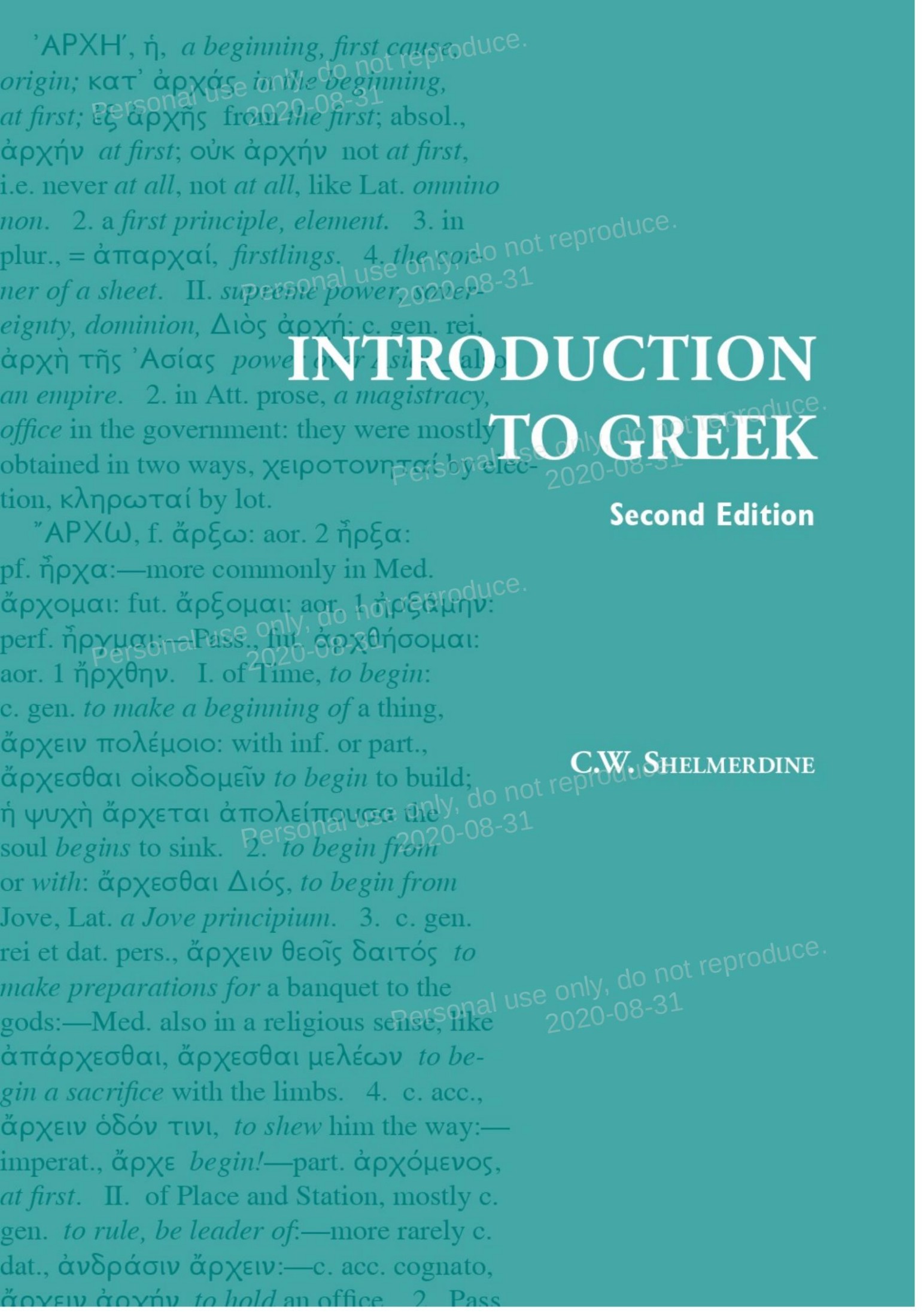
Introduction to Greek 2nd edition By Cynthia Shelmerdine – Ebook PDF Instant Download/Delivery: 1585101842 , 978-1585101849
Full download Introduction to Greek 2nd edition after payment
Product details:
ISBN 10: 1585101842
ISBN 13: 978-1585101849
Author: Cynthia Shelmerdine
Introduction to Greek, Second Edition is an introductory text to Classical Greek. It is designed for the first full year course and it concentrates on the basics in a way that allows the material to be covered easily in courses that meet three times a week over the course of two semesters. The focus of the text is on grammar with slightly altered readings drawn chiefly from the works of Xenophon and Herodotus.
Introduction to Greek 2nd Table of contents:
CHAPTER 1
1. The Greek alphabet
2. Consonant groups
3. Vowel groups (diphthongs)
4. Accents
5. Breathings
6. Punctuation and capital letters
CHAPTER 2
1. Verb formation: principal parts
2. The present active indicative of thematic verbs (1st principal part)
3. Verb accents
4. The negative οὐ
5. Common conjunctions
Chapter 2 Vocabulary
CHAPTER 3
1. Noun formation
2. The definite article
3. Feminine nouns of the 1st declension
4. Noun and adjective accents
5. Accents of 1st declension nouns
6. Prepositions
7. The future active indicative of thematic verbs (2nd principal part)
Chapter 3 Vocabulary
CHAPTER 4
1. The paradigm of the definite article
2. Masculine nouns of the 1st declension
3. The imperfect active indicative of thematic verbs (1st principal part)
4. Some uses of the definite article
5. Verbs taking genitive or dative
Chapter 4 Vocabulary
CHAPTER 5
1. Masculine and feminine nouns of the 2nd declension
2. The aorist active indicative of thematic verbs (3rd principal part)
3. Aspect in the indicative
4. Word order
5. The possessive genitive
Chapter 5 Vocabulary
CHAPTER 6
1. Neuter nouns of the 2nd declension
2. Some uses of the dative
3. The present active infinitive of thematic verbs
4. The complementary infinitive
5. Reading expectations
6. The negatives οὐ and μή
Chapter 6 Vocabulary
CHAPTER 7
1. 1st and 2nd declension adjectives
2. Attributive adjectives
3. Predicate adjectives and nouns
4. Enclitics
5. The present indicative and infinitive of εἰμί, ‘be’
6. The dative of possession
Chapter 7 Vocabulary
CHAPTER 8
1. 3rd declension nouns
2. 3rd declension nouns: stems in -κ, -τ
3. The present active imperative, 2nd person, of thematic verbs and εἰμί
4. Connection
5. μέν and δέ
Underground Dwellings
Chapter 8 Vocabulary
CHAPTER 9
1. 3rd declension nouns: stems in -τ, -δ, -θ
2. αὐτός, intensive use
3. αὐτός as personal pronoun
4. αὐτός, attributive use
5. Elision
6. οἷός τέ εἰμι
Cyrus Is Helped by Camels
Chapter 9 Vocabulary
CHAPTER 10
1. 3rd declension nouns: stems in -ντ, -κτ
2. The future and imperfect indicative of εἰμί, ‘be’
3. The relative pronoun
The Battle of Thermopylae
Chapter 10 Vocabulary
CHAPTER 11
1. 3rd declension nouns: stems in -ρ
2. Syllabic and temporal augments
3. Augments of compound verbs
4. Principal parts of palatal stem thematic verbs
5. The strong aorist active indicative of thematic verbs (3rd principal part)
Xerxes Whips the Sea
Chapter 11 Vocabulary
CHAPTER 12
1. 3rd declension nouns: stems in -ν
2. More uses of the article
3. Compounds of εἰμί, ‘be’
4. Conditions
5. Simple conditions
6. Contrary-to-fact conditions
Admetus and Alcestis
Chapter 12 Vocabulary
CHAPTER 13
1. 3rd declension nouns: stems in -σ
2. Principal parts of dental stem thematic verbs
3. The future and aorist active infinitives of thematic verbs
4. Infinitive aspect
5. The infinitive as a verbal noun; the articular infinitive
The Wooden Wall
Chapter 13 Vocabulary
CHAPTER 14
1. 3rd declension nouns: stems in -ι, -υ
2. Principal parts of labial stem verbs
3. νομίζω and φημί
4. Indirect statement
5. The infinitive in indirect statement
The Ten Thousand Reach the Sea
Chapter 14 Vocabulary
CHAPTER 15
1. 3rd declension nouns: stems in diphthongs
2. The present and imperfect passive indicative of thematic verbs (1st principal part)
3. The genitive of personal agent
4. Irregular 3rd declension nouns
5. The aorist passive indicative of thematic verbs (6th principal part)
6. The future passive indicative of thematic verbs (6th principal part)
The Cunning of Artemisia
Chapter 15 Vocabulary
Review of Principal Parts
CHAPTER 16
1. μέγας, πολύς and adjectives of the τάλας type
2. Regular comparison of adjectives
3. Comparison with ἤ and the genitive of comparison
4. Some uses of the genitive
5. Some uses of the dative
How The Egyptians Avoided Gnats
Chapter 16 Vocabulary
CHAPTER 17
1. The middle voice: meaning
2. The middle voice: formation
3. Review of middle future forms
4. Some uses of the accusative
5. Time expressions
Victory In Bad Weather
Chapter 17 Vocabulary
CHAPTER 18
1. Active imperatives of thematic verbs
2. Imperatives of εἰμί, ‘be’
3. Future and aorist middle and passive infinitives of thematic verbs
4. The future infinitive of εἰμί, ‘be’
5. Personal pronouns, 1st and 2nd persons
6. Possessive adjectives, 1st and 2nd persons
Double Dealings of Themistocles
Chapter 18 Vocabulary
CHAPTER 19
1. Contract verbs
2. Contract verbs in -εω
3. Impersonal δεῖ
4. Contract verbs in -αω
5. Contract verbs in -οω
6. Contract nouns and adjectives
Xerxes and the Helmsman
Chapter 19 Vocabulary
CHAPTER 20
1. Adjectives of the σώφρων and ἀληθής types
2. Adjectives of the ἡδύς type
3. The adjective πᾶς
4. The liquid future (2nd principal part)
5. The liquid aorist (3rd principal part)
6. Review of liquid future and aorist forms
Polycrates and the Ring 1: Advice from Amasis
Chapter 20 Vocabulary
CHAPTER 21
1. Participles
2. The present active participle in -ων (1st principal part)
4. The circumstantial participle
5. Further notes on participles
6. The future active participle (2nd principal part)
7. The aorist active participle (3rd principal part)
Polycrates and the Ring 2: Destiny Is Destiny
Chapter 21 Vocabulary
CHAPTER 22
1. Present middle / passive participles (1st principal part)
2. Future and aorist middle participles (2nd and 3rd principal parts)
3. Aorist and future passive participles (6th principal part)
4. The genitive absolute
5. Further comparison of adjectives in -τερος, -τατος
The Ingenuity of Cyrus
Chapter 22 Vocabulary
CHAPTER 23
1. Athematic (-μι) verbs
2. Athematic (-μι) verbs, 1st principal part
3. Athematic (-μι) verbs, 3rd principal part
4. Further comparison of adjectives in -(ῑ)ων, -(ι)στος
5. Declension of comparatives in -(ῑ)ων
Crocodiles
Chapter 23 Vocabulary
CHAPTER 24
1. Reflexive pronouns
2. Direct and indirect reflexives
3. The reciprocal pronoun
4. Questions
5. Demonstrative pronouns / adjectives
6. τοιοῦτος, τοσοῦτος
A Strange Rescue
Chapter 24 Vocabulary
CHAPTER 25
1. The subjunctive mood
2. The subjunctive of thematic and athematic (-μι) verbs
3. Exhortations
4. The deliberative subjunctive
5. Prohibitions
6. γίγνομαι
Aristagoras and His Map
Chapter 25 Vocabulary
CHAPTER 26
1. The optative mood
2. The optative of regular thematic verbs
3. The optative of contract verbs
4. The optative of athematic (-μι) verbs
5. The potential optative
6. Wishes
Marathon 1: Vain Appeal to Sparta
Marathon 2: The Battle
Chapter 26 Vocabulary
CHAPTER 27
1. Sequence of moods
2. Purpose (final) clauses
3. The future participle to express purpose
4. οἶδα
5. Irregular strong aorists
6. Supplementary participles in indirect statement
7. Indirect statement with ὅτι or ὡς
An Argument about Command 1: Gelon’s Offer
Chapter 27 Vocabulary
CHAPTER 28
1. Future and general conditions
2. Conditions with the subjunctive
3. Conditions with the optative
4. Directional suffixes
An Argument about Command 2: The Greek Response
Chapter 28 Vocabulary
CHAPTER 29
1. Adverbs
2. ἔχω + adverb
3. μάλα, μᾶλλον, μάλιστα
4. The interrogative pronoun / adjective
5. The indefinite pronoun / adjective
6. Interrogative and indefinite adverbs
Born To Be King 1: A High-Handed Child
Chapter 29 Vocabulary
CHAPTER 30
1. The indefinite relative pronoun / adjective
2. Correlative pronouns / adjectives
3. Correlative adverbs
4. Conditional relative and temporal clauses
Born To Be King 2: King Hereafter
Chapter 30 Vocabulary
CHAPTER 31
1. The perfect system
2. The perfect and pluperfect active indicative of regular verbs (4th principal part)
3. The perfect and pluperfect middle / passive indicative of regular verbs (5th principal part)
4. The dative of personal agent
5. The perfect infinitive (4th and 5th principal parts)
6. Result (consecutive) clauses
Pylos and Sphacteria 1: An Ill Wind
Chapter 31 Vocabulary
CHAPTER 32
1. The 2nd (strong) perfect active
2. Reduplication
3. The perfect middle / passive of consonant stem verbs
4. The perfect active participle
5. The perfect middle / passive participle
6. Supplementary participles not in indirect statement
Pylos and Sphacteria 2: Stalemate
Chapter 32 Vocabulary
CHAPTER 33
1. The perfect subjunctive and optative
2. Numbers
3. Declension of numbers
4. The negative pronouns / adjectives οὐδείς and μηδείς
5. Clauses of fearing
6. Indirect questions
Pylos and Sphacteria 3: A Boast Fulfilled?
Chapter 33 Vocabulary
CHAPTER 34
1. εἶμι, ‘go’
2. ἵημι
3. Temporal clauses with ἕως, μέχρι and ἔστε
4. Temporal clauses with πρίν
Socrates’ Defense Speech
Chapter 34 Vocabulary
Greek–English Glossary
English–Greek Glossary
Appendix 1: Principal Parts
Appendix 2: Uses of Cases
Appendix 3: Prepositions
Appendix 4: Summary of Forms
Nouns
Adjectives
Participles
Pronouns
Numbers
Regular Thematic Verbs
Contract Thematic Verbs
Athematic Verbs: δείκνυμι, τίθημι, ἵστημι, δίδωμι
Irregular Athematic Verbs: ἵημι, εἰμί, εἶμι, φημί, οἶδα
Appendix 5: Reading Expectations
Conditions (12, 28)
Fearing clauses (33)
Purpose clauses (27)
Result clauses (31)
Temporal clauses with ἕως, μέχρι and ἔστε (34)
Temporal clauses with πρίν (34)
Wishes (26)
Appendix 6: Construction Summaries
Conditions (12, 28)
Fearing clauses (33)
Purpose clauses (27)
Result clauses (31)
Temporal clauses with ἕως, μέχρι and ἔστε (34)
Temporal clauses with πρίν (34)
Wishes (26)
Appendix 7: Regular Verb Tense Markers and Endings by Tense
Appendix 8: Regular Verb Tense Markers and Endings by Mood
Index
People also search for Introduction to Greek 2nd:
introduction to greek grammar
introduction to greek
introduction to greek language
introduction to ancient greek history
introduction to greek alphabet