


An Introduction to Mathematics for Economics 1st edition by Akihito Asano – Ebook PDF Instant Download/Delivery: 0521189462 , 978-0521189460
Full download An Introduction to Mathematics for Economics 1st edition after payment
Product details:
ISBN 10: 0521189462
ISBN 13: 978-0521189460
Author: Akihito Asano
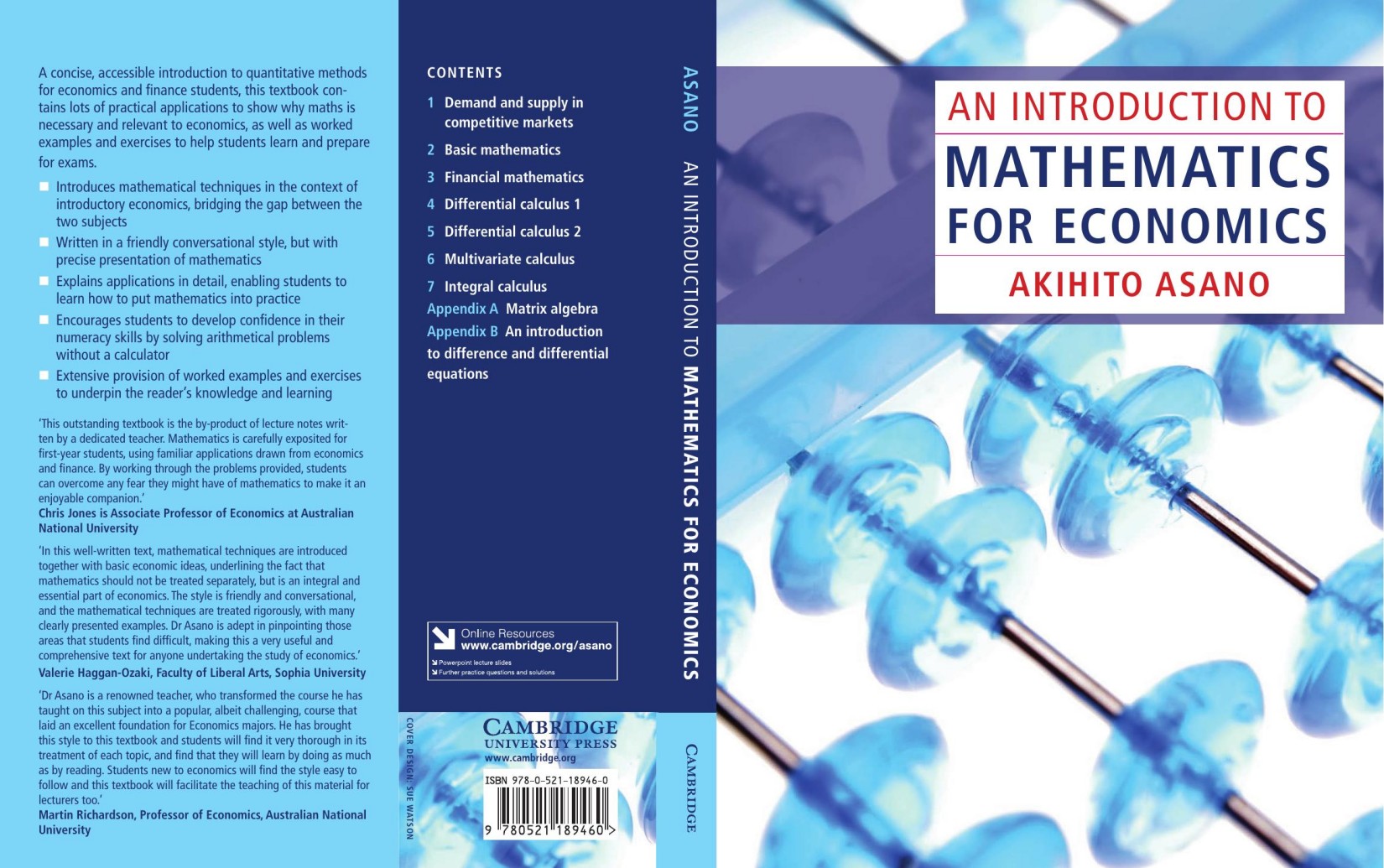
An Introduction to Mathematics for Economics introduces quantitative methods to students of economics and finance in a succinct and accessible style. The introductory nature of this textbook means a background in economics is not essential, as it aims to help students appreciate that learning mathematics is relevant to their overall understanding of the subject. Economic and financial applications are explained in detail before students learn how mathematics can be used, enabling students to learn how to put mathematics into practice. Starting with a revision of basic mathematical principles the second half of the book introduces calculus, emphasising economic applications throughout. Appendices on matrix algebra and difference/differential equations are included for the benefit of more advanced students. Other features, including worked examples and exercises, help to underpin the readers’ knowledge and learning. Akihito Asano has drawn upon his own extensive teaching experience to create an unintimidating yet rigorous textbook.
An Introduction to Mathematics for Economics 1st Table of contents:
1 Demand and supply in competitive markets
1.1 Markets
1.2 Demand and supply schedules
1.3 Market equilibrium
1.4 Rest of this book
2 Basic mathematics
2.1 Numbers
2.2 Fractions, decimal numbers and the use of a calculator
2.3 Some algebraic properties of real numbers
2.4 Equalities, inequalities and intervals
2.5 Powers
2.6 An imaginary number and complex numbers
2.7 Factorisation: reducing polynomial expressions
2.8 Equations
2.9 Functions
2.10 Simultaneous equations: the demand and supply analysis
2.11 Logic
2.12 Proofs
2.13 Additional exercises
3 Financial mathematics
3.1 Limits
3.2 Summation
3.3 A geometric series
3.4 Compound interest
3.5 The exponential function: how can we calculate the compound amount of the principal if interest is compounded continuously?
3.6 Logarithms: how many years will it take for my money to double?
3.7 Present values
3.8 Annuities: what is the value of your home loan?
3.9 Perpetuity
3.10 Additional exercises
4 Differential calculus 1
4.1 Cost function
4.2 The marginal cost and the average costs
4.3 Production function
4.4 Firm’s supply curve
4.5 From a one-unit change to an infinitesimally small change
4.6 The relative positions of MC, AC and A V C revisited
4.7 Profit maximisation
4.8 Additional exercises
5 Differential calculus 2
5.1 Curve sketching
5.2 The differential
5.3 Elasticity
5.4 Additional exercises
6 Multivariate calculus
6.1 The utility function
6.2 Indifference curves
6.3 The marginal utility for the two-good case
6.4 The marginal rate of substitution
6.5 Total differentiation and implicit differentiation
6.6 Maxima and minima revisited
6.7 The utility maximisation problem: constrained optimisation
6.8 The substitution method
6.9 The Lagrange multiplier method
6.10 The individual demand function
6.11 Additional exercises
7 Integral calculus
7.1 An anti-derivative and the indefinite integral
7.2 The fundamental theorem of integral calculus
7.3 Application of integration to finance: the present value of a continuous annuity
7.4 Demand and supply analysis revisited
7.5 The deadweight loss of taxation
7.6 Additional exercises
People also search for An Introduction to Mathematics for Economics 1st :
an introduction to mathematics for economics
an introduction to mathematics by alfred north whitehead
an introduction to mathematics whitehead
an introduction to mathematics pdf
an introduction to mathematics for economics pdf
Tags: Akihito Asano, An Introduction, Mathematics for Economics