


Introduction to Medical Imaging Physics 1st edition by Nadine Barrie Smith, Andrew Webb – Ebook PDF Instant Download/Delivery: 0521190657 , 978-0521190657
Full download Introduction to Medical Imaging Physics 1st after payment
Product details:
ISBN 10: 0521190657
ISBN 13: 978-0521190657
Author: Nadine Barrie Smith, Andrew Webb
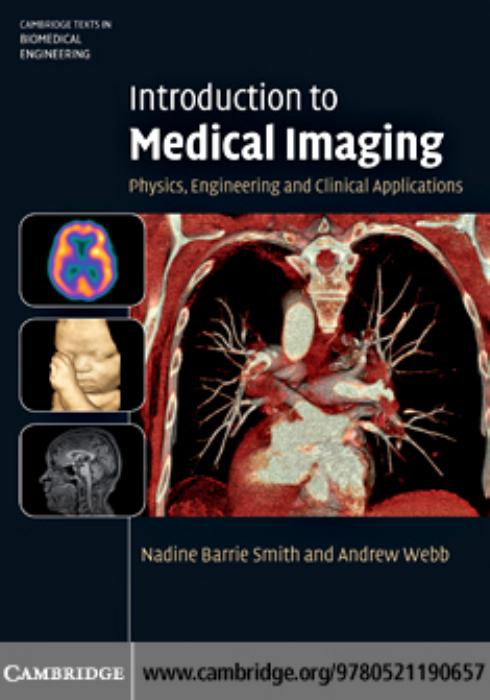
Covering the basics of X-rays, CT, PET, nuclear medicine, ultrasound, and MRI, this textbook provides senior undergraduate and beginning graduate students with a broad introduction to medical imaging. Over 130 end-of-chapter exercises are included, in addition to solved example problems, which enable students to master the theory as well as providing them with the tools needed to solve more difficult problems. The basic theory, instrumentation and state-of-the-art techniques and applications are covered, bringing students immediately up-to-date with recent developments, such as combined computed tomography/positron emission tomography, multi-slice CT, four-dimensional ultrasound, and parallel imaging MR technology. Clinical examples provide practical applications of physics and engineering knowledge to medicine. Finally, helpful references to specialised texts, recent review articles, and relevant scientific journals are provided at the end of each chapter, making this an ideal textbook for a one-semester course in medical imaging.
Introduction to Medical Imaging Physics 1st Table of contents:
1 General image characteristics, data acquisition and image reconstruction
1.1 Introduction
1.2 Specificity, sensitivity and the receiver operating characteristic (ROC) curve
1.3 Spatial resolution
1.3.1 Spatial frequencies
1.3.2 The line spread function
1.3.3 The point spread function
1.3.4 The modulation transfer function
1.4 Signal-to-noise ratio
1.5 Contrast-to-noise ratio
1.6 Image filtering
1.7 Data acquisition: analogue-to-digital converters
1.7.1 Dynamic range and resolution
1.7.2 Sampling frequency and bandwidth
1.7.3 Digital oversampling
1.8 Image artifacts
1.9 Fourier transforms
1.9.1 Fourier transformation of time- and spatial frequency-domain signals
1.9.2 Useful properties of the Fourier transform
1.10 Backprojection, sinograms and filtered backprojection
1.10.1 Backprojection
1.10.2 Sinograms
1.10.3 Filtered backprojection
References
2 X-ray planar radiography and computed tomography
2.1 Introduction
2.2 The X-ray tube
2.3 The X-ray energy spectrum
2.4 Interactions of X-rays with the body
2.4.1 Photoelectric attenuation
2.4.2 Compton scattering
2.5 X-ray linear and mass attenuation coefficients
2.6 Instrumentation for planar radiography
2.6.1 Collimators
2.6.2 Anti-scatter grids
2.7 X-ray detectors
2.7.1 Computed radiography
2.7.2 Digital radiography
2.8 Quantitative characteristics of planar X-ray images
2.8.1 Signal-to-noise
2.8.2 Spatial resolution
2.8.3 Contrast-to-noise
2.9 X-ray contrast agents
2.9.1 Contrast agents for the GI tract
2.9.2 Iodine-based contrast agents
2.10 Specialized X-ray imaging techniques
2.10.1 Digital subtraction angiography
2.10.2 Digital mammography
2.10.3 Digital fluoroscopy
2.11 Clinical applications of planar X-ray imaging
2.12 Computed tomography
2.12.1 Spiral / helical CT
2.12.2 Multi-slice spiral CT
2.13 Instrumentation for CT
2.13.1 Instrumentation development for helical CT
2.13.2 Detectors for multi-slice CT
2.14 Image reconstruction in CT
2.14.1 Filtered backprojection techniques
2.14.2 Fan beam reconstructions
2.14.3 Reconstruction of helical CT data
2.14.4 Reconstruction of multi-slice helical CT scans
2.14.5 Pre-processing data corrections
2.15 Dual-source and dual-energy CT
2.16 Digital X-ray tomosynthesis
2.17 Radiation dose
2.18 Clinical applications of CT
2.18.1 Cerebral scans
2.18.2 Pulmonary disease
2.18.3 Liver imaging
2.18.4 Cardiac imaging
References
3 Nuclear medicine: Planar scintigraphy, SPECT and PET/CT
3.1 Introduction
3.2 Radioactivity and radiotracer half-life
3.3 Properties of radiotracers for nuclear medicine
3.4 The technetium generator
3.5 The distribution of technetium-based radiotracers within the body
3.6 The gamma camera
3.6.1 The collimator
3.6.2 The detector scintillation crystal and coupled photomultiplier tubes
3.6.3 The Anger position network and pulse height analyzer
Pulse height analyzer
3.6.4 Instrument dead time
3.7 Image characteristics
Signal-to-noise
Spatial resolution
Contrast and contrast-to-noise
3.8 Clinical applications of planar scintigraphy
Bone scanning and tumour detection
3.9 Single photon emission computed tomography (SPECT)
3.10 Data processing in SPECT
3.10.1 Scatter correction
3.10.2 Attenuation correction
3.10.3 Image reconstruction
3.11 SPECT/CT
3.12 Clinical applications of SPECT and SPECT/CT
3.12.1 Myocardial perfusion
3.12.2 Brain SPECT and SPECT/CT
3.13 Positron emission tomography (PET)
3.14 Radiotracers used for PET/CT
3.15 Instrumentation for PET/CT
3.15.1 Scintillation crystals
3.15.2 Photomultiplier tubes and pulse height analyzer
3.15.3 Annihilation coincidence detection
3.16 Two-dimensional and three-dimensional PET imaging
3.17 PET/CT
3.18 Data processing in PET/CT
3.18.1 Attenuation correction
3.18.2 Corrections for accidental and multiple coincidences
3.18.3 Corrections for scattered coincidences
3.18.4 Corrections for dead time
3.19 Image characteristics
Contrast-to-noise
Spatial resolution
3.20 Time-of-flight PET
3.21 Clinical applications of PET/CT
3.21.1 Whole-body PET/CT scanning
3.21.2 PET/CT applications in the brain
3.21.3 Cardiac PET/CT studies
References
4 Ultrasound imaging
4.1 Introduction
4.2 Wave propagation and characteristic acoustic impedance
4.3 Wave reflection, refraction and scattering in tissue
4.3.1 Reflection, transmission and refraction at tissue boundaries
4.3.2 Scattering by small structures
4.4 Absorption and total attenuation of ultrasound energy in tissue
4.4.1 Relaxation and classical absorption
4.4.2 Attenuation coefficients
4.5 Instrumentation
4.6 Single element ultrasound transducers
4.6.1 Transducer bandwidth
4.6.2 Beam geometry and lateral resolution
4.6.3 Axial resolution
4.6.4 Transducer focusing
4.7 Transducer arrays
4.7.1 Linear arrays
4.7.2 Phased arrays
4.7.3 Beam-forming and steering via pulse transmission for phased arrays
4.7.4 Analogue and digital receiver beam-forming for phased arrays
4.7.5 Time gain compensation
4.7.6 Multi-dimensional arrays
4.7.7 Annular arrays
4.8 Clinical diagnostic scanning modes
4.8.1 A-mode scanning: opthalmic pachymetry
4.8.2 M-mode echocardiography
4.8.3 Two-dimensional B-mode scanning
4.8.4 Compound scanning
4.9 Image characteristics
4.9.1 Signal-to-noise
4.9.2 Spatial resolution
4.9.3 Contrast-to-noise
4.10 Doppler ultrasound for blood flow measurements
4.10.1 Pulsed wave Doppler measurements
4.10.2 Duplex and triplex image acquisition
4.10.3 Aliasing in pulsed wave Doppler imaging
4.10.4 Power Doppler
4.10.5 Continuous wave Doppler measurements
4.11 Ultrasound contrast agents
4.11.1 Microbubbles
4.11.2 Harmonic and pulse inversion imaging
4.12 Safety guidelines in ultrasound imaging
4.13 Clinical applications of ultrasound
4.13.1 Obstetrics and gynaecology
4.13.2 Breast imaging
4.13.3 Musculoskeletal structure
4.13.4 Echocardiography
4.14 Artifacts in ultrasound imaging
References
5 Magnetic resonance imaging (MRI)
5.1 Introduction
5.2 Effects of a strong magnetic field on protons in the body
5.2.1 Proton energy levels
5.2.2 Classical precession
5.3 Effects of a radiofrequency pulse on magnetization
5.3.1 Creation of transverse magnetization
5.4 Faraday induction: the basis of MR signal detection
5.4.1 MR signal intensity
5.4.2 The rotating reference frame
5.5 T1 and T2 relaxation times
5.6 Signals from lipid
5.7 The free induction decay
5.8 Magnetic resonance imaging
5.9 Image acquisition
5.9.1 Slice selection
5.9.2 Phase encoding
5.9.3 Frequency encoding
5.10 The k-space formalism and image reconstruction
5.11 Multiple-slice imaging
5.12 Basic imaging sequences
5.12.1 Multi-slice gradient echo sequences
5.12.2 Spin echo sequences
5.12.3 Three-dimensional imaging sequences
5.13 Tissue relaxation times
5.14 MRI instrumentation
5.14.1 Superconducting magnet design
5.14.2 Magnetic field gradient coils
5.14.3 Radiofrequency coils
5.14.4 Receiver design
5.15 Parallel imaging using coil arrays
5.16 Fast imaging sequences
5.16.1 Echo planar imaging
5.16.2 Turbo spin echo sequences
5.17 Magnetic resonance angiography
5.18 Functional MRI
5.19 MRI contrast agents
5.19.1 Positive contrast agents
5.19.2 Negative contrast agents
5.20 Image characteristics
5.20.1 Signal-to-noise
5.20.2 Spatial resolution
5.20.3 Contrast-to-noise
5.21 Safety considerations – specific absorption rate (SAR)
5.22 Lipid suppression techniques
5.23 Clinical applications
5.23.1 Neurological applications
5.23.2 Body applications
5.23.3 Musculoskeletal applications
5.23.4 Cardiology applications
People also search for Introduction to Medical Imaging Physics 1st :
how is physics used in radiology
why is physics important in radiology
introduction to medical physics
introduction to mri physica
introduction to physics in modern medicine