

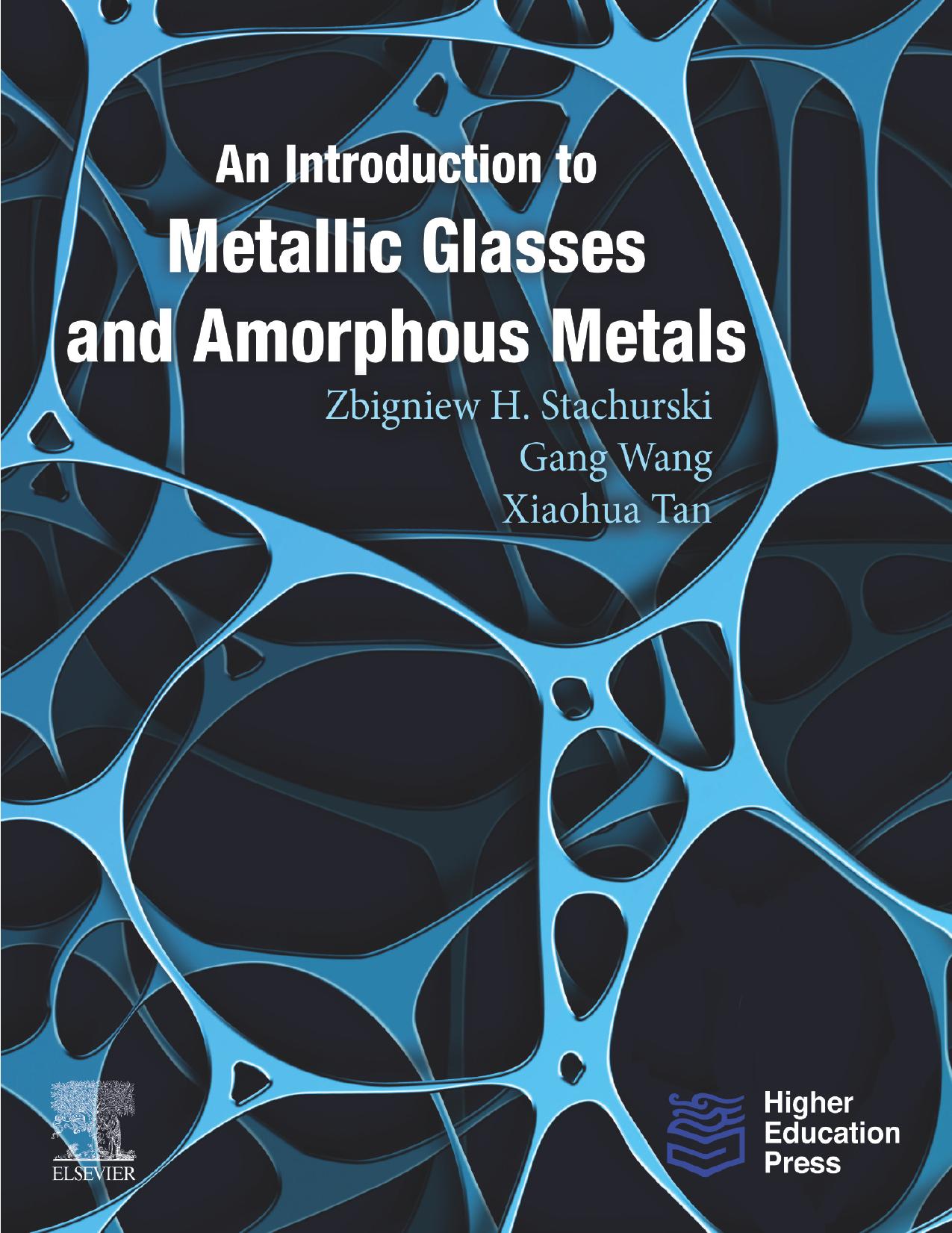
An Introduction to Metallic Glasses and Amorphous Metals 1st edition by Zbigniew Stachurski, Gang Wang, Xiaohua Tan ISBN 0128194195 9780128194195
Original price was: $70.00.$35.00Current price is: $35.00.
Instant download Introduction to Metallic Glasses and Amorphous Metals An Zbigniew H. Stachurski & Gang Wang & Xiaohua Tan after payment
An Introduction to Metallic Glasses and Amorphous Metals 1st edition by Zbigniew Stachurski, Gang Wang, Xiaohua Tan – Ebook PDF Instant Download/Delivery:0128194195, 9780128194195
Full download An Introduction to Metallic Glasses and Amorphous Metals 1st edition after payment
Product details:
ISBN 10: 0128194195
ISBN 13: 9780128194195
Author: Zbigniew Stachurski, Gang Wang, Xiaohua Tan
An Introduction to Metallic Glasses and Amorphous Metals gives a background on the physics of materials, describing relevant experimental techniques. The book presents the necessary background in physics, thermodynamics, and the mechanics of solids, before moving on to cover elasticity, plasticity, fracture and the anelastic behavior of metallic glasses, relating these properties to chemical composition, atomic arrangement, microstructure, and methods of preparation. In addition, it compares the structure-property relationships specific to metallic glasses with polycrystalline metals and alloys and describes the properties and characteristics of metallic glasses. The general features and behavior of metallic glasses are also analyzed and summarized.
The book includes full derivations of theory and equations and presents a compendium of experimental methods used in materials science to characterize and study metallic glasses and amorphous solids. The title is a comprehensive resource for any researcher interested in the materials science of metallic glasses and amorphous materials.
An Introduction to Metallic Glasses and Amorphous Metals 1st Table of contents:
Chapter 1. Introduction
Abstract
References
Chapter 2. Making of metallic glasses and applications
Abstract
Subchapter 2.1. Applications of metallic glasses
Aerospace and beyond
Biological applications of metallic glasses
Metallic glass transformers
Sporting equipment and personal items
Optical, magnetic, and electrical
Amorphous silicon solar cells
Jewellery
Metallic plasticine
Rewritable DVDs
Subchapter 2.2. Making metallic glasses
Casting into a mold
Spinning wheel method
High-pressure torsion
Ball milling
Cold rolling
Chapter 3. Solidification
Abstract
Subchapter 3.1. Solidification by crystallization
Liquid → solid transformation by crystallization
Nucleation
Crystal growth
Viscosity
Kinetics of crystallization
Microstructure of solidified metals
Analysis of the KJMA equation
Subchapter 3.2. Solidification of glass
The process
Three characteristics common to all glasses
Relationship between cooling rate and vitrification
Brief history of metallic glasses
Glass-forming ability
Fragility
The cage effect
Chapter 4. Characterization of metallic glasses
Abstract
Subchapter 4.1. Glass transition theories
Introduction
Kinetic theory (WLF)
Free volume theory
Entropy theory
Stress fluctuations’ theory
Viscoelastic theory
Mode coupling theory (MCT)
Geometrical frustration theory
Cluster jamming theory
Space-time bubbles’ theory
Local transition events
Conclusions
Subchapter 4.2. Mechanical testing
Tensile testing
Compression testing
Shear testing
Hydrostatic testing
Surface hardness testing
The science and engineering of hardness testing
Testing at high temperature
Dynamic mechanical testing
Chapter 5. Models of structure
Abstract
Atomic arrangements in solids
Atoms and their properties
Models of atomic packing in crystals
Models of atomic packing in metallic glasses
Models of micro-structure in metals
References
Chapter 6. Magnetic properties of amorphous metallic alloys
Abstract
Section 1. The history of magnetism
Atomic-scale magnetism
Magnetism of one electron
Magnetism of one atom
Macroscopic-scale magnetism
Diamagnetism and paramagnetism
Ferromagnetism
Section 2. Applications of amorphous alloys
Fabrication techniques
Enhancement of soft magnetic properties
Applications of commercialized Fe-based BMGs
Magnetic behavior of Nd-based amorphous hard magnets
Enhancing the magnetic property by alloying elements
Magneto-caloric bulk amorphous alloys
A brief history of the magneto-caloric effect
Characterization of magneto-caloric materials
Magneto-caloric bulk metallic glasses
Section 3. Outlook of magnetic amorphous alloys
References
Chapter 7. Elasticity of metallic gasses
Abstract
Continuum mechanics
Affine and non-affine deformation
Deformation in bulk metallic glass
Elastic modulus by the X-ray method
Deformation in Zr55Al10Ni5Cu30 metallic glass
Deformation in Zr46.5Cu45Al7Ti1.5 metallic glass
Deformation in Zr64Cu16Ni10Al10 metallic glass under cooling
Deformation in thin film metallic glass
Structural evolution in Zr50Cu50 metallic glass during compression
Structural evolution in Zr64.13Cu15.75Ni10.12Al10 during heating
Changes in atomic structure revealed by radial distribution
References
Chapter 8. Introduction to anelastic deformation
Abstract
Creep
Stress relaxation
Mechanical relaxation and dynamic loss modulus
Time and temperature dependent behavior
Creep of aluminium-based metallic glass
Creep of Zr-based metallic glass
Dynamic relaxation in Fe63Al27 metallic glass
Free-volume anelastic deformation of metallic glasses
The β relaxation in La–Ni–Al metallic glass
Definitions of shear viscosity
References
Chapter 9. Plastic deformation and yield strength of metals
Abstract
Time–temperature deformation maps
Plasticity in metallic glasses
Plastic flow in MGs
Serrated flow at macroscopic level
Serrated flow at microscopic level
Summary and outlook
References
Chapter 10. Fracture mechanics of metallic glasses
Abstract
Fracture strength of an uncracked material
Shear fracture – Coulomb–Mohr theory
Tensile fracture – Griffith’s fracture criterion
Calculation of elastic strain energy
Calculation of crack surface energy
Solution for fracture stress
Fracture toughness
Limits of applicability of Eq. (10.24)
Irwin fracture criterion
Fatigue and fracture of metallic glasses
Dependence of strength on sample size
Instability and morphology of fracture
References
Appendix A. Thermodynamics of a system
Molecular system
Enthalpy
Entropy
Forces between atoms, molecules, and particles
Types of physical forces
Interatomic forces
Lennard-Jones interatomic potential
Buckingham potential
Morse potential
Many-atom potential
Stillinger–Weber potential
Embedded atom model potential
Gibbs free energy
Liquid-to-solid phase transformation
Computation of cluster potential
People also search for An Introduction to Metallic Glasses and Amorphous Metals 1st:
an introduction to metallic glasses and amorphous metals
what are metallic solids
metallic and non metallic examples
metallic glass / amorphous metal
an introduction to metallic glasses and amorphous metals pdf
amorphous metallic glass
Tags: Zbigniew Stachurski, Gang Wang, Xiaohua Tan, An Introduction, Amorphous Metals