


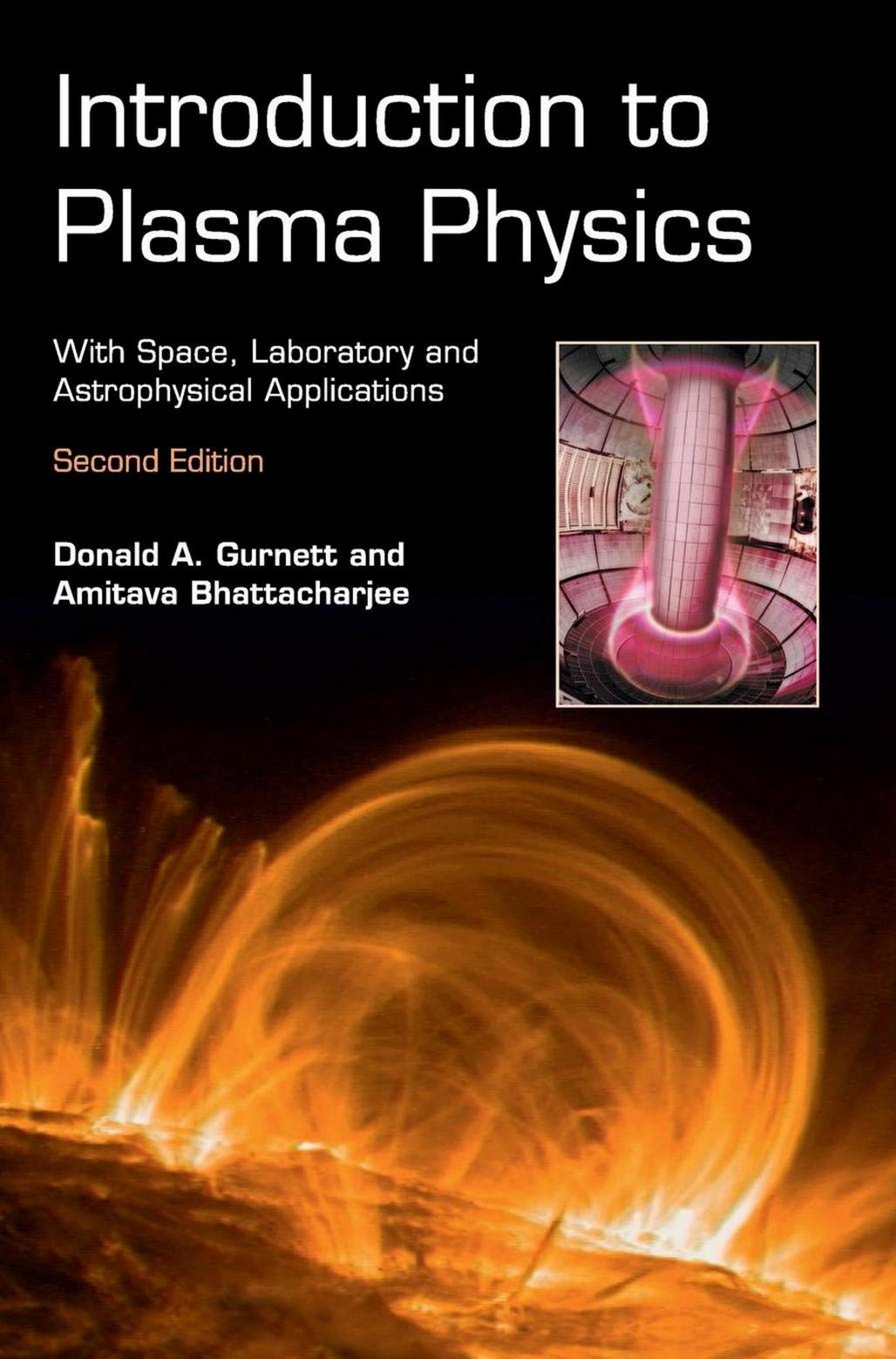
Introduction to Plasma Physics 2nd edition by Donald Gurnett, Amitava Bhattacharjee – Ebook PDF Instant Download/Delivery: 1107027373 , 978-1107027374
Full download Introduction to Plasma Physics 2nd edition after payment
Product details:
ISBN 10: 1107027373
ISBN 13: 978-1107027374
Author: Donald Gurnett, Amitava Bhattacharjee
Introducing basic principles of plasma physics and their applications to space, laboratory and astrophysical plasmas, this new edition provides updated material throughout. Topics covered include single-particle motions, kinetic theory, magnetohydrodynamics, small amplitude waves in hot and cold plasmas, and collisional effects. New additions include the ponderomotive force, tearing instabilities in resistive plasmas and the magnetorotational instability in accretion disks, charged particle acceleration by shocks, and a more in-depth look at nonlinear phenomena. A broad range of applications are explored: planetary magnetospheres and radiation belts, the confinement and stability of plasmas in fusion devices, the propagation of discontinuities and shock waves in the solar wind, and analysis of various types of plasma waves and instabilities that can occur in planetary magnetospheres and laboratory plasma devices. With step-by-step derivations and self-contained introductions to mathematical methods, this book is ideal as an advanced undergraduate to graduate-level textbook, or as a reference for researchers.
Introduction to Plasma Physics 2nd Table of contents:
1 Introduction
2 Characteristic Parameters of a Plasma
2.1 Number Density and Temperature
2.2 Debye Length
2.2.1 Plasma Sheaths
2.3 Plasma Frequency
2.4 Cyclotron Frequency
2.5 Collision Frequency
2.5.1 Collisions between Charged and Neutral Particles
2.5.2 Collisions between Charged Particles
2.6 Number of Electrons per Debye Cube
2.6.1 Macroscopic Averages
2.6.2 Ratio of Kinetic Energy to Potential Energy
2.6.3 Ratio of Collective to Discrete Interactions
2.7 The de Broglie Wavelength and Quantum Effects
Problems
References
Further Reading
3 Single-Particle Motions
3.1 Motion in a Static Uniform Magnetic Field
3.1.1 Magnetic Moment
3.2 Motion in Static and Uniform Electricand Magnetic Fields
3.2.1 Examples of E B Drifts
3.2.2 Drift Due to a Force Perpendicular to B
3.3 Gradient and Curvature Drifts
3.3.1 Gradient Drift
3.3.2 Curvature Drift
3.3.3 Examples of Gradient and Curvature Drifts
3.3.4 A Self-consistent static equilibrium
3.4 Motion in a Magnetic Mirror Field
3.4.1 Parallel Motion: The Magnetic Mirror Force
3.4.2 Azimuthal Motion: Constancy of the Magnetic Moment
3.4.3 Turning Points and the Pitch Angle
3.5 Motion in a Time Varying Magnetic Field
3.6 Polarization Drift
3.7 Ponderomotive Force
3.8 Adiabatic Invariants
3.8.1 Adiabatic Invariant for a Harmonic Oscillator
3.8.2 Adiabatic Invariants for an Axially Symmetric Magnetic Mirror
3.8.3 Violations of the Adiabatic Invariants
3.9 The Hamiltonian Method
3.9.1 Hamilton’s Equations
3.9.2 Hamiltonian for an Axisymmetric Magnetic Field
3.10 Hamiltonian Chaos
Problems
References
Further Reading
4 Waves in a Cold Plasma
4.1 Fourier Representation of Waves
4.1.1 The Dispersion Relation
4.1.2 Group Velocity
4.2 General Form of the Dispersion Relation
4.2.1 The Conductivity and Dielectric Tensors
4.2.2 The Homogeneous Equation
4.3 Waves in a Cold Uniform Unmagnetized Plasma
4.3.1 The Transverse Mode
4.3.2 The Longitudinal Mode
4.3.3 External Sources
4.4 Waves in a Cold Uniform Magnetized Plasma
4.4.1 Propagation Parallel to the Magnetic Field
4.4.2 Propagation Perpendicular to the Magnetic Field
4.4.3 Oblique Wave Propagation
4.4.4 The Clemmow–Mullaly–Allis (CMA) Diagram
4.5 Ray Paths in Inhomogeneous Plasmas
Problems
References
Further Reading
5 Kinetic Theory and the Moment Equations
5.1 The Distribution Function
5.2 The Boltzmann and Vlasov Equations
5.3 Solutions Based on Constants of the Motion
5.4 The Moment Equations
5.4.1 Zeroth Moment
5.4.2 First Moment
5.4.3 Second Moment
5.4.4 The Closure Problem
5.5 Electron and Ion Pressure Waves
5.5.1 The Langmuir Mode
5.5.2 The Ion Acoustic Mode
5.6 Collisional Drag Force
5.6.1 The Lorentz Gas Model
5.6.2 Ohm’s Law
5.6.3 Pedersen and Hall Conductivities
5.7 Ambipolar Diffusion
Problems
References
Further Reading
6 Magnetohydrodynamics
6.1 The Basic Equations of MHD
6.1.1 The Mass Continuity Equation
6.1.2 The Momentum Equation
6.1.3 Generalized Ohm’s Law
6.1.4 The Equation of State
6.1.5 The Complete Set of Resistive MHD Equations
6.2 Magnetic Pressure
6.3 Magnetic Field Convection and Diffusion
6.3.1 Rm >> 1, the Frozen Field Theorem
6.3.2 Rm << 1, Magnetic Diffusion
6.4 Conservation Relations in Ideal MHD
6.5 Magnetohydrodynamic Waves
6.5.1 The Transverse (or Shear) Alfvén Mode
6.5.2 The Fast and Slow Magnetosonic Modes
6.5.3 MHD Wave Observations
6.6 Validity of Resistive MHD Equations
Problems
References
Further Reading
7 MHD Equilibria and Stability
7.1 Magnetostatic Equilibria
7.1.1 The Virial Theorem
7.1.2 Conditions for a Magnetostatic Equilibrium
7.1.3 Force-Free Equilibria
7.1.4 Force-Balanced Equilibria
7.2 Magnetohydrodynamic Equilibria
7.3 Stability of Ideal Magnetostatic Equilibria
7.3.1 MHD Stability: A Mechanical Analogy
7.3.2 Interchange Instabilities
7.3.3 The Linear Force Operator for Magnetostatic Equilibria
7.3.4 The Normal Mode Method
7.3.5 The Energy Principle
7.3.6 A More Useful Form for δW
7.3.7 The Rayleigh–Taylor Instability
7.4 Stability of Ideal Magnetohydrodynamic Equilibria
7.4.1 The Magnetorotational Instability
7.5 Resistive Instabilities
7.6 Magnetic Reconnection
7.6.1 The Sweet–Parker Model
7.6.2 Fast Reconnection
Problems
References
Further Reading
8 Discontinuities and Shock Waves
8.1 The MHD Jump Conditions
8.2 Classification of Discontinuities
8.2.1 Contact Discontinuities
8.2.2 Rotational Discontinuities
8.3 Shock Waves
8.3.1 The de Hoffmann–Teller Frame
8.3.2 The Shock Propagation Speed
8.3.3 The Weak Shock Limit
8.3.4 Parallel and Perpendicular Shocks
8.3.5 The Strong Shock Limit
8.3.6 Arbitrary Shock Strengths and Magnetic Field Orientations
8.3.7 Entropy and Reversibility
8.3.8 Nonlinear Evolution and Stability
8.3.9 Observations of MHD Shocks
8.4 Charged Particle Acceleration by MHD Shocks
8.4.1 Shock Drift Acceleration
8.4.2 Diffusive Shock Acceleration
Problems
References
Further Reading
9 Electrostatic Waves in a Hot Unmagnetized Plasma
9.1 The Vlasov Approach
9.1.1 The Bohm–Gross Dispersion Relation
9.1.2 Cold Beam Instabilities
9.2 The Landau Approach
9.2.1 Laplace Transforms: A Brief Review
9.2.2 The Dispersion Relation for a Plasma of Hot Electrons and Immobile Ions
9.2.3 The Cauchy Velocity Distribution Function
9.2.4 The Weak Growth Rate Approximation
9.2.5 The Physical Origin of Landau Damping
9.3 The Plasma Dispersion Function
9.4 The Dispersion Relation for a Multi-component Plasma
9.4.1 Ion Acoustic Waves
9.5 Stability
9.5.1 Gardner’s Theorem
9.5.2 The Nyquist Criterion
9.5.3 The Penrose Condition
9.5.4 Some Representative Instabilities
Problems
References
Further Reading
10 Waves in a Hot Magnetized Plasma
10.1 Linearization of the Vlasov Equation
10.2 Electrostatic Waves
10.2.1 The Harris Dispersion Relation
10.2.2 The Low-temperature, Long-Wavelength Limit
10.2.3 The Bernstein Modes
10.2.4 Instabilities
10.3 Electromagnetic Waves
10.3.1 The Dispersion Relation
10.3.2 Parallel Propagation
10.3.3 Oblique Propagation
Problems
References
Further Reading
11 Nonlinear Effects
11.1 Quasi-linear Theory
11.1.1 The Quasi-linear Diffusion Equation
11.1.2 Application to the Bump-on-Tail Instability
11.1.3 Chaotic Velocity Space Diffusion
11.2 Wave–Wave Interactions
11.2.1 Amplitude Modulation
11.2.2 Three Coupled Harmonic Oscillators
11.2.3 Three-Wave Coupling in a Hot Unmagnetized Plasma
11.2.4 Driven Waves and Parametric Decay
11.3 Langmuir Wave Solitons
11.3.1 The Zakharov Equations
11.3.2 Soliton Collapse
11.4 Stationary Nonlinear Electrostatic Potentials
11.4.1 Observations of BGK Electrostatic Potentials
Problems
References
Further Reading
12 Collisional Processes
12.1 Binary Coulomb Collisions
12.2 Importance of Small-Angle Collisions
12.3 The Fokker–Planck Equation
12.3.1 The Dynamical Friction Vector
12.3.2 The Diffusion Tensor
12.4 Conductivity of a Fully Ionized Plasma
12.5 Collision Operator for Maxwellian Distributionsof Electrons and Ions
Problems
References
Further Reading
Appendix A: Symbols
Appendix B: Useful Trigonometric Identities
Appendix C: Vector Differential Operators
Appendix D: Vector Calculus Identities
Index
People also search for Introduction to Plasma Physics 2nd :
goldston and rutherford introduction to plasma physics
francis chen introduction to plasma physics
introduction to plasma physics and controlled fusion pdf
introduction to plasma physics gurnett pdf
introduction to plasma physics by ff chen pdf