


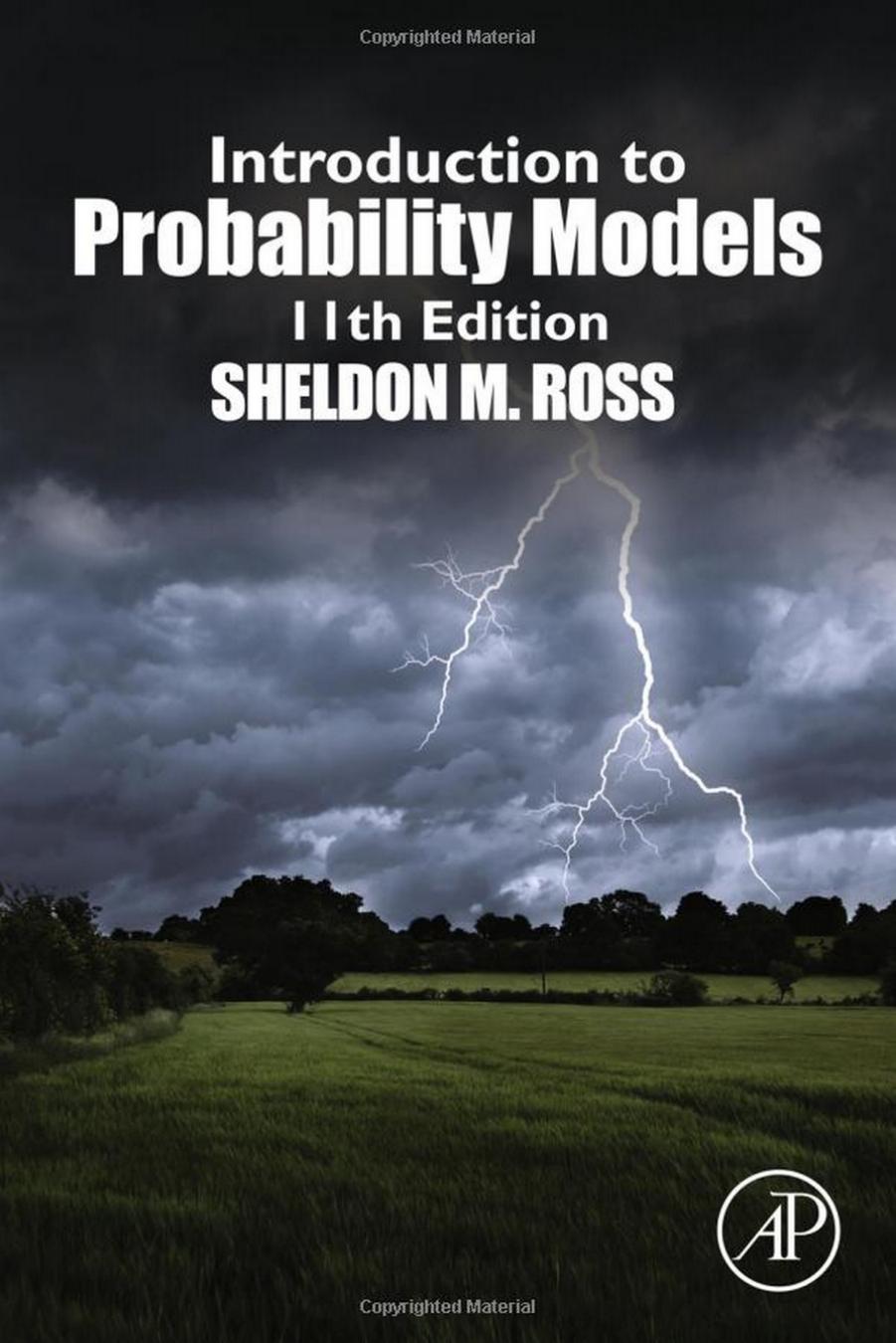
Introduction to Probability Models 11th Edition by Sheldon Ross – Ebook PDF Instant Download/Delivery: B017LCN240 , 9780124079489
Full download Introduction to Probability Models 11th edition after payment
Product details:
ISBN 10: B017LCN240
ISBN 13: 9780124079489
Author: Sheldon Ross
This best-selling reference is well-suited to those seeking to apply probability theory to phenomena in such fields as engineering, actuarial and management sciences, the physical and social sciences, and operations research.Realistic models of real-world phenomena must take into account the possibility of randomness. More often than not, quantities are not predictable, but exhibit variations that should be taken into account by the model. This is usually accomplished by allowing the model to be probabilistic in nature. Such a model is referred as a probability model.Introduction to Probability Models is a fascinating introduction to applications from diverse disciplines and an excellent introduction to a wide variety of applied probability topics.* Best-selling book by a well-known author, with over 20,000 in sales for 7th edition* Includes new examples and exercises in actuarial sciences* Contains compulsory material for Exam 3 of the Society of ActuariesAuthor Sheldon M. Ross is a professor in the Department of Industrial Engineering and Operations Research at the University of California, Berkeley. He received his Ph.D. in statistics at Stanford University in 1968 and has been at Berkeley ever since. He has published many technical articles and textbooks in the areas of statistics and applied probability. Among his texts are A First Course in Probability, Fourth Edition published by MacMillan, Introduction to Probability Models, Fifth Edition published by Academic Press, Stochastic Processes, Second Edition published by Wiley, and a new text, Introductory Statistics published by McGraw Hill.Professor Ross is the founding and continuing editor of the journal Probability in the Engineering and Informational Sciences published by Cambridge University Press. He is a Fellow of the Institute of Mathematical Statistics, and a recipient of the Humboldt US Senior Scientist Award.
Introduction to Probability Models 11th Table of contents:
1 Introduction to Probability Theory
1.1 Introduction
1.2 Sample Space and Events
1.3 Probabilities Defined on Events
1.4 Conditional Probabilities
1.5 Independent Events
1.6 Bayes’ Formula
Exercises
References
2 Random Variables
2.1 Random Variables
2.2 Discrete Random Variables
2.2.1 The Bernoulli Random Variable
2.2.2 The Binomial Random Variable
2.2.3 The Geometric Random Variable
2.2.4 The Poisson Random Variable
2.3 Continuous Random Variables
2.3.1 The Uniform Random Variable
2.3.2 Exponential Random Variables
2.3.3 Gamma Random Variables
2.3.4 Normal Random Variables
2.4 Expectation of a Random Variable
2.4.1 The Discrete Case
2.4.2 The Continuous Case
2.4.3 Expectation of a Function of a Random Variable
2.5 Jointly Distributed Random Variables
2.5.1 Joint Distribution Functions
2.5.2 Independent Random Variables
2.5.3 Covariance and Variance of Sums of Random Variables
2.5.4 Joint Probability Distribution of Functions of Random Variables
2.6 Moment Generating Functions
2.6.1 The Joint Distribution of the Sample Mean and Sample Variance from a Normal Population
2.7 The Distribution of the Number of Events that Occur
2.8 Limit Theorems
2.9 Stochastic Processes
Exercises
References
3 Conditional Probability and Conditional Expectation
3.1 Introduction
3.2 The Discrete Case
3.3 The Continuous Case
3.4 Computing Expectations by Conditioning
3.4.1 Computing Variances by Conditioning
3.5 Computing Probabilities by Conditioning
3.6 Some Applications
3.6.1 A List Model
3.6.2 A Random Graph
3.6.3 Uniform Priors, Polya’s Urn Model, and Bose–.4Einstein Statistics
3.6.4 Mean Time for Patterns
3.6.5 The k-Record Values of Discrete Random Variables
3.6.6 Left Skip Free Random Walks
3.7 An Identity for Compound Random Variables
3.7.1 Poisson Compounding Distribution
3.7.2 Binomial Compounding Distribution
3.7.3 A Compounding Distribution Related to the Negative Binomial
Exercises
4 Markov Chains
4.1 Introduction
4.2 Chapman-Kolmogorov Equations
4.3 Classification of States
4.4 Long-Run Proportions and Limiting Probabilities
4.4.1 Limiting Probabilities
4.5 Some Applications
4.5.1 The Gambler’s Ruin Problem
4.5.2 A Model for Algorithmic Efficiency
4.5.3 Using a Random Walk to Analyze a Probabilistic Algorithm for the Satisfiability Problem
4.6 Mean Time Spent in Transient States
4.7 Branching Processes
4.8 Time Reversible Markov Chains
4.9 Markov Chain Monte Carlo Methods
4.10 Markov Decision Processes
4.11 Hidden Markov Chains
4.11.1 Predicting the States
Exercises
References
5 The Exponential Distribution and the Poisson Process
5.1 Introduction
5.2 The Exponential Distribution
5.2.1 Definition
5.2.2 Properties of the Exponential Distribution
5.2.3 Further Properties of the Exponential Distribution
5.2.4 Convolutions of Exponential Random Variables
5.3 The Poisson Process
5.3.1 Counting Processes
5.3.2 Definition of the Poisson Process
5.3.3 Interarrival and Waiting Time Distributions
5.3.4 Further Properties of Poisson Processes
5.3.5 Conditional Distribution of the Arrival Times
5.3.6 Estimating Software Reliability
5.4 Generalizations of the Poisson Process
5.4.1 Nonhomogeneous Poisson Process
5.4.2 Compound Poisson Process
5.4.3 Conditional or Mixed Poisson Processes
5.5 Random Intensity Functions and Hawkes Processes
Exercises
References
6 Continuous-Time Markov Chains
6.1 Introduction
6.2 Continuous-Time Markov Chains
6.3 Birth and Death Processes
6.4 The Transition Probability Function Pij(t)
6.5 Limiting Probabilities
6.6 Time Reversibility
6.7 The Reversed Chain
6.8 Uniformization
6.9 Computing the Transition Probabilities
Exercises
References
7 Renewal Theory and Its Applications
7.1 Introduction
7.2 Distribution of N(t)
7.3 Limit Theorems and Their Applications
7.4 Renewal Reward Processes
7.5 Regenerative Processes
7.5.1 Alternating Renewal Processes
7.6 Semi-Markov Processes
7.7 The Inspection Paradox
7.8 Computing the Renewal Function
7.9 Applications to Patterns
7.9.1 Patterns of Discrete Random Variables
7.9.2 The Expected Time to a Maximal Run of Distinct Values
7.9.3 Increasing Runs of Continuous Random Variables
7.10 The Insurance Ruin Problem
Exercises
References
8 Queueing Theory
8.1 Introduction
8.2 Preliminaries
8.2.1 Cost Equations
8.2.2 Steady-State Probabilities
8.3 Exponential Models
8.3.1 A Single-Server Exponential Queueing System
8.3.2 A Single-Server Exponential Queueing System Having Finite Capacity
8.3.3 Birth and Death Queueing Models
8.3.4 A Shoe Shine Shop
8.3.5 A Queueing System with Bulk Service
8.4 Network of Queues
8.4.1 Open Systems
8.4.2 Closed Systems
8.5 The System M/G/1
8.5.1 Preliminaries: Work and Another Cost Identity
8.5.2 Application of Work to M/G/1
8.5.3 Busy Periods
8.6 Variations on the M/G/1
8.6.1 The M/G/1 with Random-Sized Batch Arrivals
8.6.2 Priority Queues
8.6.3 An M/G/1 Optimization Example
8.6.4 The M/G/1 Queue with Server Breakdown
8.7 The Model G/M/1
8.7.1 The G/M/1 Busy and Idle Periods
8.8 A Finite Source Model
8.9 Multiserver Queues
8.9.1 Erlang’s Loss System
8.9.2 The M/M/k Queue
8.9.3 The G/M/k Queue
8.9.4 The M/G/k Queue
Exercises
References
9 Reliability Theory
9.1 Introduction
9.2 Structure Functions
9.2.1 Minimal Path and Minimal Cut Sets
9.3 Reliability of Systems of Independent Components
9.4 Bounds on the Reliability Function
9.4.1 Method of Inclusion and Exclusion
9.4.2 Second Method for Obtaining Bounds on r(p)
9.5 System Life as a Function of Component Lives
9.6 Expected System Lifetime
9.6.1 An Upper Bound on the Expected Life of a Parallel System
9.7 Systems with Repair
9.7.1 A Series Model with Suspended Animation
Exercises
References
10 Brownian Motion and Stationary Processes
10.1 Brownian Motion
10.2 Hitting Times, Maximum Variable, and the Gambler’s Ruin Problem
10.3 Variations on Brownian Motion
10.3.1 Brownian Motion with Drift
10.3.2 Geometric Brownian Motion
10.4 Pricing Stock Options
10.4.1 An Example in Options Pricing
10.4.2 The Arbitrage Theorem
10.4.3 The Black-Scholes Option Pricing Formula
10.5 The Maximum of Brownian Motion with Drift
10.6 White Noise
10.7 Gaussian Processes
10.8 Stationary and Weakly Stationary Processes
10.9 Harmonic Analysis of Weakly Stationary Processes
Exercises
References
11 Simulation
11.1 Introduction
11.2 General Techniques for Simulating Continuous Random Variables
11.2.1 The Inverse Transformation Method
11.2.2 The Rejection Method
11.2.3 The Hazard Rate Method
11.3 Special Techniques for Simulating Continuous Random Variables
11.3.1 The Normal Distribution
11.3.2 The Gamma Distribution
11.3.3 The Chi-Squared Distribution
11.3.4 The Beta (n, m) Distribution
11.3.5 The Exponential Distribution’227The Von Neumann Algorithm
11.4 Simulating from Discrete Distributions
11.4.1 The Alias Method
11.5 Stochastic Processes
11.5.1 Simulating a Nonhomogeneous Poisson Process
11.5.2 Simulating a Two-Dimensional Poisson Process
11.6 Variance Reduction Techniques
11.6.1 Use of Antithetic Variables
11.6.2 Variance Reduction by Conditioning
11.6.3 Control Variates
11.6.4 Importance Sampling
11.7 Determining the Number of Runs
11.8 Generating from the Stationary Distribution of a Markov Chain
11.8.1 Coupling from the Past
11.8.2 Another Approach
People also search for Introduction to Probability Models 11th :
sm ross introduction to probability models
ross introduction to probability models
introduction to probability models 11th edition
introduction to probability models pdf
introduction to probability models 12th edition pdf
Tags: Sheldon Ross, Probability Models