


Introduction to Signal Processing Instrumentation and Control An Integrative Approach 1st edition by Joseph Bentsman ISBN 9814733121 978-9814733120
Original price was: $70.00.$35.00Current price is: $35.00.
Instant download Introduction to Signal Processing Instrumentation and Control An Integrative Approach Joseph Bentsman after payment
Introduction to Signal Processing Instrumentation and Control An Integrative Approach 1st edition by Joseph Bentsman – Ebook PDF Instant Download/Delivery: 9814733121 , 978-9814733120
Full download Introduction to Signal Processing Instrumentation and Control An Integrative Approach 1st edition after payment
Product details:
ISBN 10: 9814733121
ISBN 13: 978-9814733120
Author: Joseph Bentsman
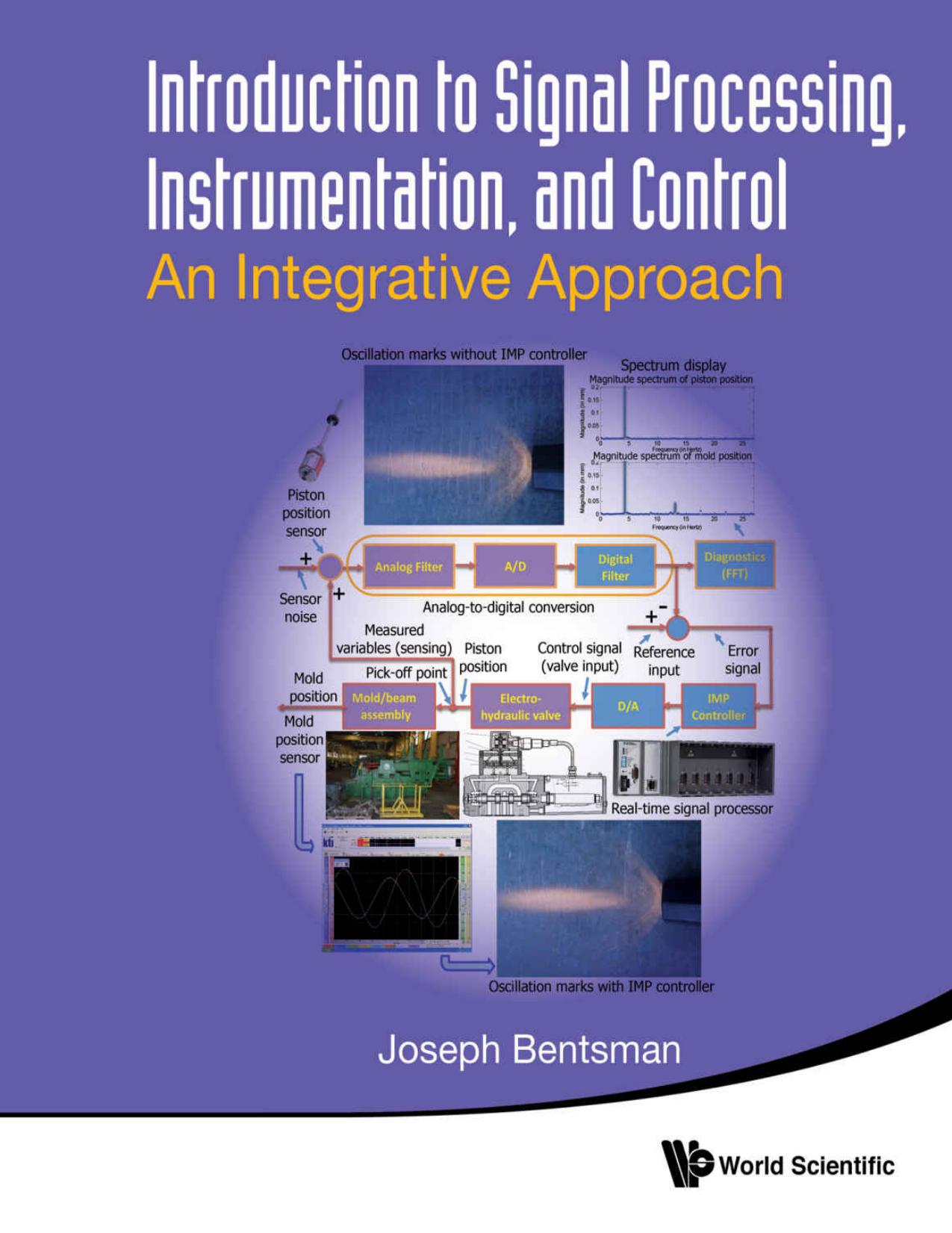
This book stems from a unique and highly effective approach in introducing signal processing, instrumentation, diagnostics, filtering, control, and system integration.It presents the interactive industrial grade software testbed of mold oscillator that captures the mold motion distortion induced by coupling of the electro-hydraulic actuator nonlinearity with the resonance of the mold oscillator beam assembly. The testbed is then employed as a virtual lab to generate input-output data records that permit unraveling and refining complex behavior of the actual production system through merging dynamics, signal processing, instrumentation, and control into a coherent problem-solving package.The material is presented in a visually rich, mathematically and graphically well supported, but not analytically overburdened format. By incorporating software testbed into homework and project assignments, the book fully brings out the excitement of going through the adventure of exploring and solving a mold oscillator distortion problem, while covering the key signal processing, diagnostics, instrumentation, modeling, control, and system integration concepts.The approach presented in this book has been supported by two education advancement awards from the College of Engineering of the University of Illinois at Urbana-Champaign.
Introduction to Signal Processing Instrumentation and Control An Integrative Approach 1st Table of contents:
Chapter 1 Case Study and Introductory Topics
1.1 Introduction
1.2 Process Description-Continuous Casting of Steel
1.2.1 Production unit description: mold oscillation system at Nucor Decatur
1.3 Project Approach and Problem Characterization
1.3.1 Project approach and workscope
1.3.2 Problem characterization
1.3.3 Development of highly simplified experimental mockup – hardware testbed
1.4 System Representation
1.4.1 Hardware testbed
1.4.2 Hardware testbed schematics, negative feedback, and the loop closure under proportional control (P-control)
1.4.3 Hardware testbed: instrumentation and data acquisition
1.4.4 Validation of hardware testbed: experimental data exhibits resonance problem
1.5 Mathematical System Modeling and Analysis
1.5.1 Software testbed
1.5.2 Problem investigation: identifying the sources of the distortion
1.5.3 Problem definition
1.6 Problem Resolution
1.6.1 Solving the problem through controller design
1.6.2 Controller implementation and testing on the testbeds and the production unit
1.7 Problem Solving Capability Buildup
1.7.1 Stage I – introduction to signals, basic filtering, loading and system integration, sensing and actuation, instrumentation, data acquisition, system identification, and spectral computation
1.7.2 Stage II – introduction to spectral analysis and system identification for system modeling, diagnostics, and decision making; basics of analog and digital filter design and implementation
1.7.3 Stage III – introduction to controller design and system integration
1.7.4 Appendices
1.7.5 Homework, project, laboratory, and examination assignments
Homework 1: Assignment and Solution Guide
References
Chapter 2 Introduction to Signals
2.1 Signal Classification and Signal Measures
2.1.1 Types of signals
2.1.2 Energy-type signal size measures: integrability and summability
2.2 Basic Operations on Signals, Signal Representation
2.2.1 Signal representation
2.2.2 Basic operations on signals
2.2.3 Signal representation
2.3 Delta-function and its Use, Signal Representations, Energy and Power Signals
2.3.1 Delta-function
2.3.2 Signal energy, power, RMS
Homework 2: Solved Examples and Solution Guide
2.4 Basic characteristics of a CT sinusoidal signal
2.4.1 Period and frequency of sinusoid:
2.4.2 Sums of sinusoids:
2.4.3 Phase of sinusoid
2.4.4 Magnitude of sinusoid
2.5 Real Harmonics, Discrete and Continuous Spectra, Frequency Response, Signal Test Instrumentation
2.5.1 Fundamental frequency of a sum of sinusoids. Real harmonics
2.5.2 Discrete real spectra
2.5.3 Continuous spectra and their application to system analysis: continuous frequency response
2.5.4 Instrumentation for signal measurement and visualization
Homework 3: Solved Examples and Solution Guide
Chapter 3 First Look at Signal Processing, Filtering, and Instrumentation
3.1 Aggregating LTI System Representations for Carrying out Design, Filtering, and Control Tasks
3.1.1 Integrative linear time invariant (LTI) system portrait
3.1.2 Mechanical systems – a filtering, or input/output viewpoint
3.1.3 MS2D system force balance
3.1.4 Implicit input/output operator: state-space representation. State-variable filter implementation
3.1.5 Impulse response as system representation
3.1.6 Explicit input/output operator – convolution integral
3.1.7 Pole-zero map: a look inside the dynamic system behavior
3.1.8 Frequency response: calculation and use
3.1.9 Bode plots
3.1.10 Resonance in the second order systems
3.1.11 What each representation is good for
3.2 Review of Parametric System Modeling, Subsystem Commutativity, Firsts Look at System Integration-Subsystem Loading, Output-Dependent System Properties
3.2.1 Passive electrical circuits
3.2.2 System integration problems
3.3 First Look at Filtering: Basic Instrumentation Techniques-AC versus DC Coupling. Active (Op Amp) Circuits, Loading Mitigation
3.3.1 Basic filtering: AC versus DC coupling
3.3.2 Op amp based active circuits
3.3.3 Other types of signal isolators
3.3.4 Voltage dividers and potentiometers
3.4 Basic Motion Sensing: Strain Gauge, Basic Instrumentation Techniques: Bridge Circuit, Instrumentation Amplifier, and Common Mode Rejection Ratio (CMRR)
3.4.1 Strain Gauge
3.4.2 Ideal instrumentation amplifier
3.4.3 Real instrumentation amplifier
Homework 4: Solved Examples and Solution Guide
Chapter 4 Sampling Basics, Harmonic Signals, and Signal Spectrum
4.1 Sampling Basics
4.1.1 Discrete time sinusoid and digital frequency
4.2 Frequency of DT Sinusoid, Principal Range, Aliasing as Folding, Sampling Theorem
4.2.1 Frequency of DT sinusoid
4.2.2 Digital frequency folding
4.3 Sampling Basics: Analog-to-Digital (A/D) and Digital-to-Analog (D/A) Conversion. Harmonic Signals: Review of Complex Numbers, Complex Variables, and Complex Functions
4.3.1 Signal conversion
4.3.2 Harmonic signals
4.3.3 Review of complex numbers, variables, and functions
Homework 5: Solved Examples and Solution Guide
4.4 Complex Harmonic Signals. Discrete Double-Sided Spectrum of CT and DT Periodic Signals. First Look at the Exponential Fourier Series.
4.4.1 From real harmonics to complex ones. Discrete double-sided spectrum of periodic signals
4.4.2 DT complex harmonic signals
4.4.3 Adding harmonics after folding and overlap
Homework 6: Solved Examples and Solution Guide
4.5 Use of Spectrum for Diagnostics and System Identification. Ideal and Real Signal Reconstruction. The Need for Oversampling.
4.5.1 Use of spectrum for diagnostics
4.5.2 Signal reconstruction
4.5.3 DT spectrum plots
Homework 7, Part A: Solved Examples and Solution Guide
Chapter 5 First Look at Projection and Fourier Series
5.1 Projection of Signal, Continuous Time and Discrete Time Harmonic Bases, Continuous Time Fourier Series
5.1.1 Continuous time harmonic basis
5.1.2 Continuous time Exponential Fourier series
5.2 Discrete Fourier Series, Power of Periodic CT and DT Signals – Parseval’s Relationship
5.2.1 Discrete Fourier Series (DFS)
5.2.2 Power of periodic signals: Parseval’s relationship
Homework 7, Part B: Solved Examples and Solution Guide
5.3 Analytical CT Fourier Series and Spectra Calculation for Square Wave
5.3.1 Square wave Exponential Fourier series representation
5.3.2 Plotting square wave spectra: Fourier coefficients as functions of frequency
5.4 Signal Speed and Bandwidth, Gibbs Phenomenon, Windowing, Filtering as Complex Windowing
5.4.1 Link between time and frequency domains: signal speed
5.4.2 Convergence of Fourier series: building abruptly changing (infinite speed) signals through smooth basis functions
5.4.3 Spectral windowing
5.4.4 What are we getting through bandwidth, i.e. means for handling almost abruptly changing (very high speed) signals
5.5 Sampling Continuous Signal Spectra: Computation of H( jω) from Fourier Series
5.6 Computing System Frequency Response from Finite Duration Sampled Data Record: Discrete Fourier Transform (DFT)
5.6.1 Sampling CF spectra: computation of H( jω) from Fourier series – summary
5.6.2 Sampling CF spectra: computation of H( jω) from Fourier series using DT data
5.6.3 Discrete Fourier Transform
5.7 DFS and DFT as Diagnostic Tools for Catching Low Magnitude Harmonics. Fast Fourier Transform and its Use
5.7.2 Fast Fourier Transform (FFT)
5.7.3 Developing DFT-based magnifying glass
Homework 8: Solved Examples and Solution Guide
Chapter 6 Linear System Characteristics, Fourier Transform and Introduction to Filters
6.1 Linear Systems: Parametric versus Nonparametric Models, Remaining Objectives and Key Relations, Impulse Response of DT System
6.1.1 Parametric system models based on physical laws
6.1.2 Working with noisy data and poorly parametrizable systems: key objectives
6.2 Discrete Time Fourier Transform (DTFT), Fourier Transform: Theory and Practice.
6.2.1 Key relations: frequency response of DT system and its relation to frequency response of CT system ..
6.2.2 Discrete Time Fourier transform (DTFT) from DFS
6.2.3 Key time domain/frequency domain relations for processing test data
6.3 Introduction to Nonparametric System Modeling: Convolution as Both Impulse and Frequency Response Based Filtering of CT and DT Signals
6.3.1 Working with field test data: linearity and time-invariance admit standard response-based signal processing techniques for finding nonparametric models
6.3.2 Building a noncausal convolution integral
6.3.3 CT: impulse response
6.3.4 CT and DT system response
6.4 Ideal and Real Filters: Continuous and Discrete Time
6.4.1 Continuous time ideal filters
6.4.2 Continuous time real filters
6.4.3 Discrete time filters
Project 1: Solved Examples and Solution Guide
Exam 1: Solved Examples and Solution Guide
Chapter 7 CT, DT and Digital Filter Design and Implementation
7.1 Introduction to CT Filter Design: Motivation and Ideal Filter Approximation. Classical Filter Transfer Functions. Butterworth Filter: Existence
7.1.1 Filter characteristics
7.1.2 Low pass filter
7.1.3 Higher-order low-pass filters obtained by cascading lower order filters
7.2 Butterworth Filter: Magnitude Response, Existence, Transfer Function, Design and Implementation
7.2.1 Butterworth filter magnitude response
7.2.2 Butterworth filter: existence
7.2.3 Butterworth filter: properties
7.2.4 Butterworth filter – design basis
7.2.5 Butterworth filter design example
7.2.6 Butterworth filter implementation
7.3 CT: High-Pass, Band-Pass and Band-Stop Filters. General Filter Implementation
7.3.1 High-pass filters
7.3.2 Band-pass filter
7.3.3 Band-stop filter
7.3.4 General active filter implementation
7.4 CT: Combined Active Filter Implementation. DT Filters: Z-Transform
7.4.1 Practical filter circuit
7.4.2 DT systems and the Z-transform
7.4.3 Z-transform
7.5 Digital Filter Design and Implementation
7.5.1 Digital filter design
7.5.2 Bilinear transformation
7.5.3 Tustin’s rule
7.5.4 DT filter implementation
Homework 9: Solved Examples and Solution Guide
Chapter 8 Introduction to Discrete-Continuous Spectral Analysis
8.1 Working with Real Signals: Introduction to Discrete-Continuous (Mixed) Spectral analysis. Correlation and Spectral Density for Energy Signals
8.1.1 Motivation: a) capturing and tracking periodic signals hidden in noise, b) system model building using random signals
8.1.2 Real signals
8.1.3 Correlation for energy signals: CT
8.2 Correlation and Spectral Density for Power Signals
8.2.1 From energy to power
8.2.2 Power spectral density
8.2.3 Calculating the PSD using pre-limit approximation
8.2.4 Calculating PSD using periodic extension
8.3 Correlation and Spectral Density of Ideal Mixed Signals
8.3.1 Building a power spectral density graph
8.3.2 PSD of a mixed ideal signal
8.4 Discrete-Continuous (Mixed) Spectral Analysis of a Sampled Signal. Spectral Analysis Applications: Diagnostics, System Identification
8.4.1 Spectral analysis of sampled data
8.4.2 Detecting CT sinusoids in noise
8.5 Applications of PSD and FFT
8.5.1 Diagnostics
8.5.2 FFT-based detection of hidden CT sinusoids – DFT ⇒ DFS ⇒ FS : summary
8.5.3 System identification using PSD: from signal processing to control
8.5.4 Filtering action of physical system
Project 2: Solved Examples and Solution Guide
Exam 2: Solved Examples and Solution Guide
Chapter 9 Introduction to Control Systems: Basic Control Actions and Basic Controller Design
9.1 Control Objectives, System Layout, Open-Loop and Closed-Loop Systems, Block Diagrams, System Performance Assessment: Tracking, Disturbance Rejection, Robustness, Position and Velocity Servomechanisms
9.1.1 Control system examples
9.1.2 Plant, and closed-loop and open-loop control systems layouts and objectives
9.1.3 Block diagrams
9.2 Closed-Loop System Topology, Negative and Positive Feedback. Block Diagram Reduction. Closed-Loop Tracking. Disturbance Rejection, Robustness, Response Shaping (Stabilization), and Output Error
9.2.1 General closed-loop system
9.2.2 Closed-loop transfer function: unity feedback (perfect sensing)
9.3 Basic Control Action
9.3.1 Basic control actions
9.3.2 Second-order systems
Homework 10: Solved Examples and Solution Guide
9.4 Basic Controller Design: Shaping the Second Order System Step Response with P and PD Controllers. Steady State Error for Unit Step and Unit Ramp Inputs. Closed-Loop Stability and Closed-Loop Poles
9.4.1 Closed-loop position and velocity servos with P-controller under unity feedback
9.4.2 Response shaping using PD controller
9.5 Basic Controller Design: Disturbance Rejection Using Internal Model Principle, Measurement Noise Rejection through Loop Frequency Response Shaping
9.5.1 Controller gain over the entire frequency range
9.5.2 Closed-loop transfer function for infinite controller gain at zero frequency: I-controller
9.5.3 Internal Model Principle (IMP) controller
9.5.4 Measurement noise rejection. 2DOF controller topology. RST structure
9.6 Mold Oscillator Problem Solution through Feedback Testbed. PID Gain Tuning, Integrator Anti-Windup
9.6.1 Mold oscillator problem
9.6.2 Solution of the mold velocity distortion problem
9.6.3 PID gain tuning
9.6.4 Anti-windup
People also search for Introduction to Signal Processing Instrumentation and Control An Integrative Approach 1st :
introduction to signal processing instrumentation and control
introduction to signal processing pdf
introduction to signal processing
introduction to signal integrity a laboratory manual
an introduction to signal detection and estimation
Tags: Joseph Bentsman, Signal Processing, Integrative Approach