


An Introduction to Sociolinguistics 4th Edition by Janet Holmes – Ebook PDF Instant Download/Delivery: B00HTJWRWE , 9781000534047
Full download An Introduction to Sociolinguistics 4th edition after payment
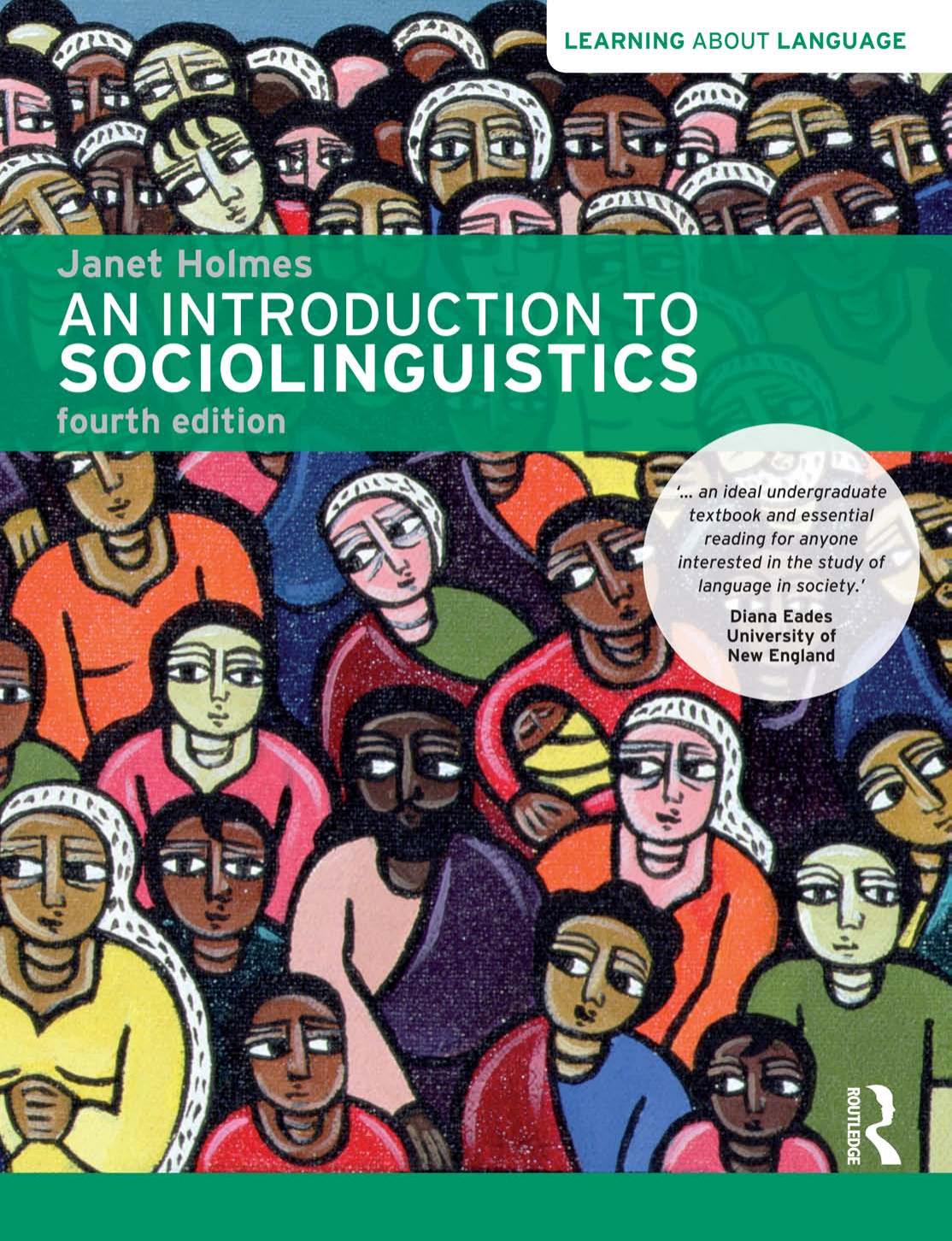
Product details:
ISBN 10: B00HTJWRWE
ISBN 13: 9781000534047
Author: Janet Holmes
Sociolinguistics is the study of the interaction between language and society. In this classic introductory work, Janet Holmes and Nick Wilson examine the role of language in a variety of social contexts, considering both how language works and how it can be used to signal and interpret various aspects of social identity. Divided into three parts, this book explains basic sociolinguistic concepts in the light of classic approaches, as well as introducing more recent research. This sixth edition has been revised and updated throughout, using key concepts and examples to guide the reader through this fascinating area, including: • New material on gender, social media and online use of language, codeswitching, and language policy • An updated companion website that is fully cross- referenced within this book and features video and audio materials and links to useful websites • Revised examples and exercises that include new material from Asia and South America • Fully updated further reading and references sections An Introduction to Sociolinguistics is an essential introductory text for all students of sociolinguistics and a splendid point of reference for students of English language studies, linguistics, and applied linguistics.
An Introduction to Sociolinguistics 4th Table of contents:
1 What do sociolinguists study?
What is a sociolinguist?
Why do we say the same thing in different ways?
What are the different ways we say things?
Social factors, dimensions, and explanations
Social factors
Social dimensions
The solidarity–social distance scale
The status scale
The formality scale
The referential and affective function scales
Looking for explanations
Some guidelines for reading this book
References
Part I Multilingual speech communities
2 Language choice in multilingual communities
Choosing your variety or code
What is your linguistic repertoire?
Domains of language use
Modelling variety or code choice
Other social factors affecting code choice
Diglossia
A linguistic division of labour
Attitudes to H vs. L in a diglossia situation
Diglossia with and without bilingualism
Extending the scope of diglossia
Polyglossia
Changes in a diglossia situation
Code-switching or code-mixing and translanguaging
Participants, solidarity and status
Topic
Switching for affective functions
Metaphorical switching
Lexical borrowing
Linguistic constraints
Attitudes to code-switching
Translanguaging
References
3 Language maintenance and shift
Language shift in different communities
Migrant minorities
Non-migrant communities
Migrant majorities
Language death and language loss
Factors contributing to language shift
Economic, social and political factors
Demographic factors
Attitudes and values
How can a minority language be maintained?
Language revival
References
4 Linguistic varieties and multilingual nations
Vernacular languages
Standard languages
World Englishes
Lingua francas
Pidgins and creoles
Pidgins
Why do pidgins develop?
What kind of linguistic structure does a pidgin language have?
Attitudes to pidgins
Lifecycle and origins of pidgins
Creoles
Structural features
Functions
Attitudes
Origins and endings
References
5 National languages, language policy, and language planning
National and official languages
Official status and minority languages
What price a national language?
Planning for a national official language
Form, functions and attitudes
Case study: Tanzania
Selecting a code
Codifying and elaborating Swahili
Attitudes to Swahili
Developing a standard variety in Norway
Selecting a code
Codification and elaboration
Acceptance
Linguistic landscapes in social and political context
The linguist’s role in language planning
Codification of orthography
Developing vocabulary
Acceptance
Acquisition planning
Conclusion
References
Part II Language variation: focus on users
6 Regional and social dialects
Regional variation
International varieties
Intra-national or intra-continental variation
Cross-continental variation: dialect chains
Social variation
Received Pronunciation: a social accent
Social dialects
Standard English
Caste dialects
Social class dialects
Vocabulary
Pronunciation
Grammatical patterns
A note about methodology
Conclusion
References
7 Gender and age
Gender-exclusive speech differences: highly structured communities
Gender-preferential speech features: variationist sociolinguistics
Gender and social class
Explanations for women’s linguistic behaviour
The social status explanation
Woman’s role as guardian of society’s values
Subordinate groups must be polite
Vernacular forms express machismo
Some alternative explanations
How are women categorised?
The influence of the interviewer and the context
Age-graded features of speech
Age and social dialect data
Age grading and language change
Conclusion
References
8 Ethnicity and social networks
Ethnicity
African American Language (AAL)
Black British English
Ma—ori English
New Englishes
Ethnolects in languages other than English
Social networks
Communities of practice and the construction of social identity
Conclusion
References
9 Language change
Variation and change
Post-vocalic [r] – its spread and its status
The spread of vernacular forms
Koines and koineisation
How do language changes spread?
From group to group
From style to style
From word to word – lexical diffusion
How do we study language change?
Apparent-time studies of language change
Language change in real time
Reasons for language change
Contact-induced change
Social status and language change
Gender and language change
Interaction and language change
Conclusion
References
Interlude: identity in sociolinguistics
Sociolinguistics and identity
Indexicality
References and further reading
Part III Language variation: focus on uses
10 Style, context, and register
Addressee as an influence on style
Age of addressee
Social background of addressee
Accommodation theory
Speech convergence
How do speakers accommodate?
Speech divergence
Stylisation
Accommodation problems
Context, style, and social class
Formal contexts and social roles
Different styles within an interview
Colloquial style or the vernacular
The interaction of social class and style
Hypercorrection
Stereotypes, markers and indicators
Third-wave variationist approaches to the concept of style
Style in non-English speaking societies
Register
Sports commentator talk
Syntactic reduction
Syntactic inversion
Heavy noun modification
Routines and formulas
Conclusion
References
11 Speech functions, politeness, and cross-cultural communication
The functions of speech
Directives
Identity construction: a more abstract function of interaction
Politeness and address forms
Linguistic politeness in different cultures
Greetings
Conclusion
References
12 Gender, politeness, and stereotypes
“Women’s language” and confidence
Features of “women’s language”
Lakoff’s linguistic features as politeness devices
Interaction
Interrupting behaviour
Conversational feedback
Explanations for gender differences in interaction
Gossip
The linguistic construction of gender identity
The linguistic construction of sexuality
Sexist language
Can a language be sexist?
Conclusion
References
13 Language, cognition, and culture
Language and perception
Verbal hygiene
Whorf: the relationship between language and thought
Vocabulary and cognition
Linguistic determinism: the medium is the message
Grammar and cognition
Linguistic categories and culture
The cost of language loss
Discourse patterns and culture
Language, social class, and cognition
Conclusion
References
14 Analysing discourse
Pragmatics and politeness theory
What is pragmatics?
Conversational maxims and implicatures
Conversational maxims and politeness
Sociolinguistics, politeness and rapport management
Ethnography of speaking
Insiders and outsiders
Interactional sociolinguistics
Contextualisation cues
Miscommunication
Conversation Analysis (CA)
Preferred and dispreferred second pair parts
Conversational feedback
Interruptions and overlaps
Keeping just to the text
Critical Discourse Analysis (CDA)
Power and CDA
Ideology and CDA
Multimodal analysis
Conclusion
References
15 Attitudes and applications
Attitudes to language
Overt and covert prestige
Attitudes to standard British English and RP
Attitudes to vernacular forms of English
African American Language
Vernacular forms of English: users and contexts
A note on methodology
Societal treatment
Direct measures
Indirect measures
Sociolinguistics and education
Vernacular dialects and educational disadvantage
Linguistic deficit
Sociolinguistics and forensic linguistics
Microaggression
Conclusion
References
16 Conclusion
Sociolinguistic competence
Dimensions of sociolinguistic analysis
Solidarity/social distance
Status/power
Formality
Function
Sociolinguistic universals
Tailpiece
References and sources
People also search for An Introduction to Sociolinguistics 4th:
an introduction to sociolinguistics 4th edition pdf
an introduction to sociolinguistics 4th ed
an introduction to sociolinguistics 4th ed routledge
an introduction to sociolinguistics janet holmes 4th edition
sociolinguistics an introduction to language and society (4th ed
Tags: Janet Holmes, An Introduction