


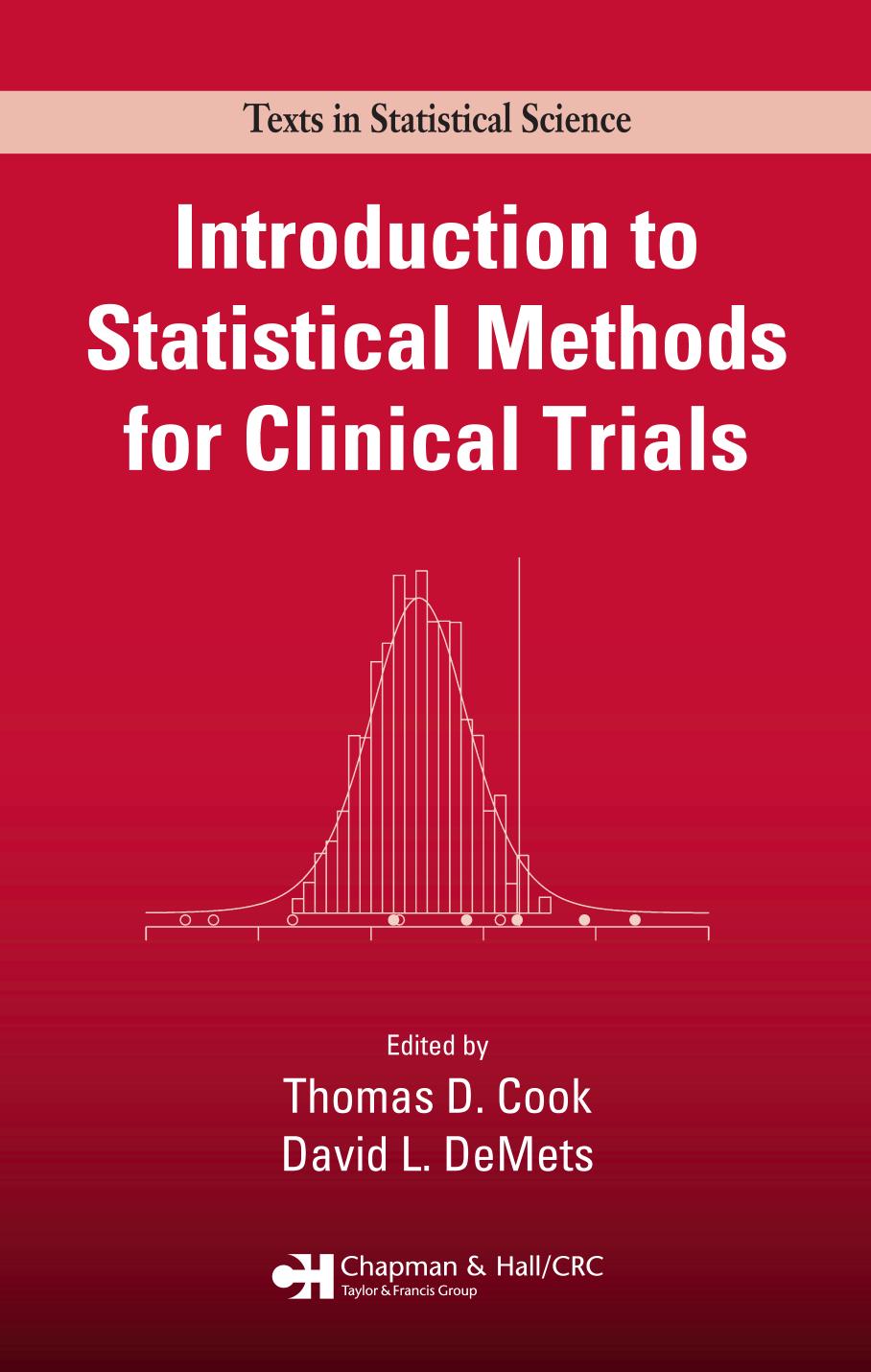
Introduction to Statistical Methods for Clinical Trials 1st edition by Bradley Carlin, Thomas Cook, Julian Faraway, Jim Zidek, Martin Tanner, David DeMets ISBN 1584880279 978-1584880271
Original price was: $70.00.$35.00Current price is: $35.00.
Instant download Introduction to Statistical Methods for Clinical Trials after payment
Introduction to Statistical Methods for Clinical Trials 1st edition by Bradley Carlin, Thomas Cook, Julian Faraway, Jim Zidek, Martin Tanner, David DeMets – Ebook PDF Instant Download/Delivery: 1584880279 , 978-1584880271
Full download Introduction to Statistical Methods for Clinical Trials 1st edition after payment
Product details:
ISBN 10: 1584880279
ISBN 13: 978-1584880271
Author: Bradley Carlin, Thomas Cook, Julian Faraway, Jim Zidek, Martin Tanner, David DeMets
Clinical trials have become essential research tools for evaluating the benefits and risks of new interventions for the treatment and prevention of diseases, from cardiovascular disease to cancer to AIDS. Based on the authors’ collective experiences in this field, Introduction to Statistical Methods for Clinical Trials presents various statistical topics relevant to the design, monitoring, and analysis of a clinical trial.
After reviewing the history, ethics, protocol, and regulatory issues of clinical trials, the book provides guidelines for formulating primary and secondary questions and translating clinical questions into statistical ones. It examines designs used in clinical trials, presents methods for determining sample size, and introduces constrained randomization procedures. The authors also discuss how various types of data must be collected to answer key questions in a trial. In addition, they explore common analysis methods, describe statistical methods that determine what an emerging trend represents, and present issues that arise in the analysis of data. The book concludes with suggestions for reporting trial results that are consistent with universal guidelines recommended by medical journals.
Developed from a course taught at the University of Wisconsin for the past 25 years, this textbook provides a solid understanding of the statistical approaches used in the design, conduct, and analysis of clinical trials.
Introduction to Statistical Methods for Clinical Trials 1st Table of contents:
1 Introduction to Clinical Trials
1.1 History and Background
1.2 Ethics of Clinical Research
1.3 Types of Research Design and Types of Trials
1.4 The Need for Clinical Trials
1.5 The Randomization Principle
1.6 Timing of a Clinical Trial
1.7 Trial Organization
1.8 Protocol and Manual of Operations
1.9 Regulatory Issues
1.9.1 Institutional Review Board
1.9.2 Informed Consent Process Guidelines
1.9.3 Food and Drug Administration & Other Regulatory Agencies
1.10 Overview of the Book
2 Defining the Question
2.1 Statistical Framework
2.1.1 Causal Inference
2.1.2 The Intent-To-Treat Principle
2.2 Elements of Study Question
2.2.1 The Population
2.2.2 Primary and Secondary Questions
2.2.3 Subgroup Questions
2.2.4 Safety Questions
2.3 Outcome or Response Measures
2.3.1 Analysis of Outcome Variables
Ordinal outcomes
Continuous Outcomes
Failure Time Outcomes
Stratification
2.4 The Surrogate Outcome
2.4.1 Criteria for Surrogacy
2.4.2 Examples
2.4.3 Statistical Surrogate Validation
2.5 Composite Outcomes
2.5.1 Combining Multiple Outcomes
O’Brien’s Rank-sum Procedure
2.5.2 Composite Failure Time Outcomes
Rationale for the use of Composite Failure Time Outcomes
Multiple Nonfatal Event Types
Recommendations Regarding the use of Composite Failure Time Outcomes
2.5.3 Use of Baseline Measurement
2.6 Summary
2.7 Problems
3 Study Design
3.1 Early Phase Trials
3.1.1 Phase I trials
3.1.2 Phase II Trials
3.2 Phase III/IV Trials
3.2.1 Types of Control Groups
Historical Controls
Concurrent Controls
Randomized Control Trials
3.2.2 Common Randomized Control Designs
Parallel Group Design
Randomized Withdrawal Design
Crossover Design
Factorial Designs
Group-randomization Designs
3.3 Non-inferiority Designs
3.4 Screening, Prevention, and Therapeutic Designs
3.5 Adaptive Designs
3.5.1 Sequential Designs
3.5.2 Outcome Based Adaptive Design
3.6 Conclusions
3.7 Problems
4 Sample Size
4.1 Sample Size versus Information
4.2 A General Setup for Frequentist Designs
4.2.1 Two Sample Binomial
4.3 Loss to Follow-up and Non-adherence
4.3.1 Loss to Follow-up
4.3.2 Non-adherence
4.4 Survival Data
4.4.1 Exponential Case
Common Censoring Time
Loss to Follow-up
4.4.2 Time-dependent Rates of Failure, Loss to Follow-up, and Non-adherence
Shoenfeld’s Formula
Markov Chain Model of Lakatos
4.5 Clustered Data
4.6 Tests for Interaction
4.7 Equivalence/Non-inferiority Trials
4.8 Other Considerations
4.9 Problems
5 Randomization
5.1 The Role of Randomization
5.1.1 Confounding
5.1.2 Selection Bias
5.1.3 Population vs. Randomization Models
5.1.4 Statistical Inference
5.2 Fixed Randomization Procedures
5.2.1 Random Allocation Rule
5.2.2 Complete Randomization
5.2.3 Permuted-Block Randomization
5.3 Treatment- and Response-Adaptive Randomization Procedures
5.3.1 Biased Coin Randomization
5.3.2 Urn Randomization
5.3.3 Play-the-Winner Rule
Randomized Play-the- Winner Rule
5.4 Covariate-Adaptive Randomization Procedures
5.4.1 Stratification
5.4.2 Pocock-Simon
5.5 Summary and Recommendations
5.6 Problems
6 Data Collection and Quality Control
6.1 Planning for Collection of Clinical Trial Data
6.1.1 Identification of Information Required
General Issues
Key Categories of Data
External Factors Influencing Data Collection
6.1.2 Mechanisms of Data Collection
IVES
Clinical Case Report Forms (CEFs)
Expedited Safety Reports
Central/Reference Laboratories
Endpoint Tracking and Adjudication
Schedule of Data Collection and Submission
6.1.3 CRF Design and Review
General Principles of Form Design
Organization of the CRF
Header Information
Form Layout
Item Formats and Content
Changes to CRFs During a Trial
Relationship Between the CRF and Database
6.2 Categories of Clinical Data
6.2.1 Subject Identification and Treatment Assignment
6.2.2 Screening and Baseline Information
6.2.3 Follow-up Visits, Tests, and Procedures
6.2.4 Adherence to Study Treatment
6.2.5 Adverse Experiences
6.2.6 Concomitant Medications and Interventions
6.2.7 Clinical Endpoints
6.2.8 Subject Treatment, Follow-up, and Survival Status
6.3 Data Quality Control
6.3.1 QC During Data Collection and Entry
6.3.2 QC by the Data Management Center
Auditing
6.3.3 QC of External Laboratories and Review Committees
6.3.4 QC by the Data Analysis Center
Verification of Treatment Assignments
Examination of Datasets
Treatment of Missing, Erroneous, and Inconsistent Data
Interactions with the Data Management Center
6.4 Conclusions
7 Survival Analysis
7.1 Background
7.2 Estimation of Survival Distributions
7.2.1 Parametric Approach
7.2.2 Nonparametric Approach
7.2.3 The Kaplan-Meier Estimator
7.3 Comparison of Survival Distributions
7.3.1 Parametric Methods
7.3.2 Nonparametric Methods
7.4 Regression Models
7.4.1 Parametric Models
7.4.2 Semiparametric Models
7.4.3 Cox Partial Likelihood
7.4.4 Estimation and Testing
7.4.5 Estimation of the baseline hazard Λ0
7.4.6 Residuals
7.5 Composite Outcomes
7.6 Summary
7.7 Problems
8 Longitudinal Data
8.1 A Clinical Longitudinal Data Example
8.2 The Subject-specific Model
8.3 Two-stage Estimation
8.3.1 Combined Estimation
8.4 The Random-effects, Subject-specific Model
8.4.1 The Model
8.4.2 Estimation for the Random-Effects Model
8.4.3 Example: Ramus Height Data
8.4.4 Marginal Versus Conditional Models
8.4.5 Serial Conditional Correlation
8.5 The Population-average (Marginal) Model
8.5.1 Varying Design Matrices
8.6 Restricted Maximum Likelihood Estimation (REML)
8.7 Standard Errors
8.7.1 Maximum and Restricted Maximum Likelihood
8.7.2 Robust Estimation of Var(β)
8.8 Testing
8.8.1 Nested Models
8.8.2 Non-nested Models
8.8.3 Example: Bone Density
8.9 Additional Levels of Clustering
8.10 Generalized Estimating Equations for Non-normal Data
8.10.1 Examples
8.10.2 The Model for Longitudinal Data
8.10.3 Example: Epilepsy Data
8.11 Missing Data
8.12 Summary
9 Quality of Life
9.1 Defining QoL
9.2 Types of QoL Assessments
9.2.1 Subject Preference Measures
9.2.2 Health Status and Functional Measures
9.3 Selecting a QoL Instrument
9.3.1 Purpose of the Assessment
9.3.2 Validity
9.3.3 Reliability
9.3.4 Sensitivity and Responsiveness
9.3.5 Determining Clinically Meaningful Differences
9.4 Developing a QoL Instrument
9.5 Quality of Life Data
9.5.1 General Issues
9.5.2 Data Collection Considerations
9.6 Analysis of QoL Data
9.6.1 Longitudinal Data Analysis
Graphical Summaries
Summary Measures
Analysis at each Time Separately
Statistical Modeling for Repeated QoL Measurements
9.6.2 Multivariate Analysis
A Global Test Statistic
Latent Variable Models
Quality-Adjusted Survival Analysis
9.7 Summary
10 Data Monitoring and Interim Analysis
10.1 Data and Safety Monitoring
10.2 Examples
10.2.1 Beta-Blocker Heart Attack Trial
10.2.2 Multicenter Automatic Defibrillator Implantation Trial
10.3 The Repeated Testing Problem
10.3.1 Sampling to a Foregone Conclusion
10.3.2 The General Setup
10.3.3 Repeated Significance Tests
10.4 Group Sequential Tests
10.4.1 Classical Group Sequential Methods
10.4.2 Early Stopping in Favor of the Null Hypothesis: One-Sided Tests
10.4.3 Early Termination in BHAT
10.4.4 Alpha Spending Approach
10.5 Triangular Test
10.5.1 Triangular Test for Normal Data
10.5.2 General Form of the Triangular Test for Continuous Monitoring
10.5.3 Triangular Test with Discrete Monitoring
10.5.4 Triangular Test in MADIT Study
10.6 Curtailment Procedures
10.6.1 Deterministic Curtailment
10.6.2 Stochastic Curtailment
10.6.3 B-value and Conditional Power
10.6.4 Predictive Power
10.7 Inference Following Sequential Tests
10.7.1 Observed Significance
10.7.2 Confidence Interval Estimation
10.7.3 Point Estimation
10.7.4 Inference in MADIT
10.8 Discussion
10.8.1 Comparison of boundaries
10.8.2 Perspectives Regarding Interim Monitoring
10.8.3 Discretion in Data Monitoring
10.8.4 Symmetry
10.8.5 Additional Comments
10.9 Problems
11 Selected Issues in the Analysis
11.1 Bias in the Analysis of Clinical Trial Data
11.2 Choice of Analysis Population
11.2.1 The Intent-To-Treat Principle
Objections to ITT
Implementation of ITT
11.2.2 Nonadherence to Assigned Treatment
11.2.3 Ineligibility
Examples
11.2.4 Model-based Alternatives to ITT
Complier Average Causal Effect
Efron and Feldman Causal Model
11.3 Missing Data
11.3.1 Terminology
11.3.2 Sensitivity Analysis
11.3.3 Imputation
Last Observation Carried Forward
11.3.4 Censoring in Survival Analyses
11.3.5 Competing Risks
11.4 Subgroup Analyses
11.4.1 Baseline Subgroups
11.4.2 Subgroups Defined by a Post-Randomization Outcome
11.5 Multiple Testing Procedures
Example
Additional Notation
11.5.1 Bonferroni Procedure
11.5.2 Closed Testing Procedures
11.5.3 Other Multiple Testing Procedures
11.6 Summary
11.7 Problems
12 Closeout and Reporting
12.1 Closing Out a Trial
12.2 Reporting Trial Results
12.2.1 Oral Presentation
12.2.2 Scientific Publication
Introduction
Methods Section
Results Section
Discussion Section
Authorship/Attribution
12.3 Problems
People also search for Introduction to Statistical Methods for Clinical Trials 1st :
introduction to statistical methods for clinical trials pdf
statistical methods for clinical trials
introduction to statistical methods and data analysis
introduction to statistical methods
clinical trials statistical analysis
Tags: Bradley Carlin, Thomas Cook, Julian Faraway, Jim Zidek, Martin Tanner, David DeMets, Statistical Methods, Clinical Trials