


Java Software Structures Designing and Using Data 4th Edition by John Lewis, Joseph Chase – Ebook PDF Instant Download/Delivery: 0137618019, 9780137618019
Full download Java Software Structures Designing and Using Data 4th edition after payment
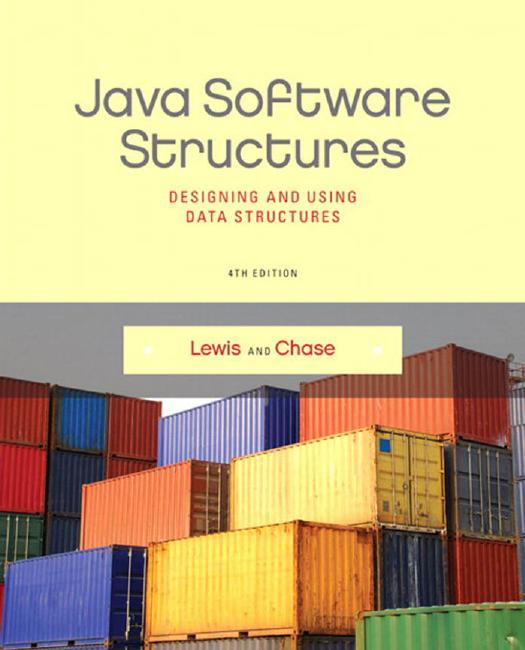
Product details:
ISBN 10: 0137618019
ISBN 13: 9780137618019
Author: John Lewis, Joseph Chase
This is the eBook of the printed book and may not include any media, website access codes, or print supplements that may come packaged with the bound book. The fourth edition of Java Software Structuresembraces the enhancements of the latest version of Java, where all structures and collections are based on generics. The framework of the text walks the reader through three main areas: conceptualization, explanation, and implementation, allowing for a consistent and coherent introduction to data structures. Readers will learn how to develop high-quality software systems using well-designed collections and algorithms.
Java Software Structures Designing and Using Data 4th Table of contents:
1. Introduction
-
1.1 Software Quality
-
Correctness
-
Reliability
-
Robustness
-
Usability
-
Maintainability
-
Reusability
-
Portability
-
Efficiency
-
Quality Issues
-
-
1.2 Data Structures
-
A Physical Example
-
Containers as Objects
-
2. Analysis of Algorithms
-
2.1 Algorithm Efficiency
-
2.2 Growth Functions and Big-Oh Notation
-
2.3 Comparing Growth Functions
-
2.4 Determining Time Complexity
-
Analyzing Loop Execution
-
Nested Loops
-
Method Calls
-
3. Introduction to Collections – Stacks
-
3.1 Collections
-
Abstract Data Types
-
The Java Collections API
-
-
3.2 A Stack Collection
-
3.3 Crucial OO Concepts
-
Inheritance and Polymorphism
-
Generics
-
-
3.4 Using Stacks: Evaluating Postfix Expressions
-
Javadoc
-
-
3.5 Exceptions
-
3.6 A Stack ADT
-
3.7 Implementing a Stack: With Arrays
-
Managing Capacity
-
-
3.8 The ArrayStack Class
-
The Constructors
-
The push Operation
-
The pop Operation
-
The peek Operation
-
Other Operations
-
The EmptyCollectionException Class
-
Other Implementations
-
4. Linked Structures – Stacks
-
4.1 References as Links
-
4.2 Managing Linked Lists
-
Accessing Elements
-
Inserting Nodes
-
Deleting Nodes
-
-
4.3 Elements without Links
-
Doubly Linked Lists
-
-
4.4 Stacks in the Java API
-
4.5 Using Stacks: Traversing a Maze
-
4.6 Implementing a Stack: With Links
-
The LinkedStack Class
-
The push Operation
-
The pop Operation
-
Other Operations
-
5. Queues
-
5.1 A Conceptual Queue
-
5.2 Queues in the Java API
-
5.3 Using Queues: Code Keys
-
5.4 Using Queues: Ticket Counter Simulation
-
5.5 A Queue ADT
-
5.6 A Linked Implementation of a Queue
-
The enqueue Operation
-
The dequeue Operation
-
Other Operations
-
-
5.7 Implementing Queues: With Arrays
-
The enqueue Operation
-
The dequeue Operation
-
Other Operations
-
-
5.8 Double-Ended Queues (Deque)
6. Lists
-
6.1 A List Collection
-
6.2 Lists in the Java Collections API
-
6.3 Using Unordered Lists: Program of Study
-
6.4 Using Indexed Lists: Josephus
-
6.5 A List ADT
-
Adding Elements to a List
-
-
6.6 Implementing Lists with Arrays
-
The remove Operation
-
The contains Operation
-
The add Operation for an Ordered List
-
Operations Particular to Unordered Lists
-
The addAfter Operation for an Unordered List
-
-
6.7 Implementing Lists with Links
-
The remove Operation
-
7. Iterators
-
7.1 What’s an Iterator?
-
Other Iterator Issues
-
-
7.2 Using Iterators: Program of Study Revisited
-
Printing Certain Courses
-
Removing Courses
-
-
7.3 Implementing Iterators: With Arrays
-
7.4 Implementing Iterators: With Links
8. Recursion
-
8.1 Recursive Thinking
-
Infinite Recursion
-
Recursion in Math
-
-
8.2 Recursive Programming
-
Recursion versus Iteration
-
Direct versus Indirect Recursion
-
-
8.3 Using Recursion
-
Traversing a Maze
-
The Towers of Hanoi
-
-
8.4 Analyzing Recursive Algorithms
9. Searching and Sorting
-
9.1 Searching
-
Static Methods
-
Generic Methods
-
Linear Search
-
Binary Search
-
Comparing Search Algorithms
-
-
9.2 Sorting
-
Selection Sort
-
Insertion Sort
-
Bubble Sort
-
Quick Sort
-
Merge Sort
-
-
9.3 Radix Sort
10. Trees
-
10.1 Trees
-
Tree Classifications
-
-
10.2 Strategies for Implementing Trees
-
Computational Strategy for Array Implementation
-
Simulated Link Strategy for Array Implementation
-
Analysis of Trees
-
-
10.3 Tree Traversals
-
Preorder Traversal
-
Inorder Traversal
-
Postorder Traversal
-
Level-Order Traversal
-
-
10.4 A Binary Tree ADT
-
10.5 Using Binary Trees: Expression Trees
-
10.6 A Back Pain Analyzer
-
10.7 Implementing Binary Trees with Links
-
The find Method
-
The iteratorInOrder Method
-
11. Binary Search Trees
-
11.1 A Binary Search Tree
-
11.2 Implementing Binary Search Trees: With Links
-
The addElement Operation
-
The removeElement Operation
-
The removeAllOccurrences Operation
-
The removeMin Operation
-
Implementing Binary Search Trees: With Arrays
-
-
11.3 Using Binary Search Trees: Implementing Ordered Lists
-
Analysis of the BinarySearchTreeList Implementation
-
-
11.4 Balanced Binary Search Trees
-
Right Rotation
-
Left Rotation
-
Rightleft Rotation
-
Leftright Rotation
-
-
11.5 Implementing BSTs: AVL Trees
-
Right Rotation in an AVL Tree
-
Left Rotation in an AVL Tree
-
Rightleft Rotation in an AVL Tree
-
Leftright Rotation in an AVL Tree
-
-
11.6 Implementing BSTs: Red/Black Trees
-
Insertion into a Red/Black Tree
-
Element Removal from a Red/Black Tree
-
12. Heaps and Priority Queues
-
12.1 A Heap
-
The addElement Operation
-
The removeMin Operation
-
The findMin Operation
-
-
12.2 Using Heaps: Priority Queues
-
12.3 Implementing Heaps: With Links
-
The addElement Operation
-
The removeMin Operation
-
The findMin Operation
-
-
12.4 Implementing Heaps: With Arrays
-
The addElement Operation
-
The removeMin Operation
-
The findMin Operation
-
-
12.5 Using Heaps: Heap Sort
13. Sets and Maps
-
13.1 Set and Map Collections
-
13.2 Sets and Maps in the Java API
-
13.3 Using Sets: Domain Blocker
-
13.4 Using Maps: Product Sales
-
13.5 Using Maps: User Management
-
13.6 Implementing Sets and Maps Using Trees
-
13.7 Implementing Sets and Maps Using Hashing
14. Multi-way Search Trees
-
14.1 Combining Tree Concepts
-
14.2 2-3 Trees
-
Inserting Elements into a 2-3 Tree
-
Removing Elements from a 2-3 Tree
-
-
14.3 2-4 Trees
-
14.4 B-Trees
-
B*-Trees
-
B+-Trees
-
Analysis of B-Trees
-
-
14.5 Implementation Strategies for B-Trees
15. Graphs
-
15.1 Undirected Graphs
-
15.2 Directed Graphs
-
15.3 Networks
-
15.4 Common Graph Algorithms
-
Traversals
-
Testing for Connectivity
-
Minimum Spanning Trees
-
Determining the Shortest Path
-
-
15.5 Strategies for Implementing Graphs
-
Adjacency Lists
-
Adjacency Matrices
-
-
15.6 Implementing Undirected Graphs with an Adjacency Matrix
-
The addEdge Method
-
The addVertex Method
-
The expandCapacity Method
-
Other Methods
-
People also search for Java Software Structures Designing and Using Data 4th :
top 5 structural design software
java software structures designing and using data structures
java software structures designing and using data structures 4th edition
top 10 structural design software
java software structures 4th edition pdf
Tags: John Lewis, Joseph Chase, Java Software, Using Data