


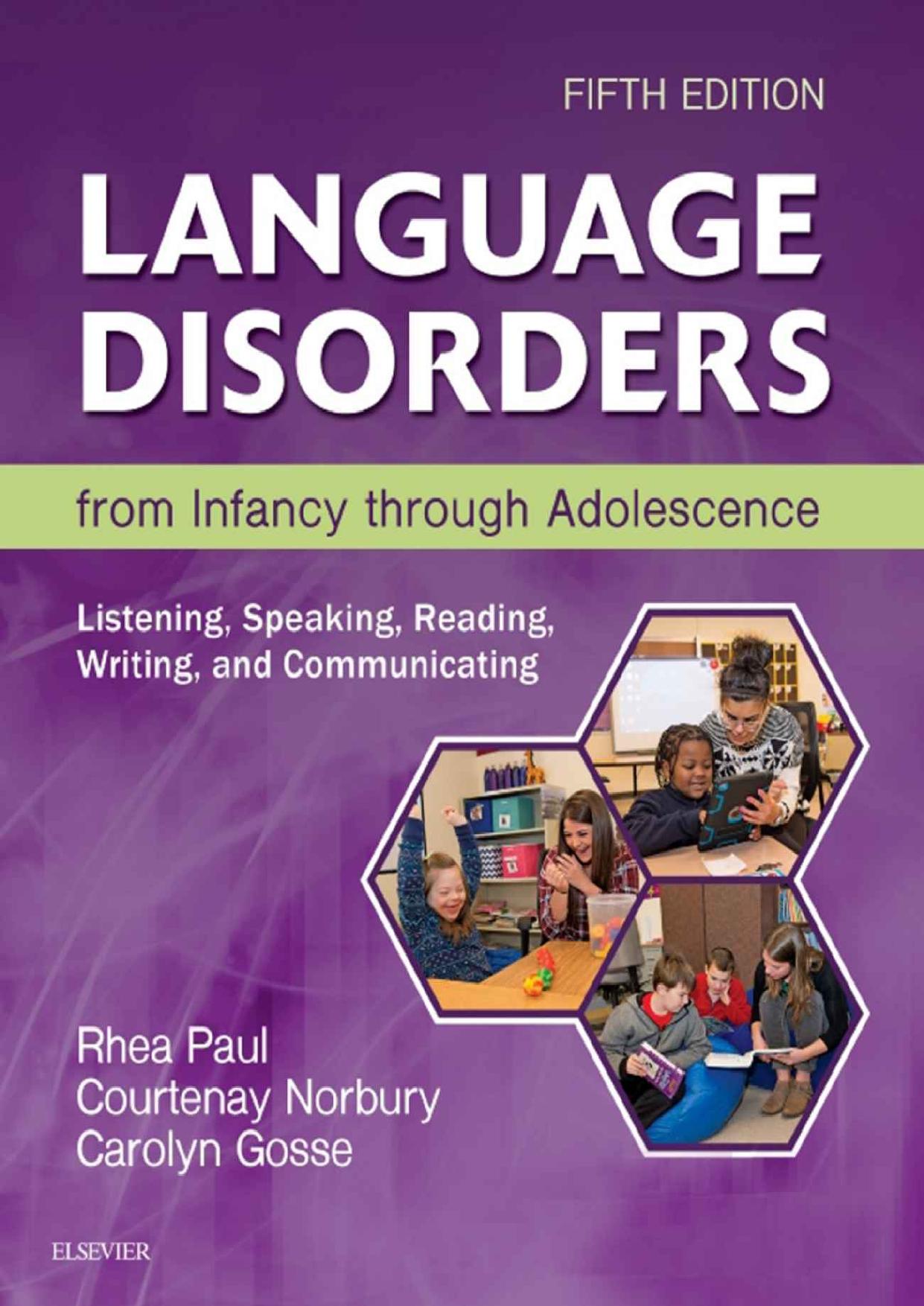
Language Disorders from Infancy Through Adolescence 5th edition by Rhea Paul, Courtenay Norbury, Carolyn Gosse ISBN B07856JLCV 978-0323442350
Original price was: $70.00.$35.00Current price is: $35.00.
Instant download Language Disorders from Infancy Through Adolescence E Book Listening Speaking Reading Writing and Communicating after payment
Language Disorders from Infancy Through Adolescence 5th edition by Rhea Paul, Courtenay Norbury, Carolyn Gosse – Ebook PDF Instant Download/Delivery: B07856JLCV, 978-0323442350
Full download Language Disorders from Infancy Through Adolescence 5th edition after payment
Product details:
ISBN 10: B07856JLCV
ISBN 13: 978-0323442350
Author: Rhea Paul, Courtenay Norbury, Carolyn Gosse
**Selected for Doody’s Core Titles® 2024 with “Essential Purchase” designation in Communication Sciences & Disorders**Spanning the entire childhood developmental period, Language Disorders from Infancy Through Adolescence, 5th Edition is the go-to text for learning how to properly assess childhood language disorders and provide appropriate treatment. The most comprehensive title available on childhood language disorders, it uses a descriptive-developmental approach to present basic concepts and vocabulary, an overview of key issues and controversies, the scope of communicative difficulties that make up child language disorders, and information on how language pathologists approach the assessment and intervention processes. This new edition also features significant updates in research, trends, social skills assessment, and instruction best practices.
– Clinical application focus featuring case studies, clinical vignettes, and suggested projects helps you apply concepts to professional practice.
– UNIQUE! Practice exercises with sample transcripts allow you to apply different methods of analysis.
– UNIQUE! Helpful study guides at the end of each chapter help you review and apply what you have learned.
– Highly regarded lead author who is an expert in language disorders in children provides authoritative guidance on the diagnosis and management of pediatric language disorders.
– More than 230 tables and boxes summarize important information such as dialogue examples, sample assessment plans, assessment and intervention principles, activities, and sample transcripts.
– Student/Professional Resources on Evolve include an image bank, video clips, and references linked to PubMed.
– NEW! Common core standards for language arts incorporated into the preschool and school-age chapters.
– NEW! Updated content features the latest research, theories, trends and techniques in the field.
– Information on preparing high-functioning students with autism for college
– Social skills training for students with autism
– The role of the speech-language pathologist on school literacy teams and in response to intervention
– Emerging theories of etiology and psychopathology added to Models of Child Language Disorders chapter
– Use of emerging technologies for assessment and intervention
Language Disorders from Infancy Through Adolescence 5th Table of contents:
SECTION I. Topics in Childhood Language Disorders
1. Models of child language disorders
Diagnostic issues in developmental language disorders
A brief history of the field of language pathology
Terminology
Aspects and modalities of language disorder
Diagnostic issues
Etiology of developmental language disorder
Comorbidity in developmental language disorder
Conclusion
Study guide
2. Evaluation and assessment
General principles of assessment for suspected developmental language disorder
Beginning the assessment process: Referral, case review, and observation
Mapping the assessment plan: Why and what to assess
Choosing measures: How will we assess?
Integrating and interpreting assessment data
Conclusions
Study guide
3. Principles of intervention
The purpose of intervention
Developing intervention plans
Evaluating intervention outcomes
Prevention of language disorders in children
Conclusions
Study guide
4. Special considerations for special populations
Intellectual disability
Developmental language disorder associated with disorders of known genetic origin
Language disorders associated with sensory impairments
Developmental language disorder associated with acquired neurological disorder
Developmental language disorder associated with other neurodevelopmental disorders
Developmental language disorder associated with extreme environmental disadvantage
The nonspeaking child
Conclusion
Study guide
5. Developmental language disorders in a pluralistic society
Introduction
The culturally competent clinician
Bilingualism
Working with families
Assessing culturally and linguistically different children
Summary
Language intervention with the culturally and linguistically different child
Conclusions
Study guide
Culturally and linguistically diverse students
SECTION II. From Birth to Brown’s Stage V
6. Assessment and intervention in the prelinguistic period
Family-centered practice
Service plans for prelinguistic clients
Risk factors for communication disorders in infants
Assessment and intervention for high-risk infants and their families in the newborn intensive care nursery
Assessment and intervention for preintentional infants and their families: 1 to 8 months old
Assessment and intervention for infants at prelinguistic stages of communication: 9 to 18 months old
Considerations for older prelinguistic clients and those with autism spectrum disorders
Infants and toddlers with autism spectrum disorders
Conclusions
Study guide
7. Assessment and intervention for emerging language
Issues in early assessment and intervention
Assessing communicative intention
Assessing comprehension
Assessing productive language
Decision-making based on assessment information
From assessment to intervention
Products, procedures, and contexts of intervention for children with emerging language
Toddlers with autism spectrum disorder
Considerations for older clients in the emerging language stage
Conclusions
Study guide
Proportion of multiword utterances
Semantic relations expressed in multiword utterances
Proportion of multiword utterances in “other” category
8. Assessment of developing language
Family-centered assessment
Assessing collateral areas
Screening for language disorders in the period of developing language
Using standardized tests in assessing developing language
Criterion-referenced assessment and behavioral observation for children with developing language
Considerations for the older clients with severe disabilities and those with autism spectrum disorder at the developing language stage
Conclusions
Study guide
9. Intervention for developing language
Intervention policy issues at the developing language level
Intervention for developing language: Products, processes, and contexts
Intervention for older clients with severe impairment and autism spectrum disorder at the developing language level
Conclusions
Study guide
SECTION III. Working with Language Learning Disabilities
10. Language, reading, and learning in school: What the speech-language pathologist needs to know
School-based practice in speech-language pathology
Students with language learning disabilities
Language, learning, and reading: What’s the connection?
Conclusions
Study guide
11. Assessing students’ language for learning
Child and family in the assessment process
Identifying students for communication assessment
Evaluation for special educational needs
Criterion-referenced assessment and behavioral observation in the language for learning stage
Considerations for older, severely affected students at the language for learning stage
Considerations for speakers with autism spectrum disorder at the language for learning stage
Conclusions
Study guide
Percentage complex sentences
Complex sentence types
Conjunctions used
Evaluation
Plan
Narrative macrostructure
Literary language style (box 11.11)
Evaluation
12. Intervening at the language-for-learning period
Planning intervention in the language for learning stage
Intervention products in the language for learning period
Intervention processes in the language for learning period
Intervention contexts in the language for learning period
Considerations for the older clients with moderate to severe disabilities and those with autism spectrum disorder
Conclusions
Study guide
13. Assessing advanced language
Language development in adolescence
Student-centered assessment
Screening, case finding, and establishing eligibility with standardized tests in the advanced language stage
Criterion-referenced assessment and behavioral observation in the advanced language stage
Assessing functional communication in students with severe disabilities in the advanced language stage
Conclusions
Study guide
14. Intervention for advanced language
Issues in intervention at the advanced language stage
Products of intervention in the advanced language stage
Processes of intervention in the advanced language stage
Contexts of intervention in the advanced language stage
Special considerations for high functioning students with autism spectrum disorder
Transitional intervention planning
Conclusions
Study guide
Transition planning summary
Bibliography
Name index
Subject index
Inside back cover
People also search for Language Disorders from Infancy Through Adolescence 5th:
language disorders from infancy through adolescence 6th edition
rhea paul’s language disorders from infancy through adolescence
borrow language disorders from infancy through adolescence – ebook
language disorders from infancy through adolescence 5th edition pdf
language disorders from infancy through adolescence 6th edition pdf
Tags: Rhea Paul, Courtenay Norbury, Carolyn Gosse, Language Disorders