


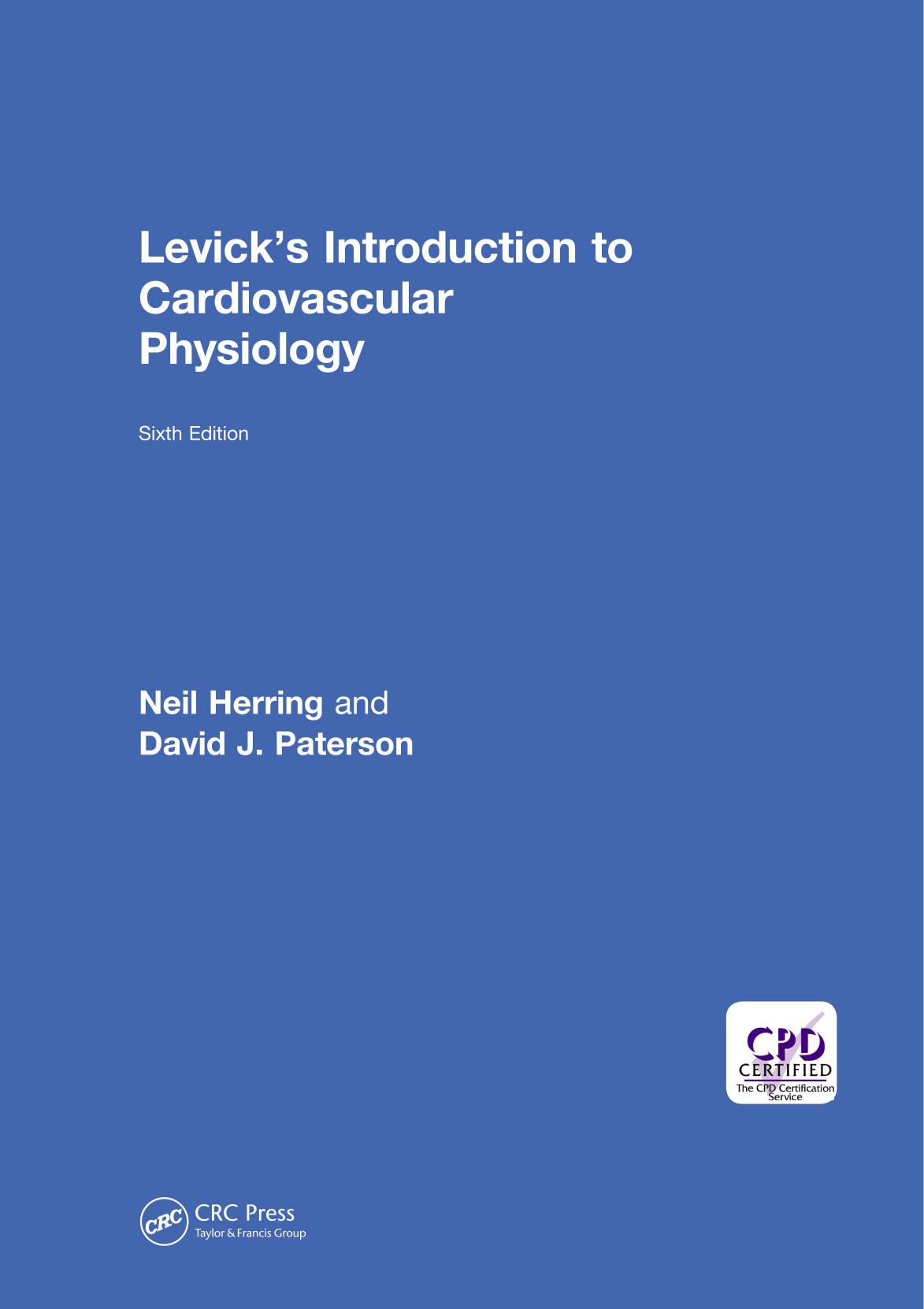
Levick’s Introduction to Cardiovascular Physiology 6th edition by Neil Herring, David Paterson – Ebook PDF Instant Download/Delivery: 1498739849 , 978-1498739849
Full download Levick’s Introduction to Cardiovascular Physiology 6th edition after payment

Product details:
ISBN 10: 1498739849
ISBN 13: 978-1498739849
Author: Neil Herring, David Paterson
A sound knowledge of cardiovascular physiology is fundamental to understanding cardiovascular disease, exercise performance and may other aspects of human physiology. Cardiovascular physiology is a major component of all undergraduate courses in physiology, biomedical science and medicine, and this popular introduction to the subject is intended primarily for these students. A key feature of this sixth edition is how state-of-the-art technology is applied to understanding cardiovascular function in health and disease. Thus the text is also well suited to graduate study programmes in medicine and physiological sciences.
Levick’s Introduction to Cardiovascular Physiology 6th Table of contents:
1 Overview of the cardiovascular system
1.1 Diffusion: its Virtues and Limitations
1.2 Functions of the Cardiovascular System
1.3 The Circulation of Blood
1.4 Cardiac Output and Its Distribution
1.5 Introducing ‘Hydraulics’: Flow, Pressure and Resistance
1.6 Blood Vessel Structure
1.7 Functional Classes of Vessel
1.8 The Plumbing of the Circulation
1.9 Control Systems
2 The cardiac cycle
2.1 The Gross Structure of the Heart
2.2 The Ventricular Cycle
2.3 The Atrial Cycle and Jugular Venous Pressure Waves
2.4 Altered Phase Durations When Heart Rate Increases
2.5 Heart Sounds and Valve Abnormalities
2.6 Clinical Assessment of the Cardiac Cycle
3 The cardiac myocyte: excitation and contraction
3.1 The Importance of Calcium
3.2 Ultrastructure of a Cardiac Myocyte
3.3 Mechanism of Contraction
3.4 Resting Membrane Potential
3.5 Role of Pumps And Exchangers
3.6 Cardiac Action Potentials
3.6 Cardiac action potentials
3.7 Advanced Aspects: Structure– Function Relations of ION Channels
3.8 Physiological and Pathological Changes in Action Potential
3.9 Excitation–Contraction Coupling and the Calcium Cycle
3.10 Regulation of Contractile
3.11 Store Overload, Afterdepolarization and Arrhythmia
4 Initiation and nervous control of heartbeat
4.1 Organization of the Pacemaker–Conduction System
4.2 Electrical Activity of the Pacemaker
4.3 Transmission of Excitation
4.4 Regulation of the Heart Rate
4.5 Effects of Sympathetic Stimulation
4.6 Effects of Parasympathetic Stimulation
4.7 Local neuromodulators and autonomic co-transmitters
4.7 Local Neuromodulators and Autonomic Co–Transmitters
4.8 Dangers of An Altered Ionic Environment
4.9 Hydrogen ions and ischaemia weaken the heartbeat
4.10 Mechano–Electrical Feedback
5 Electrocardiography and arrhythmias
5.1 Principles Of Electrocardiography
5.2 Relation of ECG Waves to Cardiac Action Potentials
5.3 Standard ECG Leads
5.4 The Cardiac Dipole
5.5 The Excitation Sequence
5.6 Why the QRS Complex is Complex
5.7 The Electrical Axis of the Heart
5.8 The Inverse Problem of Electrocardiography and ECG Imaging (ECGi)
5.9 ECG in Ischaemic Heart Disease
5.10 Arrhythmogenic Mechanisms: A Trigger, Vulnerable Window and Substrate
5.11 Arrhythmias
6 Control of stroke volume and cardiac output
6.1 Overview
6.2 Contractile Properties of Isolated Myocardiumi
6.3 Mechanisms Underlying the Length–Tension Relation
6.4 The Frank–Starling Mechanism
6.5 Stroke Work and the Pressure–Volume Loop
6.5 Stroke Work and the Pressure–Volume Loop
6.6 Central venous pressure and cardiac filling
6.7 Operation of the Frank–Starling Mechanism in Humans
6.8 Laplace’s Law and Dilated Hearts
6.9 Multiple Effects of Arterial Pressure on the Heart
6.10 Sympathetic Regulation of Contractility
6.11 Other Positive Inotropic Influences
6.12 Negative Inotropism, Ischaemia and Arrhythmia
6.13 Co–Ordinated Control of Cardiac Output
6.14 Cardiac Energetics and Metabolism
7 Assessment of cardiac output and arterial pulse
7.1 Fick’s Principle and Pulmonary Oxygen Transport
7.2 Indicator and Thermal Dilution Methods
7.3 Aortic Flow by Pulsed Doppler Method
7.4 Central Arterial Pulse and its Relation to Cardiac Output
7.5 Radionuclide Ventriculography, 2-D Echocardiography, Cardiac Magnetic Resonance Imaging and Other Methods
8 Haemodynamics: flow, pressure and resistance
8.1 hydraulic principles: the laws of darcy and bernoulli
8.2 Patterns Of Blood Flow: Laminar, Turbulent, Single–File
8.3 Measurement Of Blood Flow
8.4 The Arterial Pressure Pulse
8.5 Mean Arterial Pressure And Pressure Measurement
8.6 Pulsatile Flow
8.7 Peripheral Resistance, Poiseuille’S Law And Laplace’s Wall Mechanics
8.8 Viscous Properties of Blood
8.9 Pressure–Flow Relationships and Autoregulation
8.10 Venous Pressure and Volume
8.11 Effects of Gravity on the Venous System
8.2 Venous Blood Flow and the Accessory Pumps
9 Endothelium
9.1 Outline of Endothelial Functions
9.2 Structure of Endothelium
9.3 Ion Channels, Calcium And Endothelial Function
9.4 Nitric Oxide Production By Endothelial Cells
9.5 Other Vasoactive Endothelial Products: Endothelium–Derived Hyperpolarization, Prostacyclin and Endothelins
9.6 Actions of Endothelium on Blood
9.7 Endothelial Permeability and its Regulation
9.8 Endothelium and the Inflammatory Response
9.9 Endothelium and Angiogenesis
9.11 Endothelium, Platelets and Coagulation
10 The microcirculation and solute exchange
10.1 Organization and Perfusion of Exchange Vessels
10.2 Three Types of Capillary
10.3 Diffusion, Convection And Reflection Across A Porous Membrane
10.4 The Concept Of ‘Permeability’
10.5 Lipid–Soluble Molecules Diffuse Extremely Rapidly Across The Endothelium
10.6 Small Lipid–Insoluble Molecules Permeate The Small Pore System
10.7 Large Lipid–Insoluble Molecules Pass Through A Large Pore System
10.8 The Blood–Brain Barrier And Carrier–Mediated Transport
10.9 Extraction And Clearance In Capillaries
10.10 How Blood Flow Affects Solute Transfer
10.11 Physiological Regulation Of Solute Transfer
11 Circulation of fluid between plasma, interstitium and lymph
11.1 The Starling Principle Of Fluid Exchange
11.2 Capillary Blood Pressure (PC) And Its Regulation
11.3 Osmosis Across Capillaries: Plasma Colloid Osmotic Pressure (πP)
11.4 Magnitude And Dynamics Of Extravascular COP (πi, πg)
11.5 Interstitial Matrix And Interstitial Fluid Pressure (Pi)
11.6 Tissue Fluid Balance: Filtration Versus Absorption
11.8 Lymph And The Lymphatic System
11.9 Challenges To Tissue Fluid Balance: Orthostasis And Exercise
11.10 Oedema
11.11 The Swelling Of Inflammation
12 Vascular smooth muscle: excitation, contraction and relaxation
12.1 Overview
12.2 Structure of a Vascular Myocyte
12.3 Contractile Properties and Role of Ca2+
12.4 Vascular Ion Channels
12.5 From Sympathetic Stimulation to Contractile Response
12.7 Physiological Vasodilator Mechanisms
13 Control of blood vessels: intrinsic control
13.1 Overview of vascular control and its roles
13.2 Myogenic response to blood pressure changes
13.3 Regulation by endothelium
13.4 Regulation by Metabolic Vasoactive Factors
13.5 Regulation by Autacoids
13.6 Autoregulation of blood flow
13.7 Metabolic (functional) hyperaemia
13.8 Post-ischaemic (reactive) hyperaemia
13.9 Ischaemia-reperfusion injury
14 Control of blood vessels: extrinsic control by nerves and hormones
14.1 Sympathetic Vasoconstrictor Nerves
14.2 Parasympathetic Vasodilator Nerves
14.3 Sympathetic Vasodilator Nerves
14.4 Nociceptive C-Fibre Mediated Vasodilatation
14.5 Hormonal Control of the Circulation
14.6 Adrenaline and Noradrenaline
14.7 Vasopressin (Antidiuretic Hormone)
14.8 Renin–Angiotensin–Aldosterone System
14.9 Natriuretic Peptides
14.10 Special Features of Venous Control
15 Specialization in individual circulations
15.1 Coronary circulation
15.2 Skeletal muscle circulation
15.3 Cutaneous circulation
15.4 Cerebral Circulation
15.5 Pulmonary Circulation
16 Cardiovascular receptors, reflexes and central control
16.1 Arterial baroreceptors
16.2 The baroreflex
16.3 Receptors in the heart and pulmonary arteries
16.4 Reflexes from cardiac receptors in humans
16.5 Long-term regulation of arterial blood pressure: the kidney link
16.6 Excitatory inputs: Muscle work receptors, arterial chemoreceptors, lung stretch receptors
16.7 Central pathways: Role of the medulla oblongata
16.8 Central pathways: Role of higher regions
16.9 Overview of central control
17 Co-ordinated cardiovascular responses
17.1 Posture (ORTHOSTASIS)
17.2 The valsalva manoeuvre
17.3 Exercise
17.4 Physical training and performance
17.5 Feeding, digestion and the splanchnic circulation
17.6 The diving response
17.7 Ageing
17.8 Sleep and the alerting response
18 Cardiovascular responses in pathological situations
18.1 Systemic hypoxaemia
18.2 Shock and haemorrhage
18.3 Transient loss of consciousness (syncope)
18.4 Hypertension
18.5 Chronic heart failure
19 Experimental models and measurements to study cardiovascular physiology
19.1 The experimental approach
19.2 Isolated cells
19.3 Measurements in isolated cells
19.4 Multicellular preparations
19.5 Measurements in multicellular preparations
19.6 Animal studies in vivo
19.7 Measurements in animal studies in vivo
19.8 Computer modelling
20 Experimental perturbations to investigate cardiovascular physiology
20.1 Physical manipulation
20.2 Chemical manipulation
20.3 Genetic manipulation
20.4 Human clinical studies
People also search for Levick’s Introduction to Cardiovascular Physiology 6th :
levick’s introduction to cardiovascular physiology
levick’s introduction to cardiovascular physiology 6th edition
levick’s introduction to cardiovascular physiology
levick’s introduction to cardiovascular physiology pdf
levick cardiovascular physiology
Tags: Neil Herring, David Paterson, Levick’s Introduction, Cardiovascular Physiology