


M Business Communication 3rd Edition by Kathryn Rentz, Paula Lentz – Ebook PDF Instant Download/Delivery: 0073403229 , 978-0073403229
Full download M Business Communication 3rd edition after payment
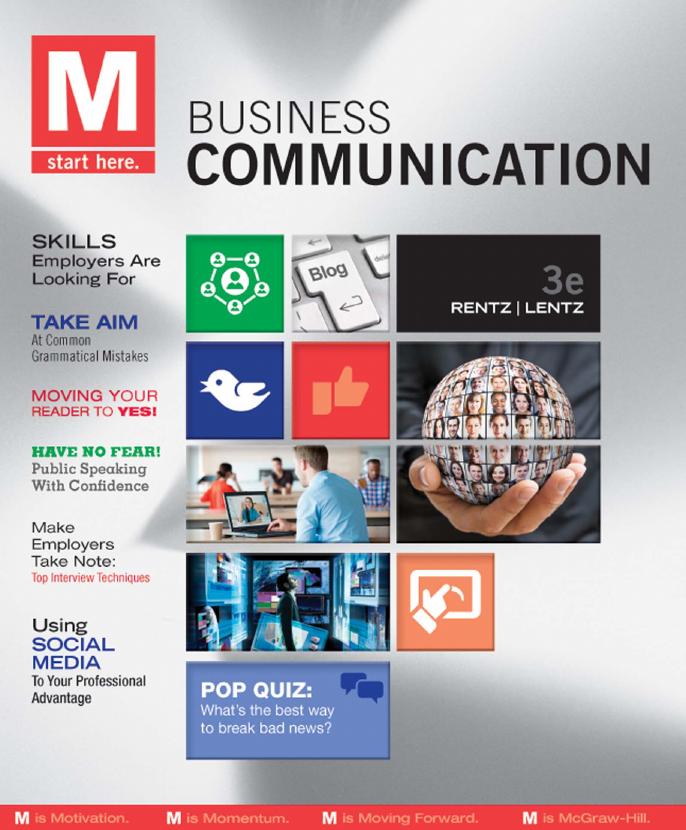
Product details:
ISBN 10: 0073403229
ISBN 13: 978-0073403229
Author: Kathryn Rentz, Paula Lentz
M: Business Communication has become the most technologically current and pedagogically effective product on the market, and is written by the authors of Lesikar’s Business Communication: Making Connections in a Digital World.
Its focus on the essentials required of today’s digital workplace makes it easy for instructors to cover all the materials presented within the semester, and its student-centered design and study resources ensure success.
Paired with Connect Business Communication; M: Business Communication contains the tools needed to navigate through the fast-paced and ever-changing field effectively and efficiently.
M Business Communication 3rd Table of contents:
PART ONE: UNDERSTANDING BUSINESS COMMUNICATION
CHAPTER 1 Communicating in the Workplace
The Role of Communication in Business
The Importance of Communication Skills
Why Business Depends upon Communication
Current Challenges for Business Communicators
Main Categories of Business Communication
Communication Networks of the Organization
Variation in Communication Activity by Business
The Business Communication Process
Business Communication as Problem Solving
A Model of Business Communication
Business Communication: The Bottom Line
Workplace Scenario: Demonstrating Your Value on a High-Profile Team
Communication Matters: This Just In: What You Can Do Is Even More Important than What You Know
Communication Matters: Why Companies Promote Workplace Diversity
Communication Matters: What’s the Dominant Metaphor in Your Workplace?
Communication Matters: Channel Choice Affects Message Success
CHAPTER 2 Understanding the Writing Process and the Main Forms of Business Messages
The Importance of Skillful Writing
The Process of Writing
Planning the Message
Drafting
Revising
Letters
Letters Defined
Letter Form
Letter Formality
Memorandums (Memos)
Memorandums Defined
Memorandum Form
Memorandum Formality
Email Defined
Email Form
Email Formality
Newer Media in Business Writing
Text Messaging
Instant Messaging
Social Media
Print Versus Online Documents
Comparing Print and Online Text
Organizing Content
Presenting the Content
Making Your Web Writing Accessible
Workplace Scenario: The Nature of Business Messages
Communication Matters: Do I Need to Write It?
Communication Matters: Instant Messaging Etiquette in the Workplace
Communication Matters: What Can You Do in 650 Hours Per Year?
From the Tech Desk: Using Good Email Etiquette Helps Writers Achieve Their Goals
PART TWO: MASTERING WRITING AND PRESENTATION BASICS
CHAPTER 3 Communicating Effectively with Visuals
Planning the Visuals
Determining the General Mechanics of Construction
Size
Orientation
Type
Rules and Borders
Color and Cross-Hatching
Clip Art
Background
Numbering
Construction of Titles and Captions
Placement of Titles and Captions
Footnotes and Acknowledgments
Constructing Textual Visuals
Tables
Pull Quotes
Bulleted Lists
Flowcharts and Process Charts
Constructing Charts, Graphs, and Other Visuals
Bar and Column Charts
Pictographs
Pie Charts
Line Charts
Scatter Diagrams
Maps
Combination Charts
Three-Dimensional Visuals
Photographs
Other Visuals
Visual Integrity
Placing and Interpreting the Visuals
Workplace Scenario: Choosing the Right Visuals for Your Data and Your Audience
Communication Matters: Communicating with Color
Communication Matters: Applying Color to Visuals
Communication Matters: Infographics: Everything Old Is New Again
From the Tech Desk: Making the Most of Excel
Communication Matters: Avoiding Chartjunk
Communication Matters: The Periodic Table of Visualization Methods
Communication Matters: Practicing Visual Ethics
CHAPTER 4 Using an Appropriate Style
Adapting Your Style to Your Readers
Selecting Appropriate Words
Use Familiar Words
Prefer Short Words
Use Slang and Popular Clichés with Caution
Use Technical Words and Acronyms Appropriately
Use Precise Language
Select Words for Appropriate Usage
Prefer Active Verbs
Avoid Camouflaged Verbs
Avoiding Discriminatory Writing
Use Gender-Neutral Words
Avoid Words That Stereotype by Race, Nationality, or Sexual Orientation
Avoid Words That Stereotype by Age
Avoid Words That Typecast Those with Disabilities
Some Final Words about Words
Writing Clear Sentences
Limit Sentence Content
Economize on Words
Manage Emphasis in Sentence Design
Give Sentences Unity
Word Sentences Logically
Writing Clear Paragraphs
Give Paragraphs Unity
Keep Paragraphs Short
Make Good Use of Topic Sentences
Leave Out Unnecessary Detail
Make Paragraphs Coherent
Writing for a Positive Effect
Use a Conversational Style
Use the You-Viewpoint
Accent the Positive
Be Courteous
Manage Emphasis for a Positive Effect
Use Positive Emphasis Ethically
Workplace Scenario: Writing with Clarity and Courtesy
Communication Matters: The Most Annoying Business Clichés
From the Tech Desk: Grammar and Style Checkers Help Writers with Word Selection
Communication Matters: Don’t Be Hoodwinked by Homophones
Communication Matters: Everything You Wanted to Know about Active and Passive Voice
Communication Matters: Will the Real Verb Please Stand Up?
Communication Matters: How Diverse Is Too Diverse?
Communication Matters: Understanding the Different Generations in the Workplace
From the Tech Desk: Readability Statistics Help Writers Evaluate Document Length and Difficulty
Communication Matters: Avoiding Stringy and See-Saw Sentences
Communication Matters: Is That a Surplus Word?
Communication Matters: There Is, There Are … Do You Really Need Them?
Communication Matters: Don’t Make Me Laugh
Communication Matters: Beware the Vague or Illogical This
From the Tech Desk: Grammar and Style Checkers Help Writers Identify Clichés, Colloquialisms, and J
Communication Matters: The Business Benefits of Positivity
Communication Matters: Parent, Child, or Adult?
Communication Matters: Business Etiquette—It Depends on Where You Are
From the Tech Desk: Courtesy in the Age of Mobile Devices
PART THREE: WRITING EFFECTIVE MESSAGES
CHAPTER 5 Writing Good-News and Neutral Messages
Preliminary Assessment
The General Direct Plan
Beginning with the Objective
Covering the Remaining Part of the Objective
Ending with Goodwill
Routine Inquiries
Choosing from Two Types of Beginnings
Informing and Explaining Adequately
Structuring the Questions
Ending with Goodwill
Reviewing the Order
Contrasting Examples of a Routine Inquiry
Favorable Responses
Identifying the Message Being Answered
Beginning with the Answer
Logically Arranging the Answers
Skillfully Handling the Negatives
Considering Extras
Closing Cordially
Reviewing the Plan
Contrasting Examples of a Favorable Response
Order Acknowledgments and Other Thank-You Messages
Order Acknowledgments
Directness and Goodwill Building in Order Acknowledgments
Tact in Order Acknowledgments
Strategies for Other Thank-You Messages
Summarizing the Structure of Order Acknowledgments and Other Thank-You Messages
Contrasting Examples of an Order Acknowledgment
Direct Claims
Using Directness for Claims
Organizing the Direct Claim
Reviewing the Plan
Contrasting Examples of a Claim Message
Adjustment Grants
Considering Special Needs
Reviewing the Plan
Contrasting Examples of an Adjustment Grant
Internal-Operational Messages
Casual Operational Messages
Moderately Formal Messages
Formal Messages
Summarizing the Structure of Internal-Operational Messages
Contrasting Examples of an Internal-Operational Message
Other Direct Message Situations
Workplace Scenario: Searching for New Regional Headquarters
Communication Matters: Choosing the Right Font
From the Tech Desk: Shortcut Tools Help Writers Improve Productivity and Quality
Case Illustration: Routine Inquiry (Getting Information about a Training Program)
Case Illustration: Routine Inquiry (An Inquiry about Hotel Accommodations)
Workplace Scenario: Answering a Potential Customer’s Questions
Communication Matters: How Routine Responses Were Written in the Late 1800s
Case Illustration: Routine Response (Favorable Response to a Professor’s Request)
Case Illustration: Routine Response (Answering a Request for Detailed Information)
Workplace Scenario: Building Goodwill with a “Thank-You” Message
From the Tech Desk: Tables Help Writers Organize Data for Easy Reading
Communication Matters: A Workplace without Email? One Company’s Strategy
Case Illustration: Online Order Acknowledgment (Order Confirmation with a Second Purpose)
Case Illustration: Order Acknowledgment (Acknowledgment with a Problem)
Case Illustration: Thank-You Message (A Follow-Up to a Meeting)
Workplace Scenario: Requesting a Correct Shipment and Revised Invoice
From the Tech Desk: Quick Parts Makes Quick Work for Business Writers
Workplace Scenario: Dealing with the Unexpected
Workplace Scenario: Reminding Employees of the Shipping Policy
Case Illustration: Adjustment Grant (Explaining a Human Error)
CHAPTER 6 Writing Bad-News Messages
Approaches to Writing Bad-News Messages
The General Indirect Plan
Using a Strategic Buffer
Setting Up the Negative News
Presenting the Bad News Positively
Offering an Alternative Solution
Ending on a Positive Note
Apologizing
Refused Requests
Developing the Strategy
Setting Up the Explanation in the Opening
Presenting the Explanation Convincingly
Handling the Refusal Positively
Offering an Alternative When Possible
Closing with Goodwill
Adapting the General Plan to Refused Requests
Contrasting Examples of a Refused Request
Indirect Claims
Choosing the Right Tone
Leading into the Problem in the Beginning
Describing the Problem Clearly
Requesting the Correction
Building Goodwill with a Fair-Minded Close
Outlining the Indirect Claim Message
Contrasting Examples of an Indirect Claim
Adjustment Refusals
Determining the Strategy
Setting Up Your Reasoning
Making Your Case
Refusing Positively and Closing Courteously
Adapting the General Plan
Contrasting Examples of an Adjustment Refusal
Negative Announcements
Determining the Strategy
Setting Up the Bad News
Positively Presenting the Bad News
Focusing on Next Steps or Remaining Benefits
Closing on a Positive or Encouraging Note
Reviewing the Plan
Contrasting Examples of a Negative Announcement
Using Directness in Some Cases
Communication Matters: You Think Saying “No” in the U.S. Is Tricky. . .
Workplace Scenario: Denying a Request for a Donation
Communication Matters: Delivering Bad News: A Sign of Leadership
Workplace Scenario: Seeking an Adjustment for a Subpar Experience
From the Tech Desk: Customizing Your Word or Outlook Toolbar
Case Illustration: Refused Request Message to an External Audience (Denying an Artist’s Request)
Case Illustration: Refused Request Message to an Internal Audience (Saying “No” to an Employee)
Workplace Scenario: Denying a Customer’s Claim
Case Illustration: Adjustment Refusal Letter (Refusing a Refund)
Workplace Scenario: Announcing an Increase in Health Insurance Costs
Case Illustration: Negative Announcement (Decreasing Work Hours)
CHAPTER 7 Writing Persuasive Messages and Proposals
The Predominance of Indirectness in Persuasive Messages
General Advice about Persuasion
Know Your Readers
Choose and Develop Targeted Reader Benefits
Make Good Use of Three Kinds of Appeals
Make It Easy for Your Readers to Comply
Persuasive Requests
Determining Your Strategy
Gaining Attention in the Opening
Developing the Appeal
Making the Request Clearly and Positively
Summarizing the Plan for Requests
Contrasting Examples of a Persuasive Request
Sales Messages
Questioning the Acceptability of Sales Messages
Preparing to Write a Sales Message
Determining the Central Appeal
Determining the Makeup of the Mailing
Gaining Attention Before the Message Begins
Gaining Attention in the Opening of the Message
Building a Persuasive Case
Stressing the You-Viewpoint
Choosing Words Carefully
Enhancing Your Message with Visuals
Including All Necessary Information
Driving for the Sale
Adding a Postscript
Offering Name Removal to Email Readers
Reviewing the General Sales Plan
Contrasting Examples of a Sales Message
Proposals
Types of Proposals
Proposal Format and Contents
Workplace Scenario: Raising Funds for a Worthy Cause
Communication Matters: The Ingredients of Successful Fundraising
Case Illustration: A Persuasive Internal Request (Using a Central Emotional Appeal Supported by Logi
Case Illustration: A Persuasive Email to Members of a Professional Organization
Workplace Scenario: Generating More Customers for Your Business
From the Tech Desk: Learn about e-Selling from Chief Marketer and MailChimp
Communication Matters: Are Sales Letters Becoming Extinct? Absolutely Not!
Communication Matters: What Type of Decision Maker Is Your Reader?
Communication Matters: Gaining—and Keeping—Readers’ Attention on Facebook and Twitter
Case Illustration: A Direct-Mail Message (Selling a Lawn Care Service)
Case Illustration: A Direct-Mail Message (Selling a Management Seminar)
Communication Matters: Current Trends in Promotional Writing: A Q&A with a Young PR Professional
From the Tech Desk: Visuals Help Business Writers Add Interest to Sales Messages
Case Illustration: An Email Sales Message (Persuading Readers Who Used a Trial Version of an Applica
Communication Matters: Persuasive Strategies Vary across Cultures
Workplace Scenario: Selling Your Services through Proposal Writing
From the Tech Desk: Web Resources for Proposal Writing
Case Illustration: First Page of a Government RFP
Communication Matters: Wise Words from a Professional Proposal Writer
Communication Matters: The Seven Deadly Sins of Proposal Writing
Case Illustration: An Internal Unsolicited Proposal
Case Illustration: A Solicited External Proposal
PART FOUR: WRITING EFFECTIVE REPORTS
CHAPTER 8 Researching and Writing Reports
Defining Reports
Determining the Report Problem and Purpose
The Preliminary Investigation
The Need for Clear Problem and Purpose Statements
Determining the Factors
Use of Subtopics in Information Reports
Hypotheses for Problems Requiring Solution
Bases of Comparison in Evaluation Studies
Gathering the Information Needed
Conducting Secondary Research on the Internet
Conducting Secondary Research in a Library
Conducting Primary Research with Surveys
Conducting Observations and Experiments
Conducting Qualitative Primary Research
Conducting Ethical Business Research
Interpreting the Findings
Avoiding Errors in Interpretation
Using Statistical Tools and Visuals to Interpret Data
Organizing the Report Information
The Nature and Benefits of Outlining
Organization by Division
Division by Conventional Relationships
Combination and Multiple Division Possibilities
From Outline to Table of Contents
Writing the Report
Beginning and Ending
Being Objective
Being Consistent with Time
Including Transitions
Maintaining Interest
Writing Reports Collaboratively
Determining the Group Makeup
Creating the Ground Rules
Choosing the Means of Collaboration
Making a Project Plan
Researching and Writing the Report
Workplace Scenario: Researching and Writing Reports on the Job
Communication Matters: How Far Should Your Report Go?
From the Tech Desk: Report-Writing Tools Help Businesses Succeed
From the Tech Desk: Managing Citations with Zotero
From the Tech Desk: Web-Based Survey Tools Help Writers Design, Analyze, and Report Results of Quest
From the Tech Desk: Brainstorm and Outline with Visualization Tools
Communication Matters: Contrasting Headings from a Sample Report
Communication Matters: Formal, Informal, or Somewhere in Between?
Communication Matters: Choice Lines Gleaned from Accident Reports Submitted to Insurance Companies
Communication Matters: Does Your Group Have Emotional Intelligence?
From the Tech Desk: Comment and Review Tools Help Writers Track Changes to Their Documents
CHAPTER 9 Writing Short Reports
An Overview of Report Components
The Report Classification Plan
The Report Components
Characteristics of the Shorter Reports
Little Need for Introductory Information
Predominance of the Direct Order
A More Personal Writing Style
Less Need for a Structured Coherence Plan
Forms for Short to Mid-Length Reports
The Short Report
Letter Reports
Email and Memo Reports
Written Reports in Other Forms
Common Types of Short Reports
Routine Operational Reports
Progress Reports
Problem-Solving Reports
Meeting Minutes
Workplace Scenario: Preparing Different Types of Business Reports
Communication Matters: Creating a Report Title with the 5 Ws and 1 H
Communication Matters: Are Tweets, Blog Comments, and Text Messages Undermining Your Report-Writing
From the Tech Desk: Using a Report Template for a Polished Look
Case Illustration: A Mid-Length Recommendation Report
Case Illustration: A Letter Report
Communication Matters: When Is a Report not a Report?
Communication Matters: The Monetary Value of a Good Report
Case Illustration: A Progress Report in Email Form
Case Illustration: A Memo Progress Report on a Class Project
Case Illustration: Illustration of Meeting Minutes
PART FIVE: DEVELOPING ADDITIONAL BUSINESS COMMUNICATION SKILLS
CHAPTER 10 Communicating Orally
Conversing Informally
Elements of Professional Talking
Courtesy in Talking
Preparing Yourself to Speak
Appealing Personal Traits
Appropriate Appearance and Physical Actions
Listening
The Nature of Listening
Improving Your Listening Ability
Conducting and Participating in Meetings
Techniques of Conducting Meetings
Techniques for Participating in a Meeting
Using the Phone
Professional Voice Quality
Courtesy
Effective Phone Procedures
Effective Voice Mail Techniques
Courteous Use of Cell Phones
Giving Speeches and Presentations
Determining the Topic and Purpose
Preparing the Presentation
Choosing the Presentation Method
Choosing the Means of Audience Feedback
Supporting Your Talk with Visuals
What Kinds of Information to Present Visually
Techniques for Using Visuals
Use of Presentation Software
Use of Handouts
Delivering Web-Based Presentations
Varieties of Web Presentations
Special Guidelines for Web Presentations
Giving Team (Collaborative) Presentations
Workplace Scenario: Speaking and Listening Like a Professional Businessperson
Communication Matters: Finding Your Professional Voice
Communication Matters: The Art of Negotiation
From the Tech Desk: Presentation Delivery Tools Help You Convey Your Message Effectively
Communication Matters: What’s in a Handshake?
Communication Matters: The Ten Commandments of Listening
From the Tech Desk: Collaborative Tools Support Virtual Meetings
From the Tech Desk: Have You Met TED?
From the Tech Desk: Look Like a Pro with PowerPoint Keyboard Shortcuts
From the Tech Desk: Virtual Presentations: The Next Best Thing to Being There
CHAPTER 11 Communicating in the Job Search
Conducting the Job Search
Building a Network of Contacts
Obtaining an Internship
Identifying Appropriate Jobs
Finding Your Employer
Preparing the Application Documents
Constructing the Résumé
Résumé Content
Printed (Hardcopy) Résumés
Electronic Résumés
Scannable Résumés
Writing the Cover Message
Cover Letters
Email Cover Messages
Handling the Interview
Investigating the Company
Making a Good Appearance
Anticipating Questions and Preparing Answers
Putting Yourself at Ease
Helping to Control the Dialogue
Following Up and Ending the Application
Other Job-Search Messages
Continuing Job-Search Activities
Workplace Scenario: Finding Your First Post-College Job
Communication Matters: The Where, What, and Whys of Hiring
From the Tech Desk: Make Your LinkedIn Profile Work for You
Communication Matters: The Most Important Six Seconds in Your Job Search
Communication Matters: Developing a Professional Portfolio
From the Tech Desk: Web Sites Offer Valuable Interview Advice
Communication Matters: Answers to the 10 Toughest Interview Questions
Communication Matters: What’s the Number One Interviewing Mistake?
Endnotes
Credits
Index
People also search for M Business Communication 3rd:
business communication 3rd edition
business communication 3rd edition thomas means
m business pdf
business communication 3rd edition thomas l. means cengage 2019 pdf
business communication 3rd edition thomas l. means cengage 2019
Tags: Kathryn Rentz, Paula Lentz, M Business Communication