

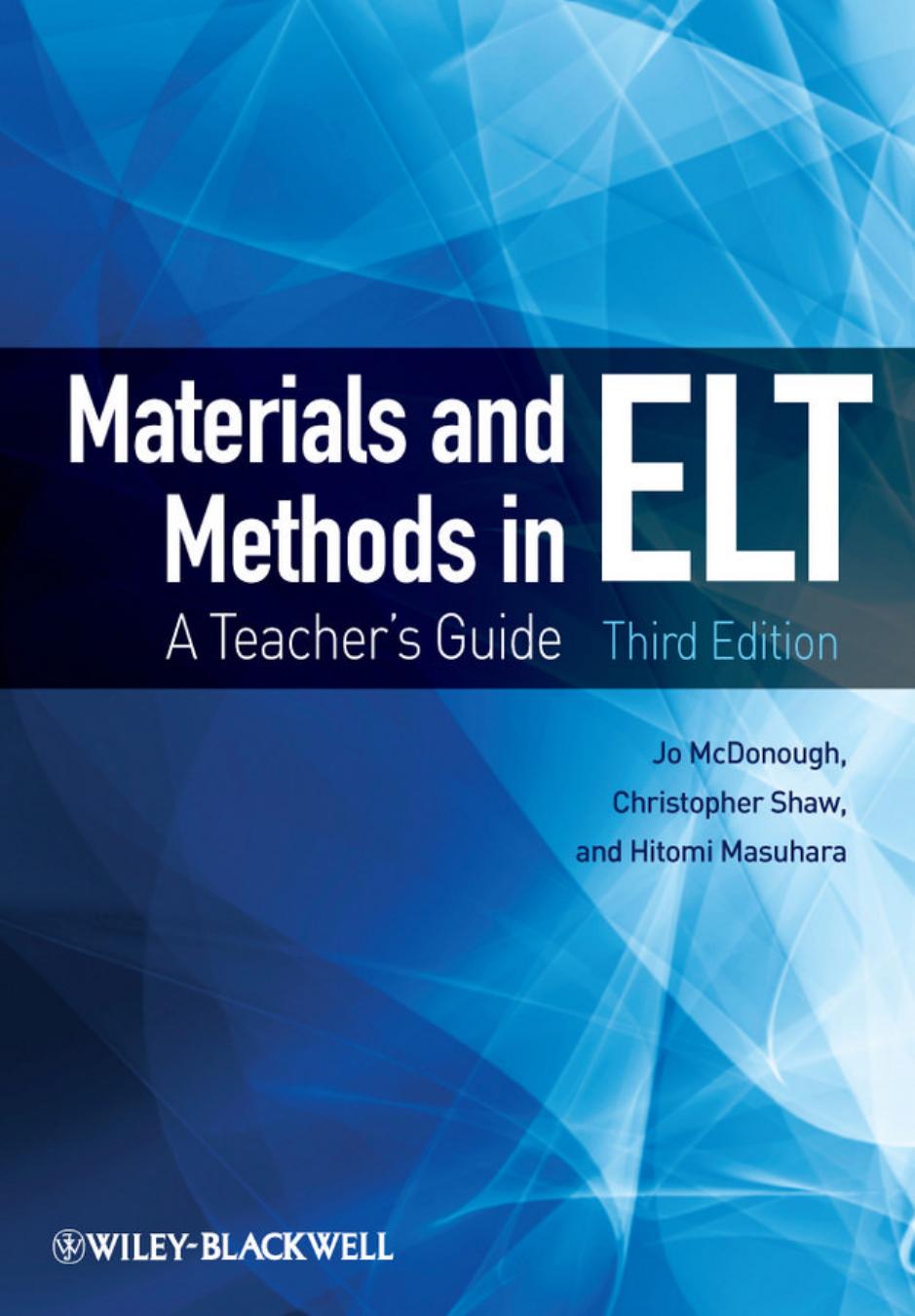
Materials and Methods in ELT 3rd edition by Jo McDonough, Christopher Shaw, Hitomi Masuhara – Ebook PDF Instant Download/Delivery: 1444336924 , 978-1444336924
Full download Materials and Methods in ELT 3rd edition after payment
Product details:
ISBN 10: 1444336924
ISBN 13: 978-1444336924
Author: Jo McDonough, Christopher Shaw, Hitomi Masuhara
Featuring extensive updates and revisions, the 3rd edition of Materials and Methods in ELT offers a comprehensive and useful introduction to the principles and practice of teaching English as a foreign/second language.
- A popular and practical guide for teachers, teachers in training, and for students studying methods and materials
- Features a new chapter on IT in English language teaching, new samples from current teaching materials, plus a new section on technology for materials and methods
- Covers how to approach materials and methods, evaluation and adaptation, technology for materials and methods, and teaching in under-resourced classrooms
- Examines the different methods available to teachers for organizing and managing an ELT classroom, including group and pair work, individualization, and classroom observation
Materials and Methods in ELT 3rd Table of contents:
Part I: Topics in the Design of Materials and Methods
1: The Framework of Materials and Methods
1.1 Introduction: Setting the Scene
1.2 The Framework: Context and Syllabus
Contextual factors
The syllabus
1.3 Conclusion
1.4 Further Reading
2: Current Approaches to Materials and Methods
2.1 Introduction
2.2 Communicative Language Teaching and Its Influences
Implication 1
Implication 2
Implication 3
Implication 4
Implication 5
Implication 6
2.3 Some Claims for Current Materials
2.4 Organization and Coverage
Multi-component syllabus
The emphasis on lexis
The task-based approach
2.5 Learners and Learning
Learners
Learning processes and strategies
2.6 Related Developments
2.7 Conclusion
2.8 Further Reading
3: Evaluating ELT Materials
3.1 Introduction
3.2 The Context of Evaluation
3.3 The External Evaluation
3.4 The Internal Evaluation
3.5 The Overall Evaluation
3.6 Conclusion
3.7 Further Reading
4: Adapting Materials
4.1 Introduction
4.2 The Context of Adaptation
4.3 Reasons for Adapting
4.4 Principles and Procedures
Adding
Deleting or omitting
Modifying
Simplifying
Reordering
4.5 A Framework for Adaptation
4.6 Conclusion
4.7 Further Reading
5: Technology in ELT
5.1 The Teacher and Technology
5.2 The Technologies
5.3 Views of Technology
5.4 Computers and Reading
5.5 Computers and Writing
5.6 Networked Technologies: Computers, Communication and Collaboration
5.7 Teachers and Technology in Context
5.8 Further Reading
Part II: Teaching Language Skills
6: Reading Skills
6.1 Introduction
6.2 Reasons for Reading
6.3 Changes in the Concept of Reading Skills
6.4 Types of Reading Skills
6.5 Schema Theory
6.6 Implications
6.7 Classroom Practice and Procedure
6.8 Feedback to Learners
6.9 Vocabulary and Vocabulary Teaching: Recent Developments
6.10 Vocabulary: What to Teach?
Definitions, connotations and appropriateness
6.11 Vocabulary: Other Possibilities
6.12 Conclusion
6.13 Further Reading
7: Listening Skills
7.1 Introduction
7.2 Reasons for Listening
7.3 The Relationship between Listening and Reading
What do reading and listening have in common?
How do they differ?
7.4 The Nature of Listening Comprehension
Product and process
Listening skills
7.5 Listening Comprehension: Teaching and Learning
Learners
Classroom applications: some issues
7.6 Materials for Teaching Listening Comprehension
Pre-listening activities
Listening activities
Language material
Post-listening activities
7.7 Conclusion
7.8 Further Reading
8: Speaking Skills
8.1 Introduction
8.2 Reasons for Speaking
8.3 Speaking Skills and Communicative Language Theory
8.4 Characteristics of Spoken Language
8.5 Teaching Pronunciation
8.6 Conversation Analysis
8.7 Classroom Implications
8.8 Types of Activity to Promote Speaking Skills
Communication games
Problem solving
Simulation/Role-play materials
Materials requiring personal responses
Materials illustrating tendencies/patterns of conversation
Materials to enhance academic speaking skills
8.9 Feedback to Learners
8.10 Conclusion
8.11 Further Reading
9: Writing Skills
9.1 Introduction
9.2 Reasons for Writing
9.3 Writing Materials in the Language Class
‘Traditional’ writing activities
9.4 The Written Product
Levels of writing
Audience
9.5 The Writing Process
The writer’s perspective
Writing in the classroom
9.6 Correcting Written Work
9.7 Conclusion
9.8 Further Reading
10: Integrated Skills
10.1 Introduction
10.2 Situations Requiring Skills Integration
10.3 Integrated Skills in the Classroom
General materials
EAP materials
Task-based materials
Oral presentations
Project work
Role play/simulation
10.4 Conclusion
10.5 Further Reading
Part III: Aspects of Classroom Methods
11: Groupwork and Pairwork
11.1 Introduction: Content and Structure
11.2 The Classroom Setting: Functions of Groupwork and Pairwork
The social organization of the classroom
Functions of groupwork and pairwork
Pairwork and groupwork
11.3 Interaction and Classroom Structure
Arranging the class
Interaction patterns in the classroom
Learning styles
11.4 Groupwork and Pairwork: Benefits or Drawbacks?
Advantages?
Disadvantages?
11.5 Conclusion
11.6 Further Reading
12: Individualization, Self-access and Learner Training
12.1 Introduction
12.2 Individualization: Some Issues
12.3 Implementation Inside and Outside the Classroom
Advantages and shortcomings
12.4 Focus on the Learner through Diary Studies
12.5 Learner Training
12.6 Conclusion
12.7 Further Reading
13: Observing the Language Classroom
13.1 Introduction
13.2 Why Focus on the Classroom?
13.3 What to Observe
13.4 Different Approaches to Classroom Observation
Observation of teaching (20–30 minutes max.)
Using video/digital recordings
13.5 Devising Classroom Observation Tasks
13.6 Applying the Tasks to Classroom Data
13.7 Conclusion
13.8 Further Reading
14: Views of the Teacher
14.1 Introduction
14.2 The Teacher’s Role
The concept of role
The wider environment
14.3 Teachers in the Classroom: Change and Innovation
Change, materials and methods
14.4 Preparing the Teachers
The ‘good language teacher’
Teacher training, teacher education and continuing professional development
14.5 Teacher Development and Teacher Research
14.6 Further Reading
People also search for Materials and Methods in ELT 3rd :
materials and methods example
materials and methods example pdf
materials and methods
materials and methods section
cambridge elt materials
Tags: Jo McDonough, Christopher Shaw, Hitomi Masuhara, Materials and Methods