


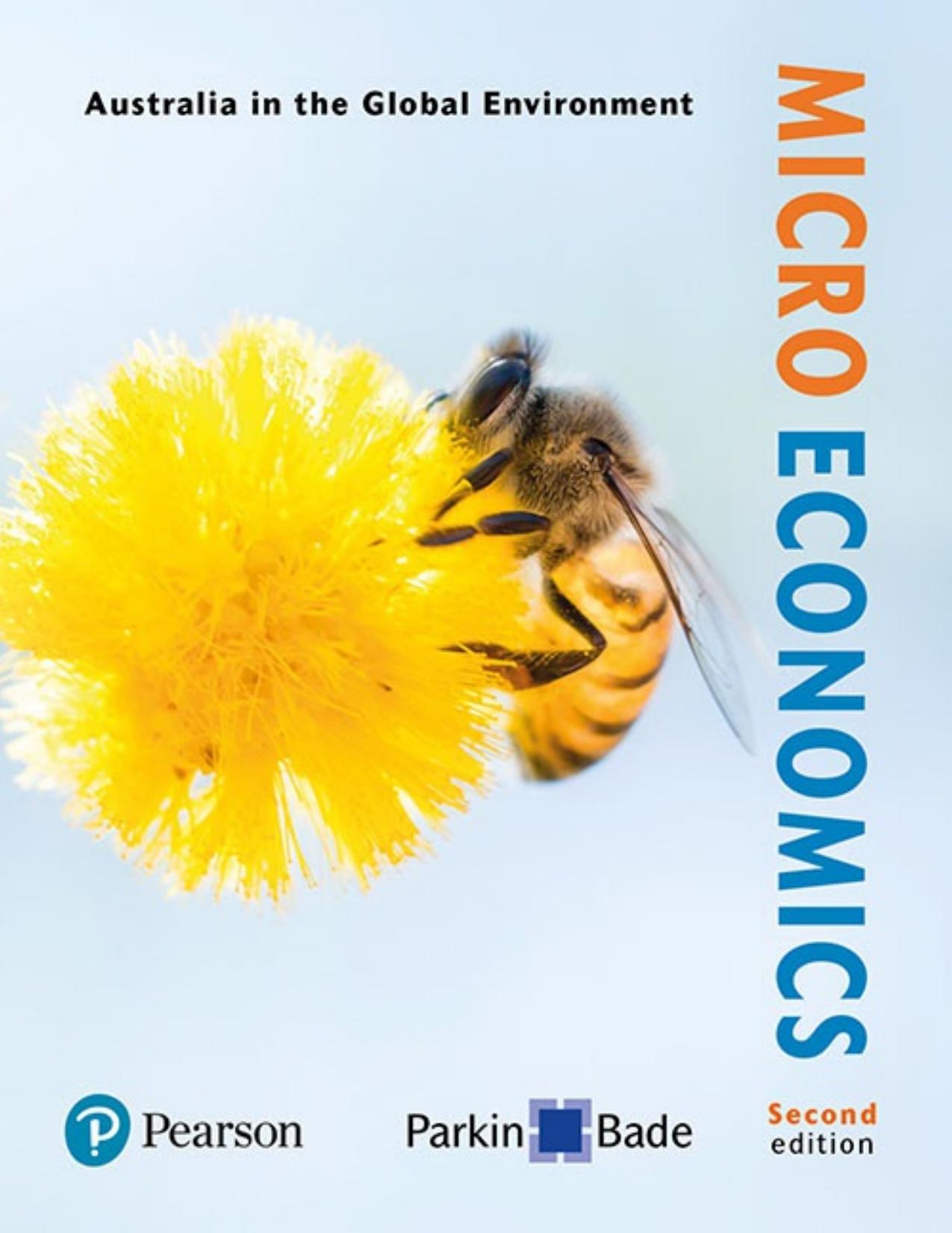
Microeconomics Australia in the Global Environment 2nd edition by Michael Parkin, Robin Bade – Ebook PDF Instant Download/Delivery: 1488625558, 9781488625558
Full download Microeconomics Australia in the Global Environment 2nd edition after payment
Product details:
ISBN 10: 1488625558
ISBN 13: 9781488625558
Author: Michael Parkin, Robin Bade
This is a product designed for students who are taking 2 semester introductory course to economics, split into micro and macroeconomics, who need to understand the principles of economic theory and how it relates to the real world.
It provides both a textbook full of exercises and examples scaffolded on underlying theory plus MyLab Economics to consolidate technical understanding.
Using this product, students can comprehend key theoretical principles of micro and macroeconomics, and feel confident in how it relates to the real world.
The full text downloaded to your computer
With eBooks you can:
- search for key concepts, words and phrases
- make highlights and notes as you study
- share your notes with friends
eBooks are downloaded to your computer and accessible either offline through the Bookshelf (available as a free download), available online and also via the iPad and Android apps.
Upon purchase, you will receive via email the code and instructions on how to access this product.
Time limit
This product is only available for a 180 day rental period starting from the date of activation of the access code in the Bookshelf.
Microeconomics Australia in the Global Environment 2nd Table of contents:
Part 1: Introduction
1. Getting Started: You’re a University Student! Did You Make the Right Decision?
-
Learning Objectives
-
1.1 Definition and Questions
-
Scarcity
-
Economics Defined
-
Microeconomics
-
Macroeconomics
-
What, How and For Whom?
-
What?
-
How?
-
For Whom?
-
-
Can the Pursuit of Self-Interest Be in the Social Interest?
-
Self-Interest and the Social Interest
-
Globalisation
-
The Information Age
-
Climate Change
-
Government Budget Deficit and Debt
-
-
-
1.2 The Economic Way of Thinking
-
Economic Ideas
-
A Choice is a Tradeoff
-
Cost: What You Must Give Up
-
Benefit: What You Gain
-
Rational Choice
-
How Much? Choosing at the Margin
-
Marginal Cost and Benefit
-
Rational Choices and Incentives
-
Economics as a Social Science
-
Economic Models
-
Normative vs Positive Disagreement
-
Economics as a Policy Tool
-
Personal, Business, and Government Policies
-
-
-
Chapter Summary
-
Key Points
-
Chapter Review
-
Study Plan Problems and Applications
-
Additional Problems and Applications
-
Multiple Choice Quiz
Appendix: Making and Using Graphs
-
Basic Ideas
-
Interpreting Data Graphs
-
Graphs in Economic Models
-
Slope and Relationships
-
Ceteris Paribus
-
Appendix Review
-
Study Plan Problems
-
Additional Problems
Part 2: The Australian and Global Economies
2. The Australian and Global Economies: Who Makes the Dreamliner?
-
Learning Objectives
-
2.1 What, How and For Whom?
-
Consumption and Capital Goods
-
Land, Labour, Capital, and Entrepreneurship
-
Financial Capital
-
-
2.2 The Global Economy
-
Advanced and Developing Economies
-
Global Production and Distribution
-
Human and Physical Capital Differences
-
-
2.3 The Circular Flows
-
Households, Firms, and Markets
-
Real and Money Flows
-
Role of Governments
-
International Trade and Finance
-
-
Chapter Summary
-
Key Points
-
Chapter Review
-
Study Plan Problems and Applications
-
Additional Problems and Applications
-
Multiple Choice Quiz
Part 3: The Economic Problem
3. The Economic Problem: Is Wind Power Free?
-
Learning Objectives
-
3.1 Production Possibilities Frontier
-
3.2 Opportunity Cost and the PPF
-
3.3 Economic Growth
-
3.4 Specialisation and Trade
-
Comparative vs Absolute Advantage
-
Gains from Trade
-
-
Chapter Summary
-
Key Points
-
Chapter Review
-
Study Plan Problems and Applications
-
Additional Problems and Applications
-
Multiple Choice Quiz
Part 4: Demand and Supply
4. Demand and Supply: Why Did the Price of Wool Rise?
-
Learning Objectives
-
4.1 Demand
-
Law of Demand
-
Market Demand
-
Shifts vs Movements
-
-
4.2 Supply
-
Law of Supply
-
Market Supply
-
Shifts vs Movements
-
-
4.3 Market Equilibrium
-
Effects of Demand and Supply Changes
-
-
Chapter Summary
-
Key Points
-
Chapter Review
-
Study Plan Problems and Applications
-
Additional Problems and Applications
-
Mathematical Note
-
Multiple Choice Quiz
Part 5: A Closer Look at Markets
5. Elasticities of Demand and Supply: What Do You Do When the Price of Petrol Rises?
-
Learning Objectives
-
5.1 Price Elasticity of Demand
-
5.2 Price Elasticity of Supply
-
5.3 Cross Elasticity and Income Elasticity
-
Chapter Summary
-
Key Points
-
Chapter Review
-
Study Plan Problems and Applications
-
Additional Problems and Applications
-
Multiple Choice Quiz
6. Efficiency and Fairness of Markets: Should Price Gouging Be Illegal?
-
Learning Objectives
-
6.1 Allocation Methods and Efficiency
-
6.2 Consumer Surplus
-
6.3 Producer Surplus
-
6.4 Are Markets Efficient?
-
6.5 Are Markets Fair?
-
Chapter Summary
-
Key Points
-
Chapter Review
-
Study Plan Problems and Applications
-
Additional Problems and Applications
-
Multiple Choice Quiz
Part 6: How Governments Influence the Economy
7. Government Actions in Markets: Can Parliament Repeal the Laws of Supply and Demand?
-
Learning Objectives
-
Price Ceilings, Floors, and Agricultural Supports
-
Chapter Summary
-
Key Points
-
Chapter Review
-
Study Plan Problems and Applications
-
Additional Problems and Applications
-
Multiple Choice Quiz
8. Taxes: Does Parliament Decide Who Pays the Taxes?
-
Learning Objectives
-
Tax Incidence and Efficiency
-
Income and Payroll Taxes
-
Fairness and Redistribution
-
Chapter Summary
-
Key Points
-
Chapter Review
-
Study Plan Problems and Applications
-
Additional Problems and Applications
-
Multiple Choice Quiz
9. Global Markets in Action: Who Wins and Who Loses from Globalisation?
-
Learning Objectives
-
How Global Markets Work
-
Winners and Losers
-
Trade Restrictions
-
Arguments For and Against Protection
-
Chapter Summary
-
Key Points
-
Chapter Review
-
Study Plan Problems and Applications
-
Additional Problems and Applications
-
Multiple Choice Quiz
Part 7: Market Failure and Public Policy
10. Externalities: How Can We Limit Climate Change?
-
Learning Objectives
-
Negative and Positive Externalities
-
Coase Theorem, Taxes, and Cap-and-Trade
-
Chapter Summary
-
Key Points
-
Chapter Review
-
Study Plan Problems and Applications
-
Additional Problems and Applications
-
Multiple Choice Quiz
11. Public Goods and Common Resources: Should Australia Build More Motorways?
-
Learning Objectives
-
Public vs Private Goods
-
Free-Rider and Overuse Problems
-
Efficient Provision
-
Chapter Summary
-
Key Points
-
Chapter Review
-
Study Plan Problems and Applications
-
Additional Problems and Applications
-
Multiple Choice Quiz
Part 8: A Closer Look at Decision Makers
12. Consumer Choice and Demand: How Much Would You Pay for a Song?
-
Learning Objectives
-
Budget Constraints and Preferences
-
Indifference Curves
-
Predicting Choices and Demand Curves
-
Chapter Summary
-
Key Points
-
Chapter Review
-
Study Plan Problems and Applications
-
Additional Problems and Applications
-
Multiple Choice Quiz
13. Production and Cost: Which Shop Has the Lower Costs—Coles or 7-Eleven?
-
Learning Objectives
-
Economic vs Accounting Profit
-
Short-Run and Long-Run Costs
-
Cost Curves and Economies of Scale
-
Chapter Summary
-
Key Points
-
Chapter Review
-
Study Plan Problems and Applications
-
Additional Problems and Applications
-
Multiple Choice Quiz
Part 9: Prices, Profits and Industry Performance
14. Perfect Competition: Where Have All the Record Shops Gone?
-
Learning Objectives
-
Characteristics and Outcomes
-
Short-Run vs Long-Run
-
Efficiency and Fairness
-
Chapter Summary
-
Key Points
-
Chapter Review
-
Study Plan Problems and Applications
-
Additional Problems and Applications
-
Multiple Choice Quiz
15. Monopoly: Are Microsoft’s Prices Too High?
-
Learning Objectives
-
Origins and Types of Monopoly
-
Price Discrimination
-
Regulation of Monopoly
-
Chapter Summary
-
Key Points
-
Chapter Review
-
Study Plan Problems and Applications
-
Additional Problems and Applications
-
Multiple Choice Quiz
16. Monopolistic Competition: Which Mobile Phone?
-
Learning Objectives
-
Market Characteristics
-
Short-Run and Long-Run
-
Product Development and Marketing
-
Chapter Summary
-
Key Points
-
Chapter Review
-
Study Plan Problems and Applications
-
Additional Problems and Applications
-
Multiple Choice Quiz
17. Oligopoly: Is Two Too Few?
-
Learning Objectives
-
Game Theory and Strategic Behaviour
-
Collusion and Dilemma
-
Trade Practices Law
-
Chapter Summary
-
Key Points
-
Chapter Review
-
Study Plan Problems and Applications
-
Additional Problems and Applications
-
Multiple Choice Quiz
Part 10: Incomes and Inequality
18. Markets for Factors of Production: Why Is Jason Day Worth $24 Million?
-
Learning Objectives
-
Labour, Capital, and Resource Markets
-
Value of Marginal Product
-
Unions and Wage Setting
-
Chapter Summary
-
Key Points
-
Chapter Review
-
Study Plan Problems and Applications
-
Additional Problems and Applications
-
Multiple Choice Quiz
19. Economic Inequality: Who Are the Rich and the Poor?
-
Learning Objectives
-
Measuring Inequality
-
Causes of Inequality
-
Redistribution Policies
-
Normative vs Positive Theories
-
Chapter Summary
-
Key Points
-
Chapter Review
-
Study Plan Problems and Applications
-
Additional Problems and Applications
-
Multiple Choice Quiz
Glossary
People also search for Microeconomics Australia in the Global Environment 2nd:
microeconomics australia in the global environment pdf
microeconomics australia in the global environment
microeconomics 2.9
microeconomics 202
microeconomics australia
Tags: Michael Parkin, Robin Bade, Global Environment, Microeconomics Australia