


A Modern Approach to Quantum Mechanics 2nd Edition by John Townsend – Ebook PDF Instant Download/Delivery: 1891389785 ,978-1891389788
Full download A Modern Approach to Quantum Mechanics 2nd edition after payment
Product details:
ISBN 10: 1891389785
ISBN 13: 978-1891389788
Author: John Townsend
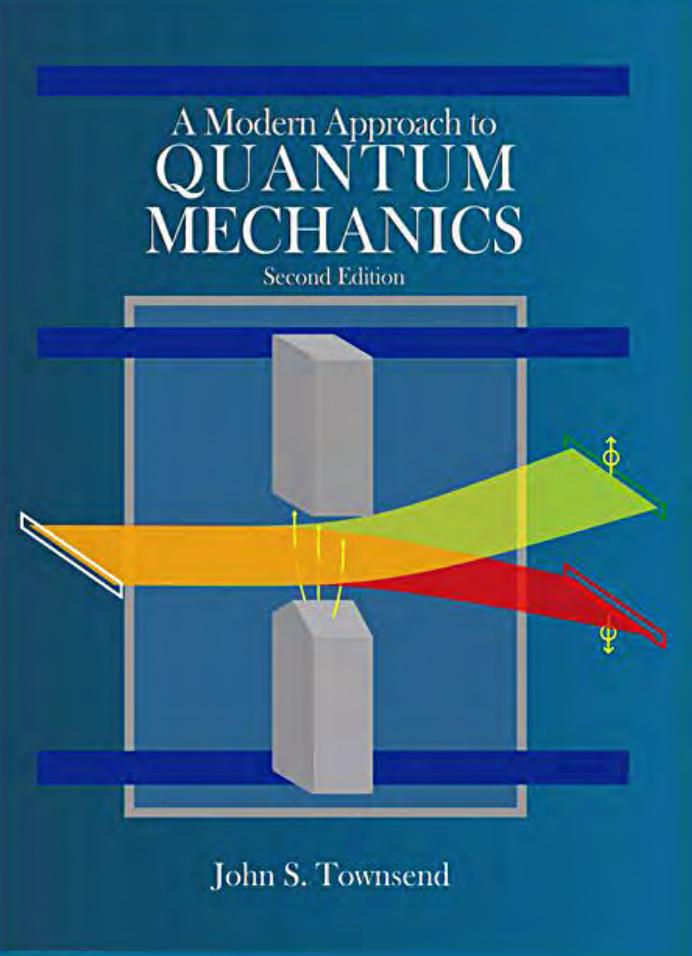
This book lays out the foundations of quantum mechanics through the physics of intrinsic spin, and is written to serve as the primary textbook for an upper-division course in quantum mechanics.
Using an innovative approach that students find both accessible and exciting, A Modern Approach to Quantum Mechanics, Second Edition lays out the foundations of quantum mechanics through the physics of intrinsic spin. Written to serve as the primary textbook for an upper-division course in quantum mechanics, Townsend’s text gives professors and students a refreshing alternative to the old style of teaching, by allowing the basic physics of spin systems to drive the introduction of concepts such as Dirac notation, operators, eigenstates and eigenvalues, time evolution in quantum mechanics, and entanglement.. Chapters 6 through 10 cover the more traditional subjects in wave mechanics―the Schrödinger equation in position space, the harmonic oscillator, orbital angular momentum, and central potentials―but they are motivated by the foundations developed in the earlier chapters. Students using this text will perceive wave mechanics as an important aspect of quantum mechanics, but not necessarily the core of the subject. Subsequent chapters are devoted to perturbation theory, identical particles, scattering, and the interaction of atoms with radiation, and an optional chapter on path integrals is also included. This new edition has been revised throughout to include many more worked examples and end-of-chapter problems, further enabling students to gain a complete mastery of quantum mechanics. It also includes new sections on quantum teleportation, the density operator, coherent states, and cavity quantum electrodynamics.AncillariesA detailed Instructors’ Manual is available for adopting professors.Art from the book may be downloaded by adopting professors.
A Modern Approach to Quantum Mechanics 2nd Table of contents:
CHAPTER 1 Stern–Gerlach Experiments
1.1 The Original Stern–Gerlach Experiment
1.2 Four Experiments
1.3 The Quantum State Vector
1.4 Analysis of Experiment 3
1.5 Experiment 5
1.6 Summary
Problems
CHAPTER 2 Rotation of Basis Statesand Matrix Mechanics
2.1 The Beginnings of Matrix Mechanics
2.2 Rotation Operators
2.3 The Identity and Projection Operators
2.4 Matrix Representations of Operators
2.5 Changing Representations
2.6 Expectation Values
2.7 Photon Polarization and the Spin of the Photon
2.8 Summary
Problems
CHAPTER 3 Angular Momentum
3.1 Rotations Do Not Commute and Neither Do the Generators
3.2 Commuting Operators
3.3 The Eigenvalues and Eigenstates of Angular Momentum
3.4 The Matrix Elements of the Raising and Lowering Operators
3.5 Uncertainty Relations and Angular Momentum
3.6 The Spin- 12 Eigenvalue Problem
3.7 A Stern–Gerlach Experiment with Spin-1 Particles
3.8 Summary
Problems
CHAPTER 4 Time Evolution
4.1 The Hamiltonian and the Schr¨odinger Equation
4.2 Time Dependence of Expectation Values
4.3 Precession of a Spin- 12 Particle in a Magnetic Field
4.4 Magnetic Resonance
4.5 The Ammonia Molecule and the Ammonia Maser
4.6 The Energy-Time Uncertainty Relation
4.7 Summary
Problems
CHAPTER 5 A System of Two Spin-1/2 Particles
5.1 The Basis States for a System of Two Spin- 12 Particles
5.2 The Hyperfine Splitting of the Ground State of Hydrogen
5.3 The Addition of Angular Momenta for Two Spin- 12 Particles
5.4 The Einstein–Podolsky–Rosen Paradox
5.5 A Nonquantum Model and the Bell Inequalities
5.6 Entanglement and Quantum Teleportation
5.7 The Density Operator
5.8 Summary
Problems
CHAPTER 6 Wave Mechanics in One Dimension
6.1 Position Eigenstates and the Wave Function
6.2 The Translation Operator
6.3 The Generator of Translations
6.4 The Momentum Operator in the Position Basis
6.5 Momentum Space
6.6 A Gaussian Wave Packet
6.7 The Double-Slit Experiment
6.8 General Properties of Solutions to the Schr¨odinger Equationin Position Space
6.9 The Particle in a Box
6.10 Scattering in One Dimension
6.11 Summary
Problems
CHAPTER 7 The One-Dimensional HarmonicOscillator
7.1 The Importance of the Harmonic Oscillator
7.2 Operator Methods
7.3 Matrix Elements of the Raising and Lowering Operators
7.4 Position-Space Wave Functions
7.5 The Zero-Point Energy
7.6 The Large-n Limit
7.7 Time Dependence
7.8 Coherent States
7.9 Solving the Schr¨odinger Equation in Position Space
7.10 Inversion Symmetry and the Parity Operator
7.11 Summary
Problems
CHAPTER 8 Path Integrals
8.1 The Multislit, Multiscreen Experiment
8.2 The Transition Amplitude
8.3 Evaluating the Transition Amplitude for ShortTime Intervals
8.4 The Path Integral
8.5 Evaluation of the Path Integral for a Free Particle
8.6 Why Some Particles Follow the Path of Least Action
8.7 Quantum Interference Due to Gravity
8.8 Summary
Problems
CHAPTER 9 Translational and Rotational Symmetryin the Two-Body Problem
9.1 The Elements of Wave Mechanics in Three Dimensions
9.2 Translational Invariance and Conservation ofLinear Momentum
9.3 Relative and Center-of-Mass Coordinates
9.4 Estimating Ground-State Energies Using theUncertainty Principle
9.5 Rotational Invariance and Conservation ofAngular Momentum
9.6 A Complete Set of Commuting Observables
9.7 Vibrations and Rotations of a Diatomic Molecule
9.8 Position-Space Representations of ˆL inSpherical Coordinates
9.9 Orbital Angular Momentum Eigenfunctions
9.10 Summary
Problems
CHAPTER 10 Bound States of Central Potentials
10.1 The Behavior of the Radial Wave Function Near the Origin
10.2 The Coulomb Potential and the Hydrogen Atom
10.3 The Finite Spherical Well and the Deuteron
10.4 The Infinite Spherical Well
10.5 The Three-Dimensional Isotropic Harmonic Oscillator
10.6 Conclusion
Problems
CHAPTER 11 Time-Independent Perturbations
11.1 Nondegenerate Perturbation Theory
11.2 Degenerate Perturbation Theory
11.3 The Stark Effect in Hydrogen
11.4 The Ammonia Molecule in an External ElectricField Revisited
11.5 Relativistic Perturbations to the Hydrogen Atom
11.6 The Energy Levels of Hydrogen
11.7 The Zeeman Effect in Hydrogen
11.8 Summary
Problems
CHAPTER 12 Identical Particles
12.1 Indistinguishable Particles in Quantum Mechanics
12.2 The Helium Atom
12.3 Multielectron Atoms and the Periodic Table
12.4 Covalent Bonding
12.5 Conclusion
Problems
CHAPTER 13 Scattering
13.1 The Asymptotic Wave Function and theDifferential Cross Section
13.2 The Born Approximation
13.3 An Example of the Born Approximation:The Yukawa Potential
13.4 The Partial Wave Expansion
13.5 Examples of Phase-Shift Analysis
13.6 Summary
Problems
CHAPTER 14 Photons and Atoms
14.1 The Aharonov–Bohm Effect
14.2 The Hamiltonian for the Electromagnetic Field
14.3 Quantizing the Radiation Field
14.4 The Hamiltonian of theAtomand the Electromagnetic Field
14.5 Time-Dependent Perturbation Theory
14.6 Fermi’s Golden Rule
14.7 Spontaneous Emission
14.8 Cavity Quantum Electrodynamics
14.9 Higher Order Processes and Feynman Diagrams
Problems
APPENDIX AElectromagnetic Units
APPENDIX BThe Addition of Angular Momenta
APPENDIX CDirac Delta Functions
APPENDIX DGaussian Integrals
APPENDIX EThe Lagrangian for a Charge qin a Magnetic Field
APPENDIX FValues of Physical Constants
APPENDIX GAnswers to Selected Problems
Index
People also search for A Modern Approach to Quantum Mechanics 2nd:
a modern approach to quantum mechanics 2nd edition pdf
a modern approach to quantum mechanics 2nd edition solutions pdf
modern approach to quantum mechanics solutions
modern approach to quantum mechanics
a modern approach to quantum mechanics second edition