


Modern Digital and Analog Communication Systems 5th Edition by BP Lathi, Zhi Ding – Ebook PDF Instant Download/Delivery: 0190686847 ,9780190686840
Full download Modern Digital and Analog Communication Systems 5th Edition after payment
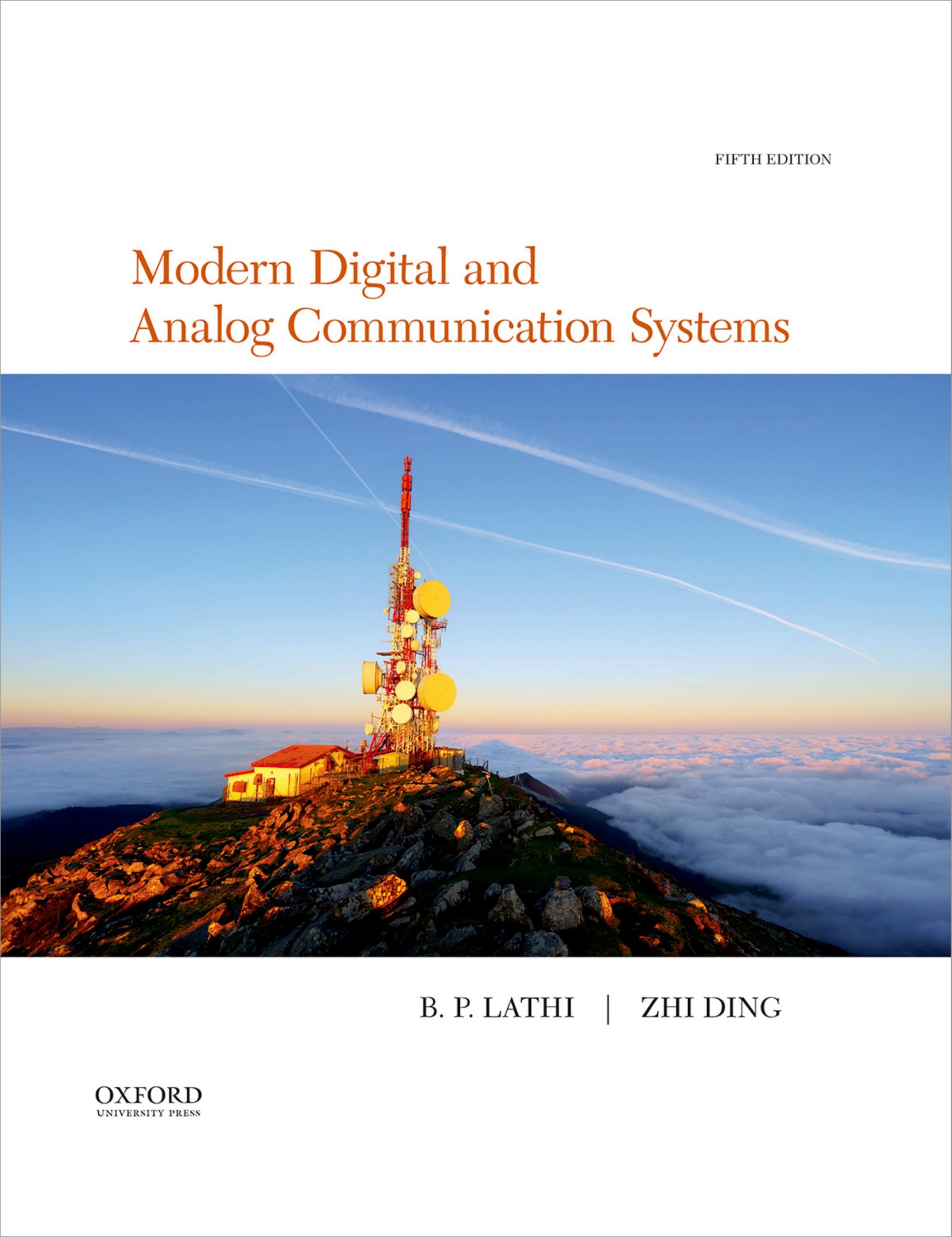
Product details:
ISBN 10: 0190686847
ISBN 13: 9780190686840
Author: BP Lathi, Zhi Ding
Modern Digital and Analog Communication Systems 5th Edition Table of contents:
1 INTRODUCTION
1.1 COMMUNICATION SYSTEMS
1.2 DESIGN CHALLENGES: CHANNEL DISTORTIONS AND NOISES
1.3 MESSAGE SOURCES
1.3.1 The Digital Revolution in Communications
1.3.2 Distortionless Regeneration of Digital Signals
1.3.3 Analog-to-Digital (A/D) Conversion for Digital Communications
1.3.4 Pulse-Coded Modulation—A Digital Representation
1.4 CHANNEL EFFECT, SIGNAL-TO-NOISE RATIO, AND CAPACITY
1.4.1 Signal Bandwidth and Power
1.4.2 Channel Capacity and Data Rate
1.5 MODULATION AND DETECTION
1.5.1 Ease of Emission/Transmission
1.5.2 Simultaneous Transmission of Multiple Signals—Multiplexing
1.5.3 Demodulation
1.6 DIGITAL SOURCE CODING AND ERROR CORRECTION CODING
1.7 A BRIEF HISTORICAL REVIEW OF MODERN TELECOMMUNICATIONS
REFERENCES
2 SIGNALS AND SIGNAL SPACE
2.1 SIZE OF A SIGNAL
2.2 CLASSIFICATION OF SIGNALS
2.2.1 Continuous Time and Discrete Time Signals
2.2.2 Analog and Digital Signals
2.2.3 Periodic and Aperiodic Signals
2.2.4 Energy and Power Signals
2.2.5 Deterministic and Random Signals
2.3 SOME USEFUL SIGNAL OPERATIONS
2.3.1 Time Shifting
2.3.2 Time Scaling
2.3.3 Time Inversion (or Folding)
2.4 UNIT IMPULSE SIGNAL
2.5 SIGNALS VERSUS VECTORS
2.5.1 Component of a Vector along Another Vector
2.5.2 Signal Decomposition and Signal Components
2.5.3 Complex Signal Space and Orthogonality
2.5.4 Energy of the Sum of Orthogonal Signals
2.6 CORRELATION OF SIGNALS
2.6.1 Identical Twins, Opposite Personalities, and Complete Strangers
2.6.2 Application of Signal Correlation in Signal Detection
2.6.3 Correlation Functions
2.6.4 Autocorrelation Function
2.7 ORTHOGONAL SIGNAL SETS
2.7.1 Orthogonal Vector Space
2.7.2 Orthogonal Signal Space
2.7.3 Parseval’s Theorem
2.7.4 Some Examples of Generalized Fourier Series
2.8 TRIGONOMETRIC FOURIER SERIES
2.8.1 Finding Trigonometric Fourier Series for Aperiodic Signals
2.8.2 Existence of the Fourier Series: Dirichlet Conditions
2.8.3 The Fourier Spectrum
2.8.4 The Effect of Symmetry
2.9 FREQUENCY DOMAIN AND EXPONENTIAL FOURIER SERIES
2.9.1 Exponential Fourier Spectra
2.9.2 What Does Negative Frequency Mean?
2.9.3 Parseval’s Theorem in the Fourier Series
2.10 MATLAB EXERCISES
2.10.1 Basic Signals and Signal Graphing
2.10.2 Signal Operations
2.10.3 Periodic Signals and Signal Power
2.10.4 Signal Correlation
2.10.5 Numerical Computation of Coefficients Dn
REFERENCES
PROBLEMS
COMPUTER ASSIGNMENT PROBLEMS
3 ANALYSIS AND TRANSMISSION OF SIGNALS
3.1 FOURIER TRANSFORM OF SIGNALS
3.2 TRANSFORMS OF SOME USEFUL FUNCTIONS
3.3 SOME FOURIER TRANSFORM PROPERTIES
3.3.1 Time-Frequency Duality
3.3.2 Duality Property
3.3.3 Time-Scaling Property
3.3.4 Time-Shifting Property
3.3.5 Frequency-Shifting Property
3.3.6 Convolution Theorem
3.3.7 Time Differentiation and Time Integration
3.4 SIGNAL TRANSMISSION THROUGH A LINEAR TIME-INVARIANT SYSTEM
3.4.1 Signal Distortion during Transmission
3.4.2 Distortionless Transmission
3.5 IDEAL VERSUS PRACTICAL FILTERS
3.6 SIGNAL DISTORTION OVER A COMMUNICATION CHANNEL
3.6.1 Linear Distortion
3.6.2 Distortion Caused by Channel Nonlinearities
3.6.3 Distortion Caused by Multipath Effects
3.6.4 Channels Fading in Time
3.7 SIGNAL ENERGY AND ENERGY SPECTRAL DENSITY
3.7.1 Parseval’s Theorem
3.7.2 Energy Spectral Density (ESD)
3.7.3 Essential Bandwidth of a Signal
3.7.4 Energy of Modulated Signals
3.7.5 Time Autocorrelation Function and Energy Spectral Density
3.8 SIGNAL POWER AND POWER SPECTRAL DENSITY
3.8.1 Power Spectral Density (PSD)
3.8.2 Time Autocorrelation Function of Power Signals
3.8.3 Input PSD versus Output PSD
3.8.4 PSD of Modulated Signals
3.9 NUMERICAL COMPUTATION OF FOURIER TRANSFORM: THE DFT
3.10 MATLAB EXERCISES
3.10.1 Computing Fourier Transforms
3.10.2 Illustration of Time-Shifting Property
3.10.3 Filtering
3.10.4 Autocorrelation Function and PSD
REFERENCES
PROBLEMS
4 ANALOG MODULATIONS AND DEMODULATIONS
4.1 BASEBAND VERSUS CARRIER COMMUNICATIONS
4.2 DOUBLE-SIDEBAND AMPLITUDE MODULATION
4.2.1 Demodulation of DSB-SC Modulation Signals
4.2.2 Amplitude Modulators
4.3 AMPLITUDE MODULATION (AM)
4.3.1 Sideband Power, Carrier Power, and Modulation Efficiency
4.3.2 Demodulation of AM Signals
4.4 BANDWIDTH-EFFICIENT AMPLITUDE MODULATIONS
4.4.1 Amplitude Modulation: Single-sideband (SSB)
4.4.2 Quadrature Amplitude Modulation (QAM)
4.4.3 Amplitude Modulations: Vestigial Sideband (VSB)
4.4.4 Receiver Carrier Synchronization for Coherent Detection
4.5 FM AND PM: NONLINEAR ANGLE MODULATIONS
4.6 BANDWIDTH ANALYSIS OF ANGLE MODULATIONS
4.7 DEMODULATION OF FM SIGNALS
4.8 FREQUENCY CONVERSION AND SUPERHETERODYNE RECEIVERS
4.9 GENERATING FM SIGNALS
4.10 FREQUENCY DIVISION MULTIPLEXING (FDM)
4.11 PHASE-LOCKED LOOP AND APPLICATIONS
4.11.1 Phase-Locked Loop (PLL)
4.11.2 Case Study: Carrier Acquisition in DSB-SC
4.12 MATLAB EXERCISES
4.12.1 DSB-SC Modulation and Demodulation
4.12.2 AM Modulation and Demodulation
4.12.3 SSB-SC Modulation and Demodulation
4.12.4 QAM Modulation and Demodulation
4.12.5 FM Modulation and Demodulation
REFERENCES
PROBLEMS
COMPUTER ASSIGNMENT PROBLEMS
5 DIGITIZATION OF ANALOG SOURCE SIGNALS
5.1 SAMPLING THEOREM
5.1.1 Uniform Sampling
5.1.2 Signal Reconstruction from Uniform Samples in D/A Conversion
5.1.3 Practical Issues in Sampling and Reconstruction
5.1.4 Maximum Information Rate through Finite Bandwidth
5.1.5 Nonideal Practical A/D Sampling Analysis
5.1.6 Pulse-Modulations by Signal Samples
5.2 PULSE CODE MODULATION (PCM)
5.2.1 Advantages of Digital Communication
5.2.2 Quantizing
5.2.3 Progressive Taxation: Nonuniform Quantization
5.2.4 Transmission Bandwidth and the Output SNR
5.3 DIGITAL TELEPHONY: PCM IN T1 SYSTEMS
A HISTORICAL NOTE
5.4 DIGITAL MULTIPLEXING HIERARCHY
5.4.1 Signal Format
5.4.2 Asynchronous Channels and Bit Stuffing
5.4.3 Plesiochronous (almost Synchronous) Digital Hierarchy
5.5 DIFFERENTIAL PULSE CODE MODULATION (DPCM)
5.5.1 Analysis of DPCM
5.5.2 ADAPTIVE DIFFERENTIAL PCM (ADPCM)
5.6 DELTA MODULATION
5.7 VOCODERS AND VIDEO COMPRESSION
5.7.1 Linear Prediction Coding Vocoders
5.7.2 Video Encoding for Transmission
5.8 MATLAB EXERCISES
5.8.1 Sampling and Reconstruction of Lowpass Signals
5.8.2 PCM Illustration
5.8.3 Delta Modulation
5.8.4 Video Residual Image Compression and Coding
REFERENCES
PROBLEMS
COMPUTER ASSIGNMENT PROBLEMS
6 PRINCIPLES OF DIGITAL DATA TRANSMISSION
6.1 DIGITAL COMMUNICATION SYSTEMS
6.1.1 Source
6.1.2 Line Codes
6.1.3 Multiplexer
6.1.4 Regenerative Repeater
6.2 BASEBAND LINE CODING
6.2.1 PSD of Various Baseband Line Codes
6.2.2 Polar Signaling
6.2.3 Constructing a DC Null in PSD by Pulse Shaping
6.2.4 On-Off Signaling
6.2.5 Bipolar Signaling
6.3 PULSE SHAPING
6.3.1 Intersymbol Interferences (ISI) and Effect
6.3.2 Nyquist’s First Criterion for Zero ISI
6.3.3 Controlled ISI or Partial Response Signaling
6.3.4 Example of a Duobinary Pulse
6.3.5 Pulse Relationship between Zero-ISI, Duobinary, and Modified Duobinary
6.3.6 Detection of Duobinary Signaling and Differential Encoding
6.3.7 Pulse Generation
6.4 SCRAMBLING
6.5 DIGITAL RECEIVERS AND REGENERATIVE REPEATERS
6.5.1 Equalizers
6.5.2 Timing Extraction
6.5.3 Detection Error
6.6 EYE DIAGRAMS: AN IMPORTANT DIAGNOSTIC TOOL
6.7 PAM: M-ARY BASEBAND SIGNALING
6.8 DIGITAL CARRIER SYSTEMS
6.8.1 Basic Binary Carrier Modulations
6.8.2 PSD of Digital Carrier Modulation
6.8.3 Connections between Analog and Digital Carrier Modulations
6.8.4 Demodulation
6.9 M-ARY DIGITAL CARRIER MODULATION
6.10 MATLAB EXERCISES
6.10.1 Baseband Pulseshaping and Eye Diagrams
6.10.2 PSD Estimation
REFERENCES
PROBLEMS
COMPUTER ASSIGNMENT PROBLEMS
7 FUNDAMENTALS OF PROBABILITY THEORY
7.1 CONCEPT OF PROBABILITY
7.1.1 Relative Frequency and Probability
7.1.2 Conditional Probability and Independent Events
7.1.3 Bernoulli Trials
7.1.4 To Divide and Conquer: The Total Probability Theorem
7.1.5 Axiomatic Theory of Probability
7.2 RANDOM VARIABLES
7.3 STATISTICAL AVERAGES (MEANS)
7.4 CORRELATION
7.5 LINEAR MEAN SQUARE ESTIMATION
7.6 SUM OF RANDOM VARIABLES
7.7 CENTRAL LIMIT THEOREM
REFERENCES
PROBLEMS
8 RANDOM PROCESSES AND SPECTRAL ANALYSIS
8.1 FROM RANDOM VARIABLE TO RANDOM PROCESS
8.2 CLASSIFICATION OF RANDOM PROCESSES
8.3 POWER SPECTRAL DENSITY
8.4 MULTIPLE RANDOM PROCESSES
8.5 TRANSMISSION OF RANDOM PROCESSES THROUGH LINEAR SYSTEMS
8.5.1 Application: Optimum Filtering (Wiener-Hopf Filter)
8.5.2 Application: Performance Analysis of Baseband Analog Systems
8.5.3 Application: Optimum Preemphasis-Deemphasis Systems
8.5.4 Application: Pulse Code Modulation
8.6 BANDPASS RANDOM PROCESSES
8.6.1 Analytical Figure of Merit of Analog Modulations
8.6.2 Application: Performance Analysis of Amplitude Modulations
REFERENCES
PROBLEMS
9 PERFORMANCE ANALYSIS OF DIGITAL COMMUNICATION SYSTEMS
9.1 OPTIMUM LINEAR DETECTOR FOR BINARY POLAR SIGNALING
9.1.1 Binary Threshold Detection
9.1.2 Optimum Receiver Filter—Matched Filter
9.2 GENERAL BINARY SIGNALING
9.2.1 Optimum Linear Receiver Analysis
9.2.2 Performance of General Binary Systems under White Gaussian Noise
9.3 COHERENT RECEIVERS FOR DIGITAL CARRIER MODULATIONS
9.4 SIGNAL SPACE ANALYSIS OF OPTIMUM DETECTION
9.4.1 Geometrical Signal Space
9.4.2 Signal Space and Basis Signals
9.5 VECTOR DECOMPOSITION OF WHITE NOISE RANDOM PROCESSES
9.5.1 Determining Basis Functions for a Random Process
9.5.2 Geometrical Representation of White Noise Processes
9.5.3 White Gaussian Noise
9.5.4 Properties of Gaussian Random Processes
9.6 OPTIMUM RECEIVER FOR WHITE GAUSSIAN NOISE CHANNELS
9.6.1 Geometric Representations
9.6.2 Dimensionality of the Detection Signal Space
9.6.3 MAP: Optimum Receiver for Minimizing Probability of Error
9.6.4 Decision Regions and Error Probability
9.6.5 Multiamplitude Signaling (PAM)
9.6.6 M-ary QAM Analysis
9.7 GENERAL ERROR PROBABILITY OF OPTIMUM RECEIVERS
9.7.1 Multitone Signaling (MFSK)
9.7.2 Bandwidth and Power Trade-offs of M-ary Orthogonal Signals
9.8 EQUIVALENT SIGNAL SETS
9.8.1 Minimum Energy Signal Set
9.8.2 Simplex Signal Set
9.9 NONWHITE (COLORED) CHANNEL NOISE
9.10 OTHER USEFUL PERFORMANCE CRITERIA
9.11 NONCOHERENT DETECTION
9.12 MATLAB EXERCISES
9.12.1 Computer Exercise 9.1: Binary Polar Signaling with Different Pulses
9.12.2 Computer Exercise 9.2: On-Off Binary Signaling
9.12.3 Computer Exercise 9.3: 16-QAM Modulation
9.12.4 Computer Exercise 9.4: Noncoherent FSK Detection
9.12.5 Computer Exercise 9.5: Noncoherent Detection of Binary Differential PSK
REFERENCES
PROBLEMS
COMPUTER ASSIGNMENT PROBLEMS
10 SPREAD SPECTRUM COMMUNICATIONS
10.1 FREQUENCY HOPPING SPREAD SPECTRUM (FHSS) SYSTEMS
10.2 MULTIPLE FHSS USER SYSTEMS AND PERFORMANCE
10.3 APPLICATIONS OF FHSS
10.4 DIRECT SEQUENCE SPREAD SPECTRUM
10.5 RESILIENT FEATURES OF DSSS
10.6 CODE DIVISION MULTIPLE-ACCESS (CDMA) OF DSSS
10.7 MULTIUSER DETECTION (MUD)
10.8 MODERN PRACTICAL DSSS CDMA SYSTEMS
10.8.1 CDMA in Cellular Phone Networks
10.8.2 CDMA in the Global Positioning System (GPS)
10.8.3 IEEE 802.11b Wireless LAN (Wi-Fi) Protocol
10.9 MATLAB EXERCISES
10.9.1 Computer Exercise 10.1: FHSS FSK Communication under Partial Band Jamming
10.9.2 Computer Exercise 10.2: DSSS Transmission of QPSK
10.9.3 Computer Exercise 10.3: Multiuser DS-CDMA System
10.9.4 Computer Exercise 10.4: Multiuser CDMA Detection in Near-Far Environment
REFERENCES
PROBLEMS
COMPUTER ASSIGNMENT PROBLEMS
11 DIGITAL COMMUNICATIONS OVER LINEARLY DISTORTIVE CHANNELS
11.1 LINEAR DISTORTIONS OF WIRELESS MULTIPATH CHANNELS
11.2 RECEIVER CHANNEL EQUALIZATION
11.2.1 Antialiasing Filter versus Matched Filter
11.2.2 Maximum Likelihood Sequence Estimation (MLSE)
11.3 LINEAR T-SPACED EQUALIZATION (TSE)
11.3.1 Zero-Forcing TSE
11.3.2 TSE Design Based on MMSE
11.4 LINEAR FRACTIONALLY SPACED EQUALIZERS (FSE)
11.4.1 The Single-Input–Multiple-Output (SIMO) Model
11.4.2 FSE Designs
11.5 CHANNEL ESTIMATION
11.6 DECISION FEEDBACK EQUALIZER
11.7 OFDM (MULTICARRIER) COMMUNICATIONS
11.7.1 Principles of OFDM
11.7.2 OFDM Channel Noise
11.7.3 Zero-Padded OFDM
11.7.4 Cyclic Prefix Redundancy in OFDM
11.7.5 OFDM Equalization
11.8 DISCRETE MULTITONE (DMT) MODULATIONS
11.9 REAL-LIFE APPLICATIONS OF OFDM AND DMT
11.10 BLIND EQUALIZATION AND IDENTIFICATION
11.11 TIME-VARYING CHANNEL DISTORTIONS DUE TO MOBILITY
11.12 MATLAB EXERCISES
11.12.1 Computer Exercise 11.1: 16-QAM Linear Equalization
11.12.2 Computer Exercise 11.2: Decision Feedback Equalization
11.12.3 Computer Exercise 11.3: OFDM Transmission of QAM Signals
REFERENCES
PROBLEMS
COMPUTER ASSIGNMENT PROBLEMS
12 INTRODUCTION TO INFORMATION THEORY
12.1 MEASURE OF INFORMATION
12.2 SOURCE ENCODING
12.3 ERROR-FREE COMMUNICATION OVER A NOISY CHANNEL
12.4 CHANNEL CAPACITY OF A DISCRETE MEMORYLESS CHANNEL
12.4.1 Definition of Capacity
12.4.2 Error-Free Communication over a BSC
12.5 CHANNEL CAPACITY OF A CONTINUOUS MEMORYLESS CHANNEL
12.5.1 Maximum Entropy for a Given Mean Square Value of x
12.5.2 Mutual Information and Channel Capacity
12.5.3 Error-Free Communication over a Continuous Channel
12.6 FREQUENCY-SELECTIVE CHANNEL CAPACITY
12.7 MULTIPLE-INPUT–MULTIPLE-OUTPUT COMMUNICATION SYSTEMS
12.7.1 Capacity of MIMO Channels
12.7.2 Transmitter without Channel Knowledge
12.7.3 Transmitter with Channel Knowledge
12.8 MATLAB EXERCISES
12.8.1 Computer Exercise 12.1: Huffman Code
12.8.2 Computer Exercise 12.2: Channel Capacity and Mutual Information
12.8.3 Computer Exercise 12.3: MIMO Channel Capacity
REFERENCES
PROBLEMS
COMPUTER ASSIGNMENT PROBLEMS
13 ERROR CORRECTING CODES
13.1 OVERVIEW
13.2 REDUNDANCY FOR ERROR CORRECTION
13.3 LINEAR BLOCK CODES
13.4 CYCLIC CODES
13.5 THE BENEFIT OF ERROR CORRECTION
13.6 CONVOLUTIONAL CODES
13.6.1 Convolutional Encoder
13.6.2 Decoding Convolutional Codes
13.7 TRELLIS DIAGRAM OF BLOCK CODES
13.8 CODE COMBINING AND INTERLEAVING
13.9 SOFT DECODING
13.10 SOFT-OUTPUT VITERBI ALGORITHM (SOVA)
13.11 TURBO CODES
13.12 LOW-DENSITY PARITY CHECK (LDPC) CODES
13.13 MATLAB EXERCISES
13.13.1 Computer Exercise 13.1: Block Decoding
13.13.2 Computer Exercise 13.2: Error Correction in AWGN Channels
REFERENCES
PROBLEMS
COMPUTER ASSIGNMENT PROBLEMS
APPENDIX A ORTHOGONALITY OF SOME SIGNAL SETS
A.1 Trigonometric Sinusoid Signal Set
A.2 Orthogonality of the Exponential Sinusoid Signal Set
APPENDIX B CAUCHY-SCHWARZ INEQUALITY
APPENDIX C GRAM-SCHMIDT ORTHOGONALIZATION OF A VECTOR SET
APPENDIX D BASIC MATRIX PROPERTIES AND OPERATIONS
D.1 Notations
D.2 Matrix Product and Properties
D.3 Identity and Diagonal Matrices
D.4 Determinant of Square Matrices
D.5 Trace
D.6 Eigendecomposition
D.7 Special Hermitian Square Matrices
APPENDIX E MISCELLANEOUS
E.1 L’Hôpital’s Rule
E.2 Taylor and Maclaurin Series
E.3 Power Series
E.4 Sums
E.5 Complex Numbers
E.6 Trigonometric Identities
E.7 Indefinite Integrals
INDEX
People also search for Modern Digital and Analog Communication Systems 5th Edition:
modern digital and analog communication systems solution manual
lathi modern digital and analog communication pdf
lathi modern digital and analog communication
modern digital and analog communication systems lathi pdf
modern digital and analog communication lathi
Tags: BP Lathi, Zhi Ding, Modern Digital, Analog Communication Systems