


Modern General Relativity Black Holes Gravitational Waves and Cosmology 1st edition by Mike Guidry – Ebook PDF Instant Download/Delivery: 1107197899, 978-1107197893
Full download Modern General Relativity Black Holes Gravitational Waves and Cosmology 1st edition after payment
Product details:
ISBN 10: 1107197899
ISBN 13: 978-1107197893
Author: Mike Guidry
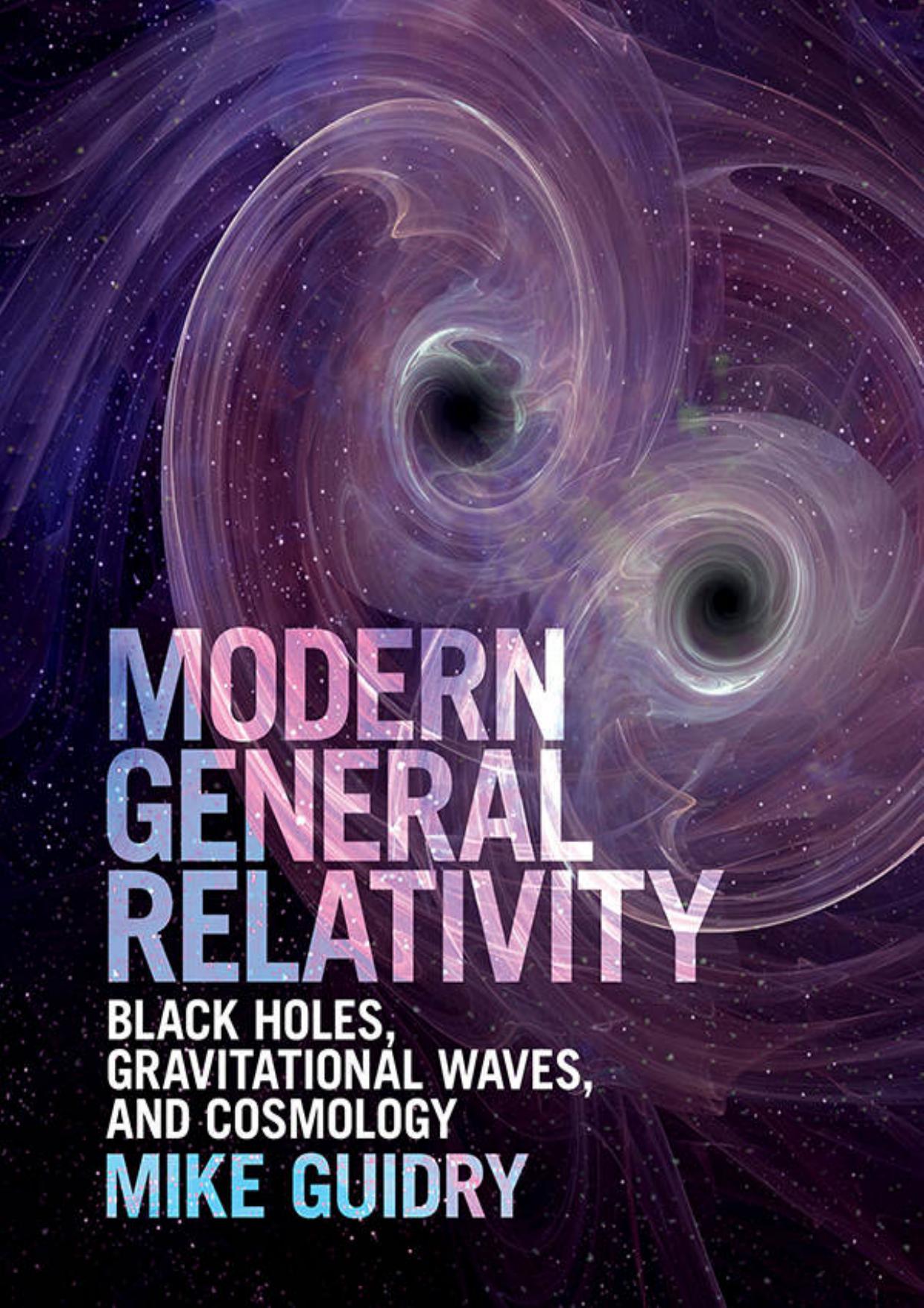
Einstein’s general theory of relativity is widely considered to be one of the most elegant and successful scientific theories ever developed, and it is increasingly being taught in a simplified form at advanced undergraduate level within both physics and mathematics departments. Due to the increasing interest in gravitational physics, in both the academic and the public sphere, driven largely by widely-publicised developments such as the recent observations of gravitational waves, general relativity is also one of the most popular scientific topics pursued through self-study. Modern General Relativity introduces the reader to the general theory of relativity using an example-based approach, before describing some of its most important applications in cosmology and astrophysics, such as gamma-ray bursts, neutron stars, black holes, and gravitational waves. With hundreds of worked examples, explanatory boxes, and end-of-chapter problems, this textbook provides a solid foundation for understanding one of the towering achievements of twentieth-century physics.
Modern General Relativity Black Holes Gravitational Waves and Cosmology 1st Table of contents:
Part I General Relativity
1 Introduction
1.1 Gravity and the Universe on Large Scales
1.2 Classical Newtonian Gravity
1.3 Transformations between Inertial Systems
1.4 Maxwell, the Aether, and Galileo
1.5 The Special Theory of Relativity
1.6 Minkowski Space
1.7 A New Theory of Gravity
1.8 The Equivalence Principle
1.9 General Relativity
Background and Further Reading
Problems
2 Coordinate Systems and Transformations
2.1 Coordinate Systems in Euclidean Space
2.1.1 Parameterizing in Different Coordinate Systems
2.1.2 Basis Vectors
2.1.3 Expansion of Vectors and Dual Vectors
2.1.4 Vector Scalar Product and the Metric Tensor
2.1.5 Relationship of Vectors and Dual Vectors
2.1.6 Properties of the Metric Tensor
2.1.7 Line Elements
2.1.8 Euclidean Line Element
2.2 Integration
2.3 Differentiation
2.4 Non-euclidean Geometry
2.5 Transformations
2.5.1 Rotational Transformations
2.5.2 Galilean Transformations
Background and Further Reading
Problems
3 Tensors and Covariance
3.1 Invariance and Covariance
3.2 Spacetime Coordinates
3.3 Vectors in Non-euclidean Space
3.4 Coordinates in Spacetime
3.4.1 Coordinate and Non-coordinate Bases
3.4.2 Utility of Coordinate and Non-coordinate Bases
3.5 Tensors and Coordinate Transformations
3.6 Tensors as Linear Maps
3.6.1 Linear Maps to Real Numbers
3.6.2 Vectors and Dual Vectors
3.6.3 Tensors of Higher Rank
3.6.4 Identification of Vectors and Dual Vectors
3.6.5 Index-free versus Component Transformations
3.7 Tensors Specified by Transformation Laws
3.7.1 Scalar Transformation Law
3.7.2 Dual Vector Transformation Law
3.7.3 Vector Transformation Law
3.7.4 Duality of Vectors and Dual Vectors
3.8 Scalar Product of Vectors
3.9 Tensors of Higher Rank
3.10 The Metric Tensor
3.11 Symmetric and Antisymmetric Tensors
3.12 Summary of Algebraic Tensor Operations
3.13 Tensor Calculus on Curved Manifolds
3.13.1 Invariant Integration
3.13.2 Partial Derivatives
3.13.3 Covariant Derivatives
3.13.4 Absolute Derivatives
3.13.5 Lie Derivatives
3.14 Invariant Equations
Background and Further Reading
Problems
4 Lorentz Covariance and Special Relativity
4.1 Minkowski Space
4.1.1 The Indefinite Metric of Spacetime
4.1.2 Scalar Products and the Metric Tensor
4.1.3 The Line Element
4.1.4 Invariance of the Spacetime Interval
4.2 Tensors in Minkowski space
4.3 Lorentz Transformations
4.3.1 Rotations in Euclidean Space
4.3.2 Generalized 4D Minkowski Rotations
4.3.3 Lorentz Spatial Rotations
4.3.4 Lorentz Boost Transformations
4.4 Lightcone Diagrams
4.5 The Causal Structure of Spacetime
4.6 Lorentz Transformations in Spacetime Diagrams
4.6.1 Lorentz Boosts and the Lightcone
4.6.2 Spacelike and Timelike Intervals
4.7 Lorentz Covariance of the Maxwell Equations
4.7.1 Maxwell Equations in Noncovariant Form
4.7.2 Scalar and Vector Potentials
4.7.3 Gauge Transformations
4.7.4 Maxwell Equations in Manifestly Covariant Form
Background and Further Reading
Problems
5 Lorentz-Invariant Dynamics
5.1 A Natural Set of Units
5.2 Velocity and Momentum for Massive Particles
5.3 Geodesics and a Variational Principle
5.4 Light and other Massless Particles
5.4.1 Affine Parameters
5.4.2 Energy and Momentum
5.5 Observers
5.6 Isometries and Killing Vectors
5.6.1 Symmetries of the Metric
5.6.2 Quantities Conserved along Geodesics
Background and Further Reading
Problems
6 The Principle of Equivalence
6.1 Einstein and Equivalence
6.2 Inertial and Gravitational Mass
6.3 The Strong Equivalence Principle
6.3.1 Elevators, Gravity, and Acceleration
6.3.2 Alternative Statements of the Equivalence Principle
6.3.3 Equivalence and the Path to General Relativity
6.4 Deflection of Light in a Gravitational Field
6.4.1 A Thought Experiment
6.4.2 Curvature Radius and the Strength of Gravity
6.5 The Gravitational Redshift
6.5.1 A Second Thought Experiment
6.5.2 The Total Redshift in a Gravitational Field
6.5.3 Gravitational Time Dilation
6.6 Equivalence and Riemannian Manifolds
6.7 Local Inertial Frames and Inertial Observers
6.7.1 Locality and Tidal Forces
6.7.2 Inertial Observers
6.7.3 Definition of Local Inertial Frames
6.8 Lightcones in Curved Spacetime
6.9 The Road to General Relativity
Background and Further Reading
Problems
7 Curved Spacetime and General Covariance
7.1 General Covariance
7.2 Curved Spacetime
7.2.1 Coordinate Systems
7.2.2 Gaussian Curvature
7.2.3 Distance Intervals
7.3 A Covariant Description of Matter
7.3.1 Stress–Energy for Perfect Fluids
7.3.2 Local Conservation of Energy
7.4 Covariant Derivatives and Parallel Transport
7.4.1 Parallel Transport of Vectors
7.4.2 The Affine Connection and Covariant derivatives
7.4.3 Absolute Derivatives and Parallel Transport
7.4.4 Geometry and Covariant Derivatives
7.5 Gravity and Curved Spacetime
7.5.1 Free Particles
7.5.2 The Geodesic Equation
7.6 The Local Inertial Coordinate System
7.7 The Affine Connection and the Metric Tensor
7.8 Uniqueness of the Affine Connection
Background and Further Reading
Problems
8 The General Theory of Relativity
8.1 Weak-Field Limit
8.2 Recipe for Motion in a Gravitational Field
8.3 Towards a Covariant Theory of Gravitation
8.4 The Riemann Curvature Tensor
8.5 The Einstein Equations
8.6 Limiting Behavior of the Einstein Tensor
8.7 Sign Conventions
8.8 Solving the Einstein Equations
8.8.1 Solutions in the Limit of Weak Fields
8.8.2 Solutions with a High Degree of Symmetry
8.8.3 Solutions by Numerical Relativity
Background and Further Reading
Problems
9 The Schwarzschild Spacetime
9.1 The Form of the Metric
9.1.1 The Schwarzschild Solution
9.1.2 The Schwarzschild Radius
9.1.3 Measuring Distance and Time
9.1.4 Embedding Diagrams
9.2 The Gravitational Redshift
9.2.1 Exploiting a Symmetry of the Metric
9.2.2 Recovering the Weak-Field Limit
9.3 Particle Orbits in the Schwarzschild Metric
9.3.1 Conserved Quantities
9.3.2 Equation of Motion
9.3.3 Classification of Orbits
9.3.4 Stable Circular Orbits
9.4 Precession of Orbits
9.4.1 The Change in Perihelion Angle
9.4.2 Testing the Prediction
9.5 Escape Velocity
9.6 Radial Fall of a Test Particle
9.7 Orbits for Light Rays
9.8 Deflection of Light in the Gravitational Field
9.9 Shapiro Time Delay of Light
9.10 Gyroscopes in Curved Spacetime
9.11 Geodetic Precession
9.12 Gyroscopes in Rotating Spacetimes
9.12.1 Slow Rotation in the Schwarzschild Metric
9.12.2 Dragging of Inertial frames
Background and Further Reading
Problems
10 Neutron Stars and Pulsars
10.1 A Qualitative Picture of Neutron Stars
10.2 Solutions inside Spherical Mass Distributions
10.2.1 Simplifying Assumptions
10.2.2 Solving the Einstein Equations
10.2.3 The Oppenheimer–Volkov Equations
10.2.4 Interpretation of Oppenheimer–Volkov Equations
10.3 Interpretation of the Mass Parameter
10.3.1 Total Mass–Energy for a Relativistic Star
10.3.2 Gravitational Mass and Baryonic Mass
10.4 Pulsars and Tests of General Relativity
10.4.1 The Binary Pulsar
10.4.2 Precision Tests of General Relativity
10.4.3 Origin and Fate of the Binary Pulsar
10.4.4 The Double Pulsar
10.4.5 The Pulsar–White Dwarf Binary PSR J0348+0432
10.4.6 The Pulsar–WD–WD Triplet PSR J0337+1715
Background and Further Reading
Problems
Part II Black Holes
11 Spherical Black Holes
11.1 Schwarzschild Black Holes
11.1.1 Event Horizons
11.1.2 Approaching the Horizon: Outside View
11.1.3 Approaching the Horizon: Spacecraft View
11.2 Lightcone Description of a Trip to a Black Hole
11.2.1 Worldline Exterior to the Event Horizon
11.2.2 Worldline Interior to the Event Horizon
11.2.3 You Can’t Get There From Here
11.3 Solution in Eddington–Finkelstein Coordinates
11.3.1 Eddington–Finkelstein Coordinates
11.3.2 Behavior of Radial Light Rays
11.3.3 The Event Horizon
11.4 Solution in Kruskal–Szekeres Coordinates
11.4.1 Kruskal–Szekeres Coordinates
11.4.2 Kruskal Diagrams
11.4.3 The Event Horizon
11.5 Black Hole Theorems and Conjectures
Background and Further Reading
Problems
12 Quantum Black Holes
12.1 Geodesics and Uncertainty
12.2 Hawking Radiation
12.2.1 4-Momentum Conservation
12.2.2 Black Hole Evaporation
12.2.3 Relative Importance of Quantum Fluctuations
12.3 Black Hole Temperatures
12.4 Miniature Black Holes
12.5 Black Hole Thermodynamics
12.5.1 Entropy of a Black Hole
12.5.2 The Generalized Second Law
12.5.3 The Four Laws of Black Hole Dynamics
12.6 The Planck Scale and Quantum Gravity
12.7 Black Holes and Information
12.7.1 The Holographic Principle
12.7.2 The Holographic Universe
Background and Further Reading
Problems
13 Rotating Black Holes
13.1 The Kerr Solution
13.1.1 The Kerr Metric
13.1.2 Extremal Kerr Black Holes
13.1.3 Cosmic Censorship
13.1.4 The Kerr Horizon
13.2 Particle and Photon Motion
13.2.1 Orbits in the Kerr Metric
13.2.2 Frame Dragging
13.2.3 The Ergosphere
13.2.4 Motion of Photons in the Ergosphere
13.3 Extracting Rotational Energy from Black Holes
13.3.1 Penrose Processes
13.3.2 Practical Energy Extraction
Background and Further Reading
Problems
14 Observational Evidence for Black Holes
14.1 Gravitational Collapse and Observations
14.2 Singularity Theorems and Black Holes
14.2.1 Global Methods in General Relativity
14.2.2 Singularities and Trapped Surfaces
14.2.3 Generalized Singularity Theorems
14.3 Observing Black Holes
14.4 Stellar-Mass Black Holes
14.4.1 Masses for Compact Objects in X-Ray Binaries
14.4.2 Masses from Mass Functions
14.4.3 An Example: A0620–00
14.4.4 Some Black Hole Candidates
14.5 Supermassive Black Holes
14.5.1 The Black Hole at Sgr A*
14.5.2 The Water Masers of NGC 4258
14.5.3 The Virial Theorem and Gravitating Mass
14.6 Intermediate-Mass Black Holes
14.7 Black Holes in the Early Universe
14.8 Show Me an Event Horizon!
14.9 A Circumstantial but Strong Case
Background and Further Reading
Problems
15 Black Holes as Central Engines
15.1 Black Hole Energy Sources
15.2 Accretion and Energy Release for Black Holes
15.2.1 Maximum Energy Release for Spherical Accretion
15.2.2 Limits on Accretion Rates
15.2.3 Accretion Efficiencies
15.2.4 Accretion onto Rotating Black Holes
15.3 Jets and Magnetic Fields
15.4 Quasars
15.4.1 “Radio Stars” and a Spectrum in Disguise
15.4.2 Quasar Characteristics
15.4.3 Quasar Energy Sources
15.5 Active Galactic Nuclei
15.5.1 Radio Galaxies
15.5.2 Seyfert Galaxies
15.5.3 BL Lac Objects
15.6 A Unified Model of AGN and Quasars
15.6.1 The AGN Black Hole Central Engine Model
15.6.2 Anisotropic Ionization Cones
15.6.3 A Unified Model
15.6.4 Example: Feeding a Nearby Monster
15.6.5 High-Energy Photons from AGN
15.7 Gamma-Ray Bursts
15.7.1 The Gamma-Ray Sky
15.7.2 Two Classes of Gamma-Ray Bursts
15.7.3 Localization of Gamma-Ray Bursts
15.7.4 Necessity of Ultrarelativistic Jets
15.7.5 Association of GRBs with Galaxies
15.7.6 Long-Period GRBs and Supernovae
15.7.7 Characteristics of Gamma-Ray Bursts
15.7.8 Mechanisms for the Central Engine
15.7.9 Gamma-Ray Bursts and Gravitational Waves
Background and Further Reading
Problems
Part III Cosmology
16 The Hubble Expansion
16.1 The Standard Picture
16.1.1 Mass Distribution on Large Scales
16.1.2 The Universe is Expanding
16.1.3 The Expansion Is Governed by General Relativity
16.1.4 There is a Big Bang in Our Past
16.1.5 Particle Content Influences the Evolution
16.1.6 There is a Cosmic Microwave Background
16.2 The Hubble Law
16.2.1 The Hubble Parameter
16.2.2 Redshifts
16.2.3 Expansion Interpretation of Redshifts
16.2.4 The Hubble Time
16.2.5 A 2-Dimensional Hubble Expansion Model
16.2.6 Measuring the Hubble Constant
16.3 Limitations of the Standard Picture
Background and Further Reading
Problems
17 Energy and Matter in the Universe
17.1 Expansion and Newtonian Gravity
17.2 The Critical Density
17.3 The Cosmic Scale Factor
17.4 Possible Expansion Histories
17.5 Lookback Times
17.6 The Inadequacy of Dust Models
17.7 Evidence for Dark Matter
17.7.1 Rotation Curves for Spiral Galaxies
17.7.2 The Mass of Galaxy Clusters
17.7.3 Hot Gas in Clusters of Galaxies
17.7.4 Gravitational Lensing
17.7.5 Dark Matter in Ultra-diffuse Galaxies
17.8 The Amount of Baryonic Matter
17.9 Baryonic Candidates for Dark Matter
17.10 Candidates for Nonbaryonic Dark Matter
17.10.1 Cold Dark Matter
17.10.2 Hot Dark Matter
17.11 Dark Energy
17.12 Radiation
17.13 The Scale Factor and Density Parameters
17.14 The Deceleration Parameter
17.14.1 Deceleration and Density Parameters
17.14.2 Deceleration and Cosmology
17.15 Problems with Newtonian Cosmology
Background and Further Reading
Problems
18 Friedmann Cosmologies
18.1 The Cosmological Principle
18.2 Homogeneous and Isotropic 2D Spaces
18.3 Homogeneous and Isotropic 3D Spaces
18.3.1 Constant Positive Curvature
18.3.2 Constant Negative Curvature
18.3.3 Zero Curvature
18.4 The Robertson–Walker Metric
18.5 Comoving Coordinates
18.6 Proper Distances
18.7 The Hubble Law and the RW Metric
18.8 Particle and Event Horizons
18.8.1 Particle Horizons in the RW Metric
18.8.2 Event Horizons in the RW Metric
18.9 Einstein Equations for the RW Metric
18.9.1 The Metric and Stress–Energy Tensor
18.9.2 The Connection Coefficients
18.9.3 The Ricci Tensor and Ricci Scalar
18.9.4 The Friedmann Equations
18.9.5 Static Solutions and the Cosmological Constant
18.10 Resolution of Newtonian Difficulties
Background and Further Reading
Problems
19 Evolution of the Universe
19.1 Friedmann Cosmologies
19.1.1 Reformulation of the Friedmann Equations
19.1.2 Equations of State
19.2 Friedmann Equations in Concise Form
19.2.1 Evolution and Scaling of Density Components
19.2.2 A Standard Model
19.3 Flat, Single-Component Universes
19.3.1 Special Solution: Vacuum Energy Domination
19.3.2 General Solutions
19.3.3 Flat Universes with Radiation or Matter
19.4 Full Solution of the Friedmann Equations
19.4.1 Evolution Equations in Dimensionless Form
19.4.2 Algorithm for Numerical Solution
19.4.3 Examples: Single Component with Curvature
19.4.4 Examples: Multiple Components
19.4.5 Parameters for a Realistic Model
19.4.6 Concordance of Cosmological Parameters
19.4.7 Calculations with Benchmark Parameters
Background and Further Reading
Problems
20 The Big Bang
20.1 Radiation- and Matter-Dominated Universes
20.1.1 Evolution of the Scale Factor
20.1.2 Matter and Radiation Density
20.2 Evolution of the Early Universe
20.2.1 Thermodynamics of the Big Bang
20.2.2 Equilibrium in an Expanding Universe
20.2.3 A Timeline for the Big Bang
20.3 Nucleosynthesis and Cosmology
20.3.1 The Neutron to Proton Ratio
20.3.2 Elements Synthesized in the Big Bang
20.3.3 Constraints on Baryon Density
20.4 The Cosmic Microwave Background
20.4.1 The Microwave Background Spectrum
20.4.2 Anisotropies in the Microwave Background
20.4.3 The Origin of CMB Fluctuations
20.4.4 Acoustic Signature in the CMB
20.4.5 Acoustic Signature in Galaxy Distributions
20.4.6 Precision Cosmology
20.4.7 Seeds for Structure Formation
20.5 Accelerated Structure Formation
20.6 Dark Matter, Dark Energy, and Structure
Background and Further Reading
Problems
21 Extending Classical Big Bang Theory
21.1 Successes of the Big Bang Theory
21.2 Problems with the Big Bang
21.2.1 The Horizon Problem
21.2.2 The Flatness Problem
21.2.3 The Magnetic Monopole Problem
21.2.4 The Structure and Smoothness Dichotomy
21.2.5 The Vacuum Energy Problem
21.2.6 The Matter–Antimatter Problem
21.2.7 Modifying the Classical Big Bang
21.3 Cosmic Inflation
21.3.1 The Basic Idea and Generic Consequences
21.3.2 Taking the Inflationary Cure
21.3.3 Inflation Doesn’t Replace the Big Bang
21.4 The Origin of the Baryons
21.4.1 Conditions for a Baryon Asymmetry
21.4.2 Grand Unified Theories
21.4.3 Leptogenesis
Background and Further Reading
Problems
Part IV Gravitational Wave Astronomy
22 Gravitational Waves
22.1 Significance of Gravitational Waves
22.1.1 Unprecedented Tests of General Relativity
22.1.2 A Probe of Dark Events
22.1.3 The Deepest Probe
22.1.4 Technology and the Quest for Gravitational Waves
22.2 Linearized Gravity
22.2.1 Linearized Curvature Tensor
22.2.2 Wave Equation
22.2.3 Coordinates and Gauge Transformations
22.2.4 Choice of Gauge
22.3 Weak Gravitational Waves
22.3.1 Polarization Tensor in TT Gauge
22.3.2 Helicity Components
22.3.3 General Solution in TT Gauge
22.4 Gravitational versus Electromagnetic Waves
22.4.1 Interaction with Matter
22.4.2 Wavelength Relative to Source Size
22.4.3 Phase Coherence
22.4.4 Field of View
22.5 The Response of Test Particles
22.5.1 Response of Two Test Masses
22.5.2 The Effect of Polarization
22.6 Gravitational Wave Detectors
22.6.1 Operating and Proposed Detectors
22.6.2 Strain and Frequency Windows
22.6.3 Detecting Very Long Wavelengths
22.6.4 Reach of Advanced LIGO and Advanced VIRGO
Background and Further Reading
Problems
23 Weak Sources of Gravitational Waves
23.1 Production of Weak Gravitational Waves
23.1.1 Energy Densities
23.1.2 Multipolarities
23.1.3 Linearized Einstein Equation with Sources
23.1.4 Gravitational Wave Amplitudes
23.1.5 Amplitudes and Event Rates
23.1.6 Power in Gravitational Waves
23.2 Gravitational Radiation from Binary Systems
23.2.1 Gravitational Wave Luminosity
23.2.2 Gravitational Radiation and Binary Orbits
23.2.3 Gravitational Waves from the Binary Pulsar
Background and Further Reading
Problems
24 Strong Sources of Gravitational Waves
24.1 A Survey of Candidate Sources
24.1.1 Merger of a Neutron Star Binary
24.1.2 Stellar Black Hole Mergers
24.1.3 Merger of a Black Hole and a Neutron Star
24.1.4 Core Collapse in Massive Stars
24.1.5 Merging Supermassive Black Holes
24.1.6 Sample Gravitational Waveforms
24.2 The Gravitational Wave Event GW150914
24.2.1 Observed Waveforms
24.2.2 Source Localization
24.2.3 Comparisons with Candidate Events
24.2.4 Binary Black Hole Mergers
24.3 Additional Gravitational Wave Events
24.3.1 GW151226 and LVT151012
24.3.2 Matched Filtering
24.3.3 Binary Masses and Inspiral Cycles
24.3.4 Increasing Sensitivity
24.3.5 LIGO–Virgo Triple Coincidences
24.4 Testing General Relativity in Strong Gravity
24.5 A New Window on the Universe
24.6 Multimessenger Astronomy
24.7 Gravitational Waves from Neutron Star Mergers
24.7.1 New Discoveries Associated with GW170817
24.7.2 The Kilonova
24.8 Gravitational Waves and Stellar Evolution
24.8.1 A Possible Evolutionary Scenario for GW150914
24.8.2 Measured Stellar Black Hole Masses
24.8.3 Are Stellar and Supermassive Black Holes Related?
Background and Further Reading
Problems
Part V General Relativity and Beyond
25 Tests of General Relativity
25.1 The Classical Tests
25.2 The Modern Tests
25.2.1 The PPN Formalism
25.2.2 Results of Modern Tests
25.3 Strong-Field Tests
25.4 Cosmological Tests
Background and Further Reading
Problems
26 Beyond Standard Models
26.1 Supersymmetry
26.1.1 Fermions and Bosons
26.1.2 Normal Symmetries
26.1.3 Symmetries Relating Fermions and Bosons
26.2 Vacuum Energy from Quantum Fluctuations
26.2.1 Vacuum Energy for Bosonic Fields
26.2.2 Vacuum Energy for Fermionic Fields
26.2.3 Supersymmetry and Dark Energy
26.3 Quantum Gravity
26.3.1 Superstrings and Branes
26.3.2 How Many Dimensions?
26.3.3 Spacetime Foam, Wormholes, and Such
26.3.4 The Ultimate Free Lunch
26.3.5 Does the Planck Scale Matter?
Background and Further Reading
Problems
Appendix A Constants
Appendix B Natural Units
B.1 Geometrized Units
B.2 Natural Units in Particle Physics
B.3 Natural Units in Cosmology
Appendix C Einstein Tensor for a General Spherical Metric
Appendix D Using arXiv and ADS
References
Index
People also search for Modern General Relativity Black Holes Gravitational Waves and Cosmology 1st :
mike guidry modern general relativity pdf
modern general relativity pdf
modern canonical quantum general relativity
modern canonical quantum general relativity pdf
is general relativity modern physics