


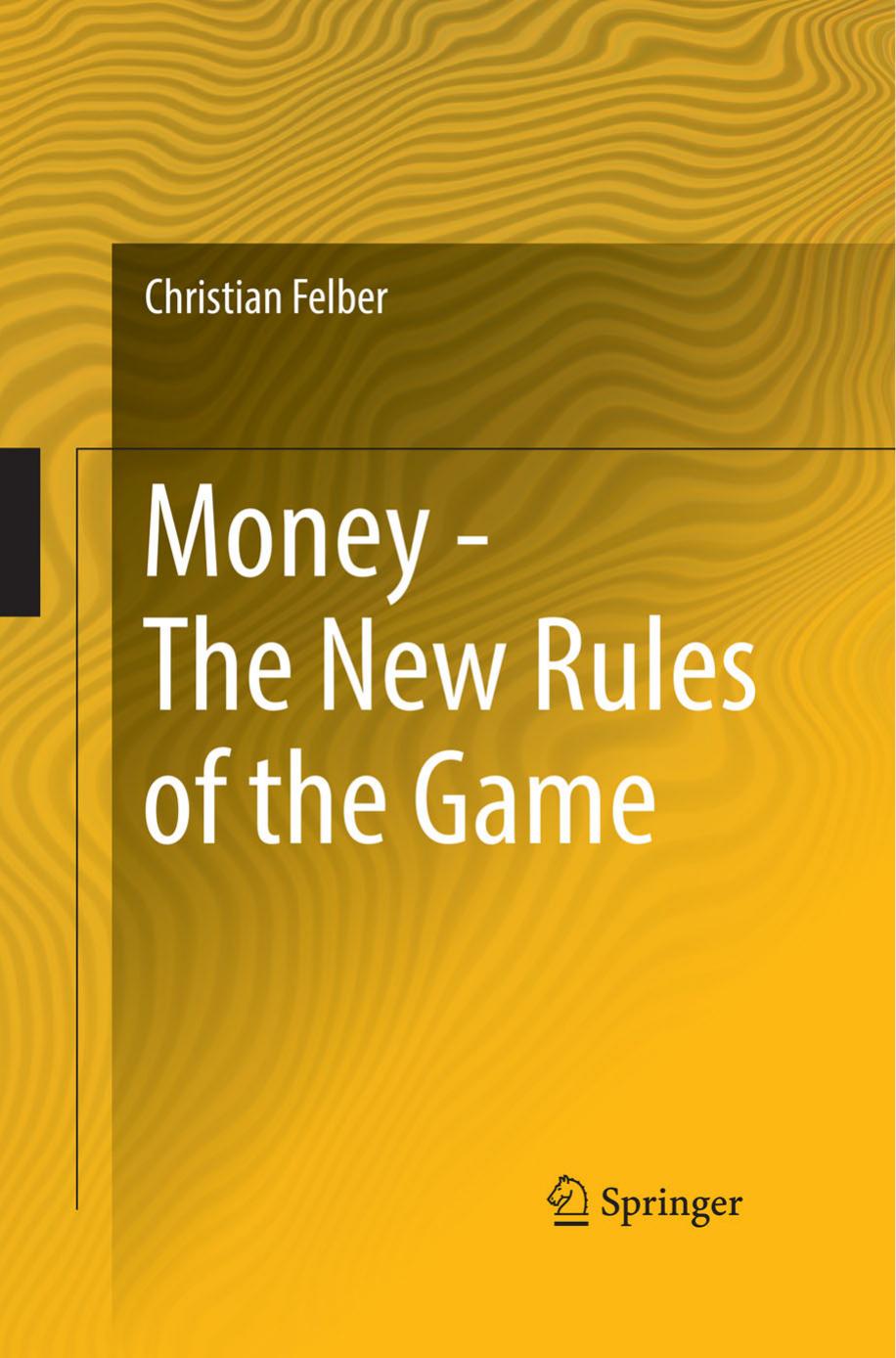
Money The New Rules of the Game 1st edition by Christian Felber – Ebook PDF Instant Download/Delivery: 3319673521 , 9783319673523
Full download Money The New Rules of the Game 1st edition after payment
Product details:
ISBN 10: 3319673521
ISBN 13: 9783319673523
Author: Christian Felber
This book advocates a holistic reform of the current monetary and financial system dealing with the issues of money creation, central banks, loans, stock markets, tax justice, pension security and the international monetary system – “Bretton Woods II”. Its innovative approach presents several alternatives for each cornerstone, in addition to introducing a participatory democratic process whereby sovereign citizens can themselves determine the rules governing the new financial and monetary system. With “democratic money conventions” in each municipality, where the elements of this new money system are discussed and decided on in a participatory manner, and a federal money covenant which then elaborates a template for a referendum about the future “money constitution”, a true “sovereign” could progressively convert money from a financial weapon into a democratic tool. The envisaged democratic monetary system, by providing equal opportunities for every member of society to participate in the development of the “new rules of the game”, turns money progressively into a public good which increases the freedom for all. The new system furthermore drives the enhancement of constitutional and relational values such as human dignity, solidarity, justice, sustainability, or democracy. Money should serve life and should serve the common good. The “Bank for the Common Good” Project, which was initiated in Austria by the author Christian Felber, represents a practical example of his proposals.
Money The New Rules of the Game 1st Table of contents:
1 Introduction: A Coercitive and Intransparent Financial System
1.1 The Non-Holistic Evolution of the Monetary System
1.2 The Multi-Dysfunctionality of Our Current Monetary System
1.3 Regulators Wanted
References
I. The Process towards a New Monetary Order
2 Tamer Wanted: Who Will Restrain the Global Monetary and Finance System?
2.1 G20 and the Financial Stability Board (FSB)
2.2 International Monetary Fund (IMF)
2.3 World Trade Organization (WTO)
2.4 Basel Committee on Banking Supervision
2.5 European Union
2.6 United Nations (UNO)
2.7 Independent Experts
2.7.1 Who then?
References
3 Rewriting the Rules of the Game: The Democratic Monetary Convention
3.1 Legitimation and Contextualization of the Convention
3.2 From Municipal to National Economic Convention
3.3 From Local to EU to Global Level
3.4 Local Matters
3.5 Core Subject Matters
3.6 Decision-Making Procedure
3.7 Utilization of Results
3.8 Initiated Prototypes
3.9 Ten Reasons for a Monetary Convention
Reference
4 The Basis: Money as a Public Good
4.1 Extended Meaning of “Public Good”
4.2 Values of the Monetary System
References
II. The Content – Cornerstones of a Democratic Monetary System
5 Who Creates Money?
5.1 The National Central Bank
5.2 Commercial Banks
5.3 Companies
5.4 Private Individuals
5.5 Political Regional Authorities
References
6 Sovereign Money Reform
6.1 Creation of Bank Money by Private Commercial Banks
6.2 Sovereign Money Reform
6.3 Benefits of the Reform
6.4 Side Note: Sovereign Money and Hundred-Percent Money
6.5 Amendment of Legislative Texts
References
7 Democratic Central Banks
7.1 Who Does the Central Bank Belong to?
7.2 Democratic Organization of the Central Bank
7.3 Objectives and Tasks of a Central Bank
7.3.1 The ECB Model
7.3.2 The Fed Model
7.3.3 The Alternative Model
7.4 Monetary Authority
References
8 Solving the Problem of Sovereign Debt
8.1 Proposal for the Reform of Sovereign Debt Financing
8.2 Benefits of the Reform for the Public
References
9 Bank Lending Regulations
9.1 Loans for What and for What Not?
9.1.1 Ethical Creditworthiness Appraisal
9.1.2 Speculative Financial Credit?
9.1.3 Regional Priority
References
10 Common Good Oriented Banks
10.1 Banks Are Historically Common-Good Oriented
10.2 Criticism of Bank Bailouts and the EU Banking Union
10.3 State Support Only for Common Good Banks
10.4 Common Good Orientation of Banks
10.5 Prototypes Everywhere
10.6 Systemic Consideration: From the Investment Bank to the Depository Bank
10.7 Adieu, Return on Investment
10.8 From the Risk Premium/Capital Tax to a Meaningful Return on Investment
10.8.1 A Hoarding Ban for Cash Millions
References
11 EU and Global Financial Supervision
11.1 EU Financial Supervision with an Edge
11.1.1 Splitting up System Relevant Banks
11.1.2 Closing or Strict Regulation of Shadow Banking Activities
11.1.3 Market Admission Approval for New Financial Products
11.1.4 Stricter Equity Capital Requirements
11.1.5 Rules for Funds and Capital Investment Companies
11.2 Global Financial Supervision
References
12 Derivatives—Close the Casino
12.1 General Regulation Proposals
12.2 Shares—Regional Common Good Exchanges
12.2.1 Regional Common Good Exchanges and the “Triple Skyline”
12.3 Close Securities Markets
12.4 Government Bonds—The Use of the Central Bank
12.5 Foreign Exchange—A New Global Currency System
12.6 Commodity Markets—Global Commodity Agreement
References
13 Secure Pensions
13.1 The PAYG Pension is Easily Financed
13.2 What Makes Private Provision Better?
13.2.1 Are Private Pensions Less Vulnerable with Regard to Demographic Factors?
13.2.2 Are the Premiums in Private Pensions Paid More Interest than Social Security Contributions?
13.2.3 Are Private Schemes Cheaper?
13.2.4 Is the Private Pension System Distributively Fairer?
13.2.5 The Methuselah Conspiracy
13.2.6 Do Favorable Framework Conditions for the Private Pension System Also have a Favorable Impact
13.3 Alternatives
References
14 Global Tax Cooperation
14.1 Systemic Tax Evasion
14.2 Step 1: Automatic Registration of All Domestic Income
14.3 Step 2: Multilateral Agreement on Information Exchange
14.4 Trust and Cooperation
14.5 From the previous EU Interest Directive to the Sound Capital Income Directive
14.6 World Financial Registry
14.7 Technical Implementation
14.8 Globally Just Corporation Tax—“Entire Group Taxation”
14.8.1 Country of Residence Principle
14.8.2 Unitary Taxation or Overall Group Tax
14.9 A Go-It-Alone by the EU is Possible!
References
15 Income and Ownership Caps—“Negative Feedback”
15.1 Excessive Inequality
15.1.1 Liberal Argument
15.1.2 System Theoretical Argument
15.1.3 Performance Justice and Equal Opportunities
15.1.4 The Financial Stability Argument
15.1.5 The Health Argument
15.1.6 The Happiness Argument
15.2 Limiting Income Inequality
15.3 Capping of Private Property
15.4 Inheritance
References
16 Currencies—Time for a Bretton Woods II
16.1 Failure of Bretton Woods I
16.2 Shortcomings of the Current Monetary Order
16.3 Pledge for a Bretton Woods II
16.4 Global Monetary Cooperation
16.5 Adjustment of Exchange Rates according to Purchasing Power Parity
16.6 Epilogues
16.6.1 Planned Economy in Peking und Zürich
16.6.2 End of the Dollar Hegemony?
16.6.3 Local and regional complementary currencies
References
III. Kick Off
17 The Path to the first Convention
17.1 Bottom-Up-Strategy
17.2 The Process of a Democratic Monetary Convention
17.2.1 Who Initiates a Convention?
17.2.2 Who is in the Convention?
17.2.3 How is the Convention Implemented?
17.2.4 How does communication and decision making take place?
17.3 Evolution of Contents
17.4 International Cooperation
17.5 From Monetary Convention to Constitutional Convention
References
18 Questionnaire for the Monetary Convention
18.1 Creation of Money
18.2 Sovereign Money Reform
18.3 Central Bank
18.4 Sovereign Debt
18.5 Banking System
18.6 Commercial Banks
18.7 Financial Supervision
18.8 Derivatives
18.9 Pensions
18.10 Tax Justice
18.11 Restriction of Inequality
18.12 International Monetary Order
Index
People also search for Money The New Rules of the Game 1st :
cash for life official game rules
what are the rules for 10000 dice game
what is money game
new rule game
money for the game of life
Tags: Christian Felber, the Game, New Rules