


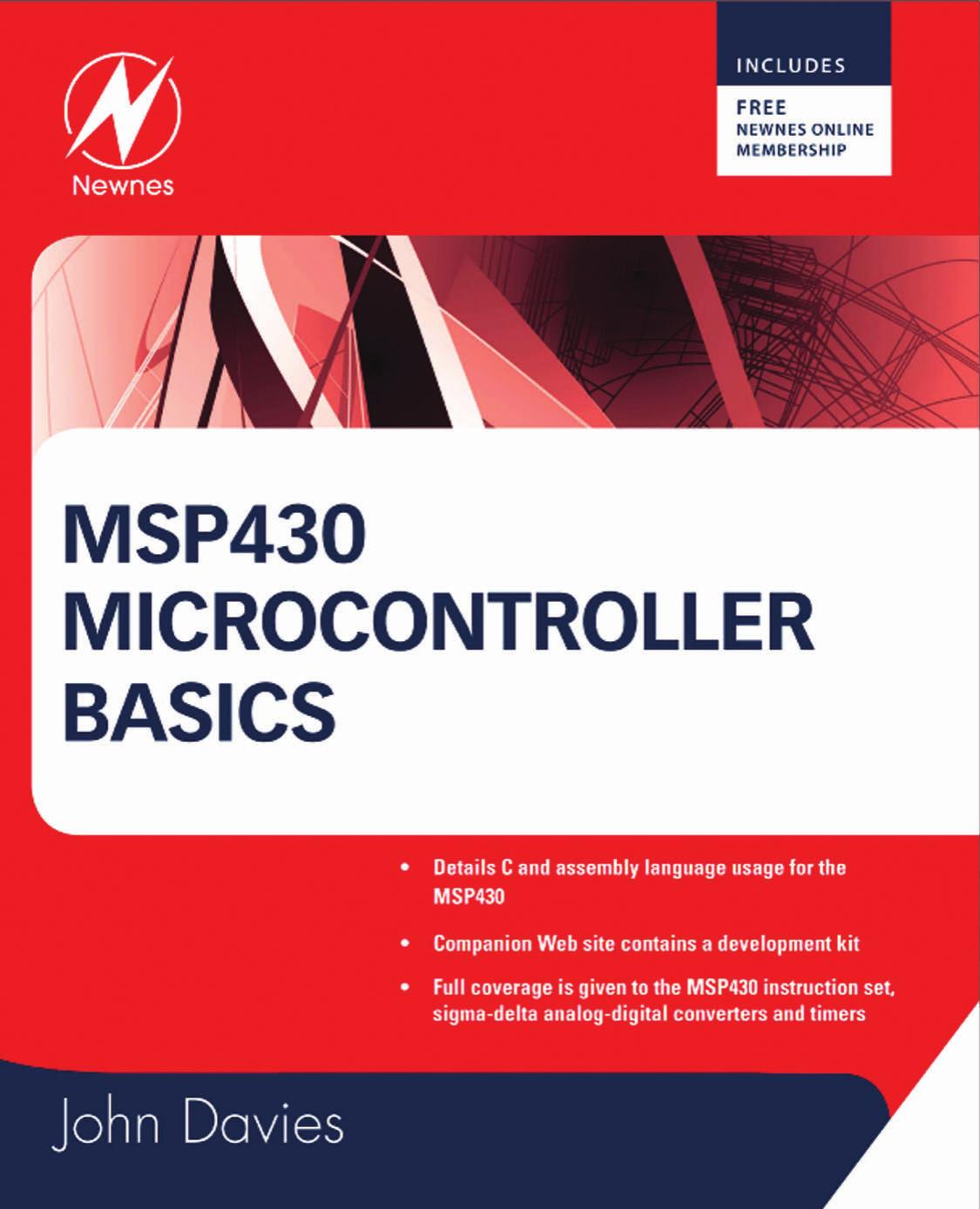
MSP430 Microcontroller Basics 1st edition by John H. Davies – Ebook PDF Instant Download/Delivery: 0750682760 , 978-0750682763
Full download MSP430 Microcontroller Basics 1st edition after payment

Product details:
ISBN 10: 0750682760
ISBN 13: 978-0750682763
Author: John H. Davies
The MSP430 microcontroller family offers ultra-low power mixed signal, 16-bit architecture that is perfect for wireless low-power industrial and portable medical applications. This book begins with an overview of embedded systems and microcontrollers followed by a comprehensive in-depth look at the MSP430. The coverage included a tour of the microcontroller’s architecture and functionality along with a review of the development environment. Start using the MSP430 armed with a complete understanding of the microcontroller and what you need to get the microcontroller up and running!
- Details C and assembly language for the MSP430
- Companion Web site contains a development kit
- Full coverage is given to the MSP430 instruction set, and sigma-delta analog-digital converters and timers
MSP430 Microcontroller Basics 1st Table of contents:
Chapter 1. Embedded Electronic Systems and Microcontrollers
1.1 What (and Where) Are Embedded Systems?
1.2 Approaches to Embedded Systems
1.3 Small Microcontrollers
1.4 Anatomy of a Typical Small Microcontroller
1.5 Memory
1.6 Software
1.7 Where Does the MSP430 Fit?
Chapter 2. The Texas Instruments MSP430
2.1 The Outside View„Pin-Out
2.2 The Inside View„Functional Block Diagram
2.3 Memory
2.4 Central Processing Unit
2.5 Memory-Mapped Input and Output
2.6 Clock Generator
2.7 Exceptions: Interrupts and Resets
2.8 Where to Find Further Information
Chapter 3. Development
3.1 Development Environment
3.2 The C Programming Language
3.3 Assembly Language
3.4 Access to the Microcontroller for Programming and Debugging
3.5 Demonstration Boards
3.6 Hardware
3.7 Equipment
Chapter 4. A Simple Tour of the MSP430
4.1 First Program on a Conventional Desktop Computer
4.2 Light LEDs in C
4.3 Light LEDs in Assembly Language
4.4 Read Input from a Switch
4.5 Automatic Control: Flashing Light by Software Delay
4.6 Automatic Control: Use of Subroutines
4.7 Automatic Control: Flashing a Light by Polling Timer_A
4.8 Header Files and Issues Brushed under the Carpet
Chapter 5. Architecture of the MSP430 Processor
5.1 Central Processing Unit
5.2 Addressing Modes
5.3 Constant Generator and Emulated Instructions
5.4 Instruction Set
5.5 Examples
5.6 Reflections on the CPU and Instruction Set
5.7 Resets
5.8 Clock System
Chapter 6. Functions, Interrupts, and Low-Power Modes
6.1 Functions and Subroutines
6.2 What Happens when a Subroutine Is Called?
6.3 Storage for Local Variables
6.4 Passing Parameters to a Subroutine and Returning a Result
6.5 Mixing C and Assembly Language
6.6 Interrupts
6.7 What Happens when an Interrupt Is Requested?
6.8 Interrupt Service Routines
6.9 Issues Associated with Interrupts
6.10 Low-Power Modes of Operation
Chapter 7. Digital Input, Output, and Displays
7.1 Digital Input and Output: Parallel Ports
7.2 Digital Inputs
7.3 Switch Debounce
7.4 Digital Outputs
7.5 Interface between 3V and 5V Systems
7.6 Driving Heavier Loads
7.7 Liquid Crystal Displays
7.8 Driving an LCD from an MSP430x4xx
7.9 Simple Applications of the LCD
Chapter 8. Timers
8.1 Watchdog Timer
8.2 Basic Timer1
8.3 Timer_A
8.4 Measurement in the Capture Mode
8.5 Output in the Continuous Mode
8.6 Output in the Up Mode: Edge-Aligned Pulse-Width Modulation
8.7 Output in the Up/Down Mode: Centered Pulse-Width Modulation
8.8 Operation of Timer_A in the Sampling Mode
8.9 Timer_B
8.10 What Timer Where?
8.11 Setting the Real-Time Clock: State Machines
Chapter 9. Mixed-Signal Systems: Analog Input and Output
9.1 Comparator_A
9.2 Analog-to-Digital Conversion: General Issues
9.3 Analog-to-Digital Conversion: Successive Approximation
9.4 The ADC10 Successive-Approximation ADC
9.5 Basic Operation of the ADC10
9.6 More Advanced Operation of the ADC10
9.7 The ADC12 Successive-Approximation ADC
9.8 Analog-to-Digital Conversion: Sigma–Delta
9.9 The SD16_A Sigma–Delta ADC
9.10 Operation of SD16_A
9.11 Signal Conditioning and Operational Amplifiers
9.12 Digital-to-Analog Conversion
Chapter 10. Communication
10.1 Communication Peripherals in the MSP430
10.2 Serial Peripheral Interface
10.3 SPI with the USI
10.4 SPI with the USCI
10.5 A Thermometer Using SPI in Mode 3 with the F2013 as Master
10.6 A Thermometer Using SPI in Mode 0 with the FG4618 as Master
10.7 Inter-integrated Circuit Bus
10.8 A Simple I²C Master with the USCI_B0 on a FG4618
10.9 A Simple I²C Slave with the USI on a F2013
10.10 State Machines for I²C Communication
10.11 A Thermometer Using I²C with the F2013 as Master
10.12 Asynchronous Serial Communication
10.13 Asynchronous Communication with the USCI_A
10.14 A Software UART Using Timer_A
10.15 Other Types of Communication
Chapter 11. The Future: MSP430X
11.1 Architecture of the MSP430X
11.2 Instruction Set of the MSP430X
11.3 Where Next?
11.4 Conclusion
People also search for MSP430 Microcontroller Basics 1st :
msp430 microcontroller basics
msp430 microcontroller price
msp430 examples
msp430 microcontroller basics pdf
arduino msp430
Tags:
John Davies,MSP430 Microcontroller,Basics