


Operations Research An Introduction 10th Edition by Hamdy Taha – Ebook PDF Instant Download/Delivery: 0134444017 , 9780134444017
Full download Operations Research An Introduction 10th edition after payment
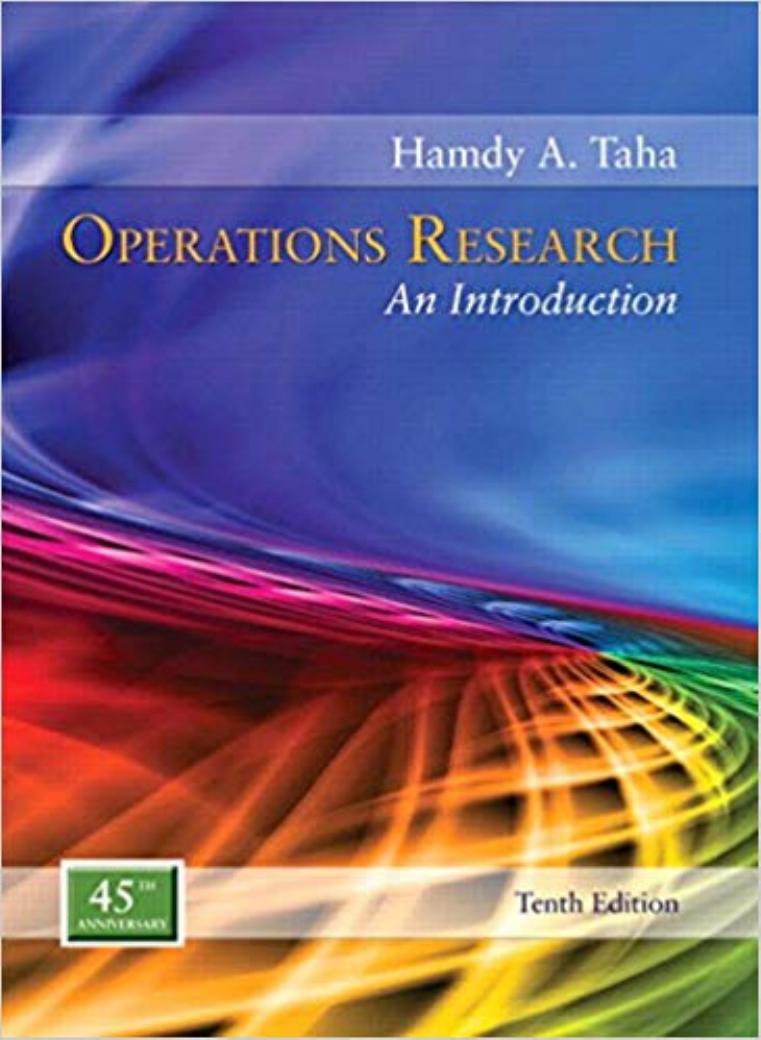
Product details:
ISBN 10: 0134444017
ISBN 13: 9780134444017
Author: Hamdy Taha
This is the eBook of the printed book and may not include any media, website access codes, or print supplements that may come packaged with the bound book. For junior/senior undergraduate and first-year graduate courses in Operations Research in departments of Industrial Engineering, Business Administration, Statistics, Computer Science, and Mathematics. Operations Research provides a broad focus on algorithmic and practical implementation of Operations Research (OR) techniques, using theory, applications, and computations to teach students OR basics. The book can be used conveniently in a survey course that encompasses all the major tools of operations research, or in two separate courses on deterministic and probabilistic decision-making. With the Tenth Edition, the author preserves classical algorithms by providing essential hand computational algorithms as an important part of OR history. Based on input and submissions from OR students, professors, and practitioners, the author also includes scenarios that show how classical algorithms can be beneficial in practice. These entries are included as Aha! Moments with each dealing with stories, anecdotes, and issues in OR theory, applications, computations, and teaching methodology that can advance the understanding of fundamental OR concepts. The Companion Website for Operations Research, 10/e (www.pearsonhighered.com/taha) provides valuable resources for both students and instructors. Resources include case studies that require students to employ OR tools from multiple chapters, Excel, TORA, and AMPL files as well as additional chapters and appendixes. A note about accessing the Companion Website: Instructors should click the “Register” link and follow the on-screen directions to access the site. Instructors need a Pearson Education account to register, but do not require an additional Access Code. Students can access the Companion Website by redeeming the Access Code included in the front of their new copy of Operations Research, 10/e. Students can also purchase Companion Website access online. The Instructor Resource Center contains the Solutions Manual and PowerPoints of the art from the book. Instructors can download these resources from www.pearsonhighered.com/irc
Operations Research An Introduction 10th Table of contents:
Chapter 1 What Is Operations Research?
1.1 Introduction
1.2 Operations Research Models
1.3 Solving the OR Model
1.4 Queuing and Simulation Models
1.5 Art of Modeling
1.6 More than Just Mathematics
1.7 Phases of an OR Study
1.8 About this Book
Bibliography
Problems7
Chapter 2 Modeling with Linear Programming
2.1 Two-Variable LP Model
2.2 Graphical LP Solution
2.2.1 Solution of a Maximization Model
Remarks.
2.2.2 Solution of a Minimization Model
Solution:
Remarks.
2.3 Computer Solution with Solver and AMPL
2.3.1 LP Solution with Excel Solver
2.3.2 LP Solution with AMPL5
Reddy Mikks Problem—A Rudimentary Model.
Reddy Mikks Problem—An Algebraic Model.
2.4 Linear Programming Applications
2.4.1 Investment
Mathematical Model:
Solution:
Remarks.
2.4.2 Production Planning and Inventory Control
Mathematical Model:
Solution:
Mathematical Model:
Solution:
Mathematical Model:
2.4.3 Workforce Planning
Mathematical Model:
2.4.4 Urban Development Planning6
Mathematical Model:
Remarks.
2.4.5 Blending and Refining
Mathematical Model:
2.4.6 Additional LP Applications
Bibliography
Problems
Chapter 3 The Simplex Method and Sensitivity Analysis
3.1 LP model in Equation Form
3.2 Transition from Graphical to Algebraic Solution
Remarks.
3.3 The Simplex Method
3.3.1 Iterative Nature of the Simplex Method
3.3.2 Computational Details of the Simplex Algorithm
3.3.3 Summary of the Simplex Method
3.4 Artificial Starting Solution
3.4.1 M-Method6
Remarks.
3.4.2 Two-Phase Method
Remarks.
3.5 Special Cases in the Simplex Method
3.5.1 Degeneracy
Remarks.
3.5.2 Alternative Optima
Remarks.
3.5.3 Unbounded Solution
Starting Iteration
Remarks.
3.5.4 Infeasible Solution
3.6 Sensitivity Analysis
3.6.1 Graphical Sensitivity Analysis
Remarks.
3.6.2 Algebraic Sensitivity Analysis—Changes in the Right-Hand Side
Determination of dual prices and feasibility ranges.
3.6.3 Algebraic Sensitivity Analysis—Objective Function
Definition of reduced cost.
Determination of the optimality ranges.
Remarks.
3.6.4 Sensitivity Analysis with TORA, Solver, and AMPL
3.7 Computational Issues in Linear Programming13
Bibliography
Problems
Chapter 4 Duality and Post-Optimal Analysis
4.1 Definition of the Dual Problem
4.2 Primal–Dual Relationships
4.2.1 Review of Simple Matrix Operations
4.2.2 Simplex Tableau Layout
Remarks.
4.2.3 Optimal Dual Solution
Remarks.
4.2.4 Simplex Tableau Computations
Formula 1: Constraint column computations.
Formula 2: Objective z-row computations.
Remarks.
4.3 Economic Interpretation of Duality
4.3.1 Economic Interpretation of Dual Variables
4.3.2 Economic Interpretation of Dual Constraints
4.4 Additional Simplex Algorithms
4.4.1 Dual Simplex Algorithm
Dual feasibility condition.
Dual optimality condition.
4.4.2 Generalized Simplex Algorithm
Remarks.
4.5 Post-Optimal Analysis
4.5.1 Changes Affecting Feasibility
Changes in the right-hand side.
Addition of a new constraint.
4.5.2 Changes Affecting Optimality
Changes in the objective function coefficients.
Addition of a new activity.
Remarks.
Bibliography
Problems
Chapter 5 Transportation Model and Its Variants
5.1 Definition of the Transportation Model
5.2 Nontraditional Transportation Models
5.3 The Transportation Algorithm
5.3.1 Determination of the Starting Solution
Northwest-corner method.
Least-cost method.
Vogel approximation method (VAM).
5.3.2 Iterative Computations of the Transportation Algorithm
Transshipment model.
5.3.3 Simplex Method Explanation of the Method of Multipliers
5.4 The Assignment Model
5.4.1 The Hungarian Method8
5.4.2 Simplex Explanation of the Hungarian Method
Bibliography
Problems10
Chapter 6 Network Model
6.1 Scope and Definition of Network Models
6.2 Minimal Spanning Tree Algorithm
Remarks.
6.3 Shortest-Route Problem
6.3.1 Examples of the Shortest-Route Applications
6.3.2 Shortest-Route Algorithms
Dijkstra’s algorithm.
Floyd’s algorithm.
6.3.3 Linear Programming Formulation of the Shortest-Route Problem
Remarks.
6.4 Maximal Flow Model
6.4.1 Enumeration of Cuts
6.4.2 Maximal Flow Algorithm
6.4.3 Linear Programming Formulation of Maximal Flow Model
6.5 CPM and Pert
6.5.1 Network Representation
6.5.2 Critical Path Method (CPM) Computations
Forward pass (earliest occurrence times, □).
Backward pass (latest occurrence times, Δ).
Forward Pass
Backward Pass
6.5.3 Construction of the Time Schedule
Construction of Preliminary Schedule.
Determination of the floats.
Red-Flagging Rule.
6.5.4 Linear Programming Formulation of CPM
6.5.5 PERT Networks
Bibliography
Problems
Chapter 7 Advanced Linear Programming
7.1 Simplex Method Fundamentals
7.1.1 From Extreme Points to Basic Solutions
7.1.2 Generalized Simplex Tableau in Matrix Form
Remarks.
7.2 Revised Simplex Method
7.2.1 Development of the Optimality and Feasibility Conditions
7.2.2 Revised Simplex Algorithm
7.2.3 Computational Issues in the Revised Simplex Method
7.3 Bounded-Variables Algorithm
7.4 Duality
7.4.1 Matrix Definition of the Dual Problem
7.4.2 Optimal Dual Solution
Unboundedness and infeasibility.
Motivation for the dual simplex algorithm.
7.5 Parametric Linear Programming
7.5.1 Parametric Changes in C
Optimal Solution at t = t0 = 0
Alternative Optimal Basis at t = t1 = 1
7.5.2 Parametric Changes in b
Alternative Basis at t = t1 = 10/3
Alternative Basis at t = t2 = 30/7
7.6 More Linear Programming Topics
Bibliography
Problems
Chapter 8 Goal Programming
8.1 A Goal Programming Formulation
8.2 Goal Programming Algorithms
8.2.1 The Weights Method
8.2.2 The Preemptive Method
Remarks.
LP1 (Exposure maximization).
LP2 (Cost minimization).
Bibliography
Problems
Chapter 9 Integer Linear Programming
9.1 Illustrative Applications
9.1.1 Capital Budgeting
Remarks.
9.1.2 Set-Covering Problem
Remarks.
9.1.3 Fixed-Charge Problem
9.1.4 Either-Or and If-Then Constraints
9.2 Integer Programming Algorithms
9.2.1 Branch-and-Bound (B&B) Algorithm4
Remarks.
Summary of the B&B Algorithm.
9.2.2 Cutting-Plane Algorithm
Remarks.
Bibliography
Problems
Chapter 10 Heuristic Programming
10.1 Introduction
10.2 Greedy (Local Search) Heuristics
10.2.1 Discrete Variable Heuristic
10.2.2 Continuous Variable Heuristic
Extension of the greedy search multiple variables.
10.3 Metaheuristic
10.3.1 Tabu Search Algorithm
“Fine-Tuning” TS.
10.3.2 Simulated Annealing Algorithm
10.3.3 Genetic Algorithm
Dealing with continuous variables.
10.4 Application of Metaheuristics to Integer Linear Programs
10.4.1 ILP Tabu Algorithm
10.4.2 ILP Simulated Annealing Algorithm
10.4.3 ILP Genetic Algorithm
10.5 Introduction to Constraint Programming (CP)
Bibliography
Problems
Chapter 11 Traveling Salesperson Problem (TSP)
11.1 Scope of the TSP
11.2 TSP Mathematical Model
TSP solution.
Interpretation of the optimum solution.
Open-tour TSP.
Lower bound on the optimum tour length.
11.3 Exact TSP Algorithms
11.3.1 B&B Algorithm
Remarks.
11.3.2 Cutting-Plane Algorithm
11.4 Local Search Heuristics
11.4.1 Nearest-Neighbor Heuristic
11.4.2 Reversal Heuristic
11.5 Metaheuristics
11.5.1 TSP Tabu Algorithm
11.5.2 TSP Simulated Annealing Algorithm
11.5.3 TSP Genetic Algorithm
Bibliography
Problems
Chapter 12 Deterministic Dynamic Programming
12.1 Recursive Nature of Dynamic Programming (DP) Computations
12.2 Forward and Backward Recursion
12.3 Selected DP Applications
12.3.1 Knapsack/Fly-Away Kit/Cargo-Loading Model
12.3.2 Workforce Size Model
12.3.3 Equipment Replacement Model
12.3.4 Investment Model
12.3.5 Inventory Models
12.4 Problem of Dimensionality
Bibliography
Problems
Chapter 13 Inventory Modeling (with Introduction to Supply Chains)
13.1 Inventory Problem: A Supply Chain Perspective1
13.1.1 An Inventory Metric in Supply Chains
13.1.2 Elements of the Inventory Optimization Model
13.2 Role of Demand in the Development of Inventory Models
13.3 Static Economic-Order-Quantity Models
13.3.1 Classical EOQ Model
13.3.2 EOQ with Price Breaks
13.3.3 Multi-Item EOQ with Storage Limitation
13.4 Dynamic EOQ Models
13.4.1 No-Setup EOQ Model
13.4.2 Setup EOQ Model
General dynamic programming algorithm.
Dynamic programming algorithm with constant or decreasing marginal costs.
Silver-Meal heuristic.
Remarks.
13.5 Sticky issues in inventory modeling
Bibliography
Problems
Chapter 14 Review of Basic Probability
14.1 Laws of Probability
14.1.1 Addition Law of Probability
14.1.2 Conditional Law of Probability
14.2 Random Variables and Probability Distributions
14.3 Expectation of a Random Variable
14.3.1 Mean and Variance (Standard Deviation) of a Random Variable
14.3.2 Joint Random Variables
14.4 Four Common Probability Distributions
14.4.1 Binomial Distribution
Remarks.
14.4.2 Poisson Distribution
Remarks.
14.4.3 Negative Exponential Distribution
Remarks.
14.4.4 Normal Distribution
Remarks.
14.5 Empirical Distributions
Bibliography
Problems
Chapter 15 Decision Analysis and Games
15.1 Decision Making Under Certainty—Analytic Hierarchy Process (AHP)
15.2 Decision Making Under Risk
15.2.1 Decision Tree–Based Expected Value Criterion
Decision tree analysis.
Remarks.
15.2.2 Variants of the Expected Value Criterion
Posterior (Bayes’) probabilities.
Utility functions.
15.3 Decision Under Uncertainty
Laplace.
Minimax.
Savage.
Hurwicz.
15.4 Game Theory
15.4.1 Optimal Solution of Two-Person Zero-Sum Games
15.4.2 Solution of Mixed Strategy Games
Graphical solution of games.
Remarks.
Linear programming solution of games.
Player A’s linear program
Player B’s Linear Program
Bibliography
Problems
Chapter 16 Probabilistic Inventory Models
16.1 Continuous Review Models
16.1.1 “Probabilitized” EOQ Model
16.1.2 Probabilistic EOQ Model
16.2 Single-Period Models
16.2.1 No-Setup Model (Newsvendor Model)
16.2.2 Setup Model (s-S Policy)
16.3 Multiperiod Model
Bibliography
Problems
Chapter 17 Markov Chains
17.1 Definition of a Markov Chain
17.2 Absolute and n-Step Transition Probabilities
17.3 Classification of the States in a Markov Chain
17.4 Steady-State Probabilities and Mean Return Times of Ergodic Chains
17.5 First Passage Time
17.6 Analysis of Absorbing States
Bibliography
Problems
Chapter 18 Queuing Systems
18.1 Why Study Queues?
18.2 Elements of a Queuing Model
18.3 Role of Exponential Distribution
18.4 Pure Birth and Death Models (Relationship Between the Exponential and Poisson Distributions)
18.4.1 Pure Birth Model
Remark.
18.4.2 Pure Death Model
18.5 General Poisson Queuing Model
18.6 Specialized Poisson Queues
18.6.1 Steady-State Measures of Performance
18.6.2 Single-Server Models
(M/M/1):(GD/∞/∞).
(M/M/1):(GD/N/∞).
18.6.3 Multiple-Server Models
(M/M/c):(GD/∞/∞).
Remarks.
(M/M/c):(GD/N/∞), c≤N.
(M/M/∞):(GD/∞/∞)—Self-Service Model.
18.6.4 Machine Servicing Model—(M/M/R):(GD/K/K), R<K
18.7 (M/G/1):(GD/∞/∞)—Pollaczek–Khintchine (P–K) Formula
18.8 Other Queuing Models
18.9 Queuing Decision Models
18.9.1 Cost Models
18.9.2 Aspiration Level Model
Bibliography
Problems
Chapter 19 Simulation Modeling
19.1 Monte Carlo Simulation
19.2 Types of Simulation
19.3 Elements of Discrete Event Simulation
19.3.1 Generic Definition of Events
19.3.2 Sampling from Probability Distributions
Inverse method.
Convolution method.
Box-Muller normal sampling formula.
19.4 Generation of Random Numbers
19.5 Mechanics of Discrete Simulation
19.5.1 Manual Simulation of a Single-Server Model
Arrival of customer 1 at T = 0.
Departure of customer 1 at T = 13.37.
Arrival of customer 2 at T = 42.48.
Arrival of customer 3 at T = 53.49.
Departure of customer 2 at T = 57.22.
Arrival of customer 4 at T = 60.81.
Arrival of customer 5 at T = 61.83.
Departure of customer 3 at T = 70.19.
Departure of customer 4 at T = 81.08.
Departure of customer 5 at T = 92.82.
19.5.2 Spreadsheet-Based Simulation of the Single-Server Model
19.6 Methods for Gathering Statistical Observations
19.6.1 Subinterval Method
19.6.2 Replication Method
19.7 Simulation Languages
Bibliography
Problems
Chapter 20 Classical Optimization Theory
20.1 Unconstrained Problems
20.1.1 Necessary and Sufficient Conditions
20.1.2 The Newton–Raphson Method
20.2 Constrained Problems
20.2.1 Equality Constraints
Constrained derivatives (Jacobian) method.
Sensitivity analysis in the Jacobian method.
Lagrangean method.
20.2.2 Inequality Constraints—Karush–Kuhn–Tucker (KKT) Conditions1
Sufficiency of the KKT conditions.
Bibliography
Problems
Chapter 21 Nonlinear Programming Algorithms
21.1 Unconstrained Algorithms
21.1.1 Direct Search Method
General step i.
21.1.2 Gradient Method
21.2 Constrained Algorithms
21.2.1 Separable Programming
Separable convex programming.
21.2.2 Quadratic Programming
21.2.3 Chance-Constrained Programming
21.2.4 Linear Combinations Method
21.2.5 SUMT Algorithm
Bibliography
Problems
Appendix A Statistical Tables1
Appendix B Partial Answers to Selected Problems1
Index
People also search for Operations Research An Introduction 10th :
operations research an introduction 10th ed hamdy a taha solution
operations research an introduction 10th ed
operations research an introduction 10th edition
introduction of operations research
introduction to operations research 11th edition pdf free download
Tags: Hamdy Taha, Operations Research, An Introduction