


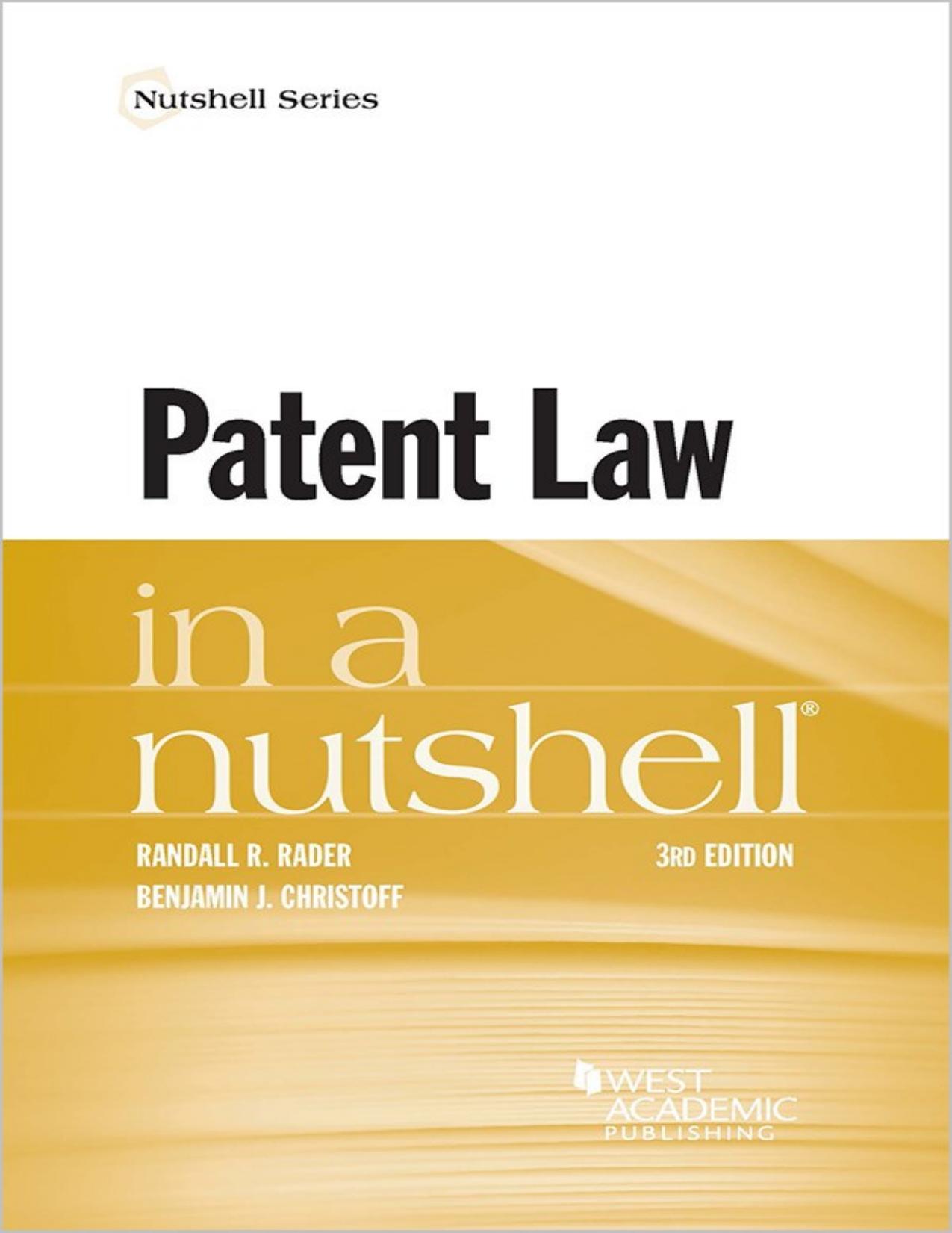
Patent Law in Nutshell (Nutshells) 3rd edition by Randall Rader, Benjamin Christoff – Ebook PDF Instant Download/Delivery:168328531X, 978-1683285311
Full download Patent Law in Nutshell (Nutshells) 3rd edition after payment
Product details:
ISBN 10: 168328531X
ISBN 13: 978-1683285311
Author: Randall Rader, Benjamin Christoff
This Nutshell provides a succinct description of the fundamentals of U.S. patent law. Ranging from the acquisition of patent rights to their enforcement, it contains an overview of relevant statutes, rules, and cases that collectively define this area of intellectual property law. Topics include claim construction, obviousness, anticipation, written description and enablement, infringement, remedies, and other notable doctrines. Patent law has evolved quickly in the past few years. This Nutshell captures those changes and relates them well to the overall fabric of intellectual property law. This reference is suitable for use by those with a beginner’s knowledge of patent law, but it has sufficient depth to be instructive for every practitioner in this exciting and dynamic field.
Patent Law in Nutshell (Nutshells) 3rd Table of contents:
Chapter 1 Foundations of Patent Law 1
I. Foundations of Patent Law 1
II. Economics (Incentive to Invent) 2
III. History: Antidote to Trade Secrets (Incentive to Disclose) 5
IV. History: Technology Transfer 8
V. Natural Rights (Entitlement Theory) 9
VI. Patents and Public Utility Theory 11
VII. Conclusion 12
Chapter 2 Patent Acquisition 13
I. The United States Patent and Trademark Office 13
A. Examination 13
B. Historical Development 17
C. Organization 24
II. Prosecution Procedures 24
A. Application Types 25
1. Provisional Applications 25
2. Non-Provisional Applications 26
3. Continuing Applications 27
B. Publication Rule 31
C. Interferences & Derivation Proceedings 32
D. Petition and Appeal Rights 33
III. Post-Grant Procedures 35
A. Certificates of Correction 36
B. Reissue 38
1. Error Correction 38
2. Intervening Rights 41
3. Recapture 42
C. Reexamination, Supplemental Examination & Inter Partes Review 43
1. Ex Parte Reexamination 44
2. Supplemental Examination 46
3. Inter Partes Reexamination & Inter Partes Review 46
D. Post-Grant Review 47
IV. Conclusion: The World’s Most Liberal System 48
Chapter 3 Patent Eligibility 51
I. Introduction 51
A. The Constitution & Laws of Nature 52
B. The Language of § 101 54
II. Processes 56
A. Process Versus Product Claims 56
B. Computer-Related Inventions 57
C. Tax Strategies 68
D. Methods of Medical Treatment 68
E. Compositions of Matter and Biotechnology 71
III. TRIPS 74
Chapter 4 Utility 77
I. Introduction 77
A. § 101 77
B. Historical Development of the Doctrine 78
II. Three Types of Utility 80
A. Chemistry and Biotechnology 83
B. Biotech Guidelines 85
III. Industrial Application 87
Chapter 5 Anticipation 89
I. Introduction 89
II. Identification of Prior Art Under the U.S. First-to-Invent Regime 91
A. Novelty Under the First-to-Invent Regime 96
B. Secret Prior Art Under the First-to- Invent Regime 100
III. Identification of Prior Art Under the U.S. First-Inventor-to-File Regime 102
A. Novelty Under the First-Inventor-to- File Regime 103
B. Secret Prior Art Under the First- Inventor-to-File Regime 104
IV. Anticipation 106
A. Each and Every Element 107
B. Enablement Requirement 110
C. Inherency 110
D. Anticipation vs. Obviousness 113
Chapter 6 Statutory Bars 115
I. Introduction 115
II. Public Use Under the First-to-Invent Regime 119
A. Definitions 119
B. Activities of the Applicant 120
1. Informing 121
2. Non-Informing 122
3. Secret 124
C. Activities of Third Parties 125
1. Informing 125
2. Non-Informing 126
3. Secret 127
III. On Sale Bar Under the First-to-Invent Regime 128
A. Definitions 128
B. Two-Part Test 129
1. Commercial Offer for Sale 129
2. Ready for Patenting 130
IV. Experimental Use Negation Under the First-to-Invent Regime 132
A. Exception Versus Negation 132
B. Sales of the Invention 134
V. Patents and Printed Publications 135
VI. Other Statutory Bars Under the First-to- Invent Regime 136
A. Abandonment 136
B. Delay 138
Chapter 7 Novelty: Prior Invention 139
I. Introduction 139
II. Prior Invention Under First-to-Invent’s § 102(a) 141
A. “Known or Used” 141
B. First-to-Invent’s § 102(a) Before the Patent and Trademark Office 144
III. Priority Under First-to-Invent’s § 102(g) 146
A. § 102(g) 146
B. Statutory Framework 148
1. Interferences 149
2. Conception 151
3. Reduction to Practice 153
4. Diligence 155
5. Abandoned, Suppressed, or Concealed 157
6. The Second Paragraph of First-to-Invent’s § 102(g) 158
7. Examples 159
IV. Prior Invention Under Pre-AIA § 102(e) & Post-AIA § 102(a)(2) 161
V. Derivation Under First-to-Invent’s § 102(f) 163
VI. Derivation Proceedings Under First- Inventor-to-File’s § 135 164
VII. Exceptions to First-Inventor-to-File’s Novelty Requirement 165
Chapter 8 Non-Obviousness 167
I. Introduction 167
II. History of Patent Law’s “Crown Jewel” 173
III. Prior Art 177
A. § 102 178
1. Analogous Art 179
2. Joint Research Exception 181
B. Prior Art by Admission 183
IV. The Supreme Court Trilogy 183
V. The Federal Circuit 188
A. Motivation or Suggestion to Combine 188
B. KSR 191
C. Scrutiny of Hindsight 194
D. Objective Criteria (Secondary Considerations) 196
E. Obviousness “Traps” 202
1. Standard of Proof 203
2. Manner of Invention Irrelevant 204
3. Obvious to Try 205
4. Patentability vs. Validity 208
F. Chemistry and Biotechnology 209
1. Chemistry 210
2. Biotechnology 210
VI. Non-Obviousness (Inventive Step) in Foreign Patent Systems 211
Chapter 9 Adequate Disclosure 213
I. Introduction 213
II. Enablement 216
A. Purpose 216
B. Test 217
1. At the Time of Filing 218
2. Scope of Disclosure 220
3. Without Undue Experimentation 224
C. Relationship to Utility 226
III. Written Description 228
A. Purpose 228
B. “Possession” of the Claimed Subject Matter 230
C. Written Description Unchained 232
IV. Best Mode 235
A. Purpose 235
B. Two-Part Test 235
1. Inventor’s Subjective Belief 236
2. Concealment 237
C. Unnecessary Vestige? 240
Chapter 10 Issues in Patent Acquisition 243
I. Introduction 243
II. Inventorship 244
A. Test for Inventorship 244
B. Consequences of Incorrect Inventorship 247
III. Inequitable Conduct 249
A. Purpose 249
B. Test for Inequitable Conduct 252
1. Materiality 254
2. Intent 255
C. International Treatment 258
IV. Double Patenting 258
A. Purpose 258
B. Two Types 259
1. Same Invention or Statutory 259
2. “Obviousness-Type” or Non- Statutory 260
C. Terminal Disclaimer 265
V. International Prosecution 266
VI. The Bayh-Dole Act 266
Chapter 11 The Patent Trial and Appeal Board 271
I. Introduction 271
II. PTAB Proceedings 272
A. Post-Grant Review 272
B. Inter Partes Review 275
C. Covered Business Method Review 279
D. Derivation Proceedings 279
E. Review of Examiner Decisions 280
III. Constitutionality of IPR Proceedings 280
IV. Claim Construction 284
V. Estoppel 289
VI. Stays of District Court Litigation 292
Chapter 12 Claims 295
I. Introduction 295
A. Central Legal Element of a Patent 295
B. Historical Development 296
C. § 112 298
II. Parts of a Claim 300
A. One-Sentence Rule 301
B. Preamble 302
C. Transitional Phrase 303
D. Body 307
E. Independent and Dependent Claims 309
III. Special Claim Formats 311
A. Means-Plus-Function 312
1. § 112, ¶ 6 (Now § 112, ¶ (f)) 312
2. Practical Significance 315
3. Equivalents Under § 112 and the Doctrine of Equivalents 320
4. International Treatment 325
B. Product-by-Process 325
1. Purpose 325
2. International Treatment 328
C. Jepson 329
D. Markush 330
IV. Definiteness 332
A. Test 332
B. Relative Terminology & Words of Approximation 336
Chapter 13 Claim Construction 339
I. Introduction 339
II. Claim Construction 342
A. Challenges of Claim Construction 343
B. Claim Construction in the Federal Circuit Era: Markman 346
C. The Process at the Trial Level 353
D. Sources of Claim Meaning 354
1. The Claim Language 356
2. The Specification 360
3. The Prosecution History 366
4. Extrinsic Evidence 369
E. Guidelines for Claim Construction 375
F. Practical Problems 377
1. Preamble 378
2. Construing Claims in Light of the Specification Versus Impermissibly Importing a Limitation from the Specification 380
3. Construing Claims to the Extent Necessary Versus Construing Claims in Light of the Accused Device 382
4. Evolving Claim Construction 383
G. Claim Construction at the Patent Office 385
Chapter 14 Infringement 387
I. Introduction 387
II. Literal Infringement 388
III. The Doctrine of Equivalents—Non-Textual Infringement 389
A. Purpose 389
B. Test(s) 393
C. Limitations 394
1. Prosecution History Estoppel 395
2. All-Elements Rule 398
3. Prior Art 400
4. Public Dedication 402
D. Means-Plus-Function Claims 403
E. Reverse Doctrine of Equivalents 404
IV. Indirect Infringement 405
A. Inducement of Infringement 407
B. Contributory Infringement 409
V. “Joint” or “Divided” Infringement 410
VI. Territorial Scope 413
A. Exporting Components of a Patented Combination 415
B. Importation of Goods Manufactured by a Patented Process 418
VII. International Trade Commission 419
VIII.Exceptions to Infringement 424
A. Implied Licenses, First Sale & Exhaustion, and Repair & Reconstruction 424
B. Experimental Use 429
IX. “Artificial” Infringement Under § 271(e)(2) 432
X. Infringement Abroad 433
Chapter 15 Additional Defenses 437
I. Introduction 437
II. Laches and Estoppel 439
A. Laches 440
B. Equitable Estoppel 442
C. Prosecution Laches 444
D. Licensee Estoppel 446
E. Assignor Estoppel 448
III. Shop Rights 449
IV. Temporary Presence in the United States 451
V. First Inventor Defense 453
VI. Patent Misuse 454
Chapter 16 Remedies 459
I. Injunctions 460
II. Damages 466
A. Lost Profits 466
B. Price Erosion 473
C. Reasonable Royalty 475
D. The Entire Market Value Rule 479
E. Marking 483
III. Willful Infringement: Enhanced Damages and Attorney Fees 486
A. Attorney Fees 487
B. Enhanced Damages 488
IV. International Remedies 492
Chapter 17 International Patent Law 495
I. Major International Agreements 495
A. Paris Convention 496
B. Patent Cooperation Treaty 502
C. Regional Agreements 505
1. European Patent Convention and the European Union 505
2. TRIPS and Bilateral Free Trade Agreements 507
II. International Enforcement 510
Chapter 18 Design Patents 511
I. Introduction 511
II. Claiming a Design 512
III. Validity 514
A. Obviousness 515
B. Functionality 517
IV. Infringement 519
V. Damages 524
Chapter 19 The Hatch-Waxman Act 527
I. Introduction 527
II. The ANDA Process 529
III. The Safe Harbor Under § 271(e)(1) 535
IV. The Orange Book 537
V. Declaratory Judgment Jurisdiction 540
VI. Authorized Generics 543
Index 547
People also search for Patent Law in Nutshell (Nutshells) 3rd:
nutshell law
nutshell law books
patent law in a nutshell pdf
nutshell legal books
patents in a nutshell
Tags: Randall Rader, Benjamin Christoff, Patent Law