
Plain English for Lawyers 6th Edition by Richard Wydick, Amy Sloan- Ebook PDF Instant Download/Delivery: 1531007003 , 9781531007003
Full download Plain English for Lawyers 6th edition after payment
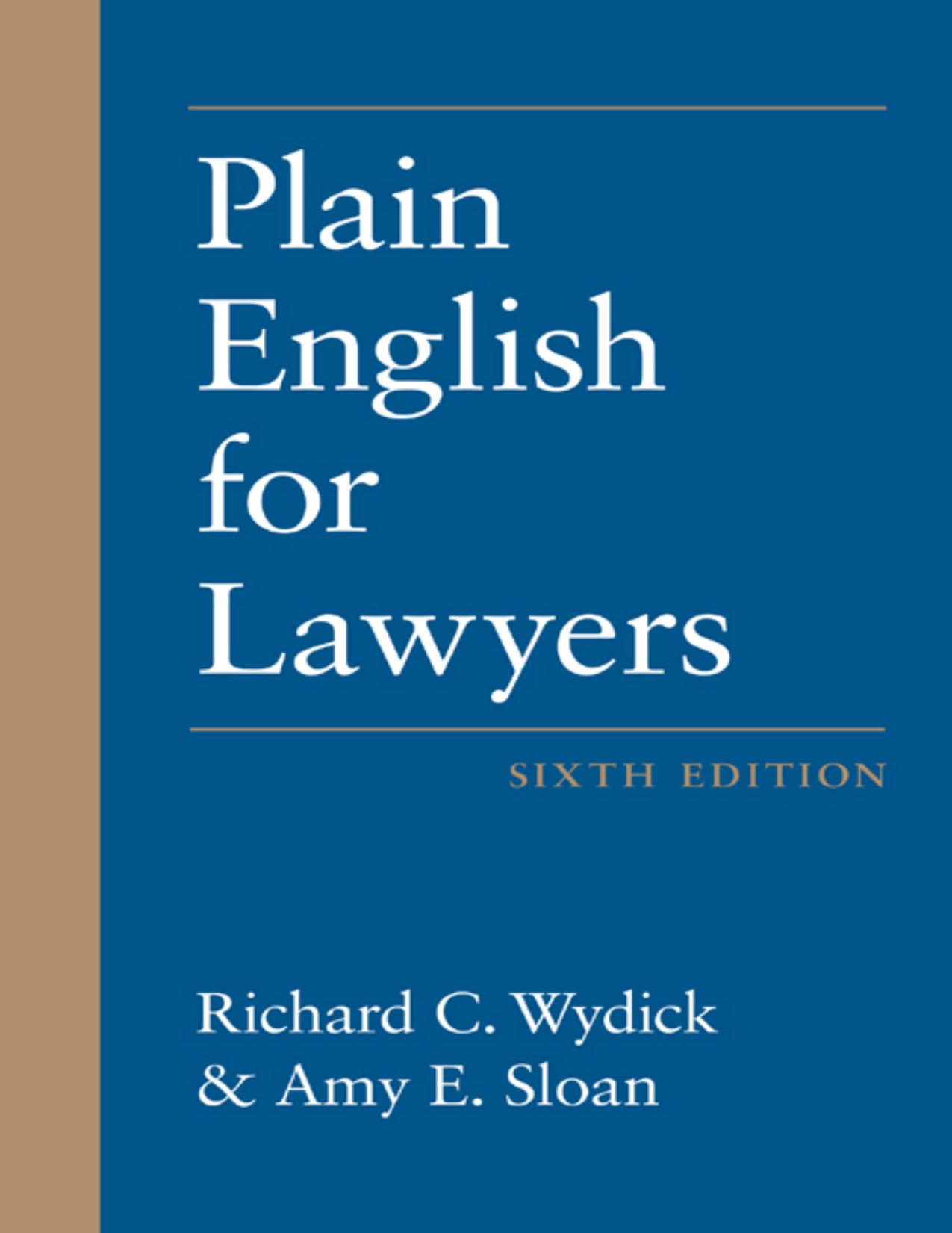
Product details:
ISBN 10: 1531007003
ISBN 13: 9781531007003
Author: Richard Wydick, Amy Sloan
Plain English for Lawyers has been a favorite of law students, legal writing teachers, lawyers, and judges for almost 40 years. The sixth edition, now co-authored by Amy Sloan, updates this classic text, including new chapter exercises, while preserving all the approaches that make it such a standard in the field. It remains (in size only!) a little book, small enough and palatable enough not to intimidate over-loaded law students. In January 2005, the Legal Writing Institute gave Wydick its Golden Pen Award for having written Plain English for Lawyers. The Legal Writing Institute is a non-profit organization that provides a forum for discussion and scholarship about legal writing, analysis, and research. The Institute has over 1,300 members representing all of the ABA-accredited law schools in the United States. Its membership also includes law teachers from other nations, English teachers, and practicing lawyers.The LWI award states: “Plain English for Lawyers … has become a classic. Perhaps no single work has done more to improve the writing of lawyers and law students and to promote the modern trend toward a clear, plain style of legal writing.”“[P]robably the most popular legal text today…” — The New York Times, on an earlier edition“[A] survival kit for the profession. It should be on every lawyer’s desk.” — New Jersey Lawyer, on an earlier edition“Plain English for Lawyers is a classic that deserves a place on every lawyer’s shelf. It is everything that a writing book should be — clear, concise, spirited, practical, accessible, and sound.” — The Scribes Journal of Legal Writing, on the fourth edition“Wydick’s Plain English for Lawyers is the most practical book of its kind, following in the fine tradition of Strunk and White’s The Elements of Style.” — The National Law Journal, on an earlier edition“A classic updated for today’s students. Concise, clear, and comprehensive. It doesn’t get any better than that.”—Linda H. Edwards, Boyd School of Law, UNLV“Hurray for the sixth edition of Plain English for Lawyers! Professor Sloan has masterfully retained Professor Wydick’s rich tradition of providing easy-to-understand advice and helpful exercises to improve legal writing clarity. This new edition updates the timeless advice and exercises for which Plain English for Lawyers is so well known, and it also provides innovative ideas on design techniques that are particularly useful for electronic and digital communications. Lawyers and law students alike will enhance their written communication skills by reviewing the advice and practicing the techniques contained in this book.”—Christine Nero Coughlin, Wake Forest University School of Law
Plain English for Lawyers 6th Table of contents:
CHAPTER ONE: Why Plain English?
CHAPTER TWO: Omit Surplus Words
How to Spot Bad Construction: Working Words and Glue Words
Avoid Compound Constructions
Avoid Word-Wasting Expressions
Avoid It is Sentences
Avoid Redundant Legal Phrases
CHAPTER THREE: Use Verbs to Express Action
CHAPTER FOUR: Prefer the Active Voice
The Difference Between Active and Passive Voice
Problems with the Passive Voice: Wordiness and Ambiguity
When to Use the Passive Voice
CHAPTER FIVE: Use Short Sentences
CHAPTER SIX: Arrange Your Words Carefully
Avoid Wide Gaps Between the Subject, the Verb, and the Object
Put Conditions and Exceptions Where They Are Clear and Easy to Read
When Necessary, Make a List
Put Modifying Words Close to What They Modify
Avoid Noun Chains
Avoid Nested Modifiers
Clarify the Reach of Modifiers
CHAPTER SEVEN: Choose Your Words Carefully
Use Concrete Words
Use Familiar Words
Use Gender-Neutral Words
Use Strong Nouns and Verbs to Persuade
Avoid Empty Lawyerisms
Avoid Multiple Negatives
Avoid Distracting Words and Syntax
CHAPTER EIGHT: Use Commas Carefully
Definitions of Terms
Comma Usage
Use a Comma to Connect Two Independent Clauses With a Conjunction
Use a Comma After an Introductory Element
Use Commas to Set Off Nonessential Elements from the Rest of the Sentence
Use Commas to Separate Items in a Series
Use Commas to Set Off Dates, Titles, Geographic Names, and Short Quotations
CHAPTER NINE: Use Other Punctuation Marks Carefully
Periods, Question Marks, and Exclamation Points
Semicolons
Colons
Parentheses
Dashes
Hyphens
Apostrophes
CHAPTER TEN: Use Easy-to-Read Design Techniques
Choose a Legible Font
Use the Right Amount of Space to Separate Words and Lines
Use Generous Page Margins
Use Visual Cues to Orient the Reader Within the Text
Use Lists and Tables
Special Considerations for Email
APPENDIX: Reader’s Exercise Key
People also search for Plain English for Lawyers 6th :
plain english for lawyers sixth edition
plain english for lawyers free pdf
a plain english handbook
legal writing in plain english second edition pdf
legal writing in plain english a text with exercises
Tags: Richard Wydick, Amy Sloan, Plain English