


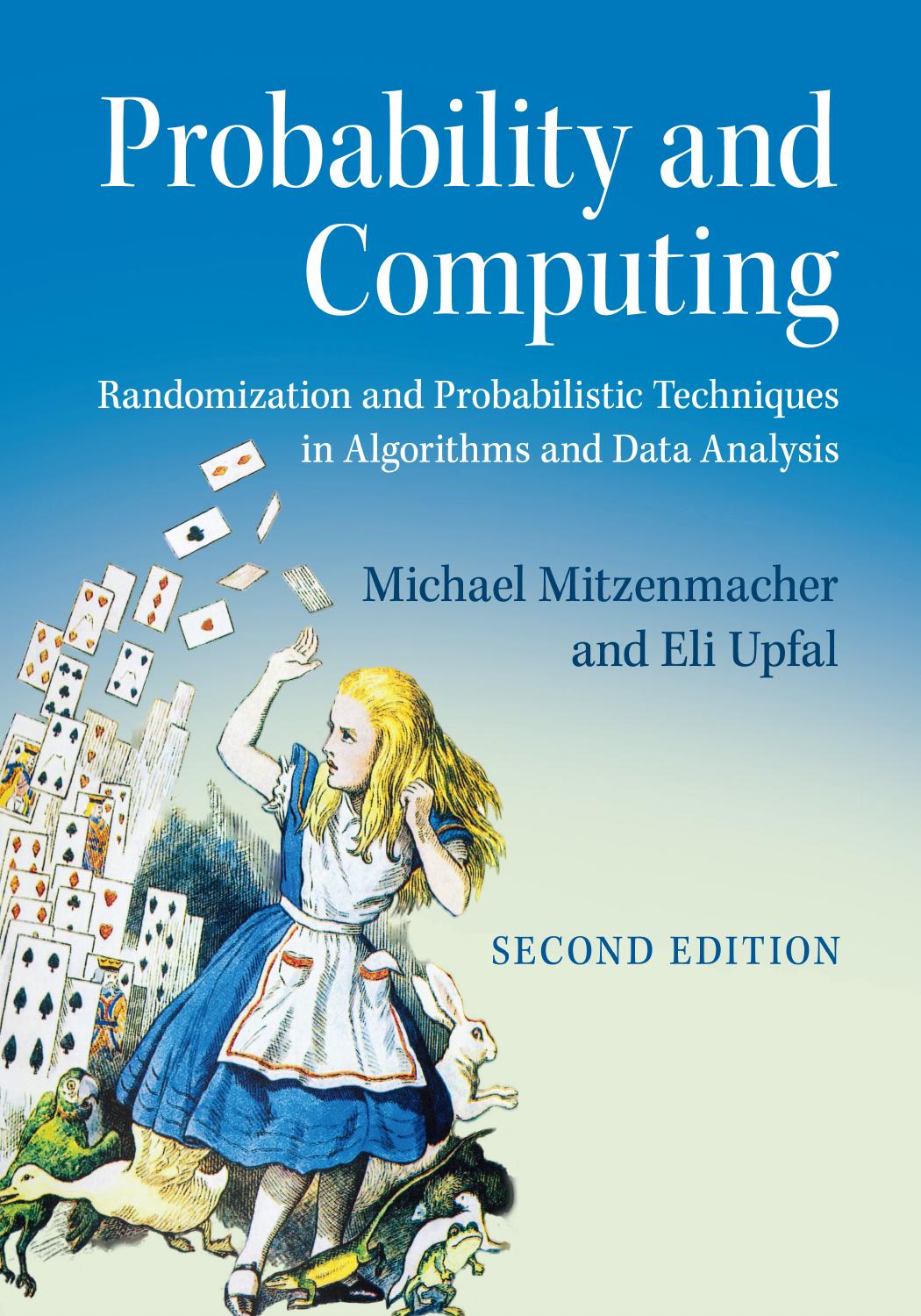
Probability and Computing Randomization and Probabilistic Techniques in Algorithms and Data Analysis 2nd edition by Mitzenmacher Michael, Upfal Eli ISBN 1108105958 9781108105958
Original price was: $70.00.$35.00Current price is: $35.00.
Instant download Probability and Computing Randomization and Probabilistic Techniques in Algorithms and Data Analysis 2th Mitzenmacher Michael; Upfal Eli; after payment
Probability and Computing Randomization and Probabilistic Techniques in Algorithms and Data Analysis 2nd edition by Mitzenmacher Michael, Upfal Eli – Ebook PDF Instant Download/Delivery: 1108105958 , 9781108105958
Full download Probability and Computing Randomization and Probabilistic Techniques in Algorithms and Data Analysis 2nd edition after payment
Product details:
ISBN 10: 1108105958
ISBN 13: 9781108105958
Author: Mitzenmacher Michael, Upfal Eli
Greatly expanded, this new edition requires only an elementary background in discrete mathematics and offers a comprehensive introduction to the role of randomization and probabilistic techniques in modern computer science. Newly added chapters and sections cover topics including normal distributions, sample complexity, VC dimension, Rademacher complexity, power laws and related distributions, cuckoo hashing, and the Lovasz Local Lemma. Material relevant to machine learning and big data analysis enables students to learn modern techniques and applications. Among the many new exercises and examples are programming-related exercises that provide students with excellent training in solving relevant problems. This book provides an indispensable teaching tool to accompany a one- or two-semester course for advanced undergraduate students in computer science and applied mathematics.
Probability and Computing Randomization and Probabilistic Techniques in Algorithms and Data Analysis 2nd Table of contents:
1 Events and Probability
1.1 Application: Verifying Polynomial Identities
1.2 Axioms of Probability
1.3 Application: Verifying Matrix Multiplication
1.4 Application: Naïve Bayesian Classifier
1.5 Application: A Randomized Min-Cut Algorithm
1.6 Exercises
2 Discrete Random Variables and Expectation
2.1 Random Variables and Expectation
2.1.1 Linearity of Expectations
2.1.2 Jensen’s Inequality
2.2 The Bernoulli and Binomial Random Variables
2.3 Conditional Expectation
2.4 The Geometric Distribution
2.4.1 Example: Coupon Collector’s Problem
2.5 Application: The Expected Run-Time of Quicksort
2.6 Exercises
3 Moments and Deviations
3.1 Markov’s Inequality
3.2 Variance and Moments of a Random Variable
3.2.1 Example: Variance of a Binomial Random Variable
3.3 Chebyshev’s Inequality
3.3.1 Example: Coupon Collector’s Problem
3.4 Median and Mean
3.5 Application: A Randomized Algorithm for Computing the Median
3.5.1 The Algorithm
3.5.2 Analysis of the Algorithm
3.6 Exercises
4 Chernoff and Hoeffding Bounds
4.1 Moment Generating Functions
4.2 Deriving and Applying Chernoff Bounds
4.2.1 Chernoff Bounds for the Sum of Poisson Trials
4.2.2 Example: Coin Flips
4.2.3 Application: Estimating a Parameter
4.3 Better Bounds for Some Special Cases
4.4 Application: Set Balancing
4.5 The Hoeffding Bound
4.6* Application: Packet Routing in Sparse Networks
4.6.1 Permutation Routing on the Hypercube
4.6.2 Permutation Routing on the Butterfly
4.7 Exercises
5 Balls, Bins, and Random Graphs
5.1 Example: The Birthday Paradox
5.2 Balls into Bins
5.2.1 The Balls-and-Bins Model
5.2.2 Application: Bucket Sort
5.3 The Poisson Distribution
5.3.1 Limit of the Binomial Distribution
5.4 The Poisson Approximation
5.4.1* Example: Coupon Collector’s Problem, Revisited
5.5 Application: Hashing
5.5.1 Chain Hashing
5.5.2 Hashing: Bit Strings
5.5.3 Bloom Filters
5.5.4 Breaking Symmetry
5.6 Random Graphs
5.6.1 Random Graph Models
5.6.2 Application: Hamiltonian Cycles in Random Graphs
5.7 Exercises
5.8 An Exploratory Assignment
6 The Probabilistic Method
6.1 The Basic Counting Argument
6.2 The Expectation Argument
6.2.1 Application: Finding a Large Cut
6.2.2 Application: Maximum Satisfiability
6.3 Derandomization Using Conditional Expectations
6.4 Sample and Modify
6.4.1 Application: Independent Sets
6.4.2 Application: Graphs with Large Girth
6.5 The Second Moment Method
6.5.1 Application: Threshold Behavior in Random Graphs
6.6 The Conditional Expectation Inequality
6.7 The Lovász Local Lemma
6.7.1 Application: Edge-Disjoint Paths
6.7.2 Application: Satisfiability
6.8* Explicit Constructions Using the Local Lemma
6.8.1 Application: A Satisfiability Algorithm
6.9 Lovász Local Lemma: The General Case
6.10* The Algorithmic Lovász Local Lemma
6.11 Exercises
7 Markov Chains and Random Walks
7.1 Markov Chains: Definitions and Representations
7.1.1 Application: A Randomized Algorithm for 2-Satisfiability
7.1.2 Application: A Randomized Algorithm for 3-Satisfiability
7.2 Classification of States
7.2.1 Example: The Gambler’s Ruin
7.3 Stationary Distributions
7.3.1 Example: A Simple Queue
7.4 Random Walks on Undirected Graphs
7.4.1 Application: An s–t Connectivity Algorithm
7.5 Parrondo’s Paradox
7.6 Exercises
8 Continuous Distributions and the Poisson Process
8.1 Continuous Random Variables
8.1.1 Probability Distributions in R
8.1.2 Joint Distributions and Conditional Probability
8.2 The Uniform Distribution
8.2.1 Additional Properties of the Uniform Distribution
8.3 The Exponential Distribution
8.3.1 Additional Properties of the Exponential Distribution
8.3.2* Example: Balls and Bins with Feedback
8.4 The Poisson Process
8.4.1 Interarrival Distribution
8.4.2 Combining and Splitting Poisson Processes
8.4.3 Conditional Arrival Time Distribution
8.5 Continuous Time Markov Processes
8.6 Example: Markovian Queues
8.6.1 M/M/1 Queue in Equilibrium
8.6.2 M/M/1/K Queue in Equilibrium
8.6.3 The Number of Customers in an M/M/∞ Queue
8.7 Exercises
9 The Normal Distribution
9.1 The Normal Distribution
9.1.1 The Standard Normal Distribution
9.1.2 The General Univariate Normal Distribution
9.1.3 The Moment Generating Function
9.2* Limit of the Binomial Distribution
9.3 The Central Limit Theorem
9.4* Multivariate Normal Distributions
9.4.1 Properties of the Multivariate Normal Distribution
9.5 Application: Generating Normally Distributed Random Values
9.6 Maximum Likelihood Point Estimates
9.7 Application: EM Algorithm For a Mixture of Gaussians
9.8 Exercises
10 Entropy, Randomness, and Information
10.1 The Entropy Function
10.2 Entropy and Binomial Coefficients
10.3 Entropy: A Measure of Randomness
10.4 Compression
10.5* Coding: Shannon’s Theorem
10.6 Exercises
11 The Monte Carlo Method
11.1 The Monte Carlo Method
11.2 Application: The DNF Counting Problem
11.2.1 The Naïve Approach
11.2.2 A Fully Polynomial Randomized Scheme for DNF Counting
11.3 From Approximate Sampling to Approximate Counting
11.4 The Markov Chain Monte Carlo Method
11.4.1 The Metropolis Algorithm
11.5 Exercises
11.6 An Exploratory Assignment on Minimum Spanning Trees
12 Coupling of Markov Chains
12.1 Variation Distance and Mixing Time
12.2 Coupling
12.2.1 Example: Shuffling Cards
12.2.2 Example: Random Walks on the Hypercube
12.2.3 Example: Independent Sets of Fixed Size
12.3 Application: Variation Distance Is Nonincreasing
12.4 Geometric Convergence
12.5 Application: Approximately Sampling Proper Colorings
12.6 Path Coupling
12.7 Exercises
13 Martingales
13.1 Martingales
13.2 Stopping Times
13.2.1 Example: A Ballot Theorem
13.3 Wald’s Equation
13.4 Tail Inequalities for Martingales
13.5 Applications of the Azuma–Hoeffding Inequality
13.5.1 General Formalization
13.5.2 Application: Pattern Matching
13.5.3 Application: Balls and Bins
13.5.4 Application: Chromatic Number
13.6 Exercises
14 Sample Complexity, VC Dimension, and Rademacher Complexity
14.1 The Learning Setting
14.2 VC Dimension
14.2.1 Additional Examples of VC Dimension
14.2.2 Growth Function
14.2.3 VC dimension component bounds
14.2.4 ε-nets and ε-samples
14.3 The ε-net Theorem
14.4 Application: PAC Learning
14.5 The ε-sample Theorem
14.5.1 Application: Agnostic Learning
14.5.2 Application: Data Mining
14.6 Rademacher Complexity
14.6.1 Rademacher Complexity and Sample Error
14.6.2 Estimating the Rademacher Complexity
14.6.3 Application: Agnostic Learning of a Binary Classification
14.7 Exercises
15 Pairwise Independence and Universal Hash Functions
15.1 Pairwise Independence
15.1.1 Example: A Construction of Pairwise Independent Bits
15.1.2 Application: Derandomizing an Algorithm for Large Cuts
15.1.3 Example: Constructing Pairwise Independent Values Modulo a Prime
15.2 Chebyshev’s Inequality for Pairwise Independent Variables
15.2.1 Application: Sampling Using Fewer Random Bits
15.3 Universal Families of Hash Functions
15.3.1 Example: A 2-Universal Family of Hash Functions
15.3.2 Example: A Strongly 2-Universal Family of Hash Functions
15.3.3 Application: Perfect Hashing
15.4 Application: Finding Heavy Hitters in Data Streams
15.5 Exercises
16 Power Laws and Related Distributions
16.1 Power Law Distributions: Basic Definitions and Properties
16.2 Power Laws in Language
16.2.1 Zipf’s Law and Other Examples
16.2.2 Languages via Optimization
16.2.3 Monkeys Typing Randomly
16.3 Preferential Attachment
16.3.1 A Formal Version
16.4 Using the Power Law in Algorithm Analysis
16.5 Other Related Distributions
16.5.1 Lognormal Distributions
16.5.2 Power Law with Exponential Cutoff
16.6 Exercises
17 Balanced Allocations and Cuckoo Hashing
17.1 The Power of Two Choices
17.1.1 The Upper Bound
17.2 Two Choices: The Lower Bound
17.3 Applications of the Power of Two Choices
17.3.1 Hashing
17.3.2 Dynamic Resource Allocation
17.4 Cuckoo Hashing
17.5 Extending Cuckoo Hashing
17.5.1 Cuckoo Hashing with Deletions
17.5.2 Handling Failures
17.5.3 More Choices and Bigger Bins
17.6 Exercises
Further Reading
Index
People also search for Probability and Computing Randomization and Probabilistic Techniques in Algorithms and Data Analysis 2nd :
probability and computing randomized algorithms and probabilistic analysis
probability and computing randomized algorithms and probabilistic analysis pdf
probability and computing pdf
probability and computing
what is random probability sampling
Tags: Mitzenmacher Michael, Upfal Eli, Computing Randomization, Data Analysis