


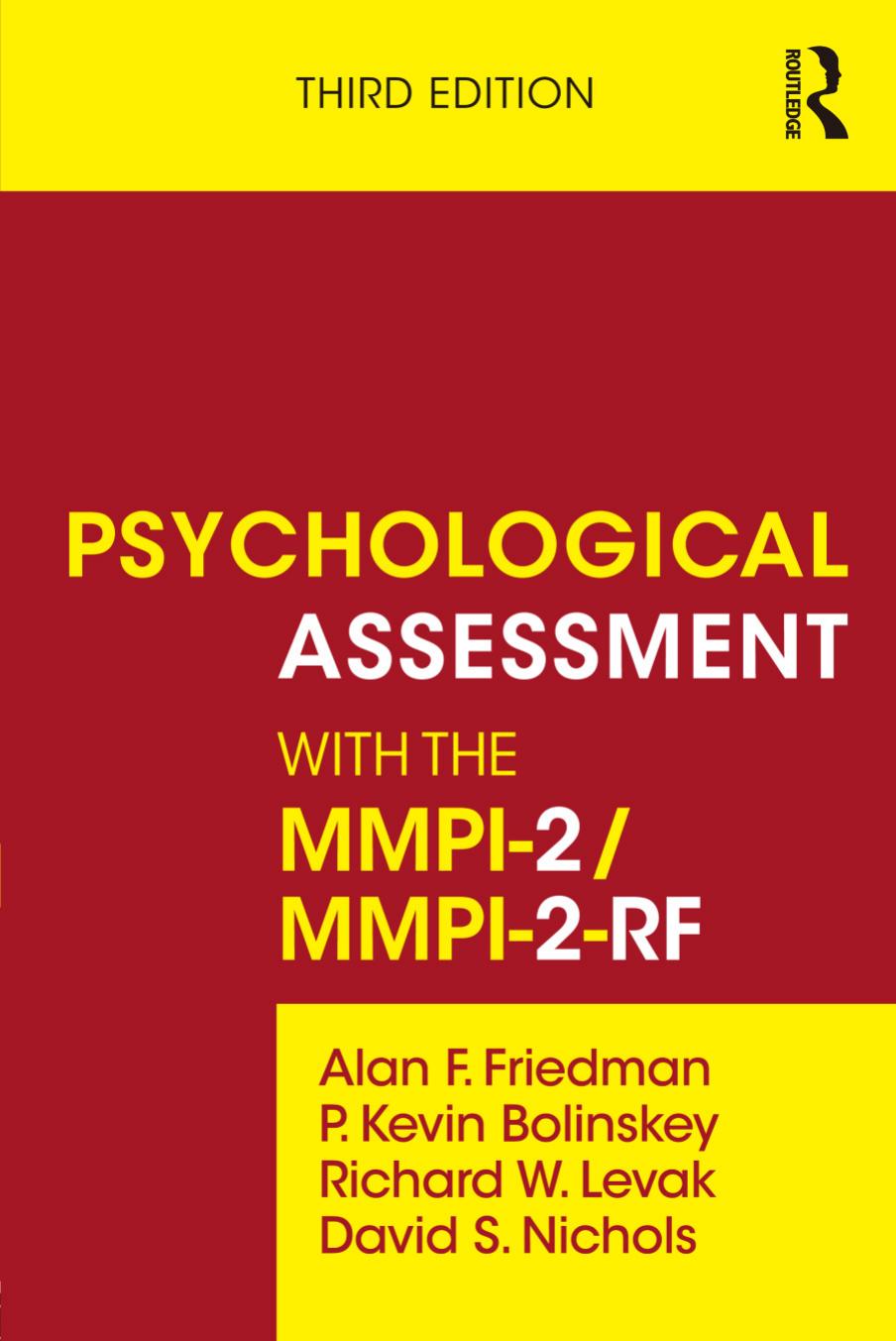
Psychological Assessment with the MMPI 2 MMPI 2 RF 3rd edition by Alan Friedman, Kevin Bolinskey, Richard Levak, David Nichols ISBN 1136315909 9781136315909
Original price was: $70.00.$35.00Current price is: $35.00.
Instant download Psychological Assessment with the MMPI 2 MMPI 2 RF Wei Zhi after payment
Psychological Assessment with the MMPI 2 MMPI 2 RF 3rd edition by Alan Friedman, Kevin Bolinskey, Richard Levak, David Nichols – Ebook PDF Instant Download/Delivery: 1136315909 , 9781136315909
Full download Psychological Assessment with the MMPI 2 MMPI 2 RF 3rd edition after payment
Product details:
ISBN 10: 1136315909
ISBN 13: 9781136315909
Author: Alan Friedman, Kevin Bolinskey, Richard Levak, David Nichols
This third edition apprises users of the MMPI-2/MMPI-2-Restructured Form (RF) for the ever-changing landscape of this dynamic personality/psychopathology instrument and its expanding utility in a variety of contexts. Two new chapters addressing the RC scales and the MMPI-2-RF are included in this updated text. Additionally, over 450 new references have been incorporated into the book, with information gathered and organized for practical clinical and forensic applications. The codetype interpretation chapter has expanded its sections with more in-depth feedback information and treatment considerations for clinicians to help in facilitating the formulation of treatment recommendations and strengthening therapeutic relationships with their clients. A number of special scales with clinical and forensic applications are also covered in this edition. An important section has been added addressing the MMPI and suicide. This new edition is a must-have resource that will inform and guide users of the MMPI-2 and MMPI-2-RF in their daily practices, and assist researchers in conceptualizing the operating characteristics and configural relationships among the various scales and indices that comprise this instrument. From simple single scale interpretation to complex configural relationships, this text addresses a broad bandwidth of interpretive information designed for text users’ at all levels of sophistication.
Psychological Assessment with the MMPI 2 MMPI 2 RF 3rd Table of contents:
1 Development of the MMPI and MMPI-2
General Description of the MMPI/MMPI-2
Original MMPI Validity Scales
Clinical Scales
Historical Development of the MMPI
MMPI Re-Standardization: The MMPI-2
Experimental Form (AX) and the MMPI-2 Booklet
New Normative Sample
Uniform T-Scores
Linear vs. Uniform T-Scores
Normalized Τ-Scores
Uniform T-Scores
2 Administration, Scoring, and Codetyping
Forms of the MMPI-2 and MMPI-2-RF
Abbreviated and Short Forms
Foreign Translations
User Qualifications and Test Instructions
Test Conditions
Participants’ Requirements
Test Scoring and Profile Plotting
Coding the Profile
MMPI/MMPI-2 Code Pattern Correspondence
Codetype stability
3 Measures of MMPI-2 Profile Validity
The Traditional Measures and Their Derivatives
Cannot Say Score (?)
Variable Response Inconsistency Scale (VRIN)
True Response Inconsistency Scale (TRIN)
Infrequency Scale (F)
F-Back Scale (FB)
Additional Measures of Response Style
Self-Unfavorable Scales
Infrequency-Psychopathology Scale: F(p)
Symptom Validity Scale (FBS; formerly Fake Bad Scale)
Dissimulation Scale (Ds)
Self-Favorable Scales
Lie Scale (L)
Correction Scale (K)
Superlative Self-Presentation Scale (S)
Positive Malingering Scale (Mp)
Social Desirability Scale (Sd)
Socioeconomic Status Scale (Ss)
Validity Indices
F-FB Index
Dissimulation Index (F – K)
True Percent Index (T percent)
Note
4 Interpreting the MMPI-2 Validity Scales
Cannot Say Score (?)
Normal Range: 5 or Fewer Unscorable Items
Moderate to High Range: 6 to 29 Unscorable Items
Marked Elevation (Possibly Invalid Profile): 30 or More Unscorable Items
Variable Response Inconsistency Scale (VRIN) (67-item pairs)
Consistent Responding: Raw Scores Between 0 and 9, T-Scores Between 30 and 66
Profile Indeterminate: Raw Scores Between 10 and 14, T-Scores Between 69 and 86
Inconsistent Responding: Raw Scores Greater Than 14, Τ-Scores of 87 or Greater
True Response Inconsistency Scale (TRIN) (23-item pairs)
Raw Scores Between 8 and 10
Raw Scores of 6 and 7, and 11 and 12
Raw Scores of 5 or Less and 13 or Greater
Infrequency Scale (F) (60 items)
Low Scores: Raw Scores of 2 or Less, T-Scores Between 42 (Males) and 44 (Females)
Moderate Scores: Raw Scores Between 3 and 7, T-Scores Between 45 and 61
High Scores: Raw Scores Between 8 and 16, T-Scores Between 61 and 92
Borderline Valid Scores: Raw Scores Between 17 and 25, T-Scores Between 88 and 113 (for Men) and Between 88 and 120 (for Women)
Very High/Invalid Scores: Raw Scores of 26 or Greater, T-Scores of 116 or Greater (for Men) and 120 or Greater (for Women)
F-Back Scale (FB) (40 items)
Low Scores: Raw Scores Between 0 and 3, Τ-Scores Between 42 and 55
High Normal to High Range: Raw Scores Between 4 and 14, Τ-Scores Between 58 and 100
Very High Range: Raw Scores Between 15 and 19, T-Scores Between 101 and 120
Extremely Elevated Scores: Raw Scores of 20 or Greater, T-Scores of 120 or Greater
Self-Unfavorable Scales
Infrequency-Psychopathology Scale: F(p) (27 items)
Dissimulation Scale (Ds) (58 items)
Self-Favorable Scales
Lie Scale (L) (15 items)
Correction Scale (K) (30 items)
Superlative Scale (S) (50 items)
Positive Malingering Scale (Mp) (26 items)
Social Desirability Scale (Sd) (33 items)
Socioeconomic Status Scale (Ss) (73 items)
Validity Indices
F-FB Index
Dissimulation Index (F – K)
True Percent Index (T percent)
Issues in Determining Validity
Basic Validity Scale Configurations
Random Response Set
Notes
Report Language
All-True Response Set
Notes
Report Language
All-False Response Set
Notes
Report Language
Common Validity Scale Patterns
“Most-Open” to “Most-Closed” Validity Configurations
“Most Open” Validity Configuration
“Most Closed” Validity Configuration
5 The MMPI-2 Clinical Scales and Their Derivatives
Clinical Scale Development and Use
Basic Clinical Scales
Scale 1: Hypochondriasis (Hs)
Scale 2: Depression (D)
Scale 2: Subtle–Obvious Subscales
Scale 3: Hysteria (Hy)
Scale 3: Subtle–Obvious Subscales
Scale 4: Psychopathic Deviate (Pd)
Scale 5: Masculinity-Femininity (MF)
Scale 6: Paranoia (Pa)
Scale 7: Psychasthenia (Pt)
Scale 8: Schizophrenia (Sc)
Scale 9: Hypomania (Ma)
Scale 0: Social Introversion (Si)
6 Interpreting the MMPI-2 Codetypes
Introduction
Clinical Scales and Codes
Scale 1 (Hs)
Relations with Other Scales
Scale 2 (D)
Relations with Other Scales
Scale 3 (Hy)
Relations with Other Scales
Scale 4 (Pd)
Relations with Other Scales
Scale 5 (Mf)
Relations with Other Scales
Scale 6 (Pa)
Relations with Other Scales
Scale 7 (Pt)
Relations with Other Scales
Scale 8 (Sc)
Relations with Other Scales
Scale 9 (Ma)
Relations with Other Scales
Scale 0 (Si)
Relations with Other Scales
7 Interpreting the Content of the MMPI-2: Critical Items, Content Scales, and Subscales
Critical Items
Content Scales
Anxiety (ANX)
Fears (FRS)
Obsessiveness (OBS)
Depression (DEP)
Health Concerns (HEA)
Bizarre Mentation (BIZ)
Anger (ANG)
Cynicism (CYN)
Antisocial Practices (ASP)
Type A Behavior (TPA)
Low Self-Esteem (LSE)
Social Discomfort (SOD)
Family Problems (FAM)
Work Interference (WRK)
Negative Treatment Indicators (TRT)
General Principles for the Interpretation of Content Scales
The Personality Psychopathology Five (PSY–5)
Aggressiveness (AGGR)
Psychoticism (PSYC)
Disconstraint (DISC)
Negative Emotionality/Neuroticism (NEGE)
Introversion/Low Positive Emotionality (INTR)
Effects of Response Styles on the PSY–5 Scales
8 Interpreting the MMPI-2 Supplementary Scales
Introduction
Factor Scales A and R
Ego Strength Scale (Es)
Dominance Scale (Do)
Social Responsibility Scale (Re)
College Maladjustment Scale (Mt); Keane et al.’s Post-Traumatic Stress Disorder Scale (PK); and Schlenger and Kulka’s Post-Traumatic Stress Disorder Scale (PS)
Marital Distress Scale (MDS)
Hostility Scale (Ho)
Overcontrolled-Hostility Scale (O-H)
Substance Abuse Measures: The MacAndrew Alcoholism Scale (MAC/MAC–R); the Addiction Admission Scale (AAS); and the Addiction Potential Scale (APS)
Gender Role—Masculine (GM) and Gender Role—Feminine (GF) Scales
Note
9 Interpretation and Report Writing
Clinical and Actuarial Approaches to Interpretation
Development of Actuarial Rules
Actuarial Data and Base Rates
The Importance of Referral Data
Demographic Variables
Age
Gender
Education
Race
Socioeconomic Variables
Interpretive Steps
Common Code Patterns
Code Patterns, Elevation, and Additional Scales
Organizing the Data
Writing the Report
Guidelines for Beginning a Report
Organization of the Report
Interpretation of “Complex Profiles”
Energizers and Suppressors
Providing Feedback to the Client
Guidelines for Giving Feedback
Feedback about the Feedback
10 The Restructured Clinical (RC) Scales
Introduction
Creation of the RC Scales
Psychometric Properties of the RC Scales
Scoring the RC Scales
Using the RC Scales
Demoralization (RCd)
Correlates
Interpretation
Somatic Complaints (RC1)
Correlates
Interpretation
Low Positive Emotions (RC2)
Correlates
Interpretation
Cynicism (RC3)
Correlates
Interpretation
Antisocial Behavior (RC4)
Correlates
Interpretation
Ideas of Persecution (RC6)
Correlates
Interpretation
Dysfunctional Negative Emotions (RC7)
Correlates
Interpretation
Aberrant Experiences (RC8)
Correlates
Interpretation
Hypomanic Activation (RC9)
Correlates
Interpretation
A Final Word on Interpretation
Criticisms of the RC Scales
Empirical Tradition
Theoretical Basis
Redundancy
Construct Drift
Sensitivity
Perspective
Note
11 The Restructured Form of the MMPI-2 (MMPI-2-RF)
The MMPI-2-RF
Administration
Available Formats
Scoring
T-score Conversions
Protocol Scoring
Validity Scales
Item Omissions
Response Consistency
Variable Response Inconsistency (VRIN-r)
True Response Inconsistency (TRIN-r)
Self-Unfavorable Reporting
Infrequent Responses (F-r)
Infrequent Psychopathology Responses (Fp-r)
Infrequent Somatic Responses (Fs-r)
Symptom Validity (FBS-r)
Response Bias Scale (RBS)
Self-Favorable Reporting
Uncommon Virtues (L-r)
Adjustment Validity (K-r)
Higher-Order Scales
Emotional/Internalizing Dysfunction (EID)
Thought Dysfunction (THD)
Behavioral/Externalizing Dysfunction (BXD)
Interpretation
Restructured Clinical (RC) Scales
Specific Problems (SP) Scales
Somatic/Cognitive Scales
Internalizing Scales
Externalizing Scales
Interpersonal Scales
Interest Scales
Aesthetic-Literary Interests (AES)
Mechanical-Physical Interests (MEC)
Personality Psychopathology Five (PSY–5) Scales
Aggressiveness-Revised (AGGR-r)
Psychoticism-Revised (PSYC-r)
Disconstraint-Revised (DISC-r)
Negative Emotionality/Neuroticism-Revised (NEGE-r)
Introversion/Low Positive Emotionality (INTR-r)
Perspective
Note
12 Automated Interpretation of the MMPI-2 and the MMPI-2-RF
Computer-Based Test Interpretation (CBTI)
Advantages and Disadvantages of CBTI
Test and Narrative Report Comparisons: A Case Example
MMPI-2 and MMPI-2-RF Score and Automated Interpretive Reports for Ms. Valenda
Commentary on the Interpretive Reports
References
Author Index
Subject Index
People also search for Psychological Assessment with the MMPI 2 MMPI 2 RF 3rd :
psychological assessment with the mmpi 2 mmpi 2 rf pdf
what is the mmpi 2 test
what is mmpi-2 in psychology
what is the mmpi 2 test used for
mmpi-2 rf
Tags: Alan Friedman, Kevin Bolinskey, Richard Levak, David Nichols, Psychological Assessment, the MMPI