


Psychology in Everyday Life 5th Edition by David Myers, Nathan DeWall – Ebook PDF Instant Download/Delivery: 1319133726 , 9781319133726
Full download Psychology in Everyday Life 5th edition after payment
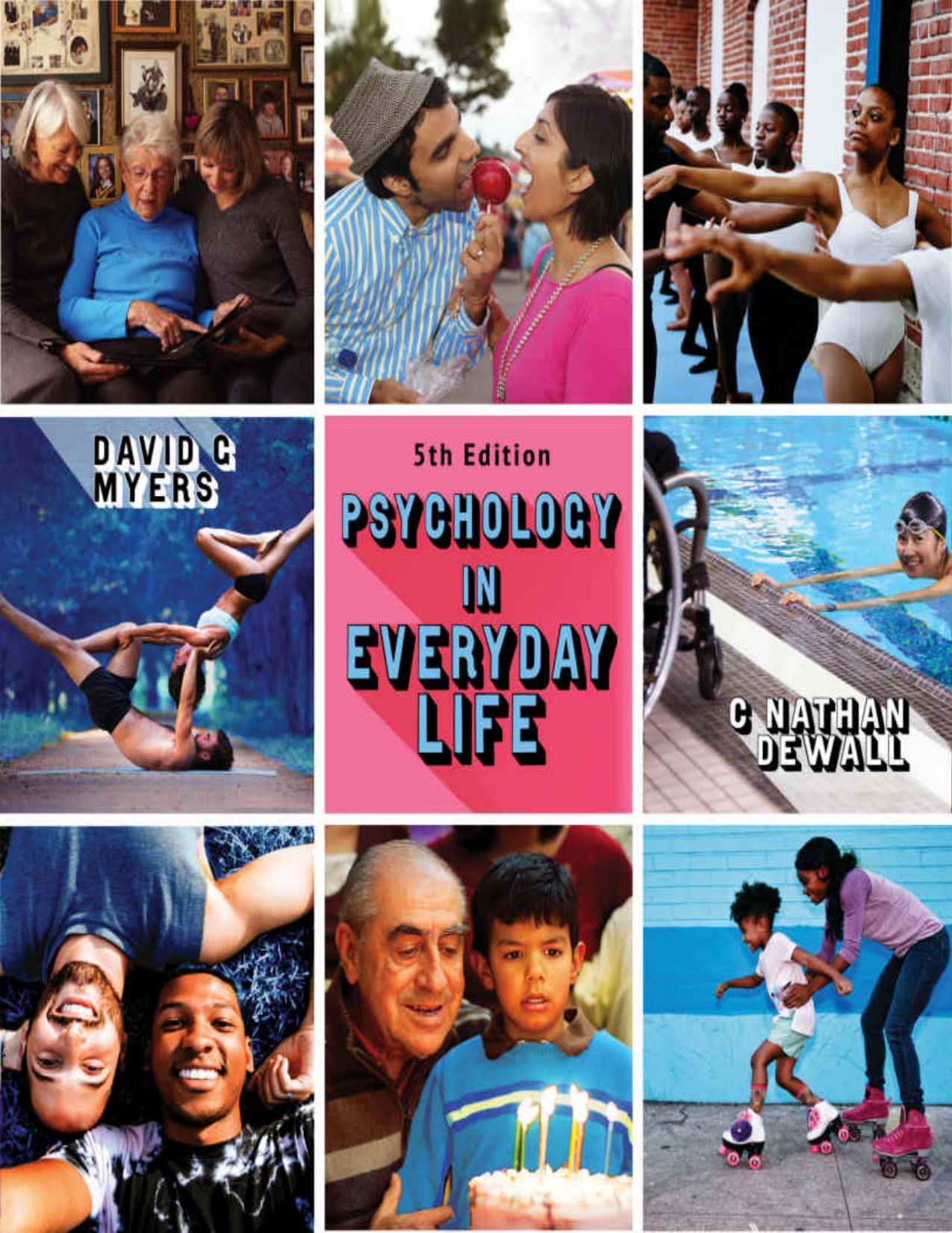
Product details:
ISBN 10: 1319133726
ISBN 13: 9781319133726
Author: David Myers, Nathan DeWall
Best-selling authors David Myers’ and Nathan DeWall’s briefest introduction to psychology speaks to all students regardless of their background or level of preparedness, with no assumptions made in the vocabulary, examples, or presentation. Students of all kinds are comfortable with the inclusive tone and the manageable, pedagogically-effective chapters. Instructors appreciate the authors’ encouraging students throughout to THINK critically, CONSIDER diverse perspectives, and IMPROVE their everyday life.
Psychology in Everyday Life 5th Table of contents:
Chapter 1: Psychology’s Roots, Critical Thinking, and Self-Improvement Tools
-
Psychology Is a Science
-
Critical Thinking and the Scientific Attitude
-
Thinking Critically About: The Scientific Attitude
-
Psychological Science’s Birth and Development
-
Today’s Psychology
-
The Need for Psychological Science
-
The Limits of Common Sense
-
Psychological Science in a Post-Truth World
-
How Do Psychologists Ask and Answer Questions?
-
The Scientific Method
-
Description
-
Correlation
-
Thinking Critically About: Correlation and Causation
-
Experimentation
-
Choosing a Research Design
-
Predicting Everyday Behavior
-
-
Psychology’s Research Ethics
-
Studying and Protecting Animals
-
Studying and Protecting Humans
-
-
Values in Psychology
-
Use Psychology to Improve Your Life and Become a Better Student
-
Chapter Review
-
Learning Objectives
-
Terms and Concepts to Remember
-
Chapter Test
-
Chapter 2: The Biology of Behavior and Consciousness
-
The Power of Plasticity
-
Neural Communication
-
A Neuron’s Structure
-
How Neurons Communicate
-
How Neurotransmitters Influence Us
-
-
The Nervous System
-
The Peripheral Nervous System
-
The Central Nervous System
-
-
The Endocrine System
-
The Brain
-
Tools of Discovery
-
Older Brain Structures
-
The Limbic System
-
The Cerebral Cortex
-
Thinking Critically About: Using Only 10 Percent of Our Brain
-
-
Responses to Damage
-
The Divided Brain
-
Brain States and Consciousness
-
Selective Attention
-
Sleep and Dreams
-
-
Chapter Review
-
Learning Objectives
-
Terms and Concepts to Remember
-
Chapter Test
-
Chapter 3: Developing Through the Life Span
-
Major Issues in Developmental Psychology
-
Nature and Nurture
-
Continuity and Stages
-
Stability and Change
-
-
Prenatal Development and the Newborn
-
Conception
-
Prenatal Development
-
The Competent Newborn
-
Twin and Adoption Studies
-
-
Infancy and Childhood
-
Physical, Cognitive, and Social Development
-
-
Thinking Critically About: Parenting Styles
-
Adolescence
-
Physical, Cognitive, and Social Development
-
-
Emerging Adulthood
-
Adulthood
-
Physical, Cognitive, and Social Development
-
-
Chapter Review
-
Learning Objectives
-
Terms and Concepts to Remember
-
Chapter Test
-
Chapter 4: Sex, Gender, and Sexuality
-
Gender Development
-
Male-Female Similarities and Differences
-
Thinking Critically About: Gender Bias in the Workplace
-
-
The Nature and Nurture of Gender
-
Thinking Critically About: Sexual Aggression
-
-
Human Sexuality
-
Physiology and Psychology of Sex
-
Sexual Orientation
-
Cultural Attitudes and Prevalence
-
-
Evolutionary Psychology and Sexuality
-
Natural Selection and Mating Preferences
-
Critiques of the Evolutionary Perspective
-
-
Sex and Human Relationships
-
Chapter Review
-
Learning Objectives
-
Terms and Concepts to Remember
-
Chapter Test
-
Chapter 5: Sensation and Perception
-
Basic Concepts
-
From Stimuli to Brain Activity
-
Thresholds and Sensory Adaptation
-
Thinking Critically About: Subliminal Sensation
-
-
Contextual Influences on Perception
-
Perceptual Set, Motivation, Emotion
-
-
Vision
-
Eye Structures
-
Information Processing
-
Organization and Interpretation
-
-
Other Senses
-
Hearing, Touch, Taste, Smell
-
Body Position and Movement
-
Sensory Interaction
-
-
ESP and Extrasensory Claims
-
Chapter Review
-
Learning Objectives
-
Terms and Concepts to Remember
-
Chapter Test
-
Chapter 6: Learning
-
Classical Conditioning
-
Pavlov’s Experiments and Legacy
-
-
Operant Conditioning
-
Skinner’s Experiments and Legacy
-
-
Classical vs. Operant Conditioning
-
Biological and Cognitive Influences
-
Observational Learning
-
Mirror Neurons
-
Thinking Critically About: Media Violence
-
-
Chapter Review
-
Learning Objectives
-
Terms and Concepts to Remember
-
Chapter Test
-
Chapter 7: Memory
-
Memory Models and Processes
-
Encoding, Storage, and Retrieval
-
Implicit vs. Explicit Memory
-
Brain Regions and Synaptic Changes
-
-
Forgetting
-
Causes: Encoding Failure, Decay, Retrieval Failure
-
-
Memory Construction Errors
-
Misinformation Effect, Source Amnesia
-
Thinking Critically About: Recovered Memories
-
Children’s Eyewitness Testimony
-
-
Improving Memory
-
Chapter Review
-
Learning Objectives
-
Terms and Concepts to Remember
-
Chapter Test
-
Chapter 8: Thinking, Language, and Intelligence
-
Thinking and Problem Solving
-
Concepts, Decision-Making, Creativity
-
Thinking Critically About: Fear Factor
-
-
Language
-
Acquisition, Development, and the Brain
-
Language and Cognition
-
-
Intelligence
-
Definitions, Testing, and Variations
-
Nature vs. Nurture
-
Group Differences
-
-
Chapter Review
-
Learning Objectives
-
Terms and Concepts to Remember
-
Chapter Test
-
Chapter 9: Motivation and Emotion
-
Theories of Motivation
-
Drives, Incentives, Arousal, Hierarchy of Needs
-
-
Hunger and Eating Behavior
-
Thinking Critically About: Obesity and Weight Control
-
-
Belongingness and Achievement Motivation
-
Theories of Emotion
-
James-Lange, Cannon-Bard, Schachter-Singer, Zajonc/LeDoux
-
-
Emotional Expression and Experience
-
Physiology, Culture, Facial Feedback
-
Thinking Critically About: Lie Detection
-
-
Chapter Review
-
Learning Objectives
-
Terms and Concepts to Remember
-
Chapter Test
-
Chapter 10: Stress, Health, and Human Flourishing
-
Concepts of Stress
-
Stressors and Reactions
-
-
Health Effects
-
Cancer, Heart Disease
-
Thinking Critically About: Stress and Health
-
-
Coping and Resilience
-
Control, Optimism, Social Support
-
Exercise, Meditation, Spirituality
-
-
Positive Psychology and Happiness
-
Predictors of Well-Being
-
-
Chapter Review
-
Learning Objectives
-
Terms and Concepts to Remember
-
Chapter Test
-
Chapter 11: Social Psychology
-
Social Thinking
-
Attribution, Attitudes, Persuasion
-
Thinking Critically About: Persuasion
-
-
Social Influence
-
Conformity, Obedience, Group Behavior
-
Thinking Critically About: The Internet as Social Amplifier
-
-
Social Relations
-
Prejudice, Aggression, Attraction, Altruism, Conflict
-
-
Chapter Review
-
Learning Objectives
-
Terms and Concepts to Remember
-
Chapter Test
-
Chapter 12: Personality
-
Theories of Personality
-
Psychodynamic, Humanistic, Trait, Social-Cognitive
-
Thinking Critically About: Introversion
-
-
The Self
-
Self-Esteem, Self-Serving Bias, Cultural Perspectives
-
-
Chapter Review
-
Learning Objectives
-
Terms and Concepts to Remember
-
Chapter Test
-
Chapter 13: Psychological Disorders
-
Defining Disorders
-
Thinking Critically About: ADHD
-
-
Classifying and Diagnosing
-
Anxiety, OCD, and PTSD
-
Substance Use Disorders
-
Thinking Critically About: Addiction
-
-
Mood Disorders
-
Schizophrenia
-
Other Disorders
-
Eating, Dissociative, Personality Disorders
-
Suicide and Self-Harm
-
-
Chapter Review
-
Learning Objectives
-
Terms and Concepts to Remember
-
Chapter Test
-
Chapter 14: Therapy
-
Psychological Therapies
-
Psychoanalysis, Humanistic, Behavior, Cognitive
-
Group and Family Therapy
-
-
Evaluating Psychotherapy
-
Biomedical Therapies
-
Thinking Critically About: Lifestyle Change
-
Drug Therapies, Brain Stimulation, Psychosurgery
-
-
Prevention and Resilience
-
Chapter Review
-
Learning Objectives
-
Terms and Concepts to Remember
-
Chapter Test
-
Appendices
-
Appendix A: Statistical Reasoning in Everyday Life
-
Describing Data, Measures, Correlation, Significance
-
Thinking Critically About: Study Types
-
-
Appendix B: Psychology at Work
-
Flow, Career Fit, Industrial-Organizational Psychology
-
-
Appendix C: Career Fields in Psychology
-
Appendix D: Complete Chapter Reviews
-
Appendix E: Answers to Retrieve & Remember and Chapter Test Questions
-
Appendix F: The Story
People also search for Psychology in Everyday Life 5th:
psychology in everyday life 5th edition free
psychology in everyday life 5th edition pdf free
psychology in everyday life 5th edition (myers & dewall)
psychology in everyday life 5th edition pdf(free download reddit)
psychology in everyday life 5th edition pdf free download reddit
Tags: David Myers, Nathan DeWall, Everyday Life