
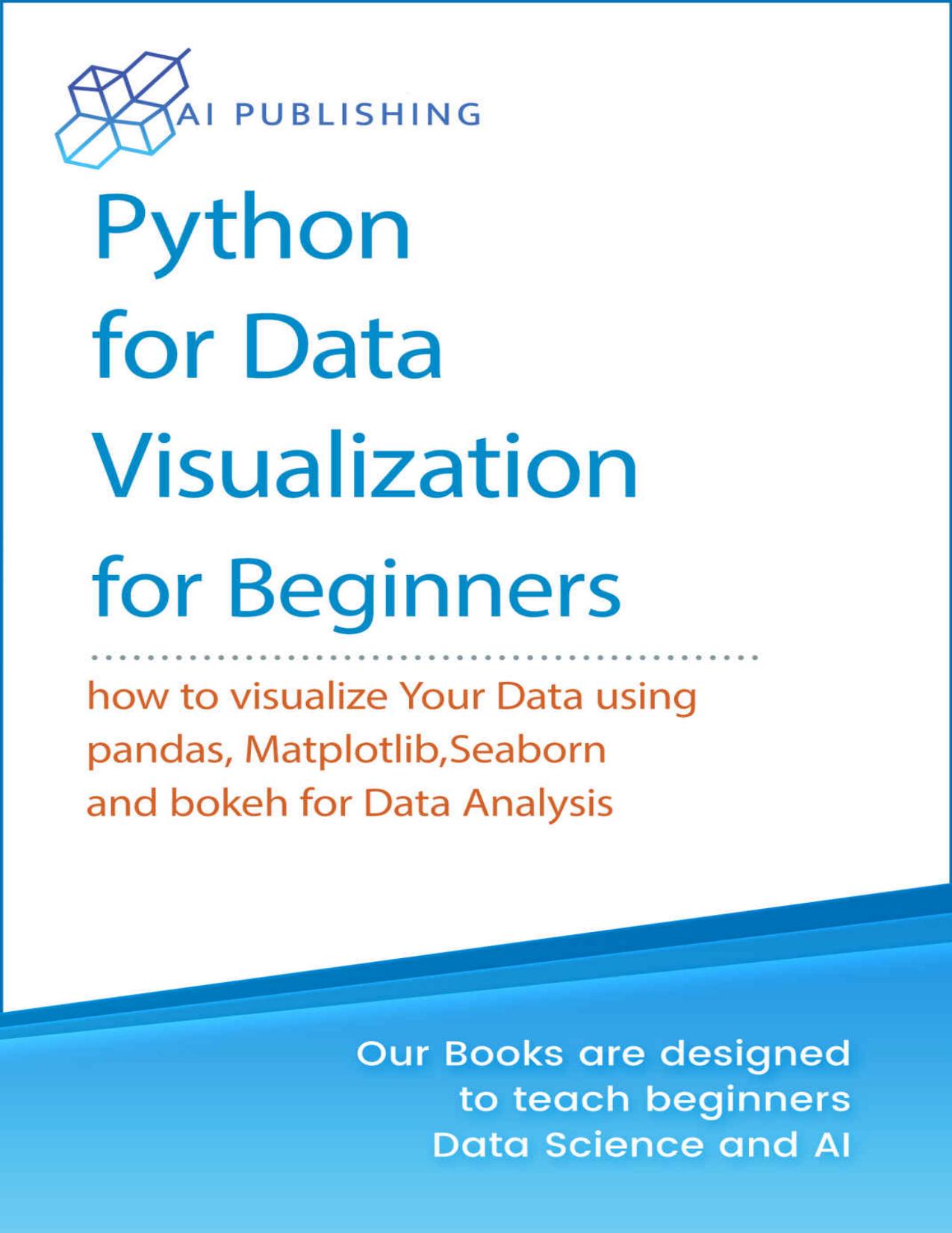
Python for Data Visualization for Beginners 1st edition by AI Publishing ISBN 1733042687 978-1733042680
Original price was: $70.00.$35.00Current price is: $35.00.
Instant download Python for Data Visualization for Beginners Visualize Your Datcises . Learning & Data Science for Beginners) AI Publishing after payment
Python for Data Visualization for Beginners 1st edition by AI Publishing – Ebook PDF Instant Download/Delivery: 1733042687 , 978-1733042680
Full download Python for Data Visualization for Beginners 1st edition after payment
Product details:
ISBN 10: 1733042687
ISBN 13: 978-1733042680
Author: AI Publishing
Data Visualization using Python for Beginners
Are you looking for a hands-on approach to learn Python for Data Visualization Fast?
Do you need to start learning Python for Data Visualization from Scratch?
This book is for you. This book works as a guide to present fundamental Python Libraries and a basis related to Data Visualization using Python.
Data science and data visualization are two different but interrelated concepts. Data science refers to the science of extracting and exploring data in order to find patterns that can be used for decision making at different levels. Data visualization can be considered as a subdomain of data science where you visualize data with the help of graphs and tables in order to find out which data is most significant and can help in the identification of important patterns.
This book is dedicated to data visualization and explains how to perform data visualization on a variety of datasets using various data visualization libraries written in the Python programming language. It is suggested that you use this book for data visualization purposes only and not for decision making. For decision making and pattern identification, read this book in conjunction with a dedicated book on machine learning and data science.
We will start by digging into Python programming as all the projects are developed using it, and it is currently the most used programming language in the world. We will also explore the most-famous libraries for Data Visualization such as Pandas, Numpy, Matplotlib, Seaborn, etc .
What this book offers…
You will learn all about python in three modules, one for Plotting with Matplotlib, one for Plotting with Seaborn, and a final one Pandas for Data Visualization. All three modules will contain hands-on projects using real-world datasets and a lot of exercises.
Clear and Easy to Understand Solutions
All solutions in this book are extensively tested by a group of beta readers. The solutions provided are simplified as much as possible so that they can serve as examples for you to refer to when you are learning a new skill.
What this book aims to do…
This book is written with one goal in mind – to help beginners overcome their initial obstacles to learning Data Visualization using Python.
A lot of times, newbies tend to feel intimidated by coding and data.
The goal of this book is to isolate the different concepts so that beginners can gradually gain competency in the fundamentals of Python before working on a project.
Python for Data Visualization for Beginners 1st Table of contents:
Chapter 1: Introduction and Environment Set Up
1.1. Difference between Data Science and Machine Learning
1.2. Steps in Learning Data Science and Machine Learning
1.3. Environment Setup
1.3.1. Windows Setup
1.3.2. Mac Setup
1.3.3. Linux Setup
1.3.4. Using Google Colab Cloud Environment
Chapter 2: Python Crash Course
2.1. Writing Your First Program
2.2. Python Variables and Data Types
2.3. Python Operators
2.4. Conditional Statements
2.5. Iteration Statements
2.6. Functions
2.7. Objects and Classes
2.8. Data Science and Machine Learning Libraries
2.8.1 NumPy
2.8.2. Matplotlib
2.8.3. Seaborn
2.8.4. Pandas
2.8.5. Scikit Learn
2.8.6. TensorFlow
2.8.7. Keras
Exercise 2.1
Exercise 2.2
Chapter 3: Python NumPy Library for Data Analysis
3.1. Advantages of NumPy Library
3.2. Creating NumPy Arrays
3.2.1 Using Array Methods
3.2.2. Using Arrange Method
3.2.3. Using Ones Method
3.2.4. Using Zeros Method
3.2.5. Using Eyes Method
3.2.6. Using Random Method
3.3. Reshaping NumPy Arrays
3.4. Array Indexing and Slicing
3.5. NumPy for Arithmetic Operations
3.5.1. Finding Square Roots
3.5.2. Finding Logs
3.5.3. Finding Exponents
3.5.4. Finding Sine and Cosine
3.6. NumPy for Linear Algebra Operations
3.6.1. Finding Matrix Dot Product
3.6.2. Element-wise Matrix Multiplication
3.6.3. Finding Matrix Inverse
3.6.4. Finding Matrix Determinant
3.6.5. Finding Matrix Trace
Exercise 3.1
Exercise 3.2
Chapter 4: Introduction to Pandas Library for Data Analysis
4.1. Introduction
4.2. Reading Data into Pandas Dataframe
4.3. Filtering Rows
4.4. Filtering Columns
4.5. Concatenating Dataframes
4.6. Sorting Dataframes
4.7. Apply Function
4.8. Pivot & Crosstab
4.9. Arithmetic Operations with Where
Exercise 4.1
Exercise 4.2
Chapter 5: Data Visualization via Matplotlib, Seaborn, and Pandas Libraries
5.1. What is Data Visualization?
5.2. Data Visualization via Matplotlib
5.2.1. Line Plots
5.2.2. Titles, Labels, and Legends
5.2.3. Plotting Using CSV and TSV files
5.2.4. Scatter Plots
5.2.5. Bar Plots
5.2.6. Histograms
5.2.7. Pie Charts
5.3. Data Visualization via Seaborn
5.3.1. The Dist Plot
5.3.2 The Joint Plot
5.3.3. The Pair Plot
5.3.4. The Bar Plot
5.3.5. The Count Plot
5.3.6. The Box Plot
5.3.7. The Violin Plot
5.4. Data Visualization via Pandas
5.4.1. Loading Datasets with Pandas
5.4.2. Plotting Histograms with Pandas
5.4.3. Pandas Line Plots
5.4.4. Pandas Scatter Plots
5.4.5. Pandas Bar Plots
5.4.6. Pandas Box Plots
Exercise 5.1
Exercise 5.2
Chapter 6: Solving Regression Problems in Machine Learning Using Sklearn Library
6.1. Preparing Data for Regression Problems
6.1.1. Dividing Data into Features and Labels
6.1.2. Converting Categorical Data to Numbers
6.1.3. Divide Data into Training and Test Sets
6.1.4. Data Scaling/Normalization
6.2. Linear Regression
6.3. KNN Regression
6.4. Random Forest Regression
6.5. Support Vector Regression
6.6. K Fold Cross-Validation
6.7. Making Prediction on a Single Record
Exercise 6.1
Exercise 6.2
Chapter 7: Solving Classification Problems in Machine Learning Using Sklearn Library
7.1. Preparing Data for Classification Problems
7.1.1. Dividing Data into Features and Labels
7.1.2. Converting Categorical Data to Numbers
7.1.3. Divide Data into Training and Test Sets
7.1.4. Data Scaling/Normalization
7.2. Logistic Regression
7.3. KNN Classifier
7.4. Random Forest Classifier
7.5. Support Vector Classification
7.6. K-Fold Cross-Validation
7.7. Predicting a Single Value
Exercise 7.1
Exercise 7.2
Chapter 8: Data Clustering with Machine Learning Using Sklearn Library
8.1. K Means Clustering
8.1.1. Clustering Dummy Data with Sklearn
8.1.2. Clustering Iris Dataset
8.2. Hierarchical Clustering
8.2.1. Clustering Dummy Data
8.2.2. Clustering the Iris Dataset
Exercise 8.1
Exercise 8.2
Chapter 9: Deep Learning with Python TensorFlow 2.0
9.1. Densely Connected Neural Network
9.1.1. Feed Forward
9.1.2. Backpropagation
9.1.3. Implementing a Densely Connected Neural Network
Importing Required Libraries
Importing the Dataset
Dividing Data into Training and Test Sets
Creating a Neural Network
Evaluating the Neural Network Performance
9.2. Recurrent Neural Networks (RNN)
9.2.1. What Is an RNN and LSTM?
What Is an RNN?
Problems with RNN
What Is an LSTM?
9.3. Predicting Future Stock Prices via LSTM in Keras
9.3.1. Training the Stock Prediction Model
9.3.2. Testing the Stock Prediction Model
9.4. Convolutional Neural Network
9.4.1. Image Classification with CNN
9.4.2. Implementing CNN with TensorFlow Keras
People also search for Python for Data Visualization for Beginners 1st:
python data visualization examples
data visualization with python for beginners
data visualization with python matplotlib for beginner
data visualization for python
using python for data visualization
Tags: AI Publishing, Data Visualization