


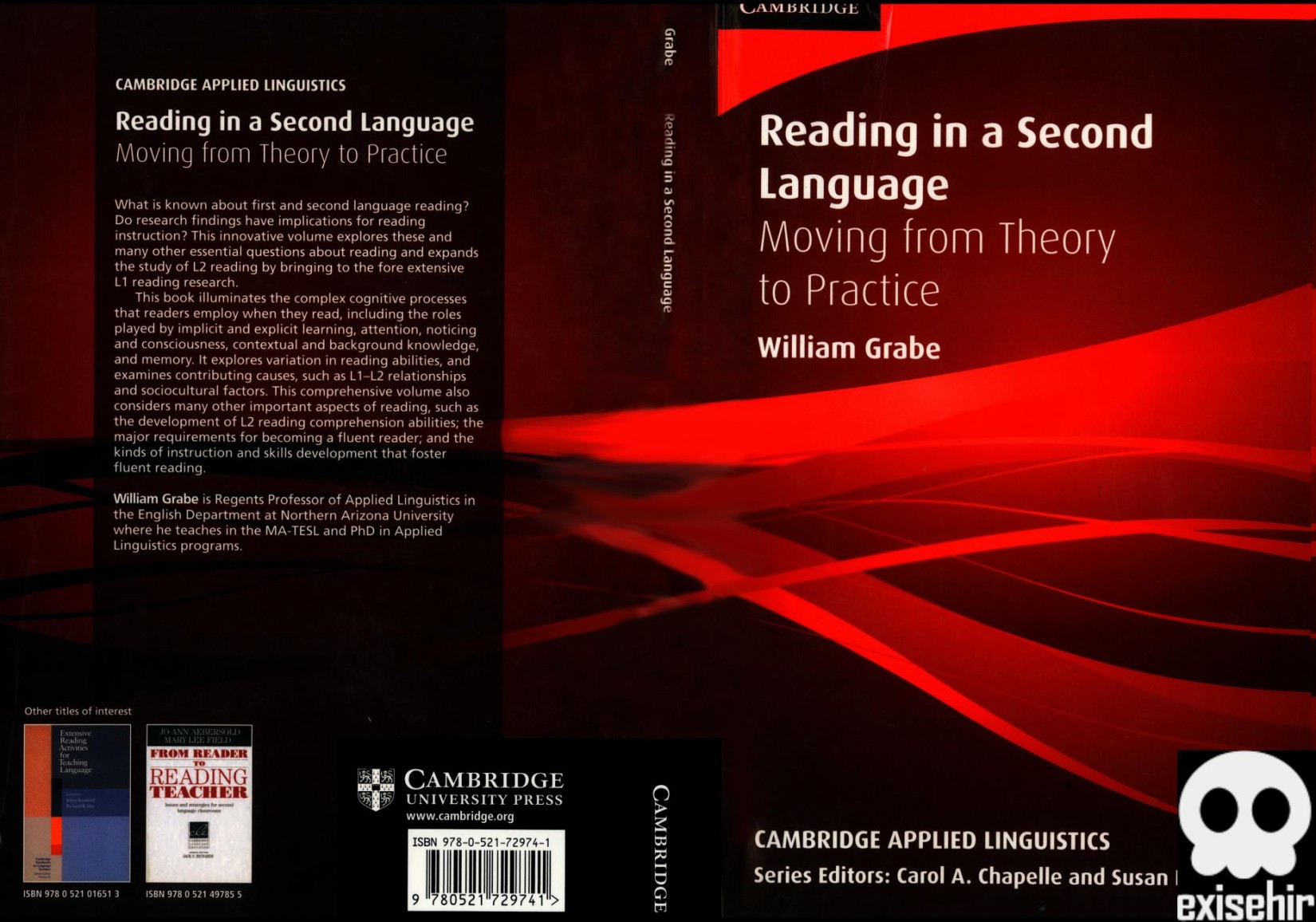
Reading in a Second Language Moving from Theory to Practice 2nd edition by William Grabe, Junko Yamashita ISBN 1108840108 978-1108840101
Original price was: $70.00.$35.00Current price is: $35.00.
Instant download Reading in a Second Language Moving from Theory to Practice (Cambridge Applied Linguistics) 1st Edition after payment
Reading in a Second Language Moving from Theory to Practice 2nd edition by William Grabe, Junko Yamashita – Ebook PDF Instant Download/Delivery: 1108840108 , 978-1108840101
Full download Reading in a Second Language Moving from Theory to Practice 2nd edition after payment

Product details:
ISBN 10: 1108840108
ISBN 13: 978-1108840101
Author: William Grabe, Junko Yamashita
Understanding reading abilities and their development is fundamental for language comprehension and human cognition. Now in its second edition, this book draws on research from multiple disciplines to explain reading abilities in both L1 and L2, and shows how this research can be applied in practice in order to support reading development. Research into reading has progressed a great deal since the first edition was published, so this edition has been completely updated and revised, in order to reflect these advances. All chapters present updated research studies, and completely new chapters are included on the neurocognition of reading, reading-writing relationships, and digital reading. If you want to know how reading works, no matter the language(s) involved, as well as how it can be taught effectively, this book provides a persuasive research foundation and many practical insights. It is essential reading for academic researchers and students in Applied Linguistics and TESOL.
Reading in a Second Language Moving from Theory to Practice 2nd Table of contents:
Part I Foundations of Reading
1 The Nature of Reading: Defining Reading
1.1 Ways We Read and Why We Read
1.2 Reading for Different Purposes: Types of Reading
1.3 Reading for Different Purposes: The Validity of the Concept
1.4 A Definition of Reading
1.5 Learning to Read
1.6 Implications for Instruction
2 How Reading Works: The Building Blocks of Fluency and Comprehension
2.1 Word Recognition
2.1.1 Orthographic Processing
2.1.2 Phonological Processing
2.1.3 Semantic Processing and the Self-Teaching Hypothesis
2.1.4 Morphological Processing
2.1.5 Spelling Knowledge, Orthographic Mapping, and Word Recognition
2.2 Lexical Access
2.3 Automaticity and Lexical Access
2.4 Lexical Quality Hypothesis
2.4.1 Lexical Access and the Lexical Quality Hypothesis
2.4.2 Lexical Access, Syntactic Processing, and Semantic Processing
2.5 Syntactic Parsing: From Word to Clause Integration
2.6 Meaning Proposition Encoding: Word-to-Text Integration
2.7 Working Memory
2.8 Now-or-Never Processing and Lower-Level Processes
2.9 Implications for Instruction
3 How Reading Works: Comprehension Processes
3.1 Key Features of Higher-Level Processing
3.2 Building a Text Representation of Comprehension
3.3 Building a Situation Model of Reader Interpretation
3.4 A Two-Level Account of Comprehension
3.5 Working Memory as Executive Function
3.6 Other Executive Functions
3.7 Attentional Processing
3.8 Inferencing
3.9 Metacognitive and Metalinguistic Awareness
3.10 Comprehension Processes and Executive Control
3.11 Implications for Instruction
4 Cognitive Issues in Reading
4.1 Implicit and Explicit Learning
4.2 Frequency
4.3 Statistical Learning and Statistical Knowledge
4.4 Associative Learning, Co-occurrence, and Emergence
4.5 Language Processing Constraints: Reading and Now-or-Never Processing
4.6 Connectionism
4.7 Speed of Processing and Rapid Automatic Naming
4.8 Long-Term Memory and Background Knowledge
4.8.1 Long-Term Memory
4.8.2 Background Knowledge
4.9 Concepts, Categorization, and Reading Comprehension
4.10 Role of Context in Reading
4.11 Implications for Instruction
5 Neurocognitive Processing and Reading Ability
5.1 Neurolinguistic Research on Reading
5.2 A Tour of Major Brain Structures
5.3 Language-Associated Brain Areas
5.4 Networks and Pathways
5.5 Neurolinguistic Research Methods
Appendix: Integrating a Reading Comprehension Timeline: Proposed attentional and Automatic Processin
6 Explaining Reading Comprehension: Models of Reading
6.1 Models of Reading
6.1.1 Simple View of Reading
6.1.2 Construction-Integration Model
6.1.3 The Landscape Model of Reading
6.1.4 Verbal Efficiency Model, Lexical Quality Hypothesis, and Word-to-Text Integration
6.1.5 Reading Systems Framework Approach
6.2 L2 Reading Comprehension and Models of Reading
6.3 Implications for Instruction
Part II Patterns of Variation in Reading
7 Reading in Different Languages
7.1 Reading in Different Languages
7.2 Orthographic Systems
7.3 Traditional Taxonomic Classification of Languages
7.4 The Orthographic Writing System and Learning to Read
7.5 The Orthographic Depth Hypothesis
7.6 Consequences of the Orthographic Depth Hypothesis for Reading
7.7 Other Factors in Word Recognition Development
7.8 From the L1 to the L2: Transfer Effects of Different L1s on L2 Reading
7.9 Universals of Reading Development
7.10 Reading Universals and L1–L2 Transfer: The Role of Phonological Decoding
7.11 Implications for Instruction
8 L1 and L2 Reading Relationships
8.1 L1 Versus L2 Reading
8.1.1 Key Linguistic and Processing Differences in L1–L2 Reading
8.1.2 Cognitive and Educational Differences in L1–L2 Reading
8.1.3 Key Sociocultural and Institutional Factors in L1–L2 Reading
8.2 Similarities between L1 and L2 Reading
8.3 Relationships Between L1 Reading and L2 Reading Development
8.3.1 Interdependence Hypothesis and Linguistic Threshold Hypothesis
8.3.2 Common Underlying Cognitive Processing Framework
8.3.3 Transfer Facilitation Model
8.3.4 Language Threshold Hypothesis
8.3.5 Dual-Language Involvement in L2 Reading
8.4 Implications for Instruction
9 Social Contexts of Reading
9.1 Demographics on Students and Reading Development in the United States
9.2 Social Factors Influencing L1 and L2 Literacy
9.2.1 The Development of Emergent Literacy
9.2.2 Socioeconomic Status
9.2.3 Going Beyond SES
9.2.4 Family Beliefs and Values
9.2.5 Language Stimulation in the Home
9.2.6 Home Literacy Environment: Shared Reading Experiences
9.2.7 Training and Interventions for Early Literacy Development: Head Start
9.3 Teacher Professional Training and Teacher Effectiveness
9.4 Language-Minority Learners in Language Majority K-12 Schools
9.5 ESL Students in Academic Settings and EFL Students
9.6 Putting the Contextual Research into Context
9.7 Implications for Instruction
10 Motivation for Reading
10.1 Definitions of Motivation
10.2 Theories of Motivation
10.2.1 Expectancy-Value Theory
10.2.2 Attribution Theory
10.2.3 Social-Cognitive Theory
10.2.4 Goal Orientation Theory
10.2.5 Self-Determination Theory
10.2.6 Related Concepts
10.3 Motivation and Reading
10.4 Dimensions of Motivation and Motivation Measurement
10.5 Intrinsic and Extrinsic Motivation
10.6 Motivation and Reading Amount
10.7 Reading Motivation and Metacognitive Awareness of Strategy Use
10.8 Motivation, Engagement, and Reading Achievement
10.9 Motivation/Engagement, Instruction and Reading Achievement
10.10 Motivation in L2 Contexts
10.11 Motivation for L2 Reading
10.12 Implications for Instruction: Teaching Motivation for L2 Reading
Part III Developing Reading Comprehension Abilities
11 Vocabulary and Reading Comprehension
11.1 The Close Relationship Between Vocabulary and Reading
11.2 Amount of Vocabulary Needed for Reading Comprehension
11.3 Identifying Individual Vocabulary Items: Exploring Lexical Quality
11.4 The Development of Vocabulary
11.5 The Value of Word Family and Lemma Analyses: Word Lists and Core Words
11.6 L2 Reading and L2 Word Knowledge
11.7 Learning Words from Context
11.7.1 Incidental Word Learning from Extensive Exposure
11.7.2 Using Vocabulary Learning Strategies
11.7.3 Guessing Word Meanings from Context
11.8 Background Knowledge and Word Learning Networks
11.9 Direct Instruction of Vocabulary
11.10 Implications for Instruction
Appendix: Vocabulary Activities Using Graphic Organizers
Semantic Map
Word-stem Map
Concept-of-Definition Map
12 Building Main Idea Comprehension: Syntax and Strategies
12.1 Syntactic Processes, Knowledge, and Awareness
12.1.1 Syntactic Processing
12.1.2 Syntactic Processing and Syntactic Awareness while Reading
12.1.3 Syntactic Knowledge (Awareness) and Reading Comprehension Abilities
12.2 Grammar as Functional Text Processing Knowledge
12.2.1 Grammatical Information as Discourse Signaling System
12.2.2 The Contribution of Grammar Knowledge to Reading Comprehension
12.2.3 Structure Building Model of Comprehension and Linguistic Cueing Systems
12.3 Academic Main Idea Comprehension
12.4 Reading Strategies That Support Comprehension
12.4.1 Previewing and Activating Prior Knowledge
12.4.2 Predicting
12.4.3 Forming Questions and Answering Questions
12.4.4 Summarizing
12.4.5 Monitoring Comprehension
12.4.6 Using Text Structure Awareness
12.4.7 Using Graphic Organizers
12.4.8 Inferencing
12.4.9 An L2-Specific Comprehension Strategy: Mental Translation
12.5 Strategies and Comprehension Development
12.6 Implications for Instruction
12.6.1 Implications for Grammar Instruction
12.6.2 Implications for Strategy Instruction
Appendix: Major Reading Strategies
13 Becoming a Strategic Reader
13.1 Skills and Strategies
13.2 Metacognition and Strategies
13.3 Metalinguistic Awareness and Strategic Reading
13.4 Promoting Strategic Reading
13.5 Active Engagement in Reading
13.6 Strategic Reading and Strategies in Combination
13.7 Research on Multiple Strategies Instruction
13.7.1 KWL and DR–TA
13.7.2 Reciprocal Teaching
13.7.3 Collaborative Strategic Reading
13.7.4 Questioning the Author
13.7.5 Transactional Strategies Instruction
13.7.6 Promoting Adolescents’ Comprehension of Text (PACT)
13.7.7 Concept-Oriented Reading Instruction (CORI)
13.7.8 Developing More Strategic Readers
13.8 Reading to Learn and the Challenge of Disciplinary Reading
13.9 Implications for Instruction
14 Building Awareness of Discourse Structure
14.1 Two Directions in Written Discourse Analysis
14.2 Text Structure: How Texts Signal Discourse Structure
14.2.1 Cohesion
14.2.2 Information Structuring
14.2.3 Lexical Signaling
14.2.4 Anaphoric Signaling
14.2.5 Topic Continuity Systems
14.2.6 Text Coherence
14.3 Text Genres and Text Purposes
14.4 Narrative and Expository Texts
14.5 Patterns of Discourse Organization
14.6 Research on Discourse Structure and Reading Comprehension
14.6.1 Discourse Structure Awareness and Discourse Signaling in Texts
14.6.2 Structural Hierarchy in Texts: Top-Level Structuring
14.6.3 Discourse Structure Awareness and Graphic Organizers
14.6.4 Meta-Analyses Involving Graphic Organizers
14.7 Refutational Texts, Simplification, Revision, and Comprehension
14.7.1 Refutations
14.7.2 Simplification
14.7.3 Text Revisions
14.8 Research on Teaching Discourse Structure Awareness
14.9 Implications for Instruction
Appendix A: Examples of basic GO forms for commonly used text structures
Appendix B DSGO that Reflects the Complexity of an Instructional Text (from Grabe & Stoller, 2020, p
Appendix B-1 Student Worksheet: Discourse Structure Graphic Organizer [created for “Looking into t
Appendix B-2 Answer key to DSGO in Appendix B-1
Part IV Expanding Reading Comprehension Skills
15 Reading to Learn and Reading–Writing Relationships
15.1 Reading, Writing, and Content Relationships
15.1.1 Reading Improves Writing Abilities
15.1.2 Writing Improves Reading Abilities
15.1.3 Reading and Writing Together Develops Both Skills Most Effectively
15.1.4 Reading More Improves Content Learning
15.1.5 Writing Instruction Improves Content Learning
15.1.6 More Content Knowledge Improves Both Reading and Writing Abilities
15.2 Specific Aspects of Writing That Support Reading Comprehension Development
15.2.1 Summarizing
15.2.2 Synthesizing Information
15.3 Intervention Studies on Writing from Sources
15.4 Summing Up the Research on Reading-Writing Relations
15.5 Implications for Instruction
16 Reading in Digital Contexts
16.1 The Growth of Digital Literacy
16.2 Print and Digital Reading in Academic Contexts
16.3 Identifying Categories and Variables for Digital Reading Research
16.4 Assessing Digital Literacy and the Limits to Reading Online
16.5 Recent Research on Print versus Online Digital Reading
16.6 The Unique Challenges of Advanced Online Digital Reading
16.7 Implications for Instruction
16.7.1 Challenges
16.7.2 Opportunities
17 Reading Fluency, Reading Rate, and Comprehension
17.1 Understanding Reading Fluency
17.2 Multiple Settings for Fluency Development
17.3 Fluency Research and the National Reading Panel
17.4 The Expanded Scope of Fluency and Its Relation to Comprehension
17.5 Key L1 Reading Fluency Research Studies
17.6 L2 Perspectives on Reading Fluency
17.7 L2 Instructional Research with Repeated Reading
17.8 Implications for Instruction
Appendix: L1 Reading Rate Development Tables
18 Extensive Reading
18.1 Research on Extensive Reading
18.1.1 An Overview of ER
18.1.2 A Major Challenge to Extensive Reading Research
18.2 Recent Research on Extensive Reading Effectiveness
18.2.1 L1 Studies
18.2.2 Motivation Studies and Amount of Reading
18.2.3 Meta-analyses
18.2.4 L2 Studies of Extensive Reading and Reading Comprehension
18.3 Further Outcomes Associated with Extensive Reading
18.3.1 Extensive Reading and Vocabulary Growth
18.3.2 Reading Rate and Fluency
18.3.3 Extensive Reading and Conceptual Knowledge Growth
18.4 Implications for Instruction
Part V Applications of Reading Research: Instruction and Assessment
19 Reading Curriculum and Instruction
19.1 Research Foundations to Guide Reading Instruction
19.2 From Research Findings to Curriculum Development Principles
19.3 Core Reading Curriculum Principles
19.3.1 Principle 1: Require Students to Read a Lot and Read Often
19.3.2 Principle #2: Have Students Read and Reread for Well-Defined Purposes
19.3.3 Principle #3: Incorporate Deliberate Practice into Reading Curricula
19.3.4 Principle #4: Promote Discussion Among Students About Text Comprehension
19.3.5 Principle #5: Build Student Motivation to Read
19.4 Reading-Skills Development Principles
19.4.1 Principle #6: Make a Commitment to Vocabulary Teaching and Learning
19.4.2 Principle #7: Teach (Not Test) Main-Idea Comprehension
19.4.3 Principle #8: Raise Students’ Discourse-Structure Awareness
19.4.4 Principle #9: Train Students to Become Strategic Readers
19.4.5 Principle #10 Promote Reading Fluency
19.5 Instructional-Design Principles
19.5.1 Principle #11: Structure Reading Lessons Around a Prereading, During-Reading, and Postreading
19.5.2 Principle #12: Select and Adapt Texts to Support Students’ Comprehension Development
19.5.3 Principle #13: Promote Students’ Digital-Literacy Skills
19.5.4 Principle #14: Connect Reading to Writing to Prepare Students for Academic Tasks
19.5.5 Principle #15: Promote Assessment for Learning
19.5.6 Principle 16: Integrate Reading and Content Learning
19.6 Overarching Frameworks for Reading Instruction
19.6.1 Reading Textbook Series
19.6.2 Content and Reading Instruction
19.7 Building a CRI Curriculum
19.8 The Challenge of CRI Implementation
19.9 Closing Thoughts
20 Reading Assessment
20.1 Goals for Reading Assessment
20.1.1 Reading Proficiency Assessment
20.1.2 Assessment of Classroom Learning
20.1.3 Assessment for Learning
20.1.4 Placement and Diagnostic Assessment
20.1.5 Assessment for Research Purposes
20.2 Reading Assessment Practices and Resources
20.2.1 Standardized L2 Reading Assessment
20.2.2 Classroom-Based Assessment Practices
20.2.3 Assessment for Learning Practices
20.2.4 Placement and Diagnostic Assessment Practices
20.2.5 Research-Based Assessment Practices
20.3 Issues and Innovations for L2 Reading Assessment
20.3.1 New Perspectives on L2 Reading Assessment
20.3.2 Additional Ideas for L2 Reading Assessment
20.4 Further Issues for Reading Assessment
20.4.1 Consequences of Assessment
20.4.2 Teacher Training for Reading Assessment
20.5 Implications for Teachers and Instruction
References
Author Index
Subject Index
People also search for Reading in a Second Language Moving from Theory to Practice 2nd:
reading in a second language moving from theory to practice
reading in a second language
reading in a second language pdf
reading in another language brain
reading a book in a second