


Representative Volume Elements and Unit Cells 1st edition by Shuguang Li, Elena Sitnikova – Ebook PDF Instant Download/Delivery: 0081026380, 9780081026380
Full download Representative Volume Elements and Unit Cells 1st edition after payment
Product details:
ISBN 10: 0081026380
ISBN 13: 9780081026380
Author: Shuguang Li, Elena Sitnikova
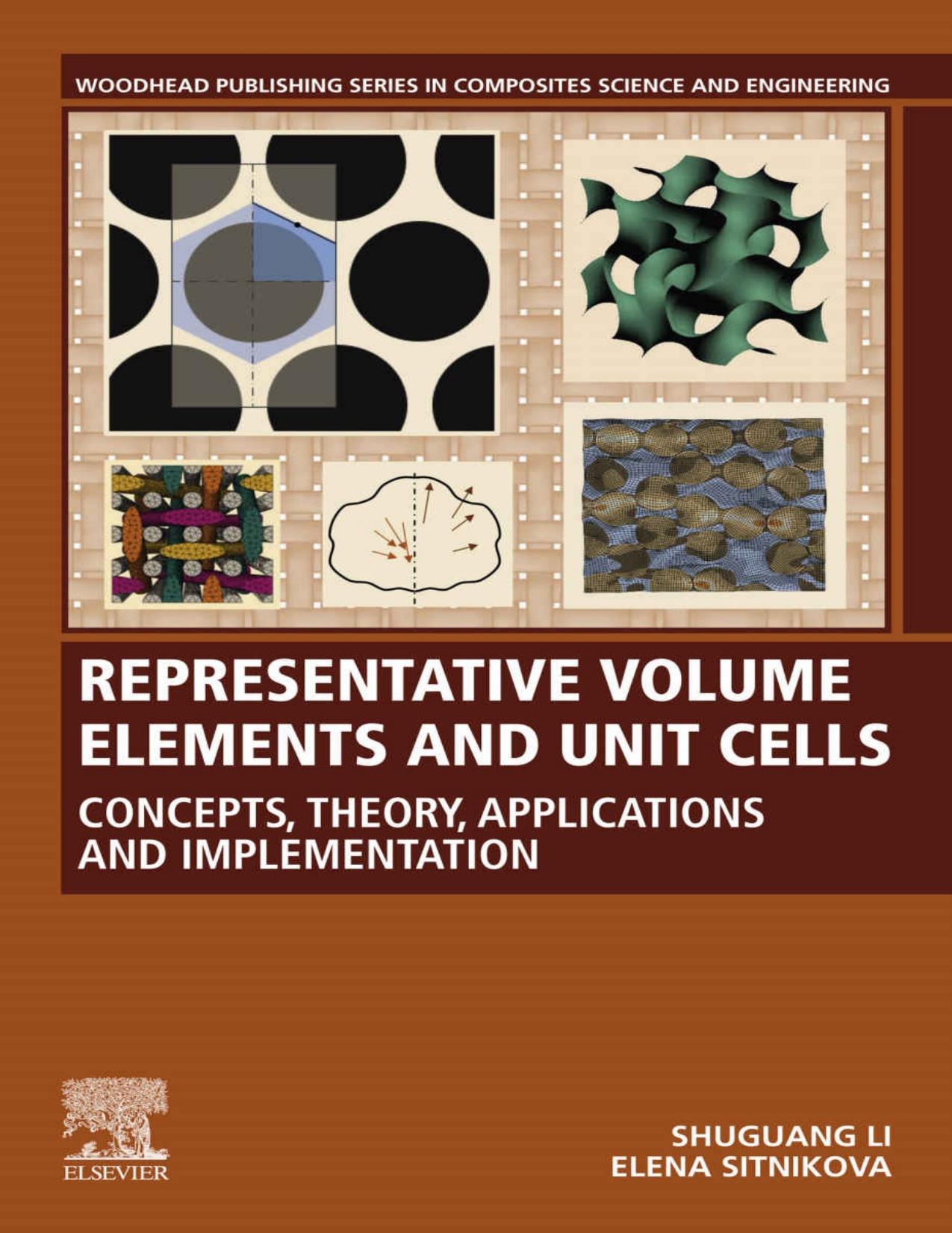
Numerical methods to estimate material properties usually involve analysis of a representative volume element (RVE) or unit cell (UC). The representative volume element (RVE) or unit cell (UC) is the smallest volume over which a measurement can be made that will yield a value representative of the whole. RVEs and UCs are widely used in the characterisation of materials with multiscale architectures such as composites. However, finite element (FE) software packages such as Abaqus and Comsol MultiPhysics do not offer the capability for RVE and UC modelling directly on their own. To apply them to analyse RVEs and UCs, the generation of the FE models for them, the imposition of boundary conditions, and the extraction of directly relevant results are essentially the responsibility of the user. These have tended to be incorrectly implemented by users! For the first time, this book will provide a comprehensive account on correct modelling of RVEs and UCs, which will eliminate any uncertainties and ambiguities.The book offers a complete and thorough review on the subject of RVEs and UCs, establishing a framework on a rigorous mathematical and mechanical basis to ensure that basic concepts, such as symmetry and free body diagrams, are applied correctly and consistently. It also demonstrates to readers that rigorous applications of mathematics and mechanics are meant to make things clear, consistent, thorough and, most of all, simple and easy to follow, rather than the opposite as many perceive. As a result, the book shows that the appropriate use of RVEs and UCs can deliver an effective and reliable means of material characterisation. It not only provides a much needed comprehensive account on material characterisation but, more importantly, explains how such characterisation can be conducted in a consistent and systematic manner. It also includes a ready-to-use open source code for UCs that can be downloaded from a companion site for potential users to utilise, adapt and expand as they wish.
- The companion site for the book can be found at https://www.elsevier.com/books-and-journals/book-companion/9780081026380
- The theories presented in this book will give users more confidence when applying RVE and UC models to analyse materials of complex architectures with accuracy and efficiency
- Systematic explanations of RVE and UC theories have been included, as well as their applications in composites
- It illustrates in detail how to set up UC models and provides an open source code to implement via Abaqus
Representative Volume Elements and Unit Cells 1st Table of contents:
Part One. Basics
Chapter 1. Introduction — background, objectives and basic concepts
1.1. The concept of length scales and typical length scales in physics and engineering
1.2. Multiscale modelling
1.3. Representative volume element and unit cell
1.4. Background of this monograph
1.5. Objectives of this monograph
1.6. The structure of this monograph
Chapter 2. Symmetry, symmetry transformations and symmetry conditions
2.1. Introduction
2.2. Geometric transformations and the concept of symmetry
2.3. Symmetry of physical fields
2.4. Continuity and free body diagrams
2.5. Symmetry conditions
2.6. Concluding remarks
Chapter 3. Material categorisation and material characterisation
3.1. Background
3.2. Material categorisation
3.3. Material characterisation
3.4. Concluding remarks
Chapter 4. Representative volume elements and unit cells
4.1. Introduction
4.2. RVEs
4.3. UCs
4.4. Concluding remarks
Chapter 5. Common erroneous treatments and their conceptual sources of errors
5.1. Realistic or hypothetic background
5.2. The construction of RVEs and their boundary
5.3. The construction of UCs
5.4. Post-processing
5.5. Implementation issues
5.6. Verification and the lack of ‘sanity checks’
5.7. Concluding remarks
Part Two. Consistent formulation of unit cells and representative volume elements
Chapter 6. Formulation of unit cells
6.1. Introduction
6.2. Relative displacement field and rigid body rotations
6.3. Relative displacement boundary conditions for unit cells
6.4. Typical unit cells and their boundary conditions in terms of relative displacements
6.5. Requirements on meshing
6.6. Key degrees of freedom and average strains
6.7. Average stresses and effective material properties
6.8. Thermal expansion coefficients
6.9. “Sanity checks” as basic verifications
6.10. Concluding remarks
Chapter 7. Periodic traction boundary conditions and the key degrees of freedom for unit cells
7.1. Introduction
7.2. Boundaries and boundary conditions for unit cells resulting from translational symmetries
7.3. Total potential energy and variational principle for unit cells under prescribed average strains
7.4. Periodic traction boundary conditions as the natural boundary conditions for unit cells
7.5. The nature of the reactions at the prescribed key degrees of freedom
7.6. Prescribed concentrated ‘forces’ at the key degrees of freedom
7.7. Examples
7.8. Conclusions
Chapter 8. Further symmetries within a UC
8.1. Introduction
8.2. Further reflectional symmetries to existing translational symmetries
8.3. Further rotational symmetries to existing translational symmetries
8.4. Examples of mixed reflectional and rotational symmetries
8.5. Centrally reflectional symmetry
8.6. Guidance to the sequence of exploiting existing symmetries
8.7. Concluding statement
Chapter 9. RVE for media with randomly distributed inclusions
9.1. Introduction
9.2. Displacement boundary conditions and traction boundary conditions for an RVE
9.3. Decay length for boundary effects
9.4. Generation of random patterns
9.5. Strain and stress fields in the RVE and the sub-domain
9.6. Post-processing for average stresses, strains and effective properties
9.7. Conclusions
Chapter 10. The diffusion problem
10.1. Introduction
10.2. Governing equation
10.3. Relative concentration field
10.4. An example of a cuboidal unit cell
10.5. RVEs
10.6. Post-processing for average concentration gradients and diffusion fluxes
10.7. Conclusions
Chapter 11. Boundaries of applicability of representative volume elements and unit cells
11.1. Introduction
11.2. Predictions of elastic properties and strengths
11.3. Representative volume elements
11.4. Unit cells
11.5. Conclusions
Part Three. Further developments
Chapter 12. Applications to textile composites
12.1. Introduction
12.2. Use of symmetries when defining an effective UC
12.3. Unit cells for two-dimensional textile composites
12.4. Unit cells for three-dimensional textile composites
12.5. Conclusions
Chapter 13. Application of unit cells to problems of finite deformation
13.1. Introduction
13.2. Unit cell modelling at finite deformations
13.3. The uncertainties associated with material definition
13.4. Concluding remarks
Chapter 14. Automated implementation: UnitCells© composites characterisation code
14.1. Introduction
14.2. Abaqus/CAE modelling practicality
14.3. Verification and validation
14.4. Concluding remarks
Index
People also search for Representative Volume Elements and Unit Cells 1st :
representative volume element
representative volume
representative elementary volume
representative unit chemistry
representative elements list
Tags: Shuguang Li, Elena Sitnikova, Representative Volume, Unit Cells