

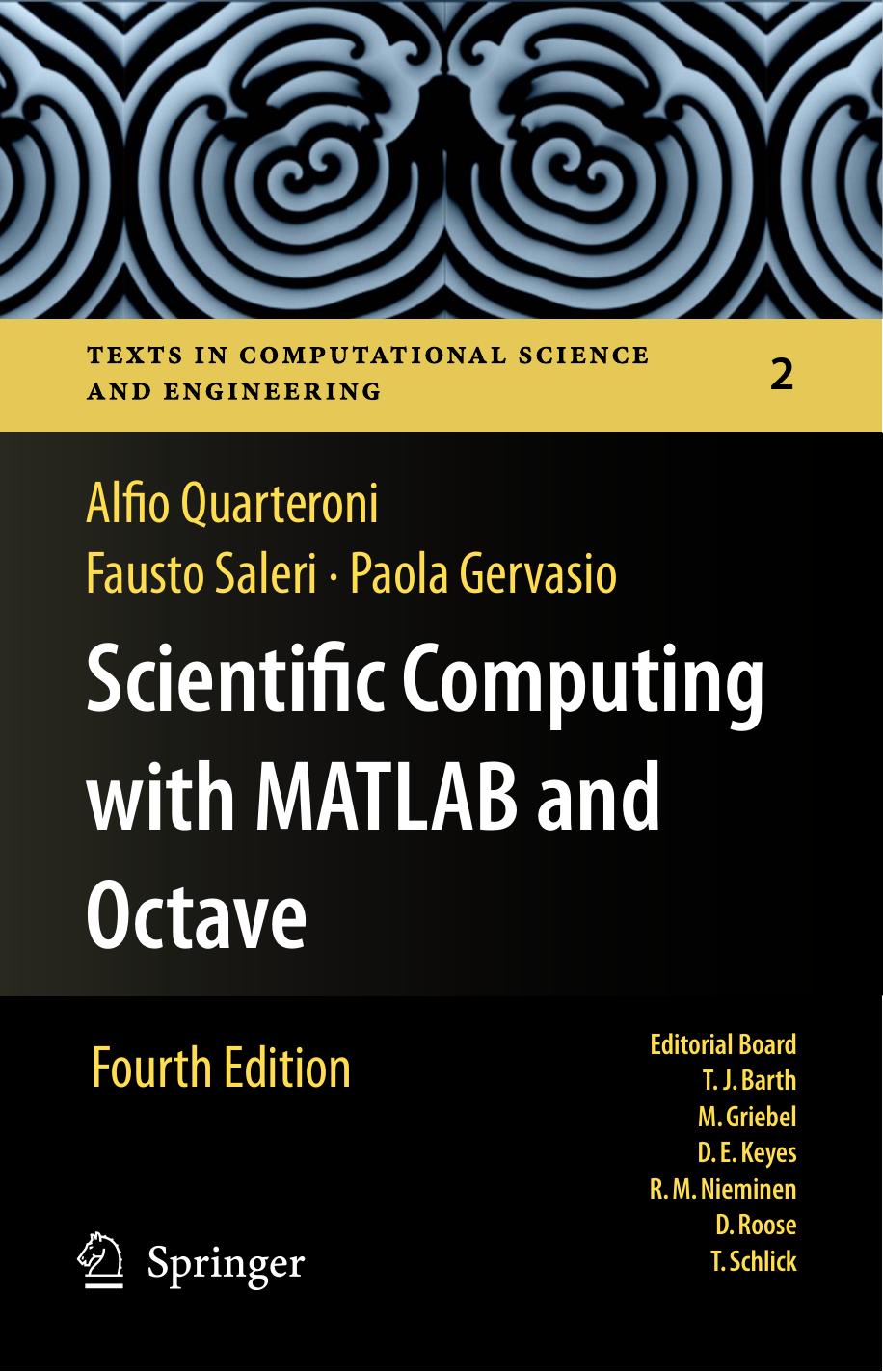
Scientific Computing with MATLAB and Octav 4th edition by Alfio Quarteroni, Fausto Saleri, Paola Gervasio – Ebook PDF Instant Download/Delivery: 3642453670, 9783642453670
Full download Scientific Computing with MATLAB and Octav 4th edition after payment
Product details:
ISBN 10: 3642453670
ISBN 13: 9783642453670
Author: Alfio Quarteroni, Fausto Saleri, Paola Gervasio
This textbook is an introduction to Scientific Computing, in which several numerical methods for the computer-based solution of certain classes of mathematical problems are illustrated. The authors show how to compute the zeros, the extrema, and the integrals of continuous functions, solve linear systems, approximate functions using polynomials and construct accurate approximations for the solution of ordinary and partial differential equations. To make the format concrete and appealing, the programming environments Matlab and Octave are adopted as faithful companions. The book contains the solutions to several problems posed in exercises and examples, often originating from important applications. At the end of each chapter, a specific section is devoted to subjects which were not addressed in the book and contains bibliographical references for a more comprehensive treatment of the material. From the review: “…. This carefully written textbook, the third English edition, contains substantial new developments on the numerical solution of differential equations. It is typeset in a two-color design and is written in a style suited for readers who have mathematics, natural sciences, computer sciences or economics as a background and who are interested in a well-organized introduction to the subject.” Roberto Plato (Siegen), Zentralblatt MATH 1205.65002.
Scientific Computing with MATLAB and Octav 4th Table of contents:
Index of MATLAB and Octave programs
1 What can’t be ignored
1.1 The MATLAB and Octave environments
1.2 Real numbers
1.2.1 How we represent them
1.2.2 How we operate with floating-point numbers
1.3 Complex numbers
1.4 Matrices
1.4.1 Vectors
1.5 Real functions
1.5.1 The zeros
1.5.2 Polynomials
1.5.3 Integration and differentiation
1.6 To err is not only human
1.6.1 Talking about costs
1.7 The MATLAB language
1.7.1 MATLAB statements
1.7.2 Programming in MATLAB
1.7.3 Examples of differences between MATLAB and Octave languages
1.8 What we haven’t told you
1.9 Exercises
2 Nonlinear equations
2.1 Some representative problems
2.2 The bisection method
2.3 The Newton method
2.3.1 How to terminate Newton’s iterations
2.4 The secant method
2.5 Systems of nonlinear equations
2.6 Fixed point iterations
2.6.1 How to terminate fixed point iterations
2.7 Acceleration using Aitken method
2.8 Algebraic polynomials
2.8.1 Hörner’s algorithm
2.8.2 The Newton-Hörner method
2.9 What we haven’t told you
2.10 Exercises
3 Approximation of functions and data
3.1 Some representative problems
3.2 Approximation by Taylor’s polynomials
3.3 Interpolation
3.3.1 Lagrangian polynomial interpolation
3.3.2 Stability of polynomial interpolation
3.3.3 Interpolation at Chebyshev nodes
3.3.4 Barycentric interpolation formula
3.3.5 Trigonometric interpolation and FFT
3.4 Piecewise linear interpolation
3.5 Approximation by spline functions
3.6 The least-squares method
3.7 What we haven’t told you
3.8 Exercises
4 Numerical differentiation and integration
4.1 Some representative problems
4.2 Approximation of function derivatives
4.3 Numerical integration
4.3.1 Midpoint formula
4.3.2 Trapezoidal formula
4.3.3 Simpson formula
4.4 Interpolatory quadratures
4.5 Simpson adaptive formula
4.6 Monte Carlo Methods for Numerical Integration
4.7 What we haven’t told you
4.8 Exercises
5 Linear systems
5.1 Some representative problems
5.2 Linear system and complexity
5.3 The LU factorization method
5.4 The pivoting technique
5.4.1 The fill-in of a matrix
5.5 How accurate is the solution of a linear system?
5.6 How to solve a tridiagonal system
5.7 Overdetermined systems
5.8 What is hidden behind the MATLAB command
5.9 Iterative methods
5.9.1 How to construct an iterative method
5.10 Richardson and gradient methods
5.11 The conjugate gradient method
5.12 When should an iterative method be stopped?
5.13 To wrap-up: direct or iterative?
5.14 What we haven’t told you
5.15 Exercises
6 Eigenvalues and eigenvectors
6.1 Some representative problems
6.2 The power method
6.2.1 Convergence analysis
6.3 Generalization of the power method
6.4 How to compute the shift
6.5 Computation of all the eigenvalues
6.6 What we haven’t told you
6.7 Exercises
7 Numerical optimization
7.1 Some representative problems
7.2 Unconstrained optimization
7.3 Derivative free methods
7.3.1 Golden section and quadratic interpolationmethods
7.3.2 Nelder and Mead method
7.4 The Newton method
7.5 Descent (or line search) methods
7.5.1 Descent directions
7.5.2 Strategies for choosing the steplength αk
7.5.3 The descent method with Newton’s directions
7.5.4 Descent methods with quasi-Newton directions
7.5.5 Gradient and conjugate gradientdescent methods
7.6 Trust region methods
7.7 The nonlinear least squares method
7.7.1 Gauss-Newton method
7.7.2 Levenberg-Marquardt’s method
7.8 Constrained optimization
7.8.1 The penalty method
7.8.2 The augmented Lagrangian method
7.9 What we haven’t told you
7.10 Exercises
8 Ordinary differential equations
8.1 Some representative problems
8.2 The Cauchy problem
8.3 Euler methods
8.3.1 Convergence analysis
8.4 The Crank-Nicolson method
8.5 Zero-stability
8.6 Stability on unbounded intervals
8.6.1 The region of absolute stability
8.6.2 Absolute stability controls perturbations
8.6.3 Stepsize adaptivity for the forward Eulermethod
8.7 High order methods
8.8 The predictor-corrector methods
8.9 Systems of differential equations
8.10 Some examples
8.10.1 The spherical pendulum
8.10.2 The three-body problem
8.10.3 Some stiff problems
8.11 What we haven’t told you
8.12 Exercises
9 Numerical approximation of boundary-valueproblems
9.1 Some representative problems
9.2 Approximation of boundary-value problems
9.2.1 Finite difference approximation of the one-dimensional Poisson problem
9.2.2 Finite difference approximation of aconvection-dominated problem
9.2.3 Finite element approximation of the one-dimensional Poisson problem
9.2.4 Finite difference approximation of the two-dimensional Poisson problem
9.2.5 Consistency and convergence of finite difference discretization of the Poisson problem
9.2.6 Finite difference approximation of the one-dimensional heat equation
9.2.7 Finite element approximation of theone-dimensional heat equation
9.3 Hyperbolic equations: a scalar pure advectionproblem
9.3.1 Finite difference discretization of the scalar transport equation
9.3.2 Finite difference analysis for the scalar transport equation
9.3.3 Finite element space discretization of the scalar advection equation
9.4 The wave equation
9.4.1 Finite difference approximation of the waveequation
9.5 What we haven’t told you
9.6 Exercises
10 Solutions of the exercises
10.1 Chapter 1
10.2 Chapter 2
10.3 Chapter 3
10.4 Chapter 4
10.5 Chapter 5
10.6 Chapter 6
10.7 Chapter 7
10.8 Chapter 8
10.9 Chapter 9
References
Index
People also search for Scientific Computing with MATLAB and Octav 4th :
scientific computing with matlab and octave
scientific computing with matlab and octave pdf
scientific computing with matlab
scientific computing mit
scientific computing with matlab pdf
Tags: Alfio Quarteroni, Fausto Saleri, Paola Gervasio, Scientific Computing, MATLAB and Octav