

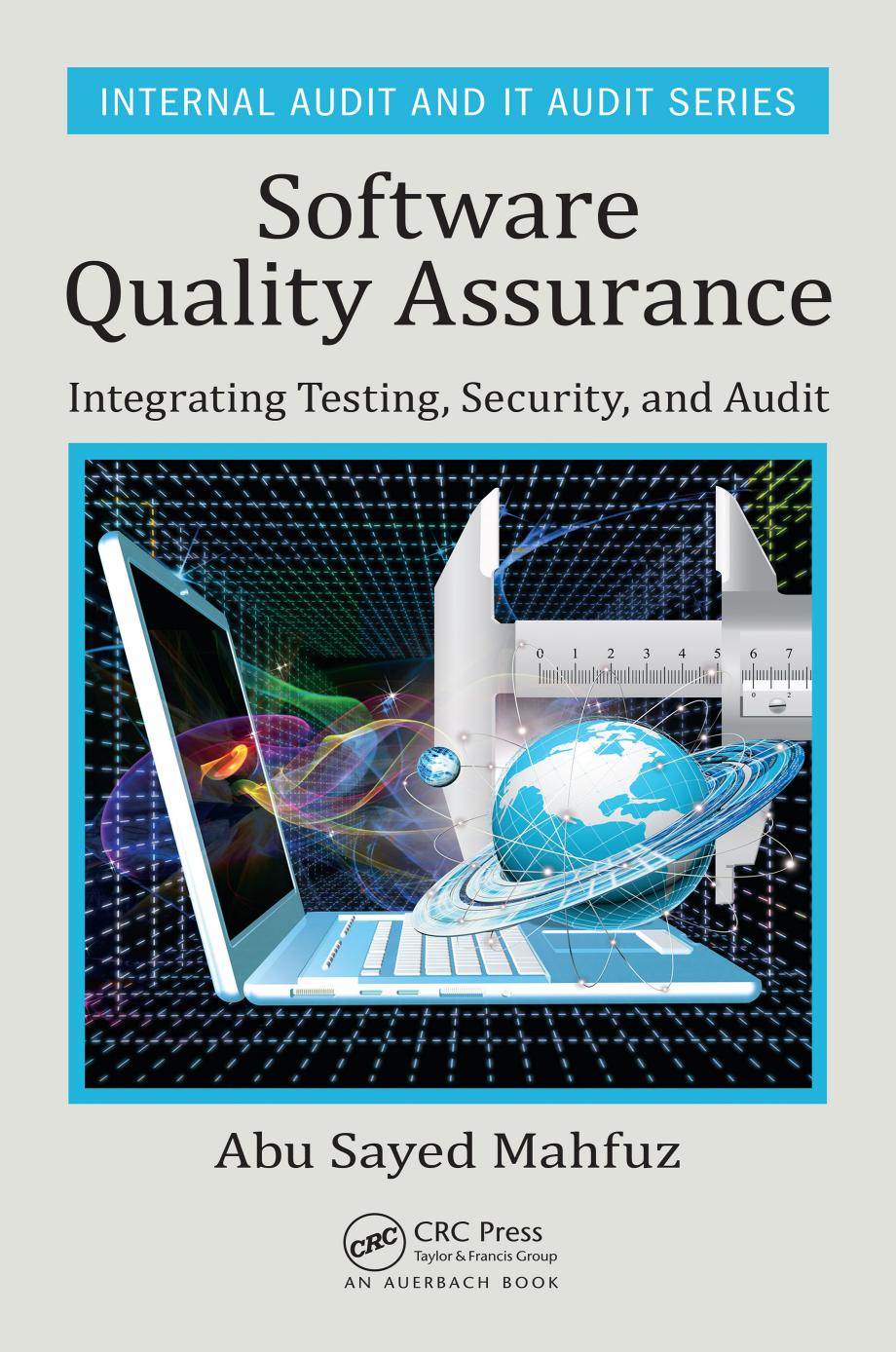
Software Quality Assurance Integrating Testing Security and Audit 1st edition by Abu Sayed Mahfuz – Ebook PDF Instant Download/Delivery: 1000427048, 9781000427042
Full download Software Quality Assurance Integrating Testing Security and Audit 1st edition after payment
Product details:
ISBN 10: 1000427048
ISBN 13: 9781000427042
Author: Abu Sayed Mahfuz
Software Quality Assurance: Integrating Testing, Security, and Audit focuses on the importance of software quality and security. It defines various types of testing, recognizes factors that propose value to software quality, and provides theoretical and real-world scenarios that offer value and contribute quality to projects and applications. The practical synopsis on common testing tools helps readers who are in testing jobs or those interested in pursuing careers as testers. It also helps test leaders, test managers, and others who are involved in planning, estimating, executing, and maintaining software. The book is divided into four sections: The first section addresses the basic concepts of software quality, validation and verification, and audits. It covers the major areas of software management, software life cycle, and life cycle processes. The second section is about testing. It discusses test plans and strategy and introduces a step-by-step test design process along with a sample test case. It also examines what a tester or test lead needs to do before and during test execution and how to report after completing the test execution. The third section deals with security breaches and defects that may occur. It discusses documentation and classification of incidences as well as how to handle an occurrence. The fourth and final section provides examples of security issues along with a security policy document and addresses the planning aspects of an information audit. This section also discusses the definition, measurement, and metrics of reliability based on standards and quality metrics methodology CMM models. It discusses the ISO 15504 standard, CMMs, PSP, and TSP and includes an appendix containing a software process improvement sample document.
Software Quality Assurance Integrating Testing Security and Audit 1st Table of contents:
SECTION I: Concept
1. Quality Concept and Perspectives
1.1 Introduction
1.2 Part 1: Software Quality Concept
1.2.1 Defining Software Quality
1.2.2 Integrating Test, Security, and Audit
1.2.3 Why Is Software Quality Important?
1.2.4 What Is the Benefit of Software Quality in Business?
1.2.5 Lack of Quality Is the Reason for Failure
1.2.6 Failure Factors
1.3 Part 2: Software Quality Characteristics
1.3.1 What Is the Business Benefit of Quality Characteristics?
1.3.2 Quality Characteristics
1.3.3 Detailed Descriptions of Quality Characteristics
– Functionality
– Reliability
– Usability
– Efficiency
– Maintainability
– Portability
1.4 Control Objectives for Information and Related Technology (COBIT)
1.4.1 Introduction
1.4.2 Meta-Requirements
1.4.3 Capability Maturity Model Integration (CMMI)
1.4.4 Quality Characteristics, COBIT, and CMMI
1.5 Part 3: Validation and Verification
1.5.1 Role of V & V in Software Quality
1.5.2 Software V&V Processes
1.6 Part 4: Reviews and Audit
1.6.1 Management Reviews
1.6.2 Review Procedures
1.6.3 Technical Reviews
1.6.4 Inspections
1.6.5 Inspection Rules and Procedures
1.6.6 Walkthroughs
1.6.7 Audits
2. Management and Process
2.1 Introduction
2.2 Part 1: Software Management
2.2.1 Software Management
2.2.2 Information Governance
2.2.3 Information Governance, IT Governance, and Data Governance
2.2.4 IT Governance
2.2.5 Data Governance
2.2.6 IG–EG and Strategic Planning
2.2.7 Making the Process Systematic
2.2.8 IT Process Alignment
2.2.9 The Expert Models for Software Management
2.2.10 ISO 12207/IEEE 12207.0
2.2.11 Serves as a Model for
– Integration of IEEE 12207 and SESC
– Acquisition
– Development
– Operation
– Supporting Documentation
2.3 Part 2: Software Life Cycle Models
2.3.1 What Is Software Life Cycle?
2.3.2 Life Cycle Models
2.3.3 Agile Principles
2.4 Part 3: Life Cycle Processes
2.4.1 Primary Life Cycle Process
2.4.2 Supporting Life Cycle Processes
2.4.3 Audit Process Tasks
SECTION II: Testing
3. Testing: Concept and Definition
3.1 Introduction
3.2 Part 1: Testing in the Software Life Cycle
3.2.1 What Is Software Testing?
3.2.2 Requirements
3.2.3 Identification and Specification
3.2.4 Specification
3.2.5 Functional System Development
3.2.6 Technical System Design
3.2.7 Component Specification
3.2.8 Coding
3.2.9 Testing
3.3 Part 2: Software Testing Life Cycle
3.3.1 SDLC and STLC
3.4 Part 3: Kinds/Types of Testing
3.4.1 Black Box Testing
3.4.2 White Box Testing
3.4.3 Unit Testing
3.4.4 Integration Testing
3.4.5 Incremental Integration Testing
3.4.6 Functional Testing
3.4.7 System Testing
3.4.8 End-to-End Testing
3.4.9 Sanity Testing
3.4.10 Regression Testing
3.4.11 Acceptance Testing
3.4.12 Load Testing
3.4.13 Stress Testing
3.4.14 Performance Testing
3.4.15 Usability Testing
3.4.16 Install/Uninstall Testing
3.4.17 Recovery Testing
3.4.18 Security Testing
3.4.19 Comparison Testing
3.4.20 Alpha Testing
3.4.21 Beta Testing
3.4.22 Automated Testing
3.4.23 Agile Testing
3.5 Suggested Readings
4. Testing: Plan and Design
4.1 Introduction
4.2 Part 1: Plan and Strategy
4.2.1 Test Plan
4.2.2 Contents of a Test Plan
– Test Plan Identification
– Document Change Control Log
– Purpose of the Document
– References
– Sample Reference Metrics
– Software Product Overview/Project Description
– Test Objectives
– Software Risk Issue and Mitigation
– Communication and Status Reporting
– Test Tools
– Test Scope
4.3 Part 2: Test Approach and Stages
4.3.1 Requirements Analysis
4.3.2 Solution Specifications
4.3.3 Testing Levels
– Unit Testing
– System/Integration Testing
– System Test
– System Test Execution
4.3.4 Defect Management
4.3.5 Acceptance Testing
4.3.6 Test Data Preparation
4.3.7 Test Environments
4.3.8 Sample Entry/Exit Criteria
4.3.9 Test Schedule
4.3.10 Defect Reporting and Tracking
4.3.11 Roles and Responsibilities
4.3.12 Appendix: Reference Documents
4.3.13 Testing Estimation
4.3.14 Lessons Learned
4.3.15 Project Description
4.4 Part 3: Test Design Factors
4.4.1 Software Requirement
4.4.2 Requirement Identification
4.4.3 Software Requirement Specification
4.4.4 Requirements Evaluation Matrix*
4.4.5 Business Value of Requirements
4.4.6 Scales/Measures
4.4.7 Significant Requirement Conflicts and Enablers
4.4.8 Estimated Costs and Risks to Satisfy Requirements
4.4.9 Requirements Cost/Benefit and Prioritization Summary
5. Test: Execution and Reporting
5.1 Introduction
5.2 Part 1: Starting Test Execution
5.2.1 Getting Ready to Start Test Execution
5.2.2 Requirement Coverage
5.2.3 Requirements Test Coverage Statement
5.2.4 Scheduling Test Runs
5.2.5 Assigning Test Execution
5.3 Part 2: Test Result Reporting
5.3.1 Status Report
5.3.2 Daily Stand-Up Update by Individual
5.3.3 Weekly Status Report Template
5.4 Part 3: View and Analyze Test Results
5.4.1 Defect: As a Part of Test Result
5.4.2 Defects by Root Cause
5.4.3 Canceled Defects
5.4.4 Defect Summary
5.4.5 System Test Coverage Metrics (Sample)
5.4.6 Defect Tracking Overview
5.4.7 Defect Linkage
SECTION III: Challenges
6. Incident Management
6.1 Introduction
6.2 Overview on Incident Management
6.3 Why Incident Management Is Important
6.4 Part 1: Identification
6.4.1 Definition
6.4.2 Information Security Incident
6.4.3 Incident Identification
6.4.4 Identifying the Attacking Hosts
6.4.5 Incident Initial Documentation
6.4.6 Incident Classification
6.5 Part 2: Investigation and Analysis
6.5.1 Reasons to Investigate
6.5.2 Investigation Process
6.5.3 Incident Analysis
6.5.4 Some Examples of Analyzing an Incident
6.5.5 Scenario Analysis
6.5.6 Time/Loss Analysis for Emergency Response Evaluation
6.5.7 Analyzing Warning Time
6.6 Part 3: Response and Recovery
6.6.1 Incident Response
6.6.2 Initiate Recovery Mechanisms
6.6.3 Preventing Incidents
6.6.4 Incident Notification
6.6.5 Evidence Collection and Documentation
6.7 Part 4: Issues
6.7.1 Issues List
6.7.2 Project Issues List Instructions
6.7.3 Project Issues Log
6.8 Part 5: Security Incidents
6.8.1 Security Incidents Reporting
6.8.2 Before an Incident Happens the Team Should
6.8.3 After an Incident Happens
6.8.4 Responding to a Security Incident
6.8.5 Tips for Responding to Security Incidents
6.8.6 Steps to Take during the Incident
6.8.7 Responding to Security Violations
7. Defect Management
7.1 Introduction
7.2 Part 1: Definition and Analysis
7.2.1 Definitions
7.2.2 Definition of an Error
7.2.3 What Causes Defects in Software
7.2.4 Detecting a Defect Early
7.2.5 What Is the Cost of Defects Not Detected Early?
7.2.6 Defect Life Cycle Steps
7.2.7 Objectives of Testing
7.2.8 Analyze Root Causes
7.2.9 Implement the Action Proposals
7.3 Part 2: Process and Methodology
7.3.1 Defect Management Process
– Identifying
– Categorizing
– Prioritizing
– Assigning
– Resolving
– Verifying
– Closing
7.3.2 Management Reporting
7.3.3 Roles and Responsibilities in Software Development Life Cycle
– Business Owner
– Stakeholders
– Analyst
– Developer
– Tester
7.3.4 Conflict Resolution and Escalations during Defect
7.3.5 Defect Management Methodology
– Document Change Control
– Documentation
– Statement of Purpose
– Risks
– Defect Steps
– Defect States
– Defect Attributes
– Defect Priorities
– Defect Severities
7.4 Part 3: Root Cause Analysis
7.4.1 Definition
7.4.2 Root Cause Fields
7.4.3 The Most Common Root Cause Classifications
7.4.4 Defect Prevention
7.4.5 Defect Prediction
People also search for Software Quality Assurance Integrating Testing Security and Audit 1st:
software quality assurance definition
quality assurance systems examples
what is software quality assurance
software quality assurance in agile methodology
software quality assurance intern
Tags: Abu Sayed Mahfuz, Software Quality, Testing Security