


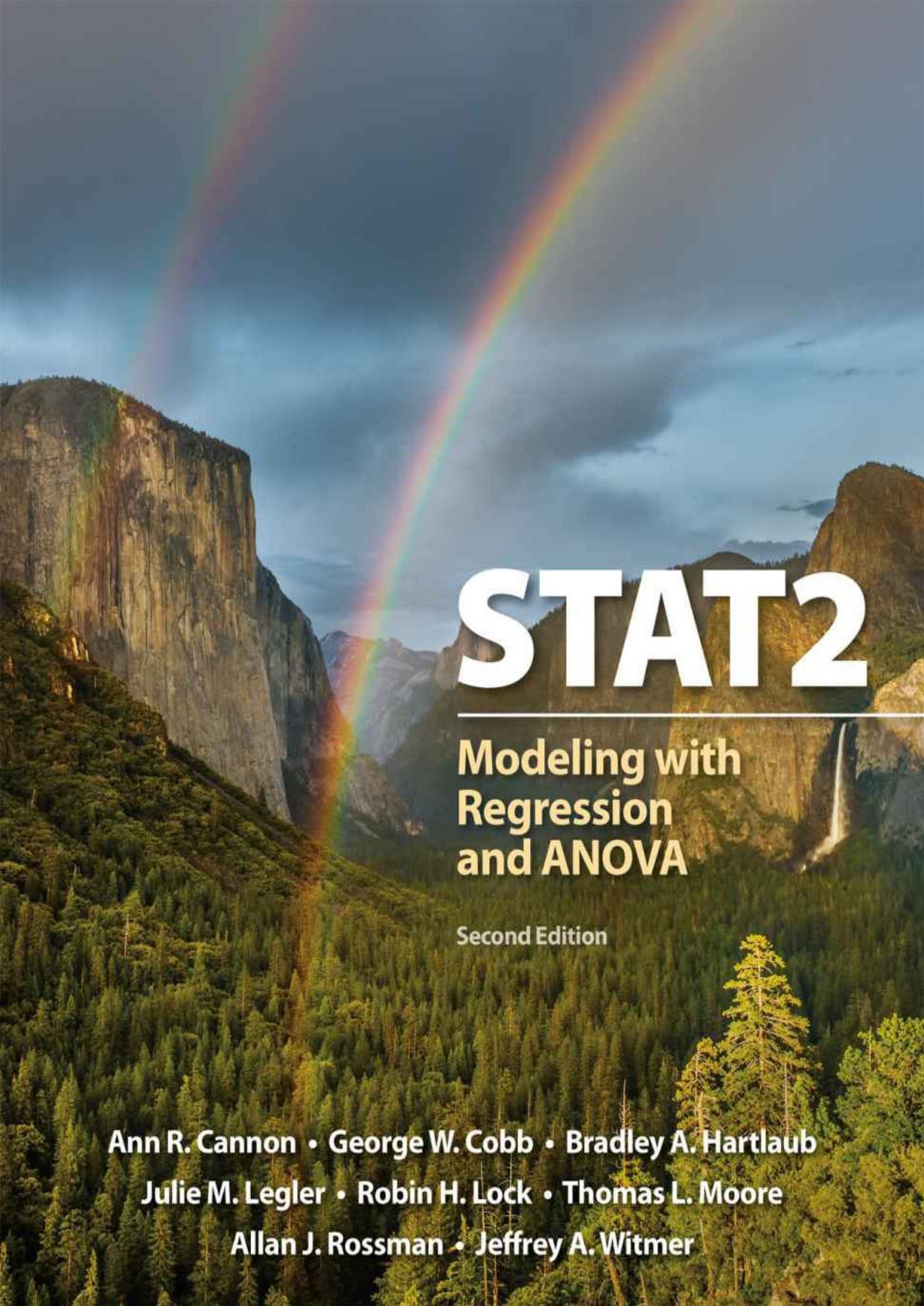
STAT2 Modeling with Regression and ANOVA 2nd Edition by Ann Cannon, George Cobb, Bradley Hartlaub, Julie Legler, Robin Lock, Thomas Moore, Allan Rossman, Jeffrey Witmer ISBN 1319054072 978-1319054076
Original price was: $70.00.$35.00Current price is: $35.00.
Instant download STAT2 Modeling with Regression and ANOVA 2nd Edition Ann R. Cannon after payment
STAT2 Modeling with Regression and ANOVA 2nd Edition by Ann Cannon, George Cobb, Bradley Hartlaub, Julie Legler, Robin Lock, Thomas Moore, Allan Rossman, Jeffrey Witmer – Ebook PDF Instant Download/Delivery: 1319054072, 978-1319054076
Full download STAT2 Modeling with Regression and ANOVA 2nd edition after payment
Product details:
ISBN 10: 1319054072
ISBN 13: 978-1319054076
Author: Ann Cannon, George Cobb, Bradley Hartlaub, Julie Legler, Robin Lock, Thomas Moore, Allan Rossman, Jeffrey Witmer
Now available with Macmillan’s online learning platform Achieve Essentials, STAT2 introduces students to statistical modeling beyond what they have learned in a Stat 101 college course or an AP Statistics course. Building on basic concepts and methods learned in that course, STAT2 empowers students to analyze richer datasets that include more variables and address a broader range of research questions.
Other than a working understanding of exponential and logarithmic functions, there are no prerequisites beyond successful completion of their first statistics course. To help all students make a smooth transition to this course, Chapter 0 reminds students of basic statistical terminology and also uses the familiar two-sample t-test as a way to illustrate the approach of specifying, estimating, and testing a statistical model.
STAT2 Modeling with Regression and ANOVA 2nd Table of contents:
Chapter 0: What Is a Statistical Model?
0.1 Model Basics
0.2 A Four-Step Process
Chapter Summary
Exercises
Unit A: Linear Regression
Chapter 1: Simple Linear Regression
1.1 The Simple Linear Regression Model
1.2 Conditions for a Simple Linear Model
1.3 Assessing Conditions
1.4 Transformations/Reexpressions
1.5 Outliers and Influential Points
Chapter Summary
Exercises
Chapter 2: Inference for Simple Linear Regression
2.1 Inference for Regression Slope
2.2 Partitioning Variability—ANOVA
2.3 Regression and Correlation
2.4 Intervals for Predictions
2.5 Case Study: Butterfly Wings
Chapter Summary
Exercises
Chapter 3: Multiple Regression
3.1 Multiple Linear Regression Model
3.2 Assessing a Multiple Regression Model
3.3 Comparing Two Regression Lines
3.4 New Predictors from Old
3.5 Correlated Predictors
3.6 Testing Subsets of Predictors
3.7 Case Study: Predicting in Retail Clothing
Chapter Summary
Exercises
Chapter 4: Additional Topics in Regression
Topic 4.1 Added Variable Plots
Topic 4.2 Techniques for Choosing Predictors
Topic 4.3 Cross-validation
Topic 4.4 Identifying Unusual Points in Regression
Topic 4.5 Coding Categorical Predictors
Topic 4.6 Randomization Test for a Relationship
Topic 4.7 Bootstrap for Regression
Exercises
Unit B: Analysis of Variance
Chapter 5: One-way ANOVA and Randomized Experiments
5.1 Overview of ANOVA
5.2 The One-way Randomized Experiment and Its Observational Sibling
5.3 Fitting the Model
5.4 Formal Inference: Assessing and Using the Model
5.5 How Big Is the Effect?: Confidence Intervals and Effect Sizes
5.6 Using Plots to Help Choose a Scale for the Response
5.7 Multiple Comparisons and Fisher’s Least Significant Difference
5.8 Case Study: Words with Friends
Chapter Summary
Exercises
Chapter 6: Blocking and Two-way ANOVA
6.1 Choose: RCB Design and Its Observational Relatives
6.2 Exploring Data from Block Designs
6.3 Fitting the Model for a Block Design
6.4 Assessing the Model for a Block Design
6.5 Using the Model for a Block Design
Chapter Summary
Exercises
Chapter 7: ANOVA with Interaction and Factorial Designs
7.1 Interaction
7.2 Design: The Two-way Factorial Experiment
7.3 Exploring Two-way Data
7.4 Fitting a Two-way Balanced ANOVA Model
7.5 Assessing Fit: Do We Need a Transformation?
7.6 Using a Two-way ANOVA Model
Chapter Summary
Exercises
Chapter 8: Additional Topics in Analysis of Variance
Topic 8.1 Levene’s Test for Homogeneity of Variances
Topic 8.2 Multiple Tests
Topic 8.3 Comparisons and Contrasts
Topic 8.4 Nonparametric Statistics
Topic 8.5 Randomization F-Test
Topic 8.6 Repeated Measures Designs and Datasets
Topic 8.7 ANOVA and Regression with Indicators
Topic 8.8 Analysis of Covariance
Exercises
Chapter 8: Online Sections: More on Repeated Measures
Topic 8.9 Repeated Measures: Mixed Designs
Topic 8.10 Repeated Measures: Advanced Material
Topic 8.11 Randomization Testing for Repeated Measures
Exercises
Unit C: Logistic Regression
Chapter 9: Logistic Regression
9.1 Choosing a Logistic Regression Model
9.2 Logistic Regression and Odds Ratios
9.3 Assessing the Logistic Regression Model
9.4 Formal Inference: Tests and Intervals
Chapter Summary
Exercises
Chapter 10: Multiple Logistic Regression
10.1 Overview
10.2 Choosing, Fitting, and Interpreting Models
10.3 Checking Conditions
10.4 Formal Inference: Tests and Intervals
10.5 Case Study: Attractiveness and Fidelity
Chapter Summary
Exercises
Chapter 11: Additional Topics in Logistic Regression
Topic 11.1 Fitting the Logistic Regression Model
Topic 11.2 Assessing Logistic Regression Models
Topic 11.3 Randomization Tests for Logistic Regression
Topic 11.4 Analyzing Two-way Tables with Logistic Regression
Topic 11.5 Simpson’s Paradox
Exercises
Unit D: Time Series Analysis
Chapter 12: Time Series Analysis
12.1 Functions of Time
12.2 Measuring Dependence on Past Values: Autocorrelation
12.3 ARIMA Models
12.4 Case Study: Residual Oil
People also search for STAT2 Modeling with Regression and ANOVA 2nd :
stat2 modeling with regression and anova pdf
stat2 modeling with regression and anova free pdf
stat2 modeling with regression and anova answers
stat2 modeling with regression and anova 2nd edition pdf
stat2 modeling with regression and anova second edition
Tags: Ann Cannon, George Cobb, Bradley Hartlaub, Julie Legler, Robin Lock, Thomas Moore, Allan Rossman, Jeffrey Witmer, STAT2 Modeling, Regression and ANOVA