

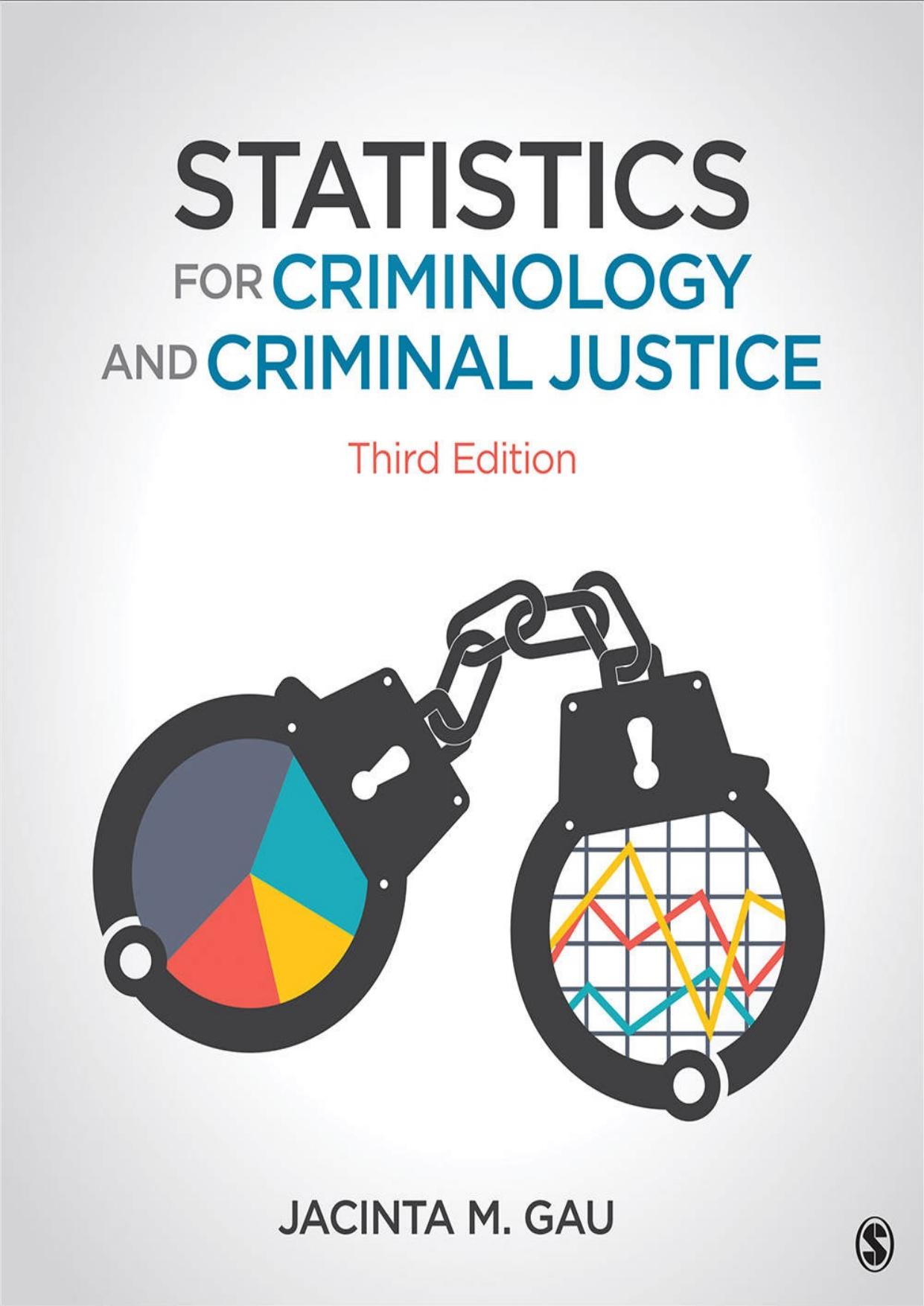
Statistics for Criminology and Criminal Justice 3rd edition by Jacinta Gau- Ebook PDF Instant Download/Delivery: 1506391788 , 978-1506391786
Full download Statistics for Criminology and Criminal Justice 3rd edition after payment
Product details:
ISBN 10: 1506391788
ISBN 13: 978-1506391786
Author: Jacinta Gau
An Introduction to Statistics in Criminology and Criminal Justice
Statistics for Criminology and Criminal Justice, Third Edition demonstrates how statistics is relevant to your life and future career by illustrating the logical connections between basic statistical concepts and their real-world implications in criminology and criminal justice. Written for students with a limited mathematical background, author Jacinta Gau eases any anxiety around statistics by simplifying the overarching goal of each statistical technique and providing step-by-step instructions for working through the formulas and numbers. You will use real data from the field to build a foundational knowledge of statistics, rather than merely memorizing key terms or formulas.
Statistics for Criminology and Criminal Justice 3rd Table of contents:
Part I Descriptive Statistics
Chapter 1 Introduction to the Use of Statistics in Criminal Justice and Criminology
▶ Research Example 1.1: What Do Criminal Justice and Criminology Researchers Study?
▶ Data Sources 1.1: The Uniform Crime Reports
▶ Data Sources 1.2: The National Crime Victimization Survey
Science: Basic Terms and Concepts
Types of Scientific Research in Criminal Justice and Criminology
Software Packages for Statistical Analysis
Organization of the Book
Review Problems
Chapter 2 Types of Variables and Levels of Measurement
Units of Analysis
Independent Variables and Dependent Variables
▶ Research Example 2.1: Choosing Variables for a Study on Police Use of Conductive Energy Devices
▶ Research Example 2.2: Units of Analysis
Relationships Between Variables: A Cautionary Note
▶ Research Example 2.3: The Problem of Omitted Variables
Levels of Measurement
The Categorical Level of Measurement: Nominal and Ordinal Variables
▶ Data Sources 2.1: The Police–Public Contact Survey
▶ Data Sources 2.2: The General Social Survey
The Continuous Level of Measurement: Interval and Ratio Variables
▶ Data Sources 2.3: The Bureau of Justice Statistics
Chapter Summary
Review Problems
Chapter 3 Organizing, Displaying, and Presenting Data
Data Distributions
Univariate Displays: Frequencies, Proportions, and Percentages
Univariate Displays: Rates
Bivariate Displays: Contingency Tables
▶ Data Sources 3.1: The Census of Jails
▶ Research Example 3.1: Does Sexual-Assault Victimization Differ Between Female and Male Jail Inmates? Do Victim Impact Statements Influence Jurors’ Likelihood of Sentencing Murder Defendants to Death?
Graphs and Charts
Categorical Variables: Pie Charts
▶ Data Sources 3.2: The Law Enforcement Management and Administrative Statistics Survey
Categorical Variables: Bar Graphs
Continuous Variables: Histograms
▶ Research Example 3.2: Are Women’s Violent-Crime Commission Rates Rising?
Continuous Variables: Frequency Polygons
Longitudinal Variables: Line Charts
Grouped Data
▶ Data Sources 3.3: CQ Press’s State Factfinder Series
SPSS
Chapter Summary
Review Problems
Chapter 4 Measures of Central Tendency
The Mode
▶ Research Example 4.1: Are People Convicted of Homicide More Violent in Prison Than People Convicted of Other Types of Offenses? Do Latino Drug Traffickers’ National Origin and Immigration Status Affect the Sentences They Receive?
The Median
The Mean
▶ Research Example 4.2: How Do Offenders’ Criminal Trajectories Impact the Effectiveness or Incarceration? Can Good Parenting Practices Reduce the Criminogenic Impact of Youths’ Time Spent in Unstructured Activities?
Using the Mean and Median to Determine Distribution Shape
Deviation Scores and the Mean as the Midpoint of the Magnitudes
SPSS
Chapter Summary
Review Problems
Chapter 5 Measures of Dispersion
The Variation Ratio
The Range
The Variance
The Standard Deviation
The Standard Deviation and the Normal Curve
▶ Research Example 5.1: Does the South Have a Culture of Honor That Increases Gun Violence? Do Neighborhoods With Higher Immigrant Concentrations Experience More Crime?
▶ Research Example 5.2: Why Does Punishment Often Increase—Rather Than Reduce—Criminal Offending?
SPSS
Chapter Summary
Review Problems
Part II Probability and Distributions
Chapter 6 Probability
Discrete Probability: The Binomial Probability Distribution
▶ Research Example 6.1: Are Police Officers Less Likely to Arrest an Assault Suspect When the Suspect and the Alleged Victim Are Intimate Partners?
Successes and Sample Size: N and r
The Number of Ways r Can Occur, Given N: The Combination
The Probability of Success and the Probability of Failure: p and q
Putting It All Together: Using the Binomial Coefficient to Construct the Binomial Probability Distribution
Continuous Probability: The Standard Normal Curve
▶ Research Example 6.2: What Predicts Correctional Officers’ Job Stress and Job Satisfaction?
The z Table and Area Under the Standard Normal Curve
Chapter Summary
Review Problems
Chapter 7 Population, Sample, and Sampling Distributions
Empirical Distributions: Population and Sample Distributions
Theoretical Distributions: Sampling Distributions
Sample Size and the Sampling Distribution: The z and t Distributions
Chapter Summary
Review Problems
Chapter 8 Point Estimates and Confidence Intervals
The Level of Confidence: The Probability of Being Correct
Confidence Intervals for Means With Large Samples
Confidence Intervals for Means With Small Samples
▶ Research Example 8.1: Do Criminal Trials Retraumatize Victims of Violent Crimes?
▶ Data Sources 8.1: The Firearm Injury Surveillance Study, 1993–2013
Confidence Intervals With Proportions and Percentages
▶ Research Example 8.2: What Factors Influence Repeat Offenders’ Completion of a “Driving Under the Influence” Court Program? How Extensively Do News Media Stories Distort Public Perceptions About Racial Minorities’ Criminal Involvement?
▶ Research Example 8.3: Is There a Relationship Between Unintended Pregnancy and Intimate Partner Violence?
Why Do Suspects Confess to Police?
Chapter Summary
Review Problems
Part III Hypothesis Testing
Chapter 9 Hypothesis Testing: A Conceptual Introduction
Sample Statistics and Population Parameters: Sampling Error or True Difference?
Null and Alternative Hypotheses
Chapter Summary
Review Problems
Chapter 10 Hypothesis Testing With Two Categorical Variables: Chi-Square
Conceptual Basis of the Chi-Square Test: Statistical Dependence and Independence
The Chi-Square Test of Independence
▶ Research Example 10.2: Do Victim or Offender Race Influence the Probability That a Homicide Will Be Cleared and That a Case Will Be Tried as Death-Eligible?
Measures of Association
SPSS
Chapter Summary
Review Problems
Chapter 11 Hypothesis Testing With Two Population Means or Proportions
▶ Research Example 11.1: Do Multiple Homicide Offenders Specialize in Killing?
Two-Population Tests for Differences Between Means: t Tests
Independent-Samples t Tests
▶ Data Sources 11.1: Juvenile Defendants in Criminal Courts
Dependent-Samples t Tests
▶ Research Example 11.2: Do Mentally Ill Offenders’ Crimes Cost More?
▶ Research Example 11.3: Do Targeted Interventions Reduce Crime?
Two-Population Tests for Differences Between Proportions
▶ Research Example 11.4: Does the Gender Gap in Offending Rates Differ Between Male and Female Drug Abusers?
SPSS
Chapter Summary
Review Problems
Chapter 12 Hypothesis Testing With Three or More Population Means: Analysis of Variance
ANOVA: Different Types of Variances
▶ Research Example 12.1: Do Asian Defendants Benefit From a “Model Minority” Stereotype?
▶ Research Example 12.2: Are Juveniles Who Are Transferred to Adult Courts Seen as More Threatening?
When the Null Is Rejected: A Measure of Association and Post Hoc Tests
▶ Research Example 12.3: Does Crime Vary Spatially and Temporally in Accordance With Routine Activities Theory?
SPSS
Chapter Summary
Review Problems
Chapter 13 Hypothesis Testing With Two Continuous Variables: Correlation
▶ Research Example 13.1: Part 1: Is Perceived Risk of Internet Fraud Victimization Related to Online Purchases?
▶ Research Example 13.2: Do Prisoners’ Criminal Thinking Patterns Predict Misconduct? Do Good Recruits Make Good Cops?
Beyond Statistical Significance: Sign, Magnitude, and Coefficient of Determination
SPSS
▶ Research Example 13.1, Continued: Part 2: Is Perceived Risk of Internet Fraud Victimization Related to Online Purchases?
Chapter Summary
Review Problems
Chapter 14 Introduction to Regression Analysis
One Independent Variable and One Dependent Variable: Bivariate Regression
Inferential Regression Analysis: Testing for the Significance of b
Beyond Statistical Significance: How Well Does the Independent Variable Perform as a Predictor of the Dependent Variable?
Standardized Slope Coefficients: Beta Weights
The Quality of Prediction: The Coefficient of Determination
Adding More Independent Variables: Multiple Regression
▶ Research Example 14.1: Does Childhood Intelligence Predict the Emergence of Self-Control?
Ordinary Least Squares Regression in SPSS
▶ Research Example 14.2: Does Having a Close Black Friend Reduce Whites’ Concerns About Crime?
▶ Research Example 14.3: Do Multiple Homicide Offenders Specialize in Killing?
Alternatives to Ordinary Least Squares Regression
▶ Research Example 14.4: Is Police Academy Performance a Predictor of Effectiveness on the Job?
People also search for Statistics for Criminology and Criminal Justice 3rd:
essentials of statistics for criminology and criminal justice
essentials of statistics for criminology and criminal justice pdf
understanding and using statistics for criminology and criminal.justice
statistics for criminology and criminal justice pdf
statistics for criminology and criminal justice 5th edition pdf
Tags: Jacinta Gau, Statistics for Criminology, Criminal Justice