


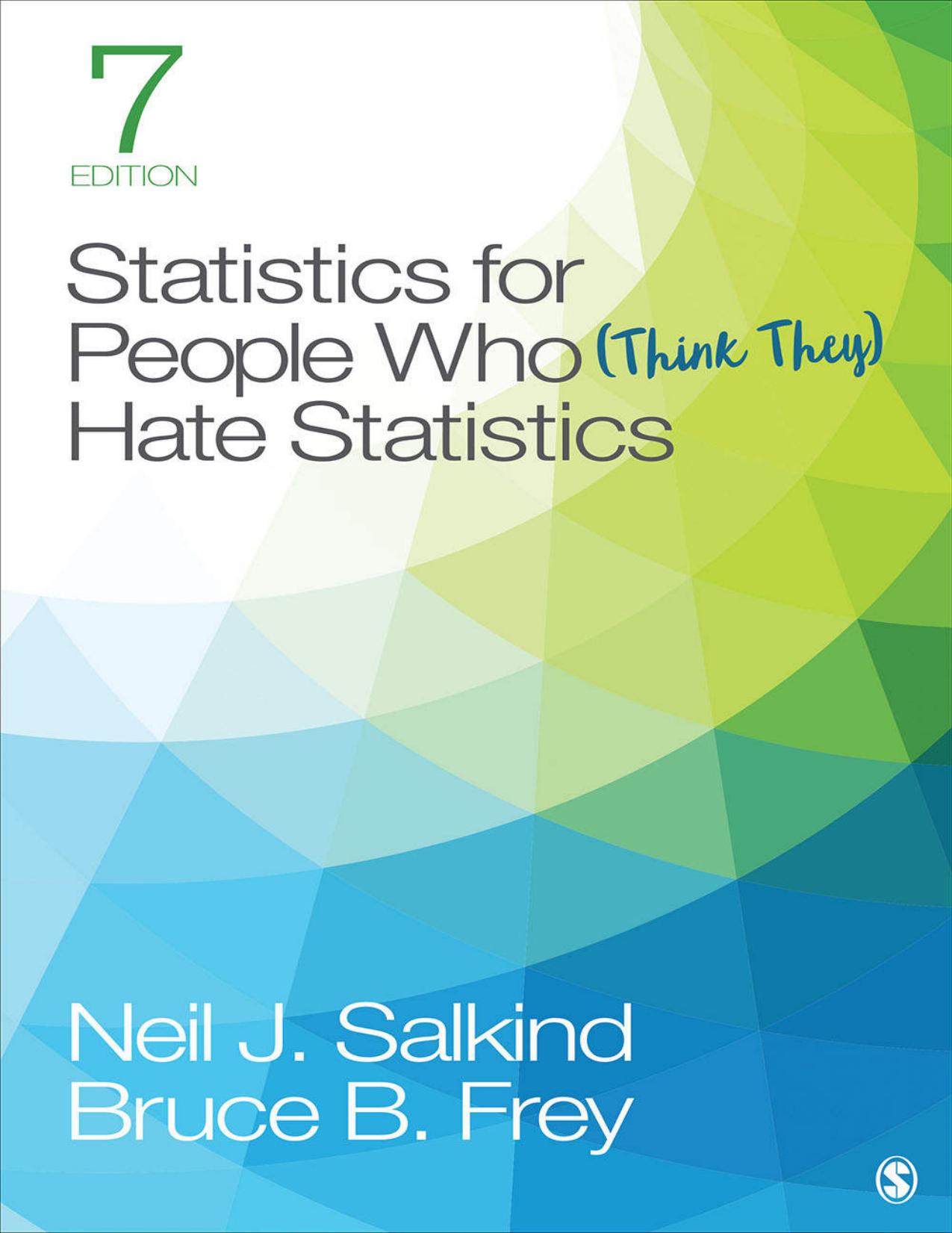
Statistics for People Who Think They Hate Statistics 7th edition by Neil Salkind, Bruce Frey – Ebook PDF Instant Download/Delivery: 1544381859 , 978-1544381855
Full download Statistics for People Who Think They Hate Statistics 7th edition after payment
Product details:
ISBN 10: 1544381859
ISBN 13: 978-1544381855
Author: Neil Salkind, Bruce Frey
Now in its Seventh Edition, Neil J. Salkind’s bestselling Statistics for People Who (Think They) Hate Statistics with new co-author Bruce B. Frey teaches an often intimidating subject with a humorous, personable, and informative approach that reduces statistics anxiety. With instruction in SPSS®, the authors guide students through basic and advanced statistical procedures, from correlation and graph creation to analysis of variance, regression, non-parametric tests, and more. The Seventh Edition includes new real-world examples, additional coverage on multiple regression and power and effect size, and a robust interactive eBook with video tutorials and animations of key concepts. In the end, students who (think they) hate statistics will understand how to explain the results of many statistical analyses and won’t be intimidated by basic statistical tasks.
Statistics for People Who Think They Hate Statistics 7th Table of contents:
Part I • Yippee! I’m in Statistics!
Chapter 1 • Statistics or Sadistics? It’s Up to You
• What You Will Learn in This Chapter
Why Statistics?
And Why SPSS?
A 5-Minute History of Statistics
Statistics: What It Is (and Isn’t)
What Are Descriptive Statistics?
What Are Inferential Statistics?
In Other Words …
What Am I Doing in a Statistics Class?
Ten Ways to Use This Book (and Learn Statistics at the Same Time!)
About the Book’s Features
Key to Difficulty Icons
Glossary
Summary
Time to Practice
Part II • Σigma Freud and Descriptive Statistics
Chapter 2 • Computing and Understanding Averages: Means to an End
• What You Will Learn in This Chapter
Computing the Mean
Computing the Median
Computing the Mode
Apple Pie à la Bimodal
When to Use What Measure of Central Tendency (and All You Need to Know About Scales of Measurement for Now)
A Rose by Any Other Name: The Nominal Level of Measurement
Any Order Is Fine With Me: The Ordinal Level of Measurement
1 + 1 = 2: The Interval Level of Measurement
Can Anyone Have Nothing of Anything? The Ratio Level of Measurement
In Sum …
Using SPSS to Compute Descriptive Statistics
The SPSS Output
• Real-World Stats
Summary
Time to Practice
Chapter 3 • Understanding Variability: Vive la Différence
• What You Will Learn in This Chapter
Why Understanding Variability Is Important
Computing the Range
Computing the Standard Deviation
Why n – 1? What’s Wrong With Just n?
What’s the Big Deal?
Computing the Variance
The Standard Deviation Versus the Variance
Using SPSS to Compute Measures of Variability
The SPSS Output
More SPSS Output
• Real-World Stats
Summary
Time to Practice
Chapter 4 • Creating Graphs: A Picture Really Is Worth a Thousand Words
• What You Will Learn in This Chapter
Why Illustrate Data?
Ten Ways to a Great Figure (Eat Less and Exercise More?)
First Things First: Creating a Frequency Distribution
The Classiest of Intervals
The Plot Thickens: Creating a Histogram
The Tallyho Method
The Next Step: A Frequency Polygon
Cumulating Frequencies
Other Cool Ways to Chart Data
Bar Charts
Column Charts
Line Charts
Pie Charts
Using the Computer (SPSS, That Is) to Illustrate Data
Creating a Histogram
Creating a Bar Graph
Creating a Line Graph
Creating a Pie Chart
• Real-World Stats
Summary
Time to Practice
Chapter 5 • Computing Correlation Coefficients: Ice Cream and Crime
• What You Will Learn in This Chapter
What Are Correlations All About?
Types of Correlation Coefficients: Flavor 1 and Flavor 2
Computing a Simple Correlation Coefficient
The Scatterplot: A Visual Picture of a Correlation
The Correlation Matrix: Bunches of Correlations
Understanding What the Correlation Coefficient Means
Using-Your-Thumb (or Eyeball) Method
Squaring the Correlation Coefficient: A Determined Effort
As More Ice Cream Is Eaten … the Crime Rate Goes Up (or Association vs. Causality)
Using SPSS to Compute a Correlation Coefficient
Creating a Scatterplot (or Scattergram or Whatever)
Other Cool Correlations
Parting Ways: A Bit About Partial Correlation
Using SPSS to Compute Partial Correlations
• Real-World Stats
Summary
Time to Practice
Chapter 6 • An Introduction to Understanding Reliability and Validity: Just the Truth
• What You Will Learn in This Chapter
An Introduction to Reliability and Validity
What’s Up With This Measurement Stuff?
Reliability: Doing It Again Until You Get It Right
Test Scores: Truth or Dare?
Observed Score = True Score + Error Score
Different Types of Reliability
Test–Retest Reliability
Parallel Forms Reliability
Internal Consistency Reliability
Interrater Reliability
How Big Is Big? Finally: Interpreting Reliability Coefficients
And If You Can’t Establish Reliability … Then What?
Just One More Thing
Validity: Whoa! What Is the Truth?
Different Types of Validity
Content-Based Validity
Criterion-Based Validity
Construct-Based Validity
And If You Can’t Establish Validity … Then What?
A Last Friendly Word
Validity and Reliability: Really Close Cousins
• Real-World Stats
Summary
Time to Practice
Part III • Taking Chances for Fun and Profit
Chapter 7 • Hypotheticals and You: Testing Your Questions
• What You Will Learn in This Chapter
So You Want to Be a Scientist
Samples and Populations
The Null Hypothesis
The Purposes of the Null Hypothesis
The Research Hypothesis
The Nondirectional Research Hypothesis
The Directional Research Hypothesis
Some Differences Between the Null Hypothesis and the Research Hypothesis
What Makes a Good Hypothesis?
• Real-World Stats
Summary
Time to Practice
Chapter 8 • Probability and Why It Counts: Fun With a Bell-Shaped Curve
• What You Will Learn in This Chapter
Why Probability?
The Normal Curve (aka the Bell-Shaped Curve)
Hey, That’s Not Normal!
More Normal Curve 101
Our Favorite Standard Score: The z Score
What z Scores Represent
What z Scores Really Represent
Hypothesis Testing and z Scores: The First Step
Using SPSS to Compute z Scores
Fat and Skinny Frequency Distributions
Average Value
Variability
Skewness
Kurtosis
• Real-World Stats
Summary
Time to Practice
Part IV • Significantly Different: Using Inferential Statistics
Chapter 9 • Significantly Significant: What It Means for You and Me
• What You Will Learn in This Chapter
The Concept of Significance
If Only We Were Perfect
The World’s Most Important Table (for This Semester Only)
More About Table 9.1
Back to Type I Errors
Significance Versus Meaningfulness
An Introduction to Inferential Statistics
How Inference Works
How to Select What Test to Use
Here’s How to Use the Chart
An Introduction to Tests of Significance
How a Test of Significance Works: The Plan
Here’s the Picture That’s Worth a Thousand Words
Be Even More Confident
• Real-World Stats
Summary
Time to Practice
Chapter 10 • The One-Sample z Test: Only the Lonely
• What You Will Learn in This Chapter
Introduction to the One-Sample z Test
The Path to Wisdom and Knowledge
Computing the z Test Statistic
So How Do I Interpret z = 2.38, p < .05?
Using SPSS to Perform a z Test
Special Effects: Are Those Differences for Real?
Understanding Effect Size
• Real-World Stats
Summary
Time to Practice
Chapter 11 • t(ea) for Two: Tests Between the Means of Different Groups
• What You Will Learn in This Chapter
Introduction to the t Test for Independent Samples
The Path to Wisdom and Knowledge
Computing the t Test Statistic
Time for an Example
So How Do I Interpret t(58) = −0.14, p > .05?
The Effect Size and t(ea) for Two
Computing and Understanding the Effect Size
Two Very Cool Effect Size Calculators
Using SPSS to Perform a t Test
• Real-World Stats
Summary
Time to Practice
Chapter 12 • t(ea) for Two (Again): Tests Between the Means of Related Groups
• What You Will Learn in This Chapter
Introduction to the t Test for Dependent Samples
The Path to Wisdom and Knowledge
Computing the t Test Statistic
So How Do I Interpret t(24) = 2.45, p < .05?
Using SPSS to Perform a Dependent t Test
The Effect Size for t(ea) for Two (Again)
• Real-World Stats
Summary
Time to Practice
Chapter 13 • Two Groups Too Many? Try Analysis of Variance
• What You Will Learn in This Chapter
Introduction to Analysis of Variance
The Path to Wisdom and Knowledge
Different Flavors of Analysis of Variance
Computing the F Test Statistic
So How Do I Interpret F(2, 27) = 8.80, p < .05?
Using SPSS to Compute the F Ratio
The Effect Size for One-Way ANOVA
• Real-World Stats
Summary
Time to Practice
Chapter 14 • Two Too Many Factors: Factorial Analysis of Variance—A Brief Introduction
• What You Will Learn in This Chapter
Introduction to Factorial Analysis of Variance
The Path to Wisdom and Knowledge
A New Flavor of ANOVA
The Main Event: Main Effects in Factorial ANOVA
Even More Interesting: Interaction Effects
Using SPSS to Compute the F Ratio
Computing the Effect Size for Factorial ANOVA
• Real-World Stats
Summary
Time to Practice
Chapter 15 • Testing Relationships Using the Correlation Coefficient: Cousins or Just Good Friends?
• What You Will Learn in This Chapter
Introduction to Testing the Correlation Coefficient
The Path to Wisdom and Knowledge
Computing the Test Statistic
So How Do I Interpret r(28) = .44, p < .05?
Causes and Associations (Again!)
Significance Versus Meaningfulness (Again, Again!)
Using SPSS to Compute a Correlation Coefficient (Again)
• Real-World Stats
Summary
Time to Practice
Chapter 16 • Using Linear Regression: Predicting the Future
• What You Will Learn in This Chapter
Introduction to Linear Regression
What Is Prediction All About?
The Logic of Prediction
Drawing the World’s Best Line (for Your Data)
How Good Is Your Prediction?
Using SPSS to Compute the Regression Line
The More Predictors the Better? Maybe
The Big Rule(s) When It Comes to Using Multiple Predictor Variables
• Real-World Stats
Summary
Time to Practice
Part V • More Statistics! More Tools! More Fun!
Chapter 17 • Chi-Square and Some Other Nonparametric Tests: What to Do When You’re Not Normal
• What You Will Learn in This Chapter
Introduction to Nonparametric Statistics
Introduction to the Goodness-of-Fit (One-Sample) Chi-Square
Computing the Goodness-of-Fit Chi-Square Test Statistic
So How Do I Interpret , p < .05?
Introduction to the Test of Independence Chi-Square
Computing the Test of Independence Chi-Square Test Statistic
Using SPSS to Perform Chi-Square Tests
Goodness of Fit and SPSS
Test of Independence and SPSS
Other Nonparametric Tests You Should Know About
• Real-World Stats
Summary
Time to Practice
Chapter 18 • Some Other (Important) Statistical Procedures You Should Know About
• What You Will Learn in This Chapter
Multivariate Analysis of Variance
Repeated-Measures Analysis of Variance
Analysis of Covariance
Multiple Regression
Meta-Analysis
Discriminant Analysis
Factor Analysis
Path Analysis
Structural Equation Modeling
Summary
Chapter 19 • Data Mining: An Introduction to Getting the Most Out of Your BIG Data
• What You Will Learn in This Chapter
Our Sample Data Set—Who Doesn’t Love Babies?
Counting Outcomes
Counting With Frequencies
Pivot Tables and Cross-Tabulation: Finding Hidden Patterns
Creating a Pivot Table
Modifying a Pivot Table
Summary
Time to Practice
People also search for Statistics for People Who Think They Hate Statistics 7th :
statistics for people who think they hate statistics 7th edition
statistics for people who think they hate statistics 5th edition
statistics for people who think they hate statistics 8th edition
statistics for people who think they hate statistics 6th edition
statistics for people who think they hate statistics ebook
Tags: Neil Salkind, Bruce Frey, People Who, Hate Statistics