


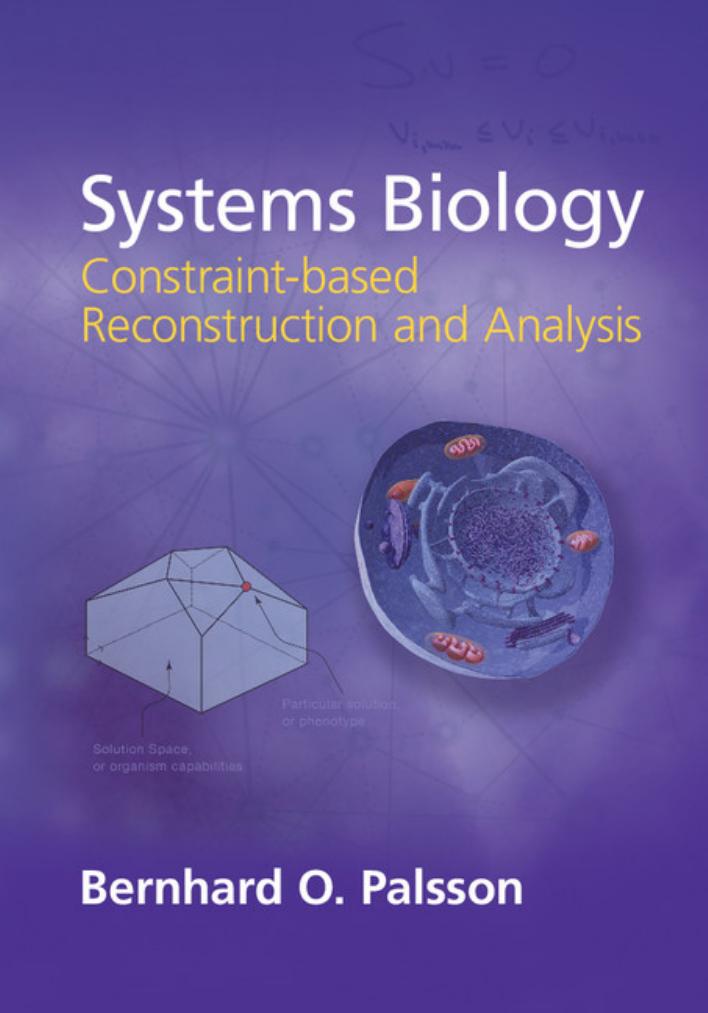
Systems Biology Constraint Based Reconstruction and Analysis 2nd edition by BERNHARD PALSSON – Ebook PDF Instant Download/Delivery: 1107038855, 978-1107038851
Full download Systems Biology Constraint Based Reconstruction and Analysis 2nd edition after payment
Product details:
ISBN 10: 1107038855
ISBN 13: 978-1107038851
Author: BERNHARD PALSSON
Recent technological advances have enabled comprehensive determination of the molecular composition of living cells. The chemical interactions between many of these molecules are known, giving rise to genome-scale reconstructed biochemical reaction networks underlying cellular functions. Mathematical descriptions of the totality of these chemical interactions lead to genome-scale models that allow the computation of physiological functions. Reflecting these recent developments, this textbook explains how such quantitative and computable genotype-phenotype relationships are built using a genome-wide basis of information about the gene portfolio of a target organism. It describes how biological knowledge is assembled to reconstruct biochemical reaction networks, the formulation of computational models of biological functions, and how these models can be used to address key biological questions and enable predictive biology. Developed through extensive classroom use, the book is designed to provide students with a solid conceptual framework and an invaluable set of modeling tools and computational approaches.
Systems Biology Constraint Based Reconstruction and Analysis 2nd Table of contents:
1 Introduction
1.1 The Genotype–Phenotype Relationship
1.2 Some Concepts of Genome-scale Science
1.3 The Emergence of Systems Biology
1.4 Building Foundations
1.5 About This Book
1.6 Summary
Part I Network Reconstruction
2 Network Reconstruction: The Concept
2.1 Many Reactions and Their Stoichiometry
2.2 Reconstructing a Pathway
2.3 Module-by-module Reconstruction
2.4 Proteins and Their Many States
2.5 Central E. coli Energy Metabolism
2.6 Genome-scale Networks
2.7 Summary
3 Network Reconstruction: The Process
3.1 Building Knowledge Bases
3.2 Reconstruction is a Four-step Process
3.3 Reconstruction is Iterative and Labor-intensive
3.4 The Many Uses of Reconstructions
3.5 Summary
4 Metabolism in Escherichia coli
4.1 Some Basic Facts about E. coli
4.2 History
4.2.1 Pre-genome era reconstructions
4.2.2 Genome era reconstructions
4.3 Content of the iJO1366 Reconstruction
4.4 From a Reconstruction to a Computational Model
4.5 Validation of iJO1366
4.6 Uses of the E. coli GEM
4.7 Summary
5 Prokaryotes
5.1 State of The Field
5.2 Metabolism in Pathogens
5.3 Metabolism in Blue-Green Algae
5.4 Metabolism in Microbial Communities
5.4.1 Systems biology of communities
5.4.2 Model-based analysis of microbial communities
5.5 An Environmentally Important Organism
5.5.1 Geobacter sulfurreducens
5.5.2 Genome-scale science for Geobacter
5.6 Summary
6 Eukaryotes
6.1 Metabolism in Saccharomyces cerevisiae
6.1.1 Reconstruction and its uses
6.1.2 Community-based reconstruction
6.2 Metabolism in Chlamydomonas reinhardtii
6.2.1 Metabolic network reconstruction
6.2.2 Description of photon usage
6.3 Metabolism in Homo sapiens
6.3.1 Recon 1
6.3.2 Uses of Recon 1
6.3.3 Building multi-cell and multi-tissue reconstructions
6.3.4 Mapping Recon 1 onto other mammals
6.3.5 Recon 2
6.4 Summary
7 Biochemical Reaction Networks
7.1 Protein Properties
7.2 Structural Biology
7.3 Transcription and Translation
7.4 Integrating Network Reconstructions
7.5 Signaling Networks
7.6 Summary
8 Metastructures of Genomes
8.1 The Concept of a Metastructure
8.2 Transcriptional Regulatory Networks
8.3 Refactoring DNA for Synthetic Biology
8.4 The Challenge of Polyomic Data Integration
8.5 Building Mathematical Descriptions
8.6 Summary
Part II Mathematical Properties of Reconstructed Networks
9 The Stoichiometric Matrix
9.1 The Many Attributes of S
9.2 Chemistry: S as a Data Matrix
9.2.1 Elementary biochemical reactions
9.2.2 Basic chemistry
9.2.3 Example: glycolysis
9.3 Network Structure: S as a Connectivity Matrix
9.3.1 The maps of S
9.3.2 Biological quantities displayed on maps
9.3.3 Linearity of maps
9.4 Mathematics: S as a Linear Transformation
9.4.1 Mapping fluxes onto concentration time derivatives
9.4.2 The four fundamental subspaces
9.4.3 Looking into the four fundamental subspaces
9.5 Systems Science: S and Network Models
9.6 Summary
10 Simple Topological Network Properties
10.1 The Binary Form of S
10.2 Participation and Connectivity
10.2.1 Rearranging the stoichiometric matrix
10.2.2 Connectivities in genome-scale matrices
10.3 Linked Participation and Connectivities
10.3.1 The adjacency matrices of S
10.3.2 Computation of the adjacency matrices
10.4 Summary
11 Fundamental Network Properties
11.1 Singular Value Decomposition
11.1.1 Decomposition into three matrices
11.1.2 The content of U, Σ, and V
11.1.3 Key properties of the SVD
11.2 SVD and Properties of Reaction Networks
11.3 Studying Elementary Reactions using SVD
11.3.1 The linear reversible reaction
11.3.2 The bi-linear association reaction
11.4 Studying Network Structure Using SVD
11.5 Drivers and Directions
11.5.1 Directions: the column space
11.5.2 Drivers: the row space
11.5.3 The fundamental subspaces are of a finite size
11.6 Summary
12 Pathways
12.1 Network-based Pathway Definitions
12.2 Choice of a Basis
12.3 Confining the Steady-state Flux Vector
12.3.1 Finite or closed spaces
12.3.2 Importance of constraints
12.4 Pathways as Basis Vectors
12.4.1 Some perspective
12.4.2 Extreme pathways
12.4.3 Classifying extreme pathways
12.4.4 The simplest set of linearly independent basis vectors
12.4.5 Examples of pathway computation
12.5 Summary
13 Use of Pathway Vectors
13.1 The Matrix of Pathway Vectors
13.2 Pathway Length and Flux Maps
13.3 Reaction Participation and Correlated Subsets
13.4 Input–output Relationships and Crosstalk
13.5 Regulation Eliminates Active Pathways
13.6 Summary
14 Randomized Sampling
14.1 The Basics
14.2 Sampling Low-dimensional Spaces
14.3 Sampling High-dimensional Spaces
14.4 Sampling Network States in Human Metabolism
14.5 Summary
Part III Determining the Phenotypic Potential of Reconstructed Networks
15 Dual Causality
15.1 Causation in Physics and Biology
15.2 Building Quantitative Models
15.2.1 The physical sciences
15.2.2 The life sciences
15.2.3 Genome-scale models
15.3 Constraints in Biology
15.4 Summary
16 Functional States
16.1 Components vs. Systems
16.2 Properties of Links
16.3 Links to Networks to Biological Functions
16.4 Constraining Allowable Functional States
16.5 Biological Consequences of Constraints
16.6 Summary
17 Constraints
17.1 Genome-scale Viewpoints
17.2 Stating and Imposing Constraints
17.3 Capacity Constraints
17.4 Constraints from Chemistry
17.4.1 Mass conservation
17.4.2 Thermodynamics
17.4.3 Fluxomics
17.5 Regulatory Constraints
17.6 Coupling Constraints
17.7 Simultaneous Satisfaction of All Constraints
17.8 Summary
18 Optimization
18.1 Overview of Constraint-based Methods
18.2 Finding Functional States
18.3 Linear Programming: the basics
18.4 Genome-scale Models
18.5 Summary
19 Determining Capabilities
19.1 Optimal Network Performance
19.1.1 Co-factors
19.1.2 Biosynthetic Precursors
19.2 Production of ATP
19.2.1 Producing ATP aerobically from glucose
19.2.2 Producing ATP anaerobically from glucose
19.2.3 Optimal ATP production from other substrates
19.3 Production of Redox Potential
19.3.1 Aerobic production of NADH from glucose
19.3.2 Anaerobic production of NADH
19.4 Capabilities of Genome-scale Models
19.5 Summary
20 Equivalent States
20.1 Equivalent Ways to Reach a Network Objective
20.2 Flux Variability Analysis
20.2.1 The concept
20.2.2 Flux variability in the core E. coli model
20.2.3 Genome-scale results
20.3 Extreme Pathways and Optimal States
20.3.1 The concept
20.3.2 Extreme pathways in the core E. coli metabolic network
20.3.3 Genome-scale results
20.4 Enumerating Alternative Optima
20.5 Summary
21 Distal Causation
21.1 The Objective Function
21.2 Types of Objective Functions
21.3 Producing Biomass
21.4 Formulating The Biomass Objective Function
21.5 Studying the Objective Function
21.6 Objective Functions in Practice
21.7 Summary
Part IV Basic and Applied Uses
22 Environmental Parameters
22.1 Varying a Single Parameter
22.1.1 Robustness analysis
22.1.2 The effects of oxygen on ATP production
22.1.3 The effects of oxygen uptake rate on growth rate
22.1.4 Sensitivity with respect to key processes
22.1.5 Uses of robustness analysis
22.2 Varying Two Parameters
22.2.1 Phenotypic phase planes
22.2.2 Using the PhPP at a small scale
22.2.3 Using the PhPP at the genome-scale
22.3 Summary
23 Genetic Parameters
23.1 Single Gene Knock-outs
23.1.1 Concept
23.1.2 Core E. coli metabolic network
23.1.3 Genome-scale studies of essential genes
23.1.4 Studying non-lethal gene KOs
23.2 Double Gene Knock-outs
23.2.1 Core E. coli metabolic network
23.2.2 Genome-scale studies
23.3 Gene Dosage and Sequence Variation
23.4 Summary
24 Analysis of Omic Data
24.1 Context for Content
24.2 Omics Data-mapping and Network Topology
24.3 Omics Data as Constraints
24.4 Omics Data and Validation of GEM Predictions
24.5 Summary
25 Model-Driven Discovery
25.1 Models Can Drive Discovery
25.2 Predicting Gap-filling Reactions
25.3 Predicting Metabolic Gene Functions
25.4 Summary
26 Adaptive Laboratory Evolution
26.1 A New Line of Biological Inquiry
26.2 Determining the Genetic Basis
26.3 Interpretation of Outcomes
26.4 A Specific Example of Nutrient Adaptation
26.5 General Uses of ALE
26.6 Complex Examples of Adaptive Evolution
26.7 Summary
27 Model-driven Design
27.1 Historical Background
27.2 GEMs and Design Algorithms
27.3 GEMs and Cell Factory Design
27.4 Summary
Part V Conceptual Foundations
28 Teaching Systems Biology
28.1 The Core Paradigm
28.2 High-throughput Technologies
28.3 Network Reconstruction
28.4 Computing Functional States of Networks
28.4.1 Conversion to a computational model
28.4.2 Topological properties
28.4.3 Determining the capabilities of networks
28.4.4 Dynamic states
28.5 Prospective Experimentation
28.6 Building a Curriculum
28.7 Summary
29 Epilogue
29.1 The Brief History of COBRA
29.2 Common Misunderstandings
29.3 Questions in Biology and in Systems Biology
29.4 Why Build Mathematical Models?
29.5 What Lies Ahead?
References
Index
People also search for Systems Biology Constraint Based Reconstruction and Analysis 2nd :
systems biology constraint based reconstruction and analysis
what is systems biology approach
systems biology constraint based reconstruction and analysis pdf
systems biology constraint-based reconstruction and analysis
systems biology constraint-based reconstruction and analysis pdf
Tags: BERNHARD PALSSON, Systems Biology, Based Reconstruction