


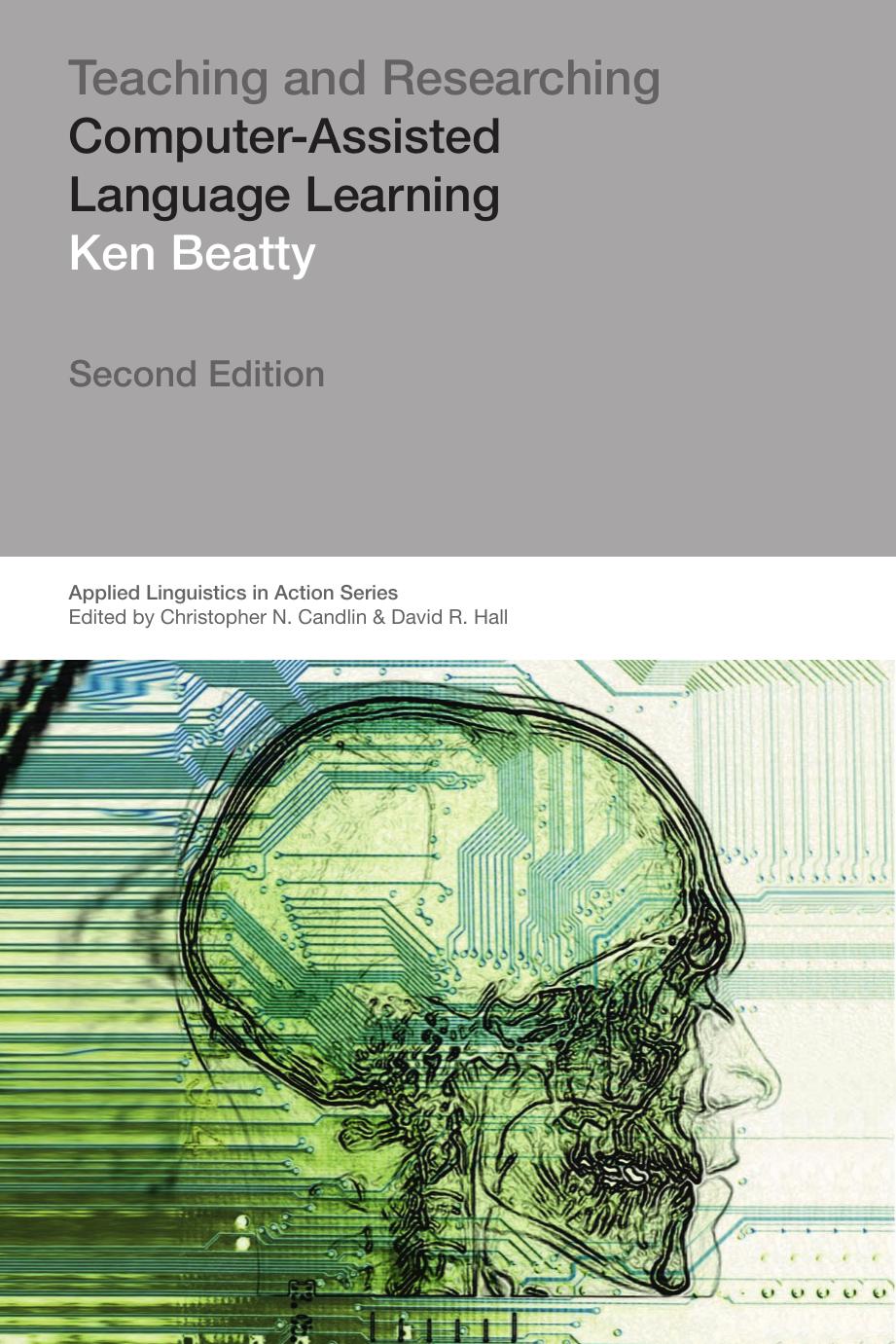
Teaching & Researching Computer Assisted Language Learning 2nd Edition by Ken Beatty – Ebook PDF Instant Download/Delivery: 1408205009, 978-1408205006
Full download Teaching & Researching Computer Assisted Language Learning 2nd edition after payment
Product details:
ISBN 10: 1408205009
ISBN 13: 978-1408205006
Author: Ken Beatty
Computers play a crucial and rapidly evolving role in education, particularly in the area of language learning. Far from being a tool mimicking a textbook or teacher, Computer-Assisted Language Learning (CALL) has the power to transform language learning through the pioneering application of innovative research and practices.
Technological innovation creates opportunities to revisit old ideas, conduct new research and challenge established beliefs, meaning that the field is constantly undergoing change. This fully revised second edition brings teachers and researchers up-to-date by offering:
- A comprehensive overview of CALL and current research issues
- Step-by-step instructions on conducting research projects in CALL
- Extensive resources in the form of contacts, websites and free software references
- A glossary of terms related to CALL
Closely linked to other branches of study such as autonomy in language learning and computer science, CALL is at the cutting edge of current research directions. This book is essential reading for all teachers and researchers interested in using CALL to make language learning a richer, more productive and more enjoyable task.
Teaching & Researching Computer Assisted Language Learning 2nd Table of contents:
I Key concepts
1 The Emergence of CALL
1.1 A broad discipline
1.2 Technology driving CALL
1.3 The changing focus of research in CALL
Summary
2 A brief history of CALL
A comparison of behaviourist and constructivist design features
2.1 CALL in the 1950s and 1960s
2.1.1 Plato
2.2 Simulations
2.2.1 Possibilities and limitations in simulations
2.3 CALL in the 1970s and 1980s
2.3.1 Macario
2.3.2 Montevidisco and Interactive Dígame
2.3.3 Allp
2.3.4 No Recuerdos
2.3.5 Eliza
2.3.6 À la rencontre de Phillippe
2.3.7 HyperCard
2.4 CALL in the 1990s
2.5 CALL in the twenty-first century
Summary
Further reading
3 Hypertext, hypermedia and multimedia
3.1 Hypertext
3.2 Hypermedia
3.3 Multimedia
3.4 Antecedents of multimedia
3.5 Science fiction and CALL
3.6 The printed book and CALL
3.7 Applications to general learning
3.8 Applications of multimedia to language learning
Summary
Further reading
4 Eight CALL applications
4.1 Word processing
4.2 Games
4.2.1 Commercial quiz software
4.3 Literature
4.3.1 The relationship of literature to computer-based learning materials
4.3.2 Hypertext and literature
4.4 Corpus linguistics
4.4.1 Corpus linguistics in the classroom
4.5 Computer-mediated communication
4.5.1 Email
4.5.3 Moo, Mua, Mud, Mug, Mush
4.6 WWW resources
4.7 Adapting other materials for CALL
4.8 Personal Digital Assistants (PDAs) and mobile telephones
4.8.1 Teaching and learning with mobile telephones
4.8.2 Graffiti handwriting software
Summary
Further reading
II The place of CALL in research and teaching
5 Second-Language Acquisition and models of instruction
5.1 Concepts in SLA, behaviourism and constructivism
5.1.1 Second-Language Acquisition (SLA)
5.2 Comprehensible input and output
5.2.1 Criticism of comprehensible input and output theory
5.3 Behaviourist models of instruction
5.3.1 Behaviourism
5.3.2 Programmed instruction
5.3.3 Mastery learning
5.3.4 Summarizing behaviourism
5.4 Constructivism
5.4.1 Schema theory
5.4.2 How constructivism differs from behaviourism
5.4.3 Contributions of Vygotsky
5.4.4 Summarizing constructivism
5.4.5 The role of collaboration and negotiation of meaning in the two models
Summary
Further reading
6 Collaboration and negotiation of meaning
6.1 The place of collaboration in CALL
6.1.1 Defining collaboration
6.1.2 Collaboration and negotiation of meaning
6.1.3 Promoting awareness and skill development
6.1.4 Achieving pedagogical objectives
6.1.5 Improving literacy
6.1.6 Promoting language acquisition
6.2 Structuring collaboration
6.3 Differences between collaboration and other terms
6.4 The range of collaboration and CALL
6.5 Collaboration at the computer
6.6 Benefits of collaborative learning at the computer
6.7 Collaboration, CALL and SLA
6.8 Collaboration at the computer as evidenced by discourse
6.8.1 Non-verbal discourse strategies
6.8.2 Verbal discourse strategies
6.9 Challenges to collaboration at the computer
6.9.1 General problems of collaboration in a language-learning setting
6.10 Challenges to collaboration in a CALL context
6.11 Discourse that evidences challenges to collaboration
6.11.1 Analysing discourse
Summary
Further reading
7 Defining a model of CALL
7.1 Defining a model
7.1.1 Problems in creating CALL models
7.2 The need for a CALL model
7.3 A model of current non-CALL language learning
7.4 Dunkin and Biddle’s model in a CALL context
7.4.1 Presage variables
7.4.2 Context variables
7.4.3 Process variables
7.5 Various views of CALL
7.6 Teacher and pupil classroom behaviour: activities used in CALL
7.6.1 Locus of control
7.6.2 Observable changes in pupil behaviour
7.7 The virtual classroom
7.8 Aspects of a CALL model
Summary
8 Theoretical and pedagogical concerns
8.1 Concerns for software development
8.2 Pedagogical concerns for classroom practice
8.2.1 Software objectives
8.2.2 Making better use of existing materials
8.2.3 Establishing an environment where CALL may take place
8.3 Evaluating software
8.4 Learning and working styles
8.5 Evolving technology
8.5.1 Lack of funds
8.5.2 Lack of expertise
8.5.3 Lack of suitable authoring programs
8.6 Commercial software
8.7 Making better use of existing materials
8.7.1 Determining expertise, motivation and roles
8.7.2 Determining the working process
8.7.3 Determining goals and priorities
8.7.4 Perceptions of the technology
8.8 Copyright and plagiarism
8.9 Viruses
8.9.1 Thought viruses
8.10 Safety online
8.10.1 Censorship
8.10.2 Pornography
8.10.3 Cyberbullying
8.11 Technological have-nots
Summary
Further reading
III Researching CALL
9 Current research interests
9.1 A new field: reporting CALL research
9.2 Approaches to research in CALL
9.3 The computer as a research tool
9.4 The role of commercial publishers
9.5 Reviewing current studies: a survey
9.5.1 Languages
9.5.2 Skills
9.5.3 Processes
9.5.4 Technologies
9.5.5 Concerns
9.5.6 Subjects
9.6 Conducting research
9.7 Action Research
Summary
Further reading
10 Research
10.1 Research context 1: The literature review
10.1.1 Research project 1: A literature review on a CALL theme
10.2 Research context 2: The pilot study
10.2.1 Research project 2: A pilot study examining automatic correction systems
10.3 Research context 3: Corpus linguistics
10.3.1 Research project 3: Investigating online language
10.4 Research context 4: Error analysis
10.4.1 Research project 4: Systematic learner writing errors
10.5 Research context 5: The experiment
10.5.1 Research project 5: Investigating the influence of models of instruction on collaborative learning
10.6 Research context 6: The case study
10.6.1 Research project 6: Evaluating software effectiveness
10.7 Research context 7: The survey
10.7.1 Research project 7: A survey of learner software fatigue
10.8 Research context 8: The ethnographic approach
10.8.1 Research project 8: The culture of Twitter
Conclusion
Further reading
IV Resources and Glossary
IV Resources
People also search for Teaching & Researching Computer Assisted Language Learning 2nd:
teaching and researching computer assisted language learning
teaching and researching computer assisted language learning pdf
teaching and researching computer assisted language learning ken beatty
beatty k. (2010) teaching and researching computer assisted language learning
beatty k 2013 teaching and researching computer assisted language learning