


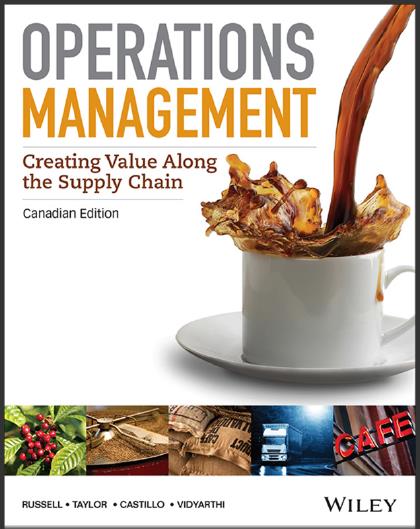
Test Bank for Operations Management 1st Editon by Roberta Russell, Bernard Taylor, Tiffany Bayley, Ignacio Castillo ISBN 1119588723 978-1119588726
Original price was: $70.00.$35.00Current price is: $35.00.
Instant download (Test Bank) Operations Management Creating Value Along the Supply Chain 1st Canadian Editon by Russell after payment
Test Bank for Operations Management 1st Editon by Roberta Russell, Bernard Taylor, Tiffany Bayley, Ignacio Castillo – Ebook PDF Instant Download/Delivery: 1119588723 , 978-1119588726
Full download Operations Management 1st edition after payment

Product details:
ISBN 10: 1119588723
ISBN 13: 978-1119588726
Author: Roberta Russell, Bernard Taylor, Tiffany Bayley, Ignacio Castillo
Operations Management: Creating Value Along the Supply Chain, 2nd Canadian Edition is designed to teach students how to create value and competitive advantage along the supply chain in a rapidly changing global environment. Beyond providing a solid foundation, this course covers increasingly important OM topics including sustainability, corporate social responsibility, global trade policies, securing the supply chain, and risk and resilience. Most importantly, Operations Management, Second Canadian Edition makes the quantitative topics easy for students to understand and the mathematical applications less intimidating. Appropriate for all business students, this course takes a balanced approach to the foundational understanding of both qualitative and quantitative operations management processes.
Operations Management 1st Table of contents:
PART ONE Operations Management
CHAPTER 1: Introduction to Operations and Supply Chain Management
1.1 The Operations Function
1.2 The Evolution of Operations and Supply Chain Management
1.3 Globalization
1.4 Productivity and Competitiveness
1.5 Strategy and Operations
SUPPLEMENT TO CHAPTER 1: Operational Decision-Making Tools: Decision Analysis
S1.1 Decision Analysis with and without Probabilities
CHAPTER 2: Quality Management
2.1 What Is Quality?
2.2 Quality Management System
2.3 Quality Tools
2.4 The Role of Employees in Quality Improvement
2.5 Six Sigma
2.6 The Cost of Quality
2.7 The Effect of Quality Management on Productivity
CHAPTER 3: Statistical Process Control
3.1 The Basics of Statistical Process Control
3.2 Control Charts
3.3 Control Charts for Attributes
3.4 Control Charts for Variables
3.5 Control Chart Patterns
3.6 Process Capability
SUPPLEMENT TO CHAPTER 3: Operational Decision-Making Tools: Acceptance Sampling
S3.1 Single-Sample Attribute Plan
S3.2 The Operating Characteristic Curve
S3.3 Average Outgoing Quality
S3.4 Double- and Multiple-Sampling Plans
CHAPTER 4: Product Design
4.1 The Design Process
4.2 Technology in Design
4.3 Design Quality Reviews
4.4 Design for the Environment
4.5 Quality Function Deployment
CHAPTER 5: Service Design
5.1 The Service Economy
5.2 Characteristics of Services
5.3 The Service Design Process
5.4 Tools for Service Design
5.5 Waiting Line Analysis for Service Improvement
CHAPTER 6: Processes and Technology
6.1 Process Planning
6.2 Process Analysis
6.3 Process Innovation
6.4 Technology Decisions
CHAPTER 7: Capacity and Facilities Design
7.1 Capacity Planning
7.2 Facilities
7.3 Basic Layouts
7.4 Designing Process Layouts
7.5 Designing Service Layouts
7.6 Designing Product Layouts
7.7 Hybrid Layouts
SUPPLEMENT TO CHAPTER 7: Operational Decision-Making Tools: Facility Location Models
S7.1 Types of Facilities
S7.2 Site Selection: Where to Locate
S7.3 Site Selection: Factors to Consider
S7.4 Location Analysis Techniques
CHAPTER 8: Human Resources
8.1 Human Resources and Quality Management
8.2 The Changing Nature of Human Resources Management
8.3 Contemporary Trends in Human Resources Management
8.4 Employee Compensation
8.5 Managing Diversity in the Workplace
8.6 Job Design
8.7 Job Analysis
8.8 Learning Curves
SUPPLEMENT TO CHAPTER 8: Operational Decision-Making Tools: Work Measurement
S8.1 Time Studies
S8.2 Work Sampling
CHAPTER 9: Project Management
9.1 Project Planning
9.2 Global Cultural and Diversity Issues in Project Management
9.3 Project Scheduling
9.4 Project Control
9.5 CPM/PERT
9.6 Probabilistic Activity Times
9.7 CPM/PERT Analysis with Excel
9.8 Project Crashing and Time–Cost Trade-off
9.9 Project Management with Smartsheet
PART TWO Supply Chain Management
CHAPTER 10: Supply Chain Management: Strategy and Design
10.1 Supply Chains
10.2 The Management of Supply Chains
10.3 Supply Chain Sustainability
10.4 Information Technology: A Supply Chain Enabler
10.5 Supply Chain Integration
10.6 Measuring Supply Chain Performance
CHAPTER 11: Global Supply Chain Procurement and Distribution
11.1 Procurement
11.2 E-Procurement
11.3 Distribution
11.4 Transportation
11.5 The Global Supply Chain
SUPPLEMENT TO CHAPTER 11: Operational Decision-Making Tools: Transportation and Trans-shipment Models
S11.1 The Transportation Model
S11.2 The Trans-shipment Model
CHAPTER 12: Forecasting
12.1 The Strategic Role of Forecasting in Supply Chain Management
12.2 Components of Forecasting Demand
12.3 Time Series Methods
12.4 Forecast Accuracy
12.5 Regression Methods
12.6 Data Mining
CHAPTER 13: Inventory Management
13.1 The Role of Inventory in Supply Chain Management
13.2 The Elements of Inventory Management
13.3 Inventory Control Systems
13.4 Economic Order Quantity Models
13.5 Quantity Discounts
13.6 Reorder Point
13.7 Order Quantity for a Periodic Inventory System
13.8 Order Quantity for the Single-Period Inventory Model
SUPPLEMENT TO CHAPTER 13: Operational Decision-Making Tools: Simulation
S13.1 Monte Carlo Simulation
S13.2 Areas of Simulation Application
CHAPTER 14: Sales and Operations Planning
14.1 The Sales and Operations Planning Process
14.2 Strategies for Adjusting Capacity
14.3 Strategies for Managing Demand
14.4 Quantitative Techniques for Aggregate Planning
14.5 The Hierarchical Nature of Planning
14.6 Aggregate Planning for Services
SUPPLEMENT TO CHAPTER 14: Operational Decision-Making Tools: Linear Programming
S14.1 Model Formulation
S14.2 Graphical Solution Method
S14.3 Linear Programming Model Solution
S14.4 Solving Linear Programming Problems with Excel
S14.5 Sensitivity Analysis
CHAPTER 15: Resource Planning
15.1 Material Requirements Planning (MRP)
15.2 Capacity Requirements Planning (CRP)
15.3 Enterprise Resource Planning (ERP)
15.4 ERP and Related Software: Connectivity and Integration
CHAPTER 16: Lean Systems
16.1 The Basic Elements of Lean Production
16.2 Implementing Lean Production
16.3 Other Applications of Lean Systems
CHAPTER 17: Scheduling
17.1 Scheduling Techniques
17.2 Loading
17.3 Sequencing
17.4 Monitoring
17.5 Advanced Planning and Scheduling Systems
17.6 Employee Scheduling
APPENDIX A: Standard Normal Distribution
APPENDIX B: Solutions to Selected Problems
INDEX
People also search for Operations Management 1st:
operations management creating value
operations management in the service sector is focused on creating
what is operations and operations management
what is operations management
what is operations management in business
Tags: Roberta Russell, Bernard Taylor, Tiffany Bayley, Ignacio Castillo, Operations Management